



















































































































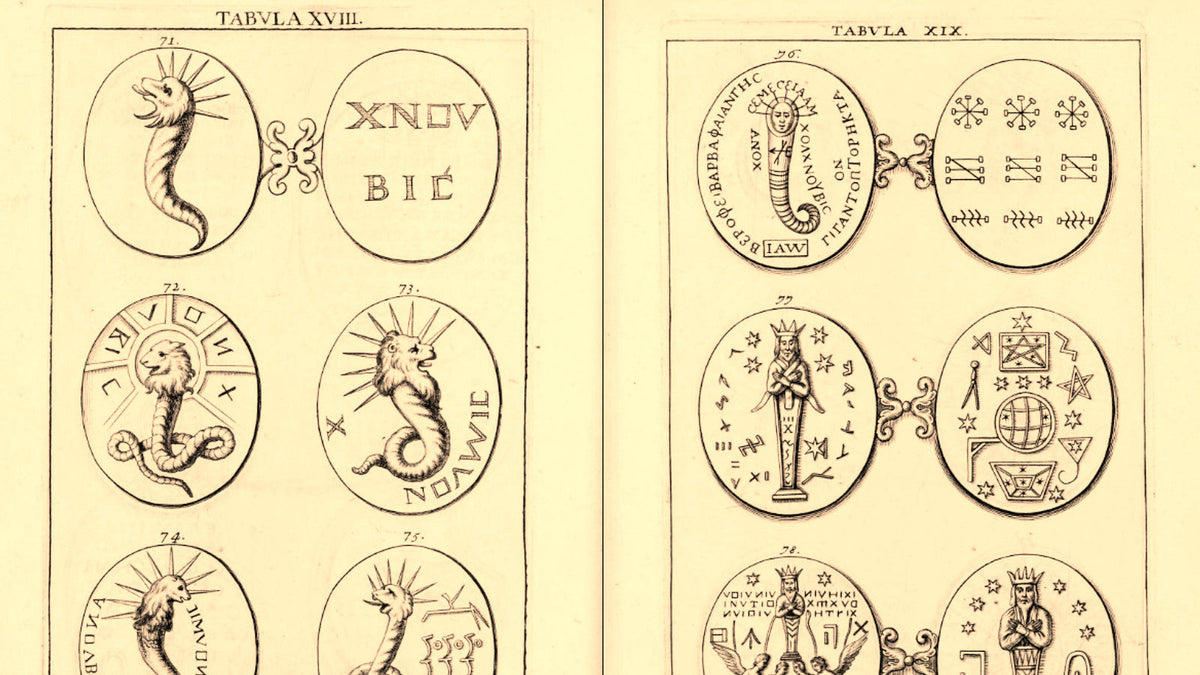
A tiny stone can hold an entire world. On a Roman intaglio, a coiled serpent has a lion’s head surrounded by rays. On another, an armored warrior has a rooster’s head and two serpent legs. Beside these figures, an engraver has squeezed in Greek letters, star-like signs, and divine names. LThe object fits between two fingers, but the powers attributed to it concerned health, happiness, prosperity, and the dangers of everyday life. It was made to be kept close, set in a ring, or worn as a pendant.
These stones are neither simple decorative jewelry nor astrological talismans of the kind that would emerge during the Renaissance. They belong primarily to the Greco-Roman world of the imperial era, shaped by Egyptian, Greek, and Eastern traditions. Their study reveals exchanges between images of gods, sacred writings, and deeply human hopes. Archaeological collections have preserved several thousand pieces, some of them documented well enough to shed light on their function, dating, and the identities of the figures depicted.
Through them, antiquity reveals itself as closer to everyday gestures than to grand public ceremonies. Wearing an engraved stone meant giving a protective image a permanent place in one’s daily travels. But interpreting these objects requires distinguishing ancient religious intentions from the material facts we can verify: an engraved inscription proves that a name was used, not that the desired protection produced a measurable effect. This distinction allows us to recover the gems’ full spiritual coherence without inventing a history for them.
Engraving turned a small stone into a personal amulet
Archaeologists use the term “magical gems” to refer to a category of engraved amulets that became especially widespread in the Roman world. The Campbell Bonner Magical Gems Database, maintained at the Museum of Fine Arts Budapest, dates most of this production to between the 1st century BCE and the 4th century CE. The pieces usually measure between one and three centimeters. Their small size is an essential feature: they could be carried in a ring or pendant, without requiring a place of worship. Their decoration combines divine figures, inscriptions, and signs that researchers must examine together to understand the object’s intended use.
The word “intaglio” indicates that the design is carved into the surface of the gem. This technique belongs to glyptics, the art of engraving hard materials, practiced for centuries in the making of seals and jewelry. When a seal was pressed into wax, the engraved lines produced a raised image. The protective gem drew on this craft without necessarily being used to seal documents. Its owner was above all seeking the lasting presence of a figure or a name. A reverse engraved with letters was not always visible when the stone was worn, but it contributed to its religious identity.
L’hematite, jasper, carnelian, chalcedony, magnetite, and other stones served as materials. The choice of material affected the color, luster, and the way the lines appeared. A light stroke stands out differently on the dark surface of hematite than on the red of carnelian. Some materials were associated with particular depictions, though no identical meaning can be assigned to every example. L’study of collections shows the same figures appearing on several materials. A gem can only be understood by considering the stone, the design, the writing, and the historical context together.
The presence of signs on both faces is particularly instructive. Some stones depict a god on the obverse and his name, emblem, or another image on the reverse. The edge itself may also bear characters. This arrangement invites us to move beyond the modern habit of looking at a piece of jewelry only from the front. L’object forms a whole whose parts speak to one another. Tiny inscriptions, invisible from a distance, could be an integral part of the value its owner attributed to the stone. A passerby did not need to be able to read the characters for their presence to have meaning for the person wearing it.
The expectations associated with gems covered practical concerns: preserving the body, promoting success, seeking goodwill, supporting personal relationships, or keeping threats at bay. The Campbell Bonner database emphasizes health, prosperity, and love among their main purposes. But no single stone represents this entire range. A figure may refer to a more specific concern; a short inscription may simply ask for a deity’s favor. We must therefore resist the idea that a modern catalog of correspondences would suffice to explain all gems. Their diversity arises from the historical combinations inscribed on each piece.
The limitations of the documentation matter as much as the surviving objects. Many ancient gems entered collections without an exact findspot. We know the stone, its two faces, its dimensions, and its material, but not the name of the person who wore it. A ring may have had several owners, and its last known location does not indicate where it was made. Researchers therefore compare images and inscriptions rather than asserting personal uses that no one recorded. This restraint makes it possible to study the object's symbolic power without turning an assumption into a historical account.
Finally, it is important to distinguish the ancient magical gem from the planetary talismans developed in medieval and Renaissance traditions. A Roman stone adorned with Chnoubis belongs to a religious milieu different from that of images engraved according to astrological correspondences developed centuries later. A shared protective intent does not constitute proven lineage. The terminology itself deserves clarification, as we do in our article on the differences between amulets and talismans. L'history of Greco-Egyptian gems remains above all a history of images and names worn on the body.
Egyptian traditions paved the way for protective stones
Long before the Roman period, Egypt had developed a rich tradition of scarabs, small pendants, and seals bearing religious signs. The scarab represented the renewal of life and the rising of the sun. The Metropolitan Museum of Art recalls the link between the insect, the Egyptian verb evoking becoming, and the solar image. L'animal that seemed to emerge from the earth offered a striking image of regeneration. This iconography predates imperial gems by many centuries. It provides a solid historical precedent for the idea of a small image capable of carrying protective meaning.
Egyptian Middle Kingdom scarabs combined practical and spiritual functions. They could serve as seals for documents, doors, or containers, and be worn as amulets. The Metropolitan holds a scarab bearing the name of Lady Nebetwadjyt, dated approximately 1760 to 1670 BCE. The catalogue entry notes that the names and titles inscribed on these objects did not negate their protective function. A single piece of engraved material could thus identify someone and accompany them with a favorable sign. This dual function helps explain why writing mattered as much as the image.
Other scarabs gave hieroglyphs a blessing function. One example at the Metropolitan, dated approximately 1300 to 664 BCE, invokes the protection of the god Amun. The divine name is formed using particular values assigned to the signs, in a condensed script suited to the small available surface. An eye refers to the god's protective vigilance. The stone shows that the sign was not used only to write an administrative message. It could evoke a divine presence that the owner wished to keep with them. This ability to condense sacred speech into a few characters connects with the role of later Greco-Roman inscriptions.
The protection of the dead occupied a distinct sphere. Heart scarabs accompanied mummies and could bear Chapter 30B of the Book of the Dead. The text related to the trial of judgment and the wish that the heart would not turn against the deceased. The Metropolitan Museum describes this role in detail on its funerary scarabs. Such an amulet did not have the same purpose as a Roman stone set in a ring and intended to be carried through the streets of a city. This distinction must be preserved. The funerary scarab demonstrates the power attributed to written images, but it belongs to a specific relationship with the afterlife.
The centuries of Ptolemaic rule, followed by the period of Roman domination, increased contact between Egypt and Greek-speaking populations. Alexandria was a major political, religious, and artisanal center, where traditions met without losing all their differences. Egyptian figures were depicted in the style of Mediterranean glyptic art, and their images were associated with Greek inscriptions. This context explains the place of Harpocrates, Chnoubis, and other powers in the repertoire of gems. It would nevertheless be excessive to assume that every stone was carved in Alexandria: the places of manufacture remain unknown for many examples.
The young Horus became particularly well known by the Greek name Harpocrates. Stones depict him on a lotus flower, bearing solar signs and attributes that ancient art associated with his figure. The child god's posture makes the theme of renewal and the rising sun visible. It can coexist with a Greek inscription or another deity. This is not a neutral translation of all pharaonic traditions, but a new way of incorporating an Egyptian god into the art and concerns of Roman Egypt. The stone condensed several traditions without erasing their origins.
Distinguishing between periods prevents an oversimplified reading of ancient magic. A Middle Kingdom scarab, a New Kingdom funerary amulet, and a Roman intaglio represent three different settings and purposes. Bringing them together becomes illuminating when we follow the role of sacred signs, worked materials, and expectations of protection. Our study of the heritage of Egyptian magic places these questions in a broader context. Imperial-era gems represent a specific chapter in this history: the exchange between images of the Nile and small-scale Mediterranean engraving.
This story also shows that writing could be condensed without becoming arbitrary. The hieroglyphs used on scarabs followed systems specific to Egyptian culture, while Greco-Roman gems could bear Greek words, vowel sequences, and signs of different kinds. The two traditions are not interchangeable. Yet they demonstrate the same attention to the association between a durable medium and the presence of a divine name. An engraved letter or symbol was not mere decoration: it could serve to make recognizable a power whose favor was sought.
Chnoubis, Harpocrates, and Abrasax gave a face to protective power
Chnoubis is recognizable by his serpent’s body and lion’s head surrounded by rays. Depending on the catalogue, his name may be transcribed as Chnoumis or Chnuphis. The sinuous body occupies the oval surface of the stone, and the radiant head immediately draws the eye. This is not a natural animal: it is a composite image expressing a power associated with the sun and protection. Its presence on many gems shows how popular this type was during the Roman Empire. However, variations in the design and inscriptions make it impossible to give the same interpretation to every appearance.
A light blue chalcedony in the British Museum, inventory number EA56402, depicts Chnoubis with a body arranged in several coils. The stone dates to the third century CE and is only seventeen millimetres high. An inscription runs around the figure, while the reverse bears a sign associated with its identity. These details are more revealing than the general idea of a “magic serpent.” They show that a sufficiently precise iconographic model existed to be reproduced on a very small surface. L'inscription and the sign complete the figure, which cannot be properly studied without examining the other side.
The Michael C. Carlos Museum at Emory University holds another small stone, dated to the second or third century. Its catalogue entry identifies Chnoubis, his name inscribed in Greek, a series of vowels, and the sign engraved on the reverse. It also cites a passage by Galen associating a stone depicting this figure with abdominal disorders. This passage should be read as a source on ancient medical and religious beliefs. It does not prove that a gem has therapeutic efficacy. It does, however, show that Chnoubis could be mentioned in ancient discourse about the body and its protection.
Several hematite amulets show images interpreted as representations of the uterus, accompanied by keys and serpentine figures. The British Museum, for example, holds a third-century stone, reference 1986,0501.22, depicting a uterus fitted with a multi-pronged key beside Chnoubis. Researchers link these objects to concerns related to motherhood and the female body. Their iconography is not a modern anatomical representation, nor does it allow us to reconstruct the personal circumstances of each owner. It does, however, let us observe how bodily dangers were conceived through protective images carved into stone.
Harpocrates belongs to another family of images. The young Horus may be seated on a lotus, knees drawn up, with a finger near his mouth and solar attributes. A hematite kept at the British Museum, EA56217, depicts him alongside other figures, some of whose identifications remain tentative. The reverse shows an ouroboros and other figures. L’object reveals how engravers could bring several powers together in a very compact composition. It also reminds us that an iconographic identification may remain uncertain, even when the name of a god seems obvious in the main scene.
Inscriptions on some stones make requests to Harpocrates for favors on behalf of their bearers. Campbell Bonner studied a Greek formula that connects Horus, Apollo, and Harpocrates and seeks the favor of this power. Such an association shows the importance of religious parallels in the imperial Mediterranean. The lotus and child figure belong to the Egyptian heritage, while the name Apollo reflects a Greek interpretation of the solar god. The engraver does not necessarily depict a rigorous doctrine developed in a particular sanctuary. Instead, the image can bring together several references that had acquired protective significance.
The armored anguipede, with a rooster’s head, a shield, a whip, and serpent-like legs, is the third major figure in this world. Museum descriptions associate it with Abrasax, also spelled Abraxas, without considering this identification certain in every case. The British Museum holds a green and yellow jasper from the 4th century, reference 1986,0501.40, depicting the anguipede alongside Harpocrates. Chnoubis appears on the other side. This gathering of figures reveals a logic of association between several powers. The scene should not be reduced to a drawing of a fantastical creature: the attributes, stars, and inscriptions belong to a religious language.
The Greek letters in the name Abrasax have a total value of 365 in the alphabetic numeral system. This correspondence explains certain associations with the year and with doctrines described by ancient writers. However, the numerical value alone is not enough to prove that every gem bearing the anguipede figure belonged to a specific religious school. The images may have circulated in distinct communities, and their names received successive interpretations. It is therefore preferable to speak of a Greco-Egyptian repertoire whose precise links to certain doctrines remain debated.
LThe historical label “Gnostic gemstones” long grouped these stones together. It owes much to the connections drawn between Abrasax and accounts concerning the disciples of Basilides. Current scholarship generally prefers the term “magical gemstones,” which does not presume the religious identity of all their owners. A stone bearing Chnoubis, Harpocrates and Iaō is not automatically an object made by an organized Gnostic group. To better understand the religious movements that ancient authors grouped under this name, see our article on the history of Gnosticism. Gemstones have a history that extends beyond this category.
All these images share an ability to condense the sacred. Chnoubis's radiant head, Harpocrates's solar childhood and the anguipede's weapons depict forms of power that are not interchangeable. The variety of combinations shows that artisans and their clients did not reproduce a pantheon fixed once and for all. Comparisons must remain grounded in objects that have actually survived and in identifiable texts. The richness of these stones lies in a tradition whose images were recognizable, but whose interpretations are now, in part, the subject of historians' painstaking work.
Inscriptions transmitted divine names and enigmatic signs
A protective gemstone is read as much as it is viewed. Some bear requests written in Greek; others bring together divine names or series of characters whose ordinary meaning cannot be identified. Scholars use the term voces magicae to describe some of these expressions. It would be wrong to regard every sequence of letters as a misspelled Greek sentence. Some are names transmitted in the religious circles of the time, others are combinations invested with particular significance, and still others show variations arising from copies or local traditions.
The name Iaō appears in this documentation. It is linked to Greek forms of the divine name in the Jewish tradition and appears in religious circles in Roman Egypt. Names such as Sabaoth and Adonai could also be included in inscriptions. Their proximity to images of Horus or other gods does not mean that Mediterranean religions had ceased to be distinct. It reveals the circulation of words, images and references between communities. A gemstone could bring together, within a space of just a few millimeters, elements from worlds that each had their own texts and histories.
The seven Greek vowels appear in ordered sequences on certain stones. The Carlos Museum's description notes them above the head of Chnoubis and relates them to the seven planets of ancient astronomy. Such correspondences assigned cosmic significance to a sequence of sounds or letters. Nevertheless, the actual arrangement of each inscription must be examined. Not every sequence of vowels necessarily follows the same associations, and a damaged inscription can confound the most obvious reading. Letter order, repetition, and placement are all part of the analysis.
Graphic figures described by epigraphers as magical signs or charaktêres are also found. Some resemble altered letters, while others are independent geometric strokes. Their presence does not prove the existence of a secret alphabet that was identical in every city of the Empire. A sign could serve as an emblem or be associated with a name without representing a sound. The engraver thus organized a surface on which image, writing, and graphic mark formed part of a single composition. The precision of the design was part of the object, regardless of what a contemporary reader can still decipher.
L'ouroboros, a serpent biting its own tail, appears on several gems. It can surround a divine image or a representation associated with the body. The circle forms a visible boundary around what it encloses, which has encouraged interpretations connected with protection and renewal. Museums describe these arrangements without consistently assigning them the same meaning. A figure surrounded by a serpent does not necessarily express the same request as another subject depicted on a different stone. To interpret the object, one must consider the names, figures, and composition as a whole.
Inscriptions could be arranged around a figure, placed on the reverse, or spread across the edge. Campbell Bonner demonstrated how frequently palindromes and word sequences appear across gems as a whole. This arrangement is partly due to the small size of the medium, but it also reflects a compositional choice. A name surrounding a deity forms a written image, while letters gathered on the other side complete the stone without being visible at all times. The engraving expresses a conception of writing in which the sacred word can have a material presence independent of being read aloud.
There is a temptation to interpret these signs through occult doctrines from much later periods. This leads to confusing Renaissance ceremonial alphabets with Roman inscriptions that belong to their own context. Some names circulated for centuries, but their reappearance is not enough to establish that they retained exactly the same meaning. Gems must be read in the languages and religious contexts attested for their time. This attention makes their history richer: the stone is not a fragment of timeless truth copied without change, but the result of specific exchanges between artists, patrons, and traditions.
The enigmatic nature of the inscriptions does not mean that their owner necessarily found them incomprehensible. Someone might recognize a name without knowing how to read all the characters; an artisan might reproduce a formula from a model; copies might introduce errors. Comparing several stones makes it possible to distinguish recurring elements from variations. This does not reveal the wearer's personal experience, but it shows how signs received as protective could be passed on in a personal object. The engraved word thus had a lasting presence, as close to the body as the stone that bore it.
Stones circulated throughout the Empire and changed meaning over the centuries
It would be inaccurate to confine all magical gems to Egypt. Examples come from many regions of the Roman Empire, although collection records do not always preserve the context in which they were found. A study by Gert Boersema, published in 2022, highlights the abundance of gems from the late 2nd century to the 4th century and their spread throughout the imperial territories. Some were set in rings, while others were worn as pendants. Lead amulets also featured similar motifs and names, proving that engraved protection was not limited to the most expensive stones.
The mobility of these objects helps explain the variety of images. A gemstone could accompany a merchant, a traveler, or a family settled far from its place of origin. But we must avoid assigning a precise trajectory to each example without archaeological evidence. The place where a stone is now kept reflects the modern history of its collection, not necessarily its ancient workshop. Researchers try to establish its provenance, compare how the figures are engraved, and examine the inscribed names. This method makes it possible to reconstruct patterns of circulation without inventing imaginary biographies.
Issues of health and bodily protection play an important role in this material. The connection between Chnoubis and the abdomen appears in an ancient medical source cited by the Carlos Museum; stones depicting the uterus are linked to gynecological concerns. These interpretations belong to the history of the body and expectations of relief. They are not medical advice and do not demonstrate that the stones altered illnesses. Romans could combine religious practices with treatments and natural explanations; the existence of such associations is itself part of the historical record.
The people who owned these gems remain mostly anonymous. We know more about certain types of objects than the hands that wore them. L'absence of a name makes it impossible to turn a stone adorned with a motif associated with pregnancy into a reliable account of a specific woman. L'study of the jewelry only allows us to reconstruct plausible uses based on the iconography and inscriptions. Nevertheless, it reveals concerns far removed from the grand official inscriptions of emperors: family security, the health they sought, the favor of a powerful force, and the desire to keep a protector close to the skin.
L'history of gems did not end with Antiquity. Some were preserved, remounted in medieval jewelry, or interpreted through new categories. In the modern era, collectors and scholars studied these extraordinary images, sometimes associating them carelessly with doctrines attributed to Basilides. Erika Zwierlein-Diehl has shown that scholarly drawings, copies, and later creations have contributed to complicating the identification of genuinely ancient objects. Comparing the material and style with archaeologically verified pieces became essential. An engraving published in the modern era is not, in itself, proof that the stone it depicts is ancient.
The cover of this article comes from an engraved plate associated with the work of Johann Chiflet and published in 1657 in a scholarly work devoted to ancient gems. Several figures can be recognized, including leonine serpents and engraved names, which fascinated antiquarians. L'image has genuine historical interest, but it must be read for what it is: a scholarly depiction from the 17th century, not a photograph of a collection of Roman jewelry. Some interpretations by scholars of that era have since been corrected by archaeology. This clarification protects readers from confusing the modern reception of gems with their ancient function.
L'scientific study took a new step forward in the 20th century. In 1950, Campbell Bonner published a study that became fundamental to research on Greco-Egyptian amulets. Simone Michel subsequently proposed an extensive inventory, while the Campbell Bonner Magical Gems Database, launched in 2010, now brings together records, images, bibliography and iconographic comparisons. The site estimates the known corpus at around 5,600 pieces. This number does not represent the entirety of ancient production: some objects have disappeared, others await identification, and the authenticity of some items circulated through the art market is in question. Nevertheless, it conveys the scale of a phenomenon long reduced to a curiosity.
Magical gems thus bear witness to a Mediterranean way of making the sacred dwell within a tiny object. The figures of Chnoubis, Harpocrates and the anguipede were not mere inventions designed to astonish the eye; the Greek letters were not mere decoration. Their bearers attributed a protective function to them and recognized in them powers capable of accompanying them through life. What archaeology can verify are the objects, their engravings, their probable dates and their inscriptions. Between these facts and the expectations of those who carried them unfolds a fascinating history of the human relationship with the invisible.
Historical and museum documentation
Historical sources provide information about representations and expectations of protection, not about the medical efficacy of amulets.
- Campbell Bonner Magical Gems Database, Museum of Fine Arts, Budapest, definition and scope of the corpus
- Campbell Bonner Magical Gems Database, typology of gem amulets
- Metropolitan Museum of Art, scarab of Nebetwadjyt
- Metropolitan Museum of Art, scarab with a blessing of Amun
- Metropolitan Museum of Art, funerary heart scarab
- British Museum, Chnoubis gem on chalcedony EA56402
- British Museum, hematite with uterus and Chnoubis, 1986,0501.22
- British Museum, jasper with Abrasax, Harpocrates and Chnoubis, 1986,0501.40
- British Museum, hematite of Harpocrates EA56217
- Michael C. Carlos Museum, Emory University, Chnoubis, inscription and Galenic source
- Gert Boersema, Roman Lead 'Iao Abrasax' Amulets, KOINON, 2022
- Campbell Bonner, Studies in Magical Amulets, scholarly online reprint
- Erika Zwierlein-Diehl, The Post-Antique History of Magical Gems
Cover: engravings by Johann Chiflet, plates XVIII and XIX associated with a scholarly work published in 1657 with Jean Macaire; Wikimedia Commons reproduction, public domain, landscape crop. These old engravings depict ancient gems as interpreted by 17th-century scholars; they are not photographs of archaeological objects.

Par Olivier of Aeternum
Passionate about esoteric traditions and the history of the occult from the earliest civilizations to the 18th century, I share some articles on these topics. I am also co-creator of the online esoteric shop Aeternum.













