



















































































































A vast sky, thirty-six figures, and a history spanning several civilizations. The decans are one of astrology's oldest and least well-known concepts. They originated in the stellar observations of pharaonic Egypt, before becoming, in Greco-Egyptian and then medieval traditions, thirty-six sectors of the zodiac associated with images and correspondences. During the Renaissance, these figures even found a place on the walls of princely palaces.
Their history invites us to recognize the true transformations of a legacy. An Egyptian decan intended to mark an hour is not automatically the character described by an Arab astrologer or the figure painted by an Italian artist. The number endured through the centuries while its meanings evolved. This history sheds light on the relationship between timekeeping, doctrines of astral influence, image magic, and artistic creation.
For the occultist, the decans are a reminder that a zodiac sign is not a uniform surface. For the historian, they offer a remarkable field of study into the transmission of ideas between Egypt, the Mediterranean world, Arabic-speaking scholars, and Renaissance Europe. We will explore this long journey without shortcuts or how-to instructions.
The stars that measured the night for the Egyptians
Long before they were incorporated into the signs of the zodiac, the decans belonged to the world of Egyptian star clocks. Groups of stars marked the passage of ten-day periods and helped organize the nighttime hours. The Egyptian civil calendar had twelve months of thirty days, with five additional days. Thirty-six ten-day periods therefore covered the 360 days in the months. This connection explains the traditional number of decans, without implying that astronomers observed thirty-six constellations in the modern sense of the term.
The sky represented far more than a practical system of reference. The movements of the celestial bodies were associated with the rhythms of religious life and the idea of regeneration after death. A star disappeared from view and then reappeared, a striking image of a cycle beginning anew. Star lists thus appear on funerary objects and in tombs, where they give the deceased a place within the ordered time of the universe. This connection with the afterlife does not diminish their astronomical interest: both dimensions belonged to the same culture.
The famous diagonal star clocks, inscribed inside several Middle Kingdom coffins, are among the earliest major sources. Their tables match decan names with intervals of time, and their diagonal layout explains the name given to them by specialists. These compositions are not dials that one could simply turn. They translate complex knowledge of stellar risings and their apparent movement at different times of the year into columns and rows.
The tomb of Senenmut, a court official under Hatshepsut, preserves the famous example of an astronomical ceiling from the New Kingdom. Its decoration brings together celestial figures, planets, and columns of star and decan names. The Metropolitan Museum of Art holds a copy made by Charles K. Wilkinson that allows this composition to be studied. This work demonstrates the prestige of stellar knowledge in a privileged funerary context; it does not resemble a modern horoscope and cannot be read as one.
The position of the stars relative to the civil calendar was not rigorously stable throughout the centuries of pharaonic history. The 365-day calendar drifted relative to the solar year. Stellar traditions therefore underwent adjustments and reorganizations. Researchers must compare inscriptions, lists, astronomical positions, and periods. This explains why some star identifications remain debated, and why a modern table claiming to translate every Egyptian name into a current constellation without hesitation is imprudent.
Sopdet, associated with Sirius, offers a well-known example of the importance of stellar returns. Its reappearance before dawn had calendrical and religious significance connected with the annual cycle. However, it does not sum up all the decans. They formed a succession of stellar groups and names whose history extends beyond one famous star. Understanding them required patient observation of the sky as well as the transmission of techniques, inscriptions, and seasonal markers.
The meaning of the decans did not stop at the calendar. The Metropolitan Museum displays a statuette of Bastet whose throne bears figures connected to the decans. These beings, with leonine or serpentine forms, belong to a religious and protective language. The museum label discusses their possible relationship to the dangerous goddess of the Eye of Re and her appeasement. This is a reasoned iconographic interpretation, not proof that every ancient decan always had an identical face.
The shift from a stellar name to a protective figure illuminates the magical evolution of the concept. The star could mark a moment in time; the image gave a personality to the powers associated with that time. The distinction remains essential. The decans in the earliest astronomical tables and those in later images do not serve exactly the same function. Yet they belong to a shared history in which the celestial order becomes measurable, representable, and imbued with religious meaning.
The Thirty-Six Faces of the Ancient Zodiac
Hellenistic astrology’s zodiac gives the decans a new arrangement. The circle comprises three hundred and sixty degrees, divided into twelve signs of thirty degrees. Each sign can be divided into three sections of ten degrees, making thirty-six decans for the entire circle. The simplicity of this division conceals its historical significance: the decan ceases to be merely a marker of the annual cycle and becomes a fixed portion of zodiacal longitude.
Mediterranean astrologers combined legacies from Babylonia, Egypt, and the Greek world. Their techniques developed through exchanges, translations, and adaptations. The zodiacal decans were part of this encounter, but there is no shortcut to attributing their entire doctrine to a single civilization. The long history of astrological knowledge has several branches. Egyptian evidence does not necessarily contain the rules that Latin authors would present centuries later.
The term “face” refers in many Western texts to the division of a sign into three parts. In some schools, each face is assigned a planetary ruler. A planet in a sign therefore does not necessarily have the same dignity depending on whether it occupies the first, second, or third decan. These dignities belong to a technical grammar that distinguishes domiciles, exaltations, terms, and faces. Confusing them would undermine the precision astrologers sought.
A classic series of correspondences uses the traditional order Saturn, Jupiter, Mars, Sun, Venus, Mercury, and Moon. The first decan of Aries belongs to Mars, the second to the Sun, and the third to Venus. The sequence continues through the following signs. The qualifier “Chaldean,” attached to this order of the seven celestial bodies, belongs to the accepted astrological vocabulary. It is not enough to prove that this entire arrangement was established in Mesopotamia in its medieval form.
These correspondences must be distinguished from the figures depicted. The planetary ruler of a face is not necessarily the character shown in its description. A decan assigned to a planet may be given a human, animal, or composite image. Texts describing figures and tables of dignities have been transmitted together or separately. Consulting them as two complementary sets helps explain discrepancies, rather than producing an artificially harmonized universal table.
Greco-Egyptian traditions present the decans as powers with a place in the cosmic order. The figures may be linked to regions of the human body in systems known as melothesia. This organization is based on an analogy between the body and the sky. It belongs to an ancient doctrine in which the human microcosm reflects the celestial macrocosm, not to a medical division recognized by modern anatomy.
The circular zodiac of Dendera, now held at the Louvre, attests to another moment of cultural encounter. Its iconography brings together Egyptian elements and Mediterranean zodiacal representations from the Greco-Roman period. Studying the figures cannot be limited to identifying twelve familiar signs: it must also examine the other celestial beings that make up the program. This monument documents a composite learned culture rather than an astrological alphabet unchanged since the earliest pharaohs.
The image of a decan does not work like a photograph of a constellation. It gives form to a quality, a period, or a celestial interpretation. Some figures hold objects, while others wear unusual clothing or adopt a distinctive pose. The details are not necessarily decorative. Their meaning, however, depends on the source that describes them, its language, and how it was transmitted. Responsible commentary begins by identifying this source before proposing an interpretation.
This is where the decans also enter the story of talismans. Some currents of astrological magic view celestial figures as models that material images can represent. The emblem becomes a symbolic link between a quality of the sky and an earthly medium. The texts attest to this doctrine; they are not experimental proof of its effectiveness. Their value lies in the precise conception of correspondences, which shaped centuries of learned occultism.
Figures from the Arabic and Latin traditions
Arabic-speaking scholars played a pivotal role in preserving and transforming astrological doctrines. They received Greek, Persian, and Indian materials and incorporated them into new syntheses. The decan figures appear in several series whose names, attributes, and origin stories do not fully coincide. This plurality shows that the history of a system is never reduced to faithfully copying an original list.
Abū Maʿshar, known in the West as Albumasar, was one of the most influential astrologers of the 9th century. His works helped astrological knowledge circulate into Latin Europe. Traditions associated with the decans include series described as Indian, Persian, or Egyptian. These labels should be understood as attributions passed down by authors: they are not modern certificates of origin proving an unbroken lineage.
Medieval descriptions have extraordinary evocative power. They feature people holding instruments, armed figures, beings accompanied by animals, and richly detailed costumes. The details may concern an object held in the hand, the color of a garment, a posture, or an expression. For an astrologer trained in these images, the decan is no longer just ten degrees: it becomes a face representing the qualities traditionally attributed to a portion of the sky.
These images did not all follow the same path. Translators had to render technical terms and proper names into other languages. Scribes introduced variations, while compilers brought distinct systems together. A figure described differently in two manuscripts does not necessarily prove that one is fraudulent. The discrepancy may bear witness to a history of transmission, and it itself becomes essential information for the historian of occult traditions.
The corpus known in Latin as Picatrix illustrates the intellectual world in which astrological images circulated. It derives from an Arabic-language textual tradition and passed through the translation culture of medieval Spain. Its doctrines belong to the history of correspondences, natural philosophy, and astral images. This reference should not be turned into a summary of the work: the interest lies in the cultural context in which the decans had symbolic and astrological significance.
Medieval philosophy debated the relationship between the stars and the earthly world. Some authors believed that celestial qualities could act through natural properties; others condemned practices involving spiritual invocations or calling human freedom into question. Astral images stood at the intersection of these controversies. The same figure could be approached as a cosmological sign or denounced, depending on the use and interpretation attributed to it.
Tables of dignities continued their technical development alongside this. Latin astrologers assigned planets to the thirty-six faces without reproducing all the figures in the illustrated series. Calculation and imagery intersected, but did not always merge. This distinction is fundamental for the modern reader: a table entry giving the planet of a decan is not a complete description of its image and symbolism.
The translation centers of the Iberian Peninsula helped bring these doctrines to the West. Astronomical tables, medical treatises, philosophy, and astrology crossed linguistic boundaries by complex routes. The decans were part of this broader movement. They remind us that Western learned magic is not an intellectually closed world: it owes part of its vocabulary, imagery, and classifications to traditions from other regions.
The authority granted to a series of figures depended on the reputation of the texts and their authors. An ancient name could lend considerable prestige, even when the attribution was doubtful. It would be contrary to historical rigor to treat this prestige systematically as proof. But this search for authority is itself instructive: it reveals the desire to link images of the heavens to wisdom considered ancient and to traditions capable of preserving its meaning.
The Decans Painted on the Walls of Ferrara
During the Renaissance, the decans left the margins of manuscripts to take their place in one of northern Italy’s most remarkable pictorial ensembles. The Palazzo Schifanoia in Ferrara preserves a cycle devoted to the months and the signs of the zodiac. Created in the 15th century for the Este court, these frescoes bring together the gods of antiquity, astrological divisions, and the activities of princely life in a single program.
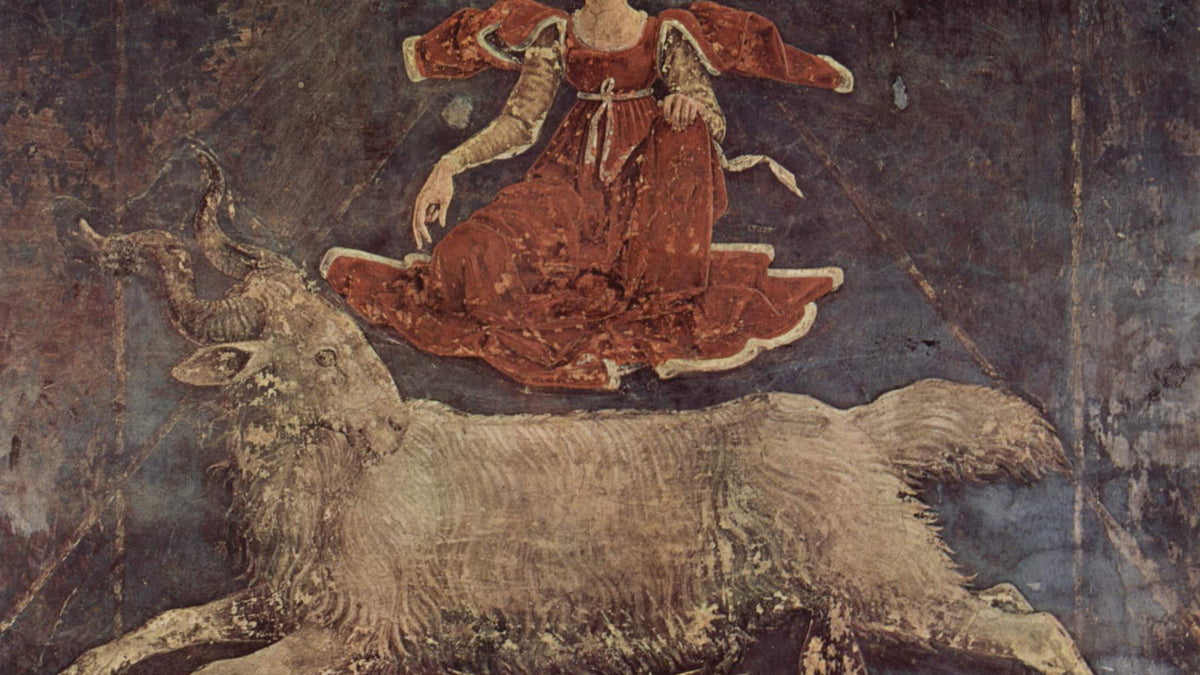
The panels' overall structure is revealing. One register depicts divine triumphs, another brings together the zodiac sign and three decan figures, while the lower level portrays seasonal activities and court life. Heaven and earth are not separate. The painting makes them interact, offering an ordered vision of the year in which the prince's authority is inscribed in the movement of the cosmos.
Francesco del Cossa was one of the artists involved in this undertaking, alongside other painters active around Ferrara. The decan figures feature unexpected silhouettes, enigmatic objects, and characters unlike the twelve best-known zodiac symbols. Their presence is no decorative whim. It bears witness to a learned astrological culture capable of incorporating descriptions inherited through medieval transmissions into a monumental program.
In 1912, art historian Aby Warburg devoted a seminal study to the astrological frescoes of Schifanoia. He focused on the journey of images across centuries and cultural boundaries. His approach shows how motifs from ancient astrological corpora could undergo transformations before being reinterpreted by Italian artists. This inquiry does not prove the existence of an immutable original image; it reveals a history of translations and reinventions.
Aries opens the zodiac wheel in these compositions. The three decans associated with the sign form a group in which the human figure plays an important role. The fresco selected to illustrate this article belongs to Francesco del Cossa's cycle, created around 1469-1470. Wikimedia Commons distributes it as a reproduction of a public-domain work. Its interest lies in the direct visual evidence it offers of the importance Renaissance astrology gave to the decans.
Ferrara's decorative program also has a political dimension. The succession of months evokes the passage of time under the government, seasonal work, and a conception of good order. Celestial images form a language capable of giving coherence to this program. A painted decan is therefore not merely an illustration of an astrological description: it has become part of a grand staging of the world and sovereignty.
Renaissance Neoplatonic philosophy also fueled interest in celestial images. Readers of Marsilio Ficino considered relationships between visible forms, the harmony of the world, and astral influences. They did not all use the same series of decans, but they shared an interest in the mediations between heaven and matter. An image could thus be studied as a sign charged with correspondences, rather than as a merely pleasing form.
In the 16th century, Heinrich Cornelius Agrippa brought together many legacies of natural magic and astrology. His work contributed to modern knowledge of planetary correspondences and celestial images. He did not invent the decans, and his syntheses should not obscure the variety of their sources. To understand his role in this legacy, readers can consult our portrait of Cornelius Agrippa, devoted to his intellectual world.
Frescoes, printed tables, and treatises do not preserve the decans in the same way. A painting gives them form, a manual assigns them planets, a compilation describes figures, and a philosophical commentary examines their qualities. Each of these sources adds an element. Comparing them makes it possible to reconstruct the astrological culture of the Renaissance without reducing it to a single image or one formula of correspondence.
A language of the heavens preserved by occult traditions
The decans illustrate traditional astrology's ability to read the sky at several scales. The sign is a major unit, but its thirty degrees do not form an entirely uniform space in the doctrines of the faces. Three sections of ten degrees introduce nuances. Assigning planetary rulers allows some astrologers to interpret positions within the same sign differently.
This technical division is not identical to the lists of symbolic figures. The former reflect an organization of dignities; the latter provide images for portions of the zodiac. The two traditions are compatible in many syntheses, but their rules are not interchangeable. When looking for the image of a decan, the chosen figurative source must be specified. When looking for its planet, the relevant system of dignities must be identified.
The concept of a talisman reveals another function of these representations. In the philosophy of astral images, a drawing or emblem can be interpreted as the material translation of a celestial quality. The figure is then not decorative: it belongs to a network of correspondences whose nature is discussed in texts. This perspective is a traditional doctrine of learned magic, which should be presented as such without confusing its historical existence with experimental validation of its effects.
The medieval debate over astrological images bears witness to an intellectual world deeply concerned with the question of causes. Some emphasized natural qualities associated with the stars; others feared confusion between celestial symbolism and the invocation of spiritual beings. This opposition reveals genuine theological and philosophical concerns. It makes clear that ancient astrological magic was not a uniform school whose members all accepted the same explanations.
Decanal imagery still holds artistic interest. The figures in the frescoes are not portraits of directly observable celestial bodies. They embody ideas, attributions, or descriptive traditions. Their strange richness becomes understandable when we follow their journeys across languages, manuscripts, and workshops. A pose, a color, or an animal may endure even as the associated name changes. Continuity comes through transmission, not perfectly faithful repetition.
The history of the decans also helps us better distinguish astronomy from astrology without artificially setting them against each other. The earliest Egyptian systems were based on observations of star risings and the organization of time. Later astrologies incorporated a zodiacal division into the language of influences and correspondences. The transition from one to the other was neither immediate nor complete. It reflects a long evolution in the purposes of celestial knowledge.
The astronomical instruments studied on our site reveal another facet of this culture. In the history of the medieval astrolabe, timekeeping and the representation of the sky come together in a crafted object. The decans are not an analogous instrument, but their history shares an interest in celestial divisions and systems of reference. These scholarly paths coexisted and influenced one another.
The number thirty-six finally invites us to read time. From ten-day periods to the thirty-six zodiacal sectors, it structures a year and a circle. Yet it would be misleading to treat this numerical continuity as proof that all depictions derive directly from a single archaic rite. A number can persist even as its uses change. Historians then examine what has actually been preserved and what has been reinvented.
Modern occultists have continued to take an interest in the decan figures, planetary sequences, and their images. Their interpretation belongs to a new stage of reception. These interpretations should be dated rather than uncritically attributed to a pharaonic origin. A tradition remains alive when it is read and reworked, but its significance does not exempt us from distinguishing the layers of its formation. On the contrary, understanding those layers restores its full richness.
The thirty-six figures therefore share more than a circle. They connect observers of the night sky, the deceased who were promised an ordered passage of time, Greek astrologers, Arabic-speaking scholars, and Italian court painters. Their journey reveals how magical knowledge was shaped through exchange and interpretation. Studying the decans means discovering, behind the simplicity of the twelve signs, a richer celestial architecture made up of calculations, images, philosophies, and memory.
Sources and references
Metropolitan Museum of Art, Astronomical Ceiling, facsimile of Senenmut’s astronomical ceiling; Metropolitan Museum of Art, Bastet on a throne decorated with the decans; Warburg Institute, iconography of the decans of the Dendera zodiac; Aby Warburg, Italian Art and International Astrology in the Palazzo Schifanoia in Ferrara, 1912; David Pingree, The Thousands of Abu Maʿshar, Warburg Institute, 1968; Francesca Rochberg, The Heavenly Writing, Cambridge University Press, 2004; Francesco del Cossa, Schifanoia frescoes, 1469-1470.

Par Olivier of Aeternum
Passionate about esoteric traditions and the history of the occult from the earliest civilizations to the 18th century, I share some articles on these topics. I am also co-creator of the online esoteric shop Aeternum.













