



























































































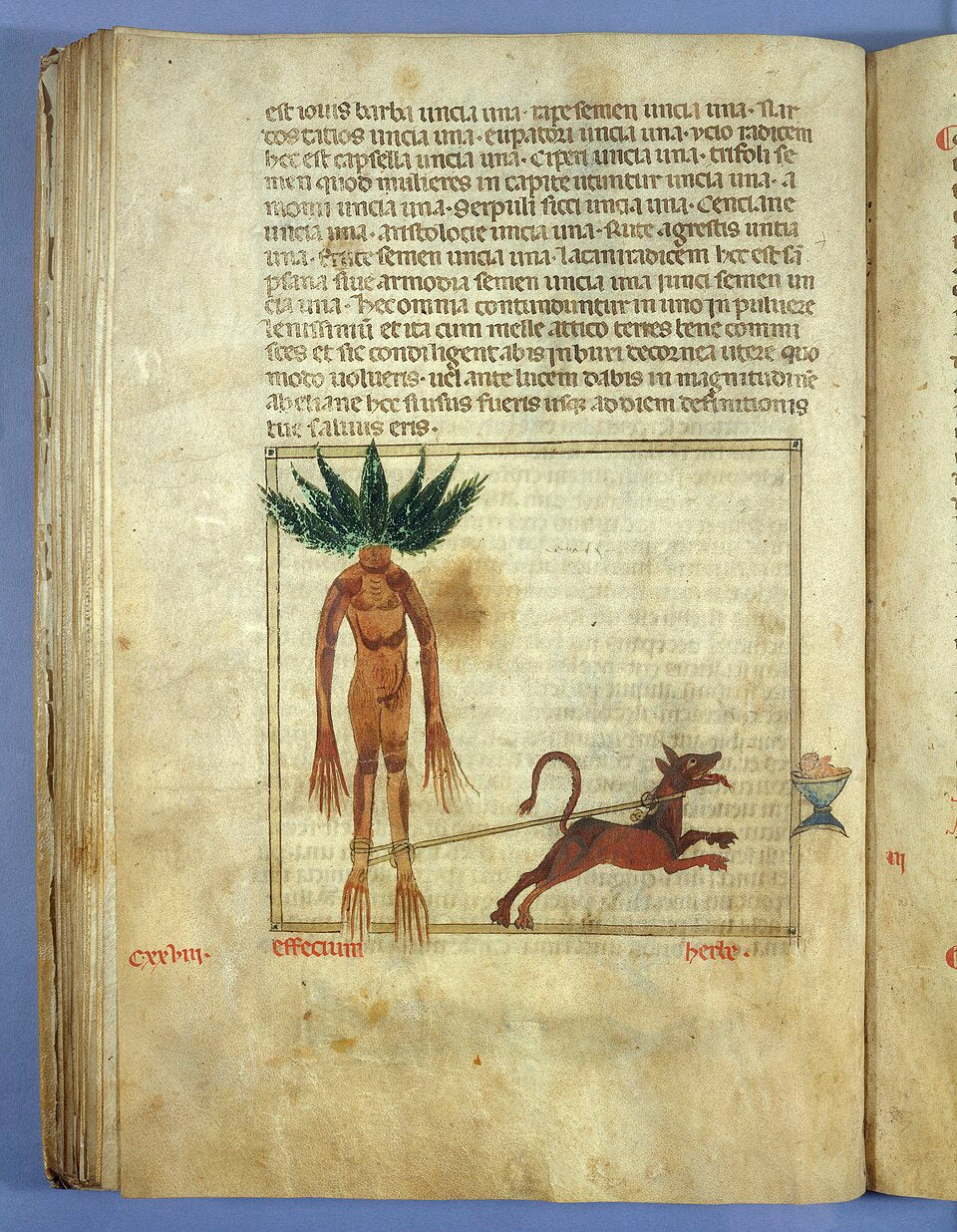
Looking at certain pages of medieval herbals, one might think that the mandrake belonged to a forgotten human species. Beneath a crown of leaves, illuminators depict a small body: a head, arms, a torso, and legs held captive by the ground. A dog pulls on a rope tied to its feet. This scene recounts one of Europe’s most famous plant legends: it was said that the mandrake let out a terrible cry when it was pulled from the earth, and that anyone who heard it risked losing their reason or their life.
Yet the mandrake was not born in the margins of a manuscript. It is a real plant, known to physicians of antiquity, familiar in Mediterranean regions, and endowed with powerful physiological properties. The ancients associated it with pain, sleep, fertility, and love. Others entrusted it with the role of a protective talisman. Then its reputation moved into apothecaries and markets, where carved roots eventually took the place of real mandrakes to meet buyers’ expectations.
Few plants make it possible to follow so clearly the movement of knowledge among botany, medicine, religious narrative, magic, and commerce. The same root was described by Dioscorides, commented on in Bible translations, drawn in Latin herbals, reproduced in Arabic manuscripts, and depicted with the features of a small human being. Over the centuries, the mandrake became far more than an ingredient: it became a presence endowed with a face and a history.
Understanding this journey requires respecting traditions without confusing their accounts with botanical observations. The aim is not to provide a method for harvesting or using a poisonous plant, but to discover what its images, names, and transmission teach us about ancient magic.
A Real Plant Behind the Human Face
The name mandrake refers to plants of the genus Mandragora, belonging to the nightshade family. The genus includes several species accepted by the Royal Botanic Gardens, Kew, including Mandragora officinarum and Mandragora autumnalis. Studying them requires taking a complicated botanical history into account: some authors once grouped together species that others distinguished, and the word “mandrake” found in an ancient source does not always make it possible to identify the plant observed precisely.
A living mandrake does not have the spectacular appearance attributed to it by miniatures. It has a rosette of leaves close to the ground, flowers, and fleshy fruits. The part that made it famous lies underground: a large, fleshy root capable of extending into branches. Some roots divide into two branches that evoke legs; others have protuberances interpreted as arms or a torso. But most do not spontaneously resemble small, complete human figures.
Herbals transformed this possibility into a model. Where a real root has irregularities, an illuminator draws shoulders and a waist. Where the offshoots mingle without order, they draw feet. The leaves become hair. The result is a human figure whose silhouette appears almost natural to readers accustomed to such representations. This transition from observed form to inherited image helps explain a significant part of talismanic magic.
In some ancient texts, one encounters “male” and “female” mandrakes. The descriptions distinguish roots, flowers, colors, and forms. This does not mean that the plants naturally possess a hidden male or female body underground. These categories belong to pre-modern botany and to a symbolism that recognizes human characteristics in natural forms. Their distribution also changed according to the authors and the periods.
Geography reinforces this phenomenon. Mandrakes associated with the ancient tradition belong mainly to the Mediterranean and Near Eastern worlds. An apothecary or collector in Northern Europe could know the root's name perfectly without encountering a living specimen in the surrounding countryside. Books and images then became their primary references. One could search for a plant character matching an engraving without having a botanical specimen available to verify what one was buying.
An ethnobotanical study published in 2021 in the Journal of Ethnobiology and Ethnomedicine illustrates the richness of this transmission. The researchers studied nearly three hundred vernacular names for mandrakes in forty-one languages. They found names evoking the human silhouette, birth, narcotic properties, dogs, gallows, and invisible beings. This vocabulary preserves a genuine inventory of the relationships societies have maintained with the plant.
Plant names are not mere labels. They carry interpretations. A plant called by a word associated with love will naturally be linked to desire; a name evoking the human body will make its root seem more impressive; another, associated with witchcraft, may arouse suspicion. The same species have thus been understood through regional stories that do not entirely coincide with one another.
There is one reality that fascination with its shape must never obscure: the mandrake is toxic. It contains tropane alkaloids, notably hyoscyamine and scopolamine. These substances can cause confusion, visual disturbances, agitation, accelerated heart rate, and severe poisoning. Their concentrations cannot be inferred from the appearance of a root. Ancient uses therefore do not provide a safe basis for a modern preparation.
This physiological activity helps explain the mandrake's reputation. A plant capable of altering consciousness could appear in stories where sleep, visions, pain, and the invisible world draw close to one another. But it would be excessive to reduce its entire magical tradition to its chemical composition. A root kept as a talisman was not necessarily consumed. Its appearance, provenance, and the stories surrounding it could be enough to attribute a function to it.
The mandrake thus helps distinguish several perspectives on the same substance: that of the botanist who identifies a species, that of the ancient physician who describes effects, that of the merchant who presents a rare object, and that of the occultist who sees in the shape of the root a particular relationship with human beings. Witch plants have other stories that are just as rich, but the mandrake brings these perspectives together in a singular way.
From the Bible to Greek physicians, a root linked to life
One of the earliest appearances of the mandrake in Western memory is found in chapter 30 of Genesis. Reuben, Leah's son, brings back plants found in the fields. Rachel, who wishes to have a child, wants to obtain them. A negotiation begins between the two women. This scene places the plants at the heart of a story of fertility, waiting, and rivalry within Jacob's family.
The Hebrew text uses the term dûdâ'îm, traditionally identified as mandrakes. Many commentators and translators have adopted this interpretation. Some researchers have nevertheless proposed other identifications, and caution is still warranted when attempting to associate an ancient term with a specific species. The passage attests to the value attributed to plants in the biblical narrative; it does not demonstrate a physiological effect that promotes pregnancy.
In the Song of Songs, mandrakes belong to the language of gardens, perfumes, and desire. This presence in religious texts had a long afterlife. It helps explain why the root could be regarded as connected with love and fertility in communities that would not necessarily have identified with witchcraft practices. Mandrake never belonged exclusively to a marginal tradition.
Greek authors add another dimension. Theophrastus, whose botanical works belong to classical antiquity, already reports uses and stories associated with roots. He bears witness to a world in which observing a plant's properties could coexist with symbolic precautions. The existence of these ancient descriptions shows that the medieval legend was not created entirely by medieval scribes.
In the 1st century, Dioscorides gives mandrake an important place in De materia medica, a major work of ancient pharmacopoeia. He distinguishes several forms and reports properties related to sleep and the alleviation of pain. His texts were copied and commented on for centuries. Illustrated manuscripts in Greek, Latin, and Arabic bear witness to this transmission, which passed from one medical and linguistic environment to another.
Historians of anesthesia have paid particular attention to these passages. In a study published in 2017, Marta Mion places mandrake among the substances to which ancient physicians attributed soporific effects. Some medieval compilations also mention preparations intended to promote sleep during painful procedures. This documentary continuity can be studied without confusing the methods used at the time with the safety, precision, and protocols of modern medicine.
Pliny the Elder also devotes passages to mandrake in his Natural History. His work juxtaposes descriptions, information borrowed from other authors, and uses presented as belonging to the traditions of his time. The modern reader is tempted to immediately separate medical data from symbolic prescriptions. The ancient world did not distribute them in this way: a substance could be described in terms of its appearance, its effect on the body, and the proper way to approach it.
The plant thus occupies the meeting point of two orders of knowledge. In the first, its substances are associated with bodily states: sleep, pain, dizziness, or agitation. In the second, its form and its supposed relationship with natural forces give it a place in acts of protection, desire, or fertility. The mistake would be to use the existence of the first order as automatic proof of the second. Their historical coexistence is real; their claims require different levels of verification.
Arabic translations of Greek botanical works played an essential part in their transmission. The British Library presents an illustration of mandrakes in an Arabic version of De materia medica preserved in a 14th-century Baghdad manuscript. The plants are shown with their leaves, underground parts, and the features expected of a herbal. This document reminds us that the history of the mandrake does not pass directly from ancient Greece to Renaissance Europe: it follows scholarly paths that also cross the Islamic world.
An ethnopharmacological review published in 2023 examines the evolution of the medicinal uses of mandrake through a vast historical corpus. It shows how strongly ancient traditions persisted, while tracing the transformations that led medicine to abandon the routine use of the whole plant. The alkaloids responsible for its effects are now being studied and, in some cases, used in controlled pharmaceutical settings. This does not authorize any domestic use of mandrake.
To understand its place in ancient conceptions of nature, this discussion can be extended with our article on magia naturalis. The mandrake benefited precisely from an intellectual world that sought to grasp the relationships between forms, substances, and effects, without imposing the disciplinary boundaries to which we are accustomed.
The Mandrake's Scream and the Dog in Herbaria
The most memorable scene is not that of an ancient laboratory, but that of a medieval herbal. In a manuscript of Pseudo-Apuleius, held by the Wellcome Collection under the reference MS 573, a human-shaped root is tied by a rope to a dog. The plant is not drawn as a simple specimen. Its root has a body, and its leaves form a head of hair. The animal seems about to pull it out of the ground.
The British Library manuscripts preserve other versions of this story, notably Harley MS 1585 and Cotton MS Vitellius C III. The story conveyed by these images is well known: the mandrake was believed to emit such a terrible scream when uprooted that it could drive anyone who heard it mad or kill them. The dog appeared in the legend as the one exposed to danger in the man's place. These images are not harvesting guides to follow; they bear witness to an ancient representation.
Why give a root a voice? The human resemblance offers a first symbolic explanation. When a plant is drawn as a little man, its separation from the earth looks more like an injury or a birth than a simple act of gardening. The cry gives the root sensitivity. It seems to resist the person who wants to possess it, and its value partly comes from this resistance.
The images bring this idea to life with astonishing force. Some roots have outstretched arms or almost anatomical limbs. Others display masculine or feminine characteristics. The dog, meanwhile, introduces a dramatic movement into a page devoted to plants. The miniature does not merely represent what a mandrake is according to the text: it tells a story that the reader can remember without knowing every word.
Elements of the harvesting story appear in ancient sources, but medieval versions accumulate new details. The study of vernacular names conducted by Amots Dafni and his colleagues shows that the motifs of the dog, the gallows, the human silhouette, and danger do not necessarily share a common origin. They became associated over the course of transmission. Presenting the whole as an identical rite practiced without interruption since Antiquity would oversimplify the sources excessively.
The doctrine of signatures helps explain the importance accorded to the body represented by the root. In this traditional system of correspondences, the form of a substance can indicate the relationship that earlier people attributed to an organ, a function, or a human quality. A plant resembling a whole person therefore offers particularly rich ground for interpretation. Accounts of fertility, life, and protection find support in this image, not in reproducible medical observation.
In some European traditions, the mandrake is also linked to gallows. It was said that it could grow in soil touched by the death of an executed person. The plant thus became the imagined product of a place of violence, justice, and passage into the world of the dead. These stories do not describe any botanical origin; they place the root within a geography charged with unsettling forces.
This account of the gallows nourished much later literature. Modern European texts retained the image of a plant originating in a place of execution or connected with violent death. It brings together two opposites: the desire to obtain a beneficial root and the fear of the origin attributed to it. The mandrake's power would have arisen precisely from what ordinary people do not wish to encounter.
Shakespeare, in turn, evokes the cries of mandrakes torn from the ground in Romeo and Juliet. The passage does not invent the legend. It uses an image whose power the audience already understood. The screaming root belongs to the language of familiar fears, alongside the dead, tombs, and nocturnal presences.
The miniaturization of the mandrake into a small figure ultimately helps explain its lasting success. A representation could move from a medical herbal to a book of curiosities, from a religious tale to an engraving, and then to a popular story. Each new image confirmed the old one. People already knew a drawn mandrake before seeing one in a garden.
This iconographic tradition is a genuine object of historical study. It teaches us how magical knowledge can be preserved through drawing, even when the text changes language and readership. The dog and the root-being became the two characters in a scene whose meaning endured across the centuries.
Alraunes, carved roots, and the trade in false talismans
The mandrake has another face in central and northern Europe: that of the Alraune. The German word is used to designate the plant, but also root objects kept as amulets or small figures imbued with a magical reputation. Its etymology is debated by researchers. Several hypotheses link it to words associated with secrecy or whispering, but none accounts for the entire history of the name.
The meaning attributed to the alraune goes beyond simple botanical identification. Some traditions credit it with the ability to bring prosperity, protection, love, or fertility. It becomes an object that can be kept in a house, passed down, or presented as precious. The root is no longer valued solely for a presumed natural property. It acquires a personal history: that of its provenance, the people who owned it, and the virtues they recognized in it.
This reputation creates demand in markets where the Mediterranean mandrake is not readily available. A genuine root may be sold there as a rare object. But the human form sought by buyers creates another problem: not all mandrakes naturally produce the expected arms and legs. The gap between the real plant and the traditional image paves the way for transformations and substitutions.
The Wellcome Collection describes the trade in false mandrakes fashioned from bryony roots in these terms. Bryony belongs to another botanical family. Its underground part can nevertheless be large and fleshy, allowing it to be given a human shape. A merchant or craftsman could present the shaped object as a root matching the old drawings. This practice is documented in the British context, where the Mediterranean mandrake was not familiar to all buyers.
The false mandrake was not necessarily made with what we would today call fraudulent intent. An object could be openly fashioned as a figurative amulet. In other cases, the transformation was probably intended to convince a buyer that an extraordinary shape had been discovered just as it was. We should therefore not attribute the same intention to every carved root preserved in collections.
The Science Museum in London owns objects associated with this history, including a root dated between 1501 and 1700 whose silhouette seems to have been enhanced to resemble a human being. Such a piece offers researchers a valuable material trace. The question is no longer merely what a text claimed about the mandrake, but to observe what hands actually did to a root so that it would correspond to the expected figure.
Alraunes also show that a talisman can be thought of as a being rather than as a simple object. A root with a human appearance invites people to imagine relationships of proximity, guardianship, or transmission. This does not mean that all traditions considered it alive. But this personification explains why it could occupy a special place among a household's possessions.
The trade involved several audiences. The apothecary might seek a medicinal material; the collector sought a natural rarity; the talisman buyer was interested in the power attributed to the figure. The same words were used to designate objects whose functions were different. The least scrupulous sellers could exploit the confusion between a botanical root and a plant figurine.
At the end of the 16th century, John Gerard expressed reservations about the wondrous tales surrounding the mandrake. He embodied a tendency to compare real plants with inherited images and claims. Challenging exaggerations was therefore not a recent invention: during the Renaissance itself, naturalists sought to distinguish observation from marvelous stories. Nevertheless, the two ways of speaking about the mandrake would continue to coexist.
This file concerns the broader issue of plant substitutions. Two roots may resemble each other without belonging to the same genus, and transferring a name guarantees neither the same qualities nor the same risks. Bryony itself is toxic: a plant sold as a substitute for another does not thereby become a safe preparation.
The historical value of these false talismans is considerable. They testify to the power of a collective representation. Illuminators had drawn a root that resembled a man; buyers then wanted to possess this root; and artisans eventually began shaping objects to match the drawing. The market did not merely spread the legend: it gave it a material body.
Mandrake Between Medicine, Protection, and Plant Magic
Through all these transformations, mandrake retains a remarkable symbolic core: it connects the human body to plant matter. Its ancient reputation speaks of sleep, desire, pain, and birth. Its medieval figure has a voice and a silhouette. Alraunes become household presences to which luck or protection is attributed. These are several uses, not a rigid doctrine that remained identical throughout the ages.
Mandrake talismans were not necessarily meant to be consumed. Traditions reported by the Wellcome Collection describe roots kept near a person or carried as objects favorable to love, fertility, and good fortune. The material becomes a sign of a relationship. Its reputation then rests on its appearance, origin, and the transmission of what it is supposed to represent, rather than on the action of a substance in the body.
It is essential to distinguish this magical function from the plant's chemical activity. A material may occupy an important place in the history of symbols without being suitable for use in modern treatments. Mandrake and related poisonous plants must not be prepared, applied, or ingested in the hope of reproducing the practices mentioned in ancient treatises. Historical study does not require experimenting with dangerous procedures.
Its human resemblance also gave mandrake a particular significance among talismans. A stone may represent a celestial body, a metal may carry martial value, and a seal may evoke authority. A root that seems to possess arms and legs suggests something else: the presence of a miniature double. In accounts that attribute protection or fortune to it, the figure can thus take on the symbolic role of an auxiliary.
Ancient readings of nature frequently connect form and function. They are not reduced to an automatic association between an image and an effect. The origin of a material, its rarity, the environment in which it was found, and the words used to name it also contribute to its value. Mandrake brings these dimensions together with exceptional intensity.
We recently discussed thunderstones, ancient stone axes that became protective objects in European traditions. Their trajectory sheds light on that of the mandrake. In one case, a prehistoric tool receives a celestial origin; in the other, a real root receives a human form. The objects do not necessarily change in material, but their history and function are transformed.
The mandrake also passes through religious worlds that do not all interpret it in the same way. Biblical accounts give it a place among plants associated with fertility. Some Christian traditions view it with suspicion when it appears close to witchcraft. Healing practitioners, amulet merchants, and naturalist writers are not seeking the same meaning. It would be unfair to present all these legacies as though they formed a unanimous worldview.
The development of botanical observation and chemistry then significantly changed the mandrake's medical role. Its active substances were eventually identified more precisely, and methods of treatment changed. The whole plant gradually disappeared from common medical use, while compounds from this family became the subject of controlled pharmaceutical applications. The legends, meanwhile, continue to circulate through images and literature.
In the 19th and 20th centuries, literary and artistic works took up the screaming root, the plant child, and the alraune. The public still recognizes these features without having read Dioscorides or consulted a Latin herbarium. The mandrake now belongs to several traditions at once: the history of plants, that of healing, that of divination through shapes, and that of fantastic characters.
The occultist can recover the coherence of these legacies by returning to the sources: Greek texts, biblical tradition, Arabic copies, Latin manuscripts, engravings, preserved objects, and botanical investigations. Respecting the mandrake does not require turning every image into a material fact. On the contrary, it requires recognizing the centuries of reflection and imagination that have made its root a major symbolic object.
Our article on green magic helps place this story within the broader relationship between plant materials and traditional thought. The mandrake represents a particularly powerful expression of this because it brings together knowledge of plants and an almost human representation.
The real mandrake has no face, does not scream, and does not grow beneath gallows by some secret law of nature. But the character that people discovered in its root has a real history. Generations have read in it sleep, fertility, danger, protection, and the bonds between the body and the earth. A simple plant form became a magical language capable of traversing antiquity, medieval manuscripts, and today's collections. This is what the mandrake conveys, far beyond the image of a root resembling a little man.
Sources and references
Royal Botanic Gardens, Kew, Plants of the World Online, genus Mandragora. Botanical classification and accepted species.
Kate Quarry and Lalita Kaplish, “Mandrake medicine and myths,” Wellcome Collection, 2022. Medieval herbals, anthropomorphic roots, talismans, carved bryonies, and medical history.
Julian Harrison, “How to harvest a mandrake,” British Library, 2017. Manuscript accounts and medieval depictions of the dog and the screaming mandrake.
Amots Dafni et al., “In search of traces of the mandrake myth: the historical, and ethnobotanical roots of its vernacular names,” Journal of Ethnobiology and Ethnomedicine, 2021. History and analysis of vernacular names.
Amots Dafni et al., “The rise and fall of mandrake in medicine,” Journal of Ethnopharmacology, 2023. History of its uses and toxicology.
Marta Mion, “From Circe's Root to Spongia Soporifera: The Role of the Mandrake as True Anesthetic of Ancient Times,” Journal of Anesthesia History, 2017. History of ancient and medieval soporific preparations.
Cover: page from the Herbarium attributed to Pseudo-Apuleius, Wellcome Collection, MS 573, 13th century. Image “Pseudo-Apuleius, Herbarium,” Wellcome Library photograph, CC BY 4.0 license; photograph details and credit.

Par Olivier of Aeternum
Passionate about esoteric traditions and the history of the occult from the earliest civilizations to the 18th century, I share articles exploring these subjects. I am also a co-founder of Aeternum, the online esoteric store.