A living creature’s chest rises, then falls. When that movement stops for good, a question remains: what animated the body moments before? For philosophers, physicians, and occultists of past centuries, the answer was not simply the air entering through the nostrils. Breath could mean the principle keeping an organism alive, the mediator between soul and matter, or even the force making heaven and earth parts of an ordered world. Two words have particularly shaped this history: the Greek pneuma and the Latin spiritus.
The history of vital breath is not a single, uniform doctrine. Anaximenes sought nature’s first principle in air; the Stoics conceived of a bodily breath giving things cohesion; ancient physicians described spirits associated with blood, heart, and brain. Much later, Renaissance Neoplatonists used spiritus to understand how an immaterial soul could act on the body and how the stars related to earthly matter. Shared vocabulary thus served different theories, with religious, medical, and philosophical consequences that must not be confused.
We can recover the coherence of these ideas without presenting their hypotheses as confirmed scientific discoveries. There is a real interest for students of occult thought in understanding how earlier thinkers organized the invisible, distinguished nature’s qualities, and assigned breath a place in the world’s order. Yet this remains a documented history of ideas. It establishes neither a universal vital fluid nor a method for altering the body or the stars. Respecting these contexts is precisely what restores the full significance of pneuma within the history of natural magic.
Greek Breath: Between Respiration and the Cosmos
The Greek word pneuma belongs to the language of breath, wind, and moving air. Its relationship with psychê, a term that can denote life and soul, reflects an elementary human experience: a living organism breathes, while one that dies loses that movement. Yet this observation alone does not produce a philosophical theory. Greek authors offered competing explanations of life, movement, and intelligence. Some focused on the matter things were made of; others sought to understand the soul’s organization or bodily properties. Shared vocabulary should not obscure this variety.
Anaximenes of Miletus, active in the 6th century BCE, assigned air the role of a primordial principle. In testimony transmitted by ancient commentators, air changes through condensation and rarefaction: variations in density were meant to account for other materials’ emergence. This was not a description of atmospheric molecules but an attempt at natural philosophy. For Anaximenes, observed phenomena belonged to a whole whose transformations needed explanation. Richard McKirahan’s article in the Routledge Encyclopedia of Philosophy emphasizes this project of explaining physical change, far beyond human respiration alone.
The doxographical tradition also preserves a famous comparison: the soul, understood as air holding the body together, was likened to the breath surrounding the cosmos. The fragment is classified as DK 13 B2 among Presocratic testimonies. Its interest lies in the relationship between two scales. A living person and the ordered universe were both sustained by activity not directly visible to the eye. Anaximenes’ original text has not survived, however, and the known formulations come through later compilers. This is ancient transmission rather than an indisputable transcript of words spoken in Miletus.
Other philosophers gave nature different structures. Empedocles explained transformations through four roots and two forces, while Aristotle linked matter, form, and movement in an elaborate system. Innate breath appears in Aristotle’s discussions of animal generation without becoming the universal principle of Stoic physics. It would therefore be wrong to say all Greeks accepted one theory of living air. The meaning of pneuma depends on the author, question, and period. This precision matters when tracing natural philosophy’s transmission into learned magic.
In the Timaeus, Plato envisages a living world ordered by a cosmic soul. This model greatly influenced Neoplatonic readers and later the Renaissance. Yet Plato’s world soul is not simply another name for the bodily breath described by the Stoics. It belongs to a conception of intelligible order, whereas Stoic analysis would give pneuma a particular physical status. Later authors sought connections between these legacies, but that does not justify retrospectively merging them. Antiquity offered several answers to the question of the cosmos’s animation, even when they seemed to describe the same living world.
Greek medical texts give breath yet another role. In the Hippocratic treatise On Breaths, air helps explain bodily phenomena and diseases. The project is not star worship but an investigation of natural causes. Respiratory functions, body temperature, and changes in condition directly concerned physicians. These treatises combine useful observations with mechanisms no longer consistent with present knowledge. Their historical importance lies in attempting to explain life without reducing every symptom to divine intervention. The language of breath thus extended between cosmology and physiology.
Virgil gives poetic expression to this idea of an animated world. In Book 6 of the Aeneid, Anchises describes an inner spirit nourishing heaven, earth, and stars: spiritus intus alit. The phrase accompanies an image of intelligence diffused throughout the universe’s limbs. Preserved and discussed in Dickinson College’s scholarly edition, the passage shows this language’s power in the Augustan era. It is neither a physical experiment nor an unmodified exposition of Stoic doctrine. It shows how the image of a vast animated cosmic body could enter religious poetry and illuminate human destiny.
This first stage reveals the power of an analogy: the body cannot live without circulation and movement, while the sky also seems to display a stable order. Ancient thinkers sought connections without a universally accepted theory. Pneuma should therefore not be confused with the element Air in every later esoteric tradition. Our article on the history of the four elements describes a different vocabulary whose relationships with breath must be investigated rather than assumed.
Stoic Pneuma Held All Matter Together
Stoic philosophy, originating in the Hellenistic period, gave pneuma a systematic role. It distinguishes a passive principle, matter, from an active principle penetrating and organizing it. The latter relates to divine reason, which Stoic authors associate with Zeus and the logos. Breath is its bodily vehicle. This may seem paradoxical to a modern reader who readily reserves “spirit” for the immaterial. For the Stoics, the activity giving bodies their properties itself has physical reality. Nature does not merely receive order from outside: it is permeated by what makes it coherent.
Their explanation of cohesion invokes tonos, the tension of breath. According to surviving accounts, pneuma moves simultaneously inward toward the center and outward. The first movement secures an object’s unity; the second contributes to its qualities. Stone, plant, and animal do not immediately fall apart because each possesses an organization. The Stoics sought to describe it through an active principle present in different degrees. Modern physics does not confirm their mechanism, but its underlying question remains recognizable: how does diverse matter maintain a stable form?
Precise vocabulary distinguishes degrees of breath. Hexis is the holding together of inanimate objects, while physis concerns plants’ growth and nutrition. In animals, breath also enables perception and spontaneous movement and is associated with psychê. In rational human beings, it further participates in the directing faculty, the hêgemonikon. These levels do not give a mineral the same life as a person. They organize a continuity of capacities within a hierarchical doctrine. The Stanford Encyclopedia of Philosophy specifically emphasizes this gradation and the Stoic distinction between plant growth and animal perception.
This model allowed the cosmos to be conceived as a living whole. Earthly matter, stars, and living beings belong to a totality permeated by the active principle. Stoic theology identifies the world’s reason with immanent activity rather than a god located solely beyond heaven’s limits. This helped make the cosmos an intelligible order in which natural phenomena could be related. Yet translating this thought into the modern expression “universal energy” should be avoided. Stoic breath belongs to a precise physics of bodies, mixtures, and tension; replacing it with an undefined word would strip away its content.
The concept of sympatheia, or cosmic interconnectedness, belongs to this picture. If the world’s parts participate in one order, some relationships can be interpreted as signs of that cohesion. Stoic authors defended forms of divination by connecting them with fate and providence. That does not mean all their contemporaries accepted every oracle’s validity. Philosophical debates about signs, causes, and omens were significant in antiquity. To understand divinatory practices, we must distinguish systems claiming to ground them from actions actually attested by historical sources.
The question of human freedom did not disappear within the doctrine of fate. Stoics gave reason, judgment, and assent essential roles in individual conduct. A world ordered by causes did not necessarily mean people were incapable of deciding. The rational faculty was instead among the most developed manifestations of active breath. This ethical dimension is essential if the system is not to be reduced to a mechanical theory of matter. It brought together nature, responsibility, and divine order—questions structuring many later philosophical debates.
The evidence nevertheless calls for restraint. Writings by early masters, notably Zeno of Citium and Chrysippus, are largely lost. Several descriptions come from philosophers, physicians, and compilers discussing their ideas, not always sympathetically. Accounts by Alexander of Aphrodisias, Galen, Diogenes Laertius, and other transmitters must be compared. Researchers therefore reconstruct Stoic physics from fragmentary evidence in which some terms evolve. Presenting every detail as an identical opinion held by all members of the school for centuries would be risky.
This conception of active matter belongs to the intellectual background encountered by authors of natural magic. Their interest in hidden qualities and correspondences could find a language of cohesion and relationships in antiquity. Transmission was not linear, however: it passed through medicine, philosophy, theology, and translation. Stoic pneuma is neither a magical recipe nor a timeless synonym for Renaissance planetary influences. Its significance lies in offering an ambitious explanation of the material world as an organized totality in which what animates a person participates in a greater reality.
Medical Breath Passed from Heart to Brain
From the Hellenistic period onward, some physicians used pneuma to address questions distinct from those of the Stoics. Anatomical studies in Alexandria, particularly traditions associated with Herophilus and Erasistratus, concerned vessels, nerves, and organ function. Their texts are known only partially through quotations and discussions by successors. Their interest in breath was physiological: how does the body nourish and warm itself, feel, and move? Describing a universal force was no longer enough; they sought specific pathways inside the organism.
Galen of Pergamon, active in the 2nd century CE, gave these questions considerable importance. A physician and philosopher, he knew Platonic, Aristotelian, and Stoic debates without accepting their doctrines as an unquestionable whole. He studied nerves, respiration, muscles, pulse, and relationships between the body and the soul’s functions. In a study published by Cambridge University Press, Philip van der Eijk shows how Galen’s thinking about breath belongs to complex medical controversies. His hypotheses should thus be considered within that investigation rather than turned into a catechism of invisible energies.
Ancient and medieval medical traditions eventually organized a classification of natural, vital, and psychic spirits. The first was associated with nutrition and the liver, the second with the heart and arteries, and the third with the brain and nerves. Vital spirit, spiritus vitalis in Latin, helped explain bodily warmth; animal spirit, spiritus animalis, represented the transmission of sensations and movements. This teaching synthesis must be distinguished from the full range of Galen’s own positions. Historians emphasize diverse versions and interpretations, particularly among schools receiving his legacy.
This account of bodily functions had internal coherence. Physicians saw blood flow from wounds, observed the effects of stopped breathing, and noted movement disorders after certain injuries. Yet they lacked current knowledge of gas exchange, neurons, and cellular signaling pathways. Inner breath linked phenomena whose exact mechanisms escaped observation. It mediated between identified organs and functions difficult to explain. We can admire the organizing effort without endorsing the pathways imagined.
Debates also concerned the location of higher faculties. The heart’s place in some ancient philosophies differed from the brain’s role in other schools. Galen contributed to nerve anatomy and defended the brain’s importance in sensation and movement. Animal spirits had a function in this relationship between brain and limbs. Later discoveries changed the model, but it marks a significant shift: breath was no longer merely a term for life in general; it became part of a theory of how messages travel through the body.
Greek, Arabic, and Latin translations helped concepts of breath circulate over centuries. In the Islamic world and European schools, physicians and philosophers reread earlier explanations of soul and life. The Latin spiritus could refer to a subtle physiological substance, an animating function, or a theological reality. Language, author, and discipline must always be considered. A spirit mentioned in an anatomical text is not necessarily an angel, disembodied soul, or power a magician might invoke. The history of words guards against such confusion.
In the 17th century, Descartes still used the vocabulary of animal spirits, but within a largely mechanical model of the organism. These spirits were described as subtle particles moving through the supposed structures of brain and nerves. This was no longer the Stoic living cosmos, although some terms survived. Advances in anatomy and blood circulation also changed explanations of warmth, movement, and breathing. The “Animal Spirits” entry in the Cambridge Descartes Lexicon traces this conceptual transformation from Hellenistic medicine to modern philosophy.
Current biology explains respiration through gas exchange, cellular energy production through biochemical reactions, and nerve transmission through electrochemical phenomena. Such knowledge does not establish the reality of natural or animal spirits as ancient schools described them. Yet judging their entire history solely by its distance from modern findings would be unfair. Physicians sought causal relationships between organs and human faculties, and their vocabulary influenced centuries of thought. This history helps explain why spiritus became a favored Renaissance term.
Marsilio Ficino Saw Spiritus as a Link Between Soul and Stars
The Florentine Renaissance transformed the question of breath by bringing several philosophical traditions together. Marsilio Ficino, born in 1433 and deceased in 1499, was a major reader and translator of ancient Platonism. His work on Plato and Plotinus belonged to a Christian culture attentive to medicine, astrology, and knowledge of nature. For him, the human world could not be understood apart from cosmic order. Spiritus offered a possible answer to a problem troubling Platonists: if the soul is not simply a piece of matter, how can it feel and act through a body?
Ficino drew from contemporary medicine the idea of an extremely subtle bodily spirit. In a passage discussed by the Stanford Encyclopedia of Philosophy, he describes a fine vapor arising from blood and the heart’s warmth, reaching the brain and serving the senses. This belongs to a historical theory rather than the identification of a verified physiological substance. It nevertheless explained how the soul’s activity could reach organs without being reduced to dense matter. Spiritus thus occupied an intermediate position at the intersection of Galenic medicine and Neoplatonic philosophy.
The same question extended to the cosmos. If the universe has a soul, how can that soul manifest in a material world? The idea of spiritus mundi, world spirit, proposed an intermediary between cosmic soul and the universe’s body. This principle should not be confused with the air we breathe or an independent deity. Historians of Renaissance thought highlight connections among this idea, imagination, vehicles of the soul, and celestial influences. Breath became a conceptual passage between levels of reality that Ficino’s philosophy sought to connect while keeping them distinct.
Natural magic received an original justification from this conception. Plants, minerals, colors, and sounds were regarded as carrying qualities related to heavenly order. Renaissance authors supposed these affinities could manifest harmony within creation. Spiritus offered an explanation for their circulation. This was not a list of symbols wholly detached from matter: the doctrine claimed to describe effective natural properties. Historians can establish that such theories were defended and debated; they cannot confirm a physical transfer of planetary qualities through invisible breath.
Music also had a place in this thinking. From Greek speculation about the harmony of the spheres to the musica mundana transmitted by Boethius, authors connected musical proportions with universal order. Ficino was interested in sounds’ power over inner dispositions. Breath, voice, and listening could meet in a theory of soul–body relationships. This connection should not become a modern treatment method or a claim that melody establishes experimentally demonstrated contact with a planet. The history of musical philosophy, studied by the Stanford Encyclopedia, shows how these ideas changed over centuries.
The boundary between natural and demonic magic was sensitive for Christian thinkers. Creation’s hidden qualities could be considered legitimate subjects of study, while animated images and the language of influences raised theological objections. Ficino had to defend the compatibility of some ideas with his faith and ecclesiastical positions. This tension reveals his era’s complexity. Authors did not inhabit a world where every magical explanation escaped criticism; they worked among debates over natural powers and the divine. Spiritus stood at the center of these discussions.
Explore Ficino’s thought further in our article on his life and role in Florence. Here, the focus is his imagined intermediary among the soul’s faculties, bodily functions, and the world’s forces. Encyclopedic writers on learned magic, including Cornelius Agrippa, later took up questions of natural, celestial, and intellectual correspondences. Yet each author reshaped inherited traditions and did not necessarily accept the same explanations. Lines of transmission do not erase each system’s doctrinal originality.
Nor was the Renaissance unanimously favorable to animated heavens. H. Darrel Rutkin has studied disagreements between Ficino and Giovanni Pico della Mirandola on this question. Ficino defended a Platonic understanding of a living cosmos; Pico moved toward different positions. The debate concerned more than a poetic image: it involved the philosophical status of stars and the consequences for nature. The history of spiritus must therefore remain one of specific controversies rather than a simplified story of knowledge transmitted intact from the earliest Greeks.
The World Soul Across Early Modern European Images and Doctrines
The passage from Greek pneuma to Latin spiritus was never a translation without consequences. Christianity used these words for the Spirit while giving them nonmaterial meanings in many contexts. Stoic cosmic breath should therefore not be confused with Christian theology’s Holy Spirit. In his study of transitions from Hermetic pneuma to the Christian Spirit, Claudio Moreschini shows how authors reinterpreted the principle through religious debates. The same syllables could designate very different realities. Understanding these changes avoids reducing ancient languages to a uniform esoteric vocabulary.
Medieval and Renaissance readers thus encountered several histories of breath: the body’s history in medicine, reflection on the soul in philosophy, and inquiry into the created world in theology. These fields communicated without producing a single doctrine. Medical texts might describe a physiological spirit where religious authors meant an immaterial reality. Astrological speculation added celestial influences. The term’s richness came from its capacity to mediate. Its ambiguity also generated disagreements because authors did not always mean the same thing by breath.
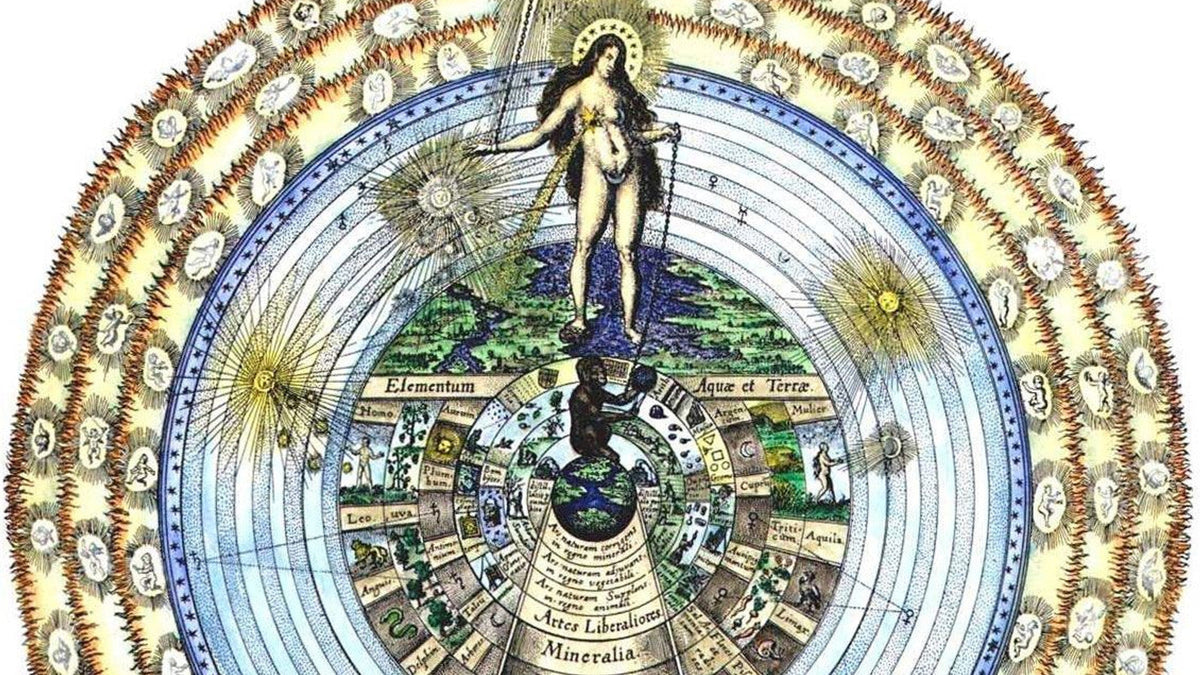
Robert Fludd, an English physician and thinker active in the early 17th century, gave spectacular visual expression to an animated cosmos. An engraving from 1617 arranges elements, plants, animals, metals, and planetary spheres in concentric circles. A human figure stands within this ordered world. The image bears the phrase Integrae Naturae Speculum Artisque Imago, evoking a mirror of nature and art. Viewers immediately grasp the author’s ambition: to show nature as a totality whose parts correspond. This historical engraving is our article’s cover image.
The Science History Institute holds examples of Fludd’s illustrated works published in Oppenheim in 1617–1618. Its records document editions and associated engravers, including Johann Theodor de Bry and Matthäus Merian. These works belong to the history of scholarly imagery, using geometry and allegory to represent a cosmological proposition. The figure among the spheres is not the result of astronomical observation: it is an image of thought. It illuminates the idea of living nature without establishing that planets connect to our organs through a fluid. Its interest lies in the union of learning, symbolism, and art.
The relationship between macrocosm and microcosm is a major legacy of these doctrines. The human body is viewed as an organized totality capable of reflecting the world’s structure. This analogy brings seemingly distant things together: life’s rhythms, seasons, stars, plant qualities, and relationships among elements. Meaningful resemblance must nevertheless be distinguished from demonstrated causation. An author’s comparison of Sun and heart does not prove that solar force governs the heartbeat. The analogy’s historical value lies in how it guided inquiry and scholarly imagination.
Related concerns appear in other forms in the doctrine of plant signatures, which interpreted nature’s markings as signs of hidden properties. The thirty-six astrological decans, meanwhile, attest to a symbolic organization of the sky. These should not be confused with breath theory: reading appearances, mapping celestial images, and explaining cosmic cohesion are different practices. Their historical relationship rests on the broader idea of an ordered world whose parts can be interpreted as connected.
Modern sciences have replaced ancient physiological and cosmological models with explanations based on observation, experimentation, and revisable theories. Respiration involves gas exchange; cells obtain energy through chemical reactions; nerve signals rely on electrochemical mechanisms. These phenomena do not demonstrate an invisible breath shared by bodies, plants, and stars. Stoic pneuma is not previously unknown electricity, and Ficino’s spiritus is not secretly a quantum force. Such equations would strip these doctrines of historical meaning.
Nor should every civilization’s concept of breath be equated without investigation. Asian or African vocabularies of life and animation belong to languages and traditions whose histories deserve study in their own right. Comparison can be productive, but a similar translation proves neither doctrinal identity nor direct descent. Western pneuma already underwent substantial transformations. Respecting differences helps us better understand what readers of ancient philosophy, medieval physicians, and Renaissance occultists sought to transmit.
Vital breath remains one of natural magic’s most expressive concepts. It invites us to view matter as a network of relationships, question what links living functions, and understand why some authors imagined the cosmos as a vast organism. Their hypotheses need not become contemporary certainties for their thought to be taken seriously. Texts show how they organized the world; works such as Fludd’s show how they represented it. Between breathing air and the soul of the stars, spiritus traces a persistent human question: what holds life together?
Cover illustration: Robert Fludd, “Integrae Naturae Speculum Artisque Imago,” historical engraving from 1617 depicting the Anima Mundi among the spheres. Wikimedia Commons, public domain. Additional heritage source: Science History Institute. Cropped to 16:9; no artificially generated image.

Par Olivier of Aeternum
Passionate about esoteric traditions and the history of the occult from the earliest civilizations to the 18th century, I share articles exploring these subjects. I am also a co-founder of Aeternum, the online esoteric store.