





























































































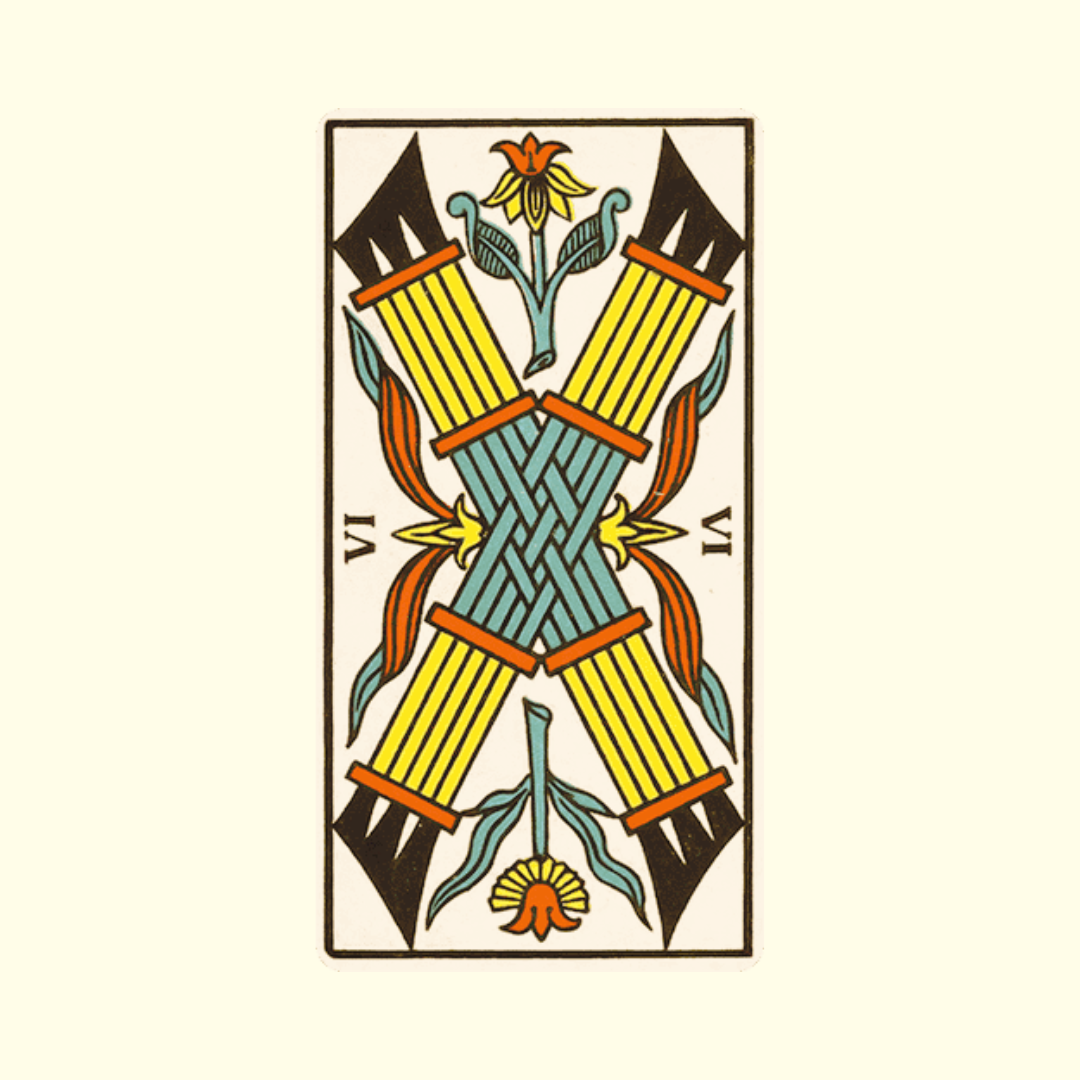

Six wands give success a public form. In the Tarot de Marseille, they extend the suit's regular pattern. In the Waite-Smith, a rider crowned with laurel advances amid a procession, his wand bearing a second wreath. The card speaks of victory, recognition, and long-awaited news—but also of the collective gaze on which this victory depends.
The Six of Wands marks a visible result after the ordeal. Someone receives congratulations, an application is accepted, a campaign finds its audience, or a team achieves the gain it sought. The card does not merely describe the intimate feeling of having succeeded: it stages recognition granted by others.
Yet the sources do not all place “victory” front and center. Mathers speaks of attempt, hope, desire, and expectation. The Golden Dawn assigns it the title “Lord of Victory” and Jupiter in Leo. Waite brings these strands together by evoking the victor, the great news, and hope crowned by what it desired.
From six wands to the victor's return
In a Tarot de Marseille, six wands form a balanced framework amid leaves and flowers. No rider or audience appears. The number six stabilizes the interlacing and distributes the force. The idea of victory therefore comes from a later divinatory transmission, not from a hidden scene in the French suit symbols.
Smith depicts a rider dressed in red and green. A laurel wreath encircles his head; another is attached to the wand he holds. Men on foot carry their own wands around him. Waite sees on the surface a triumphant victor, but also a royal messenger bringing great news. The image combines result, message, and public ceremony.
Iconographic marker. The horse, laurel wreaths, and procession belong to the Waite-Smith deck. Marseille preserves six wands without a narrative. A reading centered on recognition can apply to both decks if its origin is named; the image of the acclaimed hero should not be projected onto them as an ancient detail.
Divinatory transmission
In 1888, Mathers attributed attempt, hope, desire, wish, and expectation to the Six of Wands. Reversed, the card receives infidelity, betrayal, disloyalty, and treachery. Its vocabulary therefore describes active hope before describing an assured result.
Book T names the card “Lord of Victory” and assigns it Jupiter in Leo. Six torches cross one another and produce flames. The text speaks of victory after the struggle, pleasure obtained through work, sociability, and gain. It also adds insolence and pride connected to wealth or success when the card is poorly surrounded.
Waite presents several levels: triumph, great news, wish fulfilled, and the crowning of hope. Reversed, the card indicates fear, betrayal, disloyalty, and indefinite delay. The reading must therefore establish who recognizes the result, what has actually been won, and whether the announcement has proof.
Meaning in a spread
In a favorable reading
The Six of Wands announces that an effort is receiving a favorable response. The querent may obtain an agreement, selection, promotion, positive answer, or recognition from their group. The card suits moments when the result must be announced, displayed, or celebrated without false modesty.
It can also represent news that confirms an expectation. Waite's letter reminds us that success arrives through a channel: letter, call, publication, official decision, or the word of an authorized person. The neighboring cards show the nature and scope of this confirmation.
In a tension reading
Recognition can feed pride, create dependence on approval, or conceal collective work. The card then signals an image-based victory, a leader taking credit, a promise of success used to secure obedience, or fear of losing a position that has become public.
The delay and disloyalty of the old lists invite you to verify the announcement. An oral agreement, provisional ranking, or congratulations do not necessarily amount to payment, a contract, or a final decision. The useful question becomes: what fact confirms the victory, and who contributed to achieving it?
Love, work, and finances
The Six makes the result visible. In each area, recognition must be linked to a fact, an authority, or an identifiable group.
| Area | Favorable reading | Tension aspect | Question to ask |
|---|---|---|---|
| Love | Acknowledged relationship, recognized gesture, partner who publicly expresses their choice. | Need to be admired, couple used as proof of success, promise without private action. | Does public recognition correspond to the reality of the relationship? |
| Work | Promotion, successful competition, praised project, spokesperson or leadership role. | Credit claimed by one person, rivalry after the victory, announcement before signing. | What document or result confirms this recognition? |
| Finances | Gain tied to completed work, bonus, contract won, reputation that supports sales. | Prestige spending, income announced before collection, overconfidence. | Is the gain secured, invoiced, or merely hoped for? |
| Creation | Acclaimed work, publication, award, favorable response from an audience. | Creation guided by applause, difficulty accepting the next criticism. | How can recognition be turned into continuity of work? |
| Collective life | Recognized leadership, a group united around a result, a message delivered on behalf of everyone. | Leader isolated on horseback, collaborators reduced to decoration. | Are the success and its benefits shared? |
Reading associations
The Six brings victory, news, or recognition. The neighboring card shows the challenge overcome, the duration of the success, and what the victor must now take on.
| Association | Possible dynamic | Point of caution |
|---|---|---|
| Six of Wands + Five of Wands | Victory achieved after a competition, selection at the end of a trial. | Opposition may persist after the result. |
| Six of Wands + Seven of Wands | A position that has been won must now be defended. | Success attracts requests, criticism, or competitors. |
| Six of Wands + Chariot | Highly visible triumph, rapid progress, recognized mastery. | Pride and speed can distance you from the group. |
| Six of Wands + Sun | Clear success, shared recognition, an unambiguous public result. | Do not overlook less visible contributions. |
| Six of Wands + Moon | A reputation surrounded by rumors, a poorly understood victory, or an announcement that is still uncertain. | Wait for verifiable confirmation. |
| Six of Wands + Ten of Wands | Success brings a new burden and greater responsibilities. | Recognition does not make up for a lasting overload. |
Correspondences according to the schools
The six wands belong to the French deck. Jupiter in Leo and the title of Victory come from the Golden Dawn. The crowned rider, the procession, and the great news were developed by Smith and Waite.
| Reference | Attribution | Historical scope |
|---|---|---|
| Family | Minor Arcana, Six of Wands | Sixth numbered card of the suit. |
| Tarot de Marseille | Six crossed wands and botanical ornaments | Suit card without rider or laurel. |
| Mathers, 1888 | Attempt, hope, desire, wish, expectation | Reversed: infidelity, betrayal, disloyalty, treachery. |
| Golden Dawn | Lord of Victory | Title of Book T. |
| Element | Fire | Occult attribution to the suit of Wands. |
| Astrology | Jupiter in Leo | Second decan of Leo in the Golden Dawn system. |
| Waite-Smith | Rider, laurel crowns, wand, and procession | Scene published in 1909. |
| Hebrew letter | No letter specific to the card | The numbered cards are not each assigned a letter in this system. |
| Stone and plant | No shared historical agreement | Recent lists should be presented as editorial choices. |
| Reading keywords | Victory, recognition, announcement, reputation, expectations fulfilled | The result must be confirmed by the facts. |
Reading advice
Ask who holds the crown and who walks on foot. This distinction reveals how merit is shared, the source of the announcement, and the relationship between the representative and their group. Then look for evidence of the result: a document, payment, decision, figure, or clear commitment.
The Six of Wands does not authorize anyone to promise a legal victory or guarantee a profit. It describes a dynamic of recognition. To read it accurately, distinguish between success achieved, an announcement awaited, and a need for approval.
Sources and reference texts
For the history of decks and suits: Victoria and Albert Museum, A History of Tarot Cards ; British Museum, reproduction of Nicolas Conver’s Tarot de Marseille.
For divinatory and occult texts: S. L. MacGregor Mathers, The Tarot, 1888, card meanings ; Liber LXXVIII, “The Lord of Victory,” publication of material from Book T ; Arthur Edward Waite and Pamela Colman Smith, The Pictorial Key to the Tarot, Six of Wands, 1911.