




























































































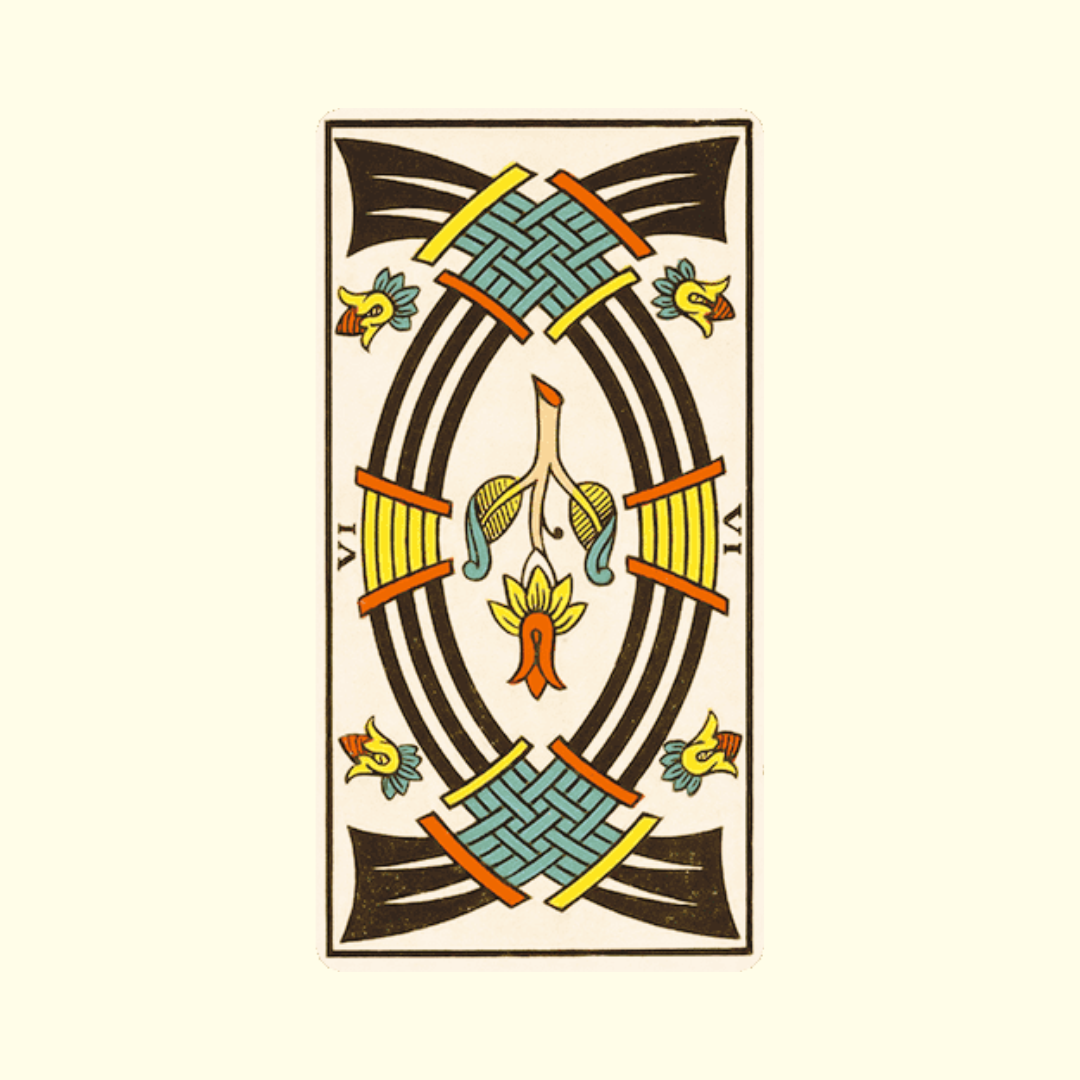

Six swords regain order after the rupture of the Five. In the Tarot de Marseille, the curved blades form a regular enclosure around a vegetal motif. In the Waite-Smith, a ferryman leads two travelers toward the opposite shore, with six swords standing upright in the boat. The Six of Swords speaks of a journey, mediation, and success achieved after difficulty: a real crossing, but one whose arrival still requires work.
The Six indicates that a workable solution exists. It may take the form of a move, an intermediary, a procedure, a team change, or an intellectual transition. The card does not promise a perfect shore. It shows a sturdy enough vessel, a load compatible with the ferryman’s strength, and a direction that makes it possible to leave the site of the conflict.
The journey does not erase what is being carried. The swords remain in the boat: knowledge, memories, rules, documents, or tensions accompany the move. The reading therefore becomes more precise when it distinguishes what must be taken along from what can remain on the shore.
From Six Blades to Crossing the Water
In a Tarot de Marseille, six curved blades answer one another in regular bands and surround a central flower or shoot. No boat, water, or person appears on the card. The composition creates order after the imbalance of the Five. The even number gives it a structure in which the forces are distributed without a straight blade at the center.
Smith transforms this arrangement into a crossing. A ferryman pushes a boat carrying a figure wrapped in a cloak and a child. Six swords are planted at the front of the vessel. The water changes appearance from one side to the other, and a shore awaits in the distance. Waite notes that the load is light and that the task does not exceed the ferryman’s strength. He speaks of travel by water, a route, a messenger, and an expedient means.
Iconographic reference. The boat, ferryman, travelers, and opposite shore belong to the Waite-Smith. The Marseille offers an abstract arrangement of six blades. The sense of transition can connect the two decks, but the idea of leaving a painful past comes chiefly from the narrative formed by Smith and by the cards that precede it.
Divinatory Transmission
Mathers assigns the Six of Swords messenger, envoy, journey, and travel. Reversed, he lists declaration, romantic proposal, revelation, and surprise. His catalogue makes the card a vehicle: a person, a message, or news crosses a distance. He does not say that every journey leads to improvement.
Book T names the card “Lord of Earned Success” and attributes Mercury in Aquarius to it. Two hands hold four swords crossing around a restored rose. The text speaks of success after anxiety and difficulty, of patience, work, and travel by water. The result is “earned” because it comes after effort, not because an outside force guarantees arrival.
Waite depicts a ferryman and gives voyage by water, road, path, messenger, agent, and expedient. Reversed, the card receives declaration, confession, and publicity; another source mentioned by Waite sees a love proposal in it. This variety prevents reducing the Six to a simple inner transition. It may indicate logistics, an intermediary, or words emerging from secrecy.
Meaning in a spread
In a favorable reading
The Six of Swords shows that an exit can be organized. The querent finds a competent contact, changes methods, leaves a conflict-ridden environment, or turns a difficulty into a journey broken down into stages. The card supports solutions modest enough to be feasible: transport, a relay, correspondence, mediation, file transfer, or a transition schedule.
Its favorable aspect requires a ferryman and a boat. Who has the expertise? What means of transport can carry the load? Where is the next shore? A concrete answer to these three questions makes the movement credible. Without them, the departure remains a wish.
In a tension reading
The journey may be forced, slow, or burdened with what caused the conflict. Someone changes location without changing their method, entrusts their direction to an unreliable intermediary, or seeks a temporary solution that becomes permanent. The travelers’ silence may also show a transition completed without words, leaving expectations and responsibilities unclear.
The card does not promise that the other shore will be better. It only indicates that movement is possible and that work remains within reach. The useful question becomes: what are we taking with us, who is steering, and what action will prove that the transition is complete?
Love, work, and finances
The Six sets a situation in motion through a route, a message, or an intermediary. It does not guarantee a move, a romantic reconciliation, or medical improvement. The spread provides observable criteria for the crossing.
| Area | Favorable reading | Tension aspect | Question to ask |
|---|---|---|---|
| Love | Emergence from a conflict, a new phase being organized, dialogue facilitated by a neutral third party. | Emotional distance, a problem carried along without being addressed, departure decided by one person alone. | What words should accompany the change? |
| Work | Change, transfer, change of method, file taken over by a competent contact. | Transition without a relay, unclear responsibilities, departure that shifts the problem elsewhere. | Who is managing the transfer, and until what date? |
| Finances | Repayment plan, gradual exit from a difficulty, pragmatic trade-off. | Transition costs underestimated, debt shifted elsewhere, temporary solution too expensive. | What budget makes it possible to reach the next stage? |
| Travel | Prepared journey, accompanied passage, transport suited to the load. | Forced movement, unclear route, dependence on an intermediary. | Have the documents, deadlines, and resources been checked? |
| Decision | Choosing a viable path after a period of confusion. | A solution chosen only to escape immediate discomfort. | What problem will this movement actually solve? |
Reading associations
The Six brings passage and relay. The associated card indicates what is being left behind, the quality of the route, or the result the journey must achieve.
| Association | Possible dynamic | Point of caution |
|---|---|---|
| Six of Swords + Five of Swords | Departure after a conflict, withdrawal from a field that has become sterile. | Do not carry the quarrel into the new setting. |
| Six of Swords + Chariot | Rapid transition, command of the route, decisive movement. | Speed does not replace logistical preparation. |
| Six of Swords + Hermit | Solitary journey, study, or retreat guided by a precise inquiry. | Plan the connection with those who need to receive news. |
| Six of Swords + Tower | Departure imposed by upheaval, evacuation from a framework that no longer holds. | Secure immediate needs before interpreting the crisis. |
| Six of Swords + World | Journey brought to completion, passage toward a broader or international setting. | Settle the obligations left on the former shore. |
| Six of Swords + Ten of Wands | A difficult transition, move, or transfer that requires redistributing the weight. | Lighten the boat before the load prevents passage. |
Correspondences according to the schools
The former chart associated Mercury, autumn, aquamarine, reed, and Vav. Mercury in Aquarius does belong to the Golden Dawn. The season, stone, plant, and letter do not form a shared tradition with it.
| Reference | Attribution | Historical scope |
|---|---|---|
| Family | Minor Arcana, Six of Swords | Sixth pip card of the suit. |
| Tarot de Marseille | Six curved blades arranged around a plant motif | Suit card without a boat or travelers. |
| Mathers, 1888 | Sent, messenger, journey, movement | Reversed: declaration, proposal, revelation, surprise. |
| Golden Dawn | Lord of Earned Success | Title of Book T. |
| Element | Air | Occult attribution to the suit of Swords. |
| Astrology | Mercury in Aquarius | Second decan of Aquarius in the Golden Dawn system. |
| Waite-Smith | Ferryman, boat, two travelers, six swords, and the other shore | Scene published in 1909. |
| Hebrew letter | No letter specific to the card | Vav belongs to the Hierophant in the Golden Dawn system. |
| Stone, plant, season | No common historical agreement | These recent additions should remain distinct from dated correspondences. |
| Reading keywords | Passage, journey, relay, message, effort, transition | The context clarifies the starting point and the intended shore. |
Reading advice
Build the crossing in three columns: what remains, what travels, and what awaits on the other shore. Add the name of the ferryman, whether it is a person, a procedure, a vehicle, or a skill. This method prevents treating change as a vague promise.
For a love question, infer neither a return nor a definitive separation. For a professional question, check the contract, schedule, and transfer of the file. The Six indicates a viable route; it is up to the querent and their counterparts to make the arrival a reality.
Sources and reference texts
For the history of tarot decks and suits: Victoria and Albert Museum, A History of Tarot Cards; British Museum, reproduction of Nicolas Conver’s Tarot of Marseille.
For divinatory and occult texts: S. L. MacGregor Mathers, The Tarot, 1888, card meanings; Liber LXXVIII, “The Lord of Earned Success,” publication of the Book T material; Arthur Edward Waite and Pamela Colman Smith, The Pictorial Key to the Tarot, Six of Swords, 1911.