


















































































































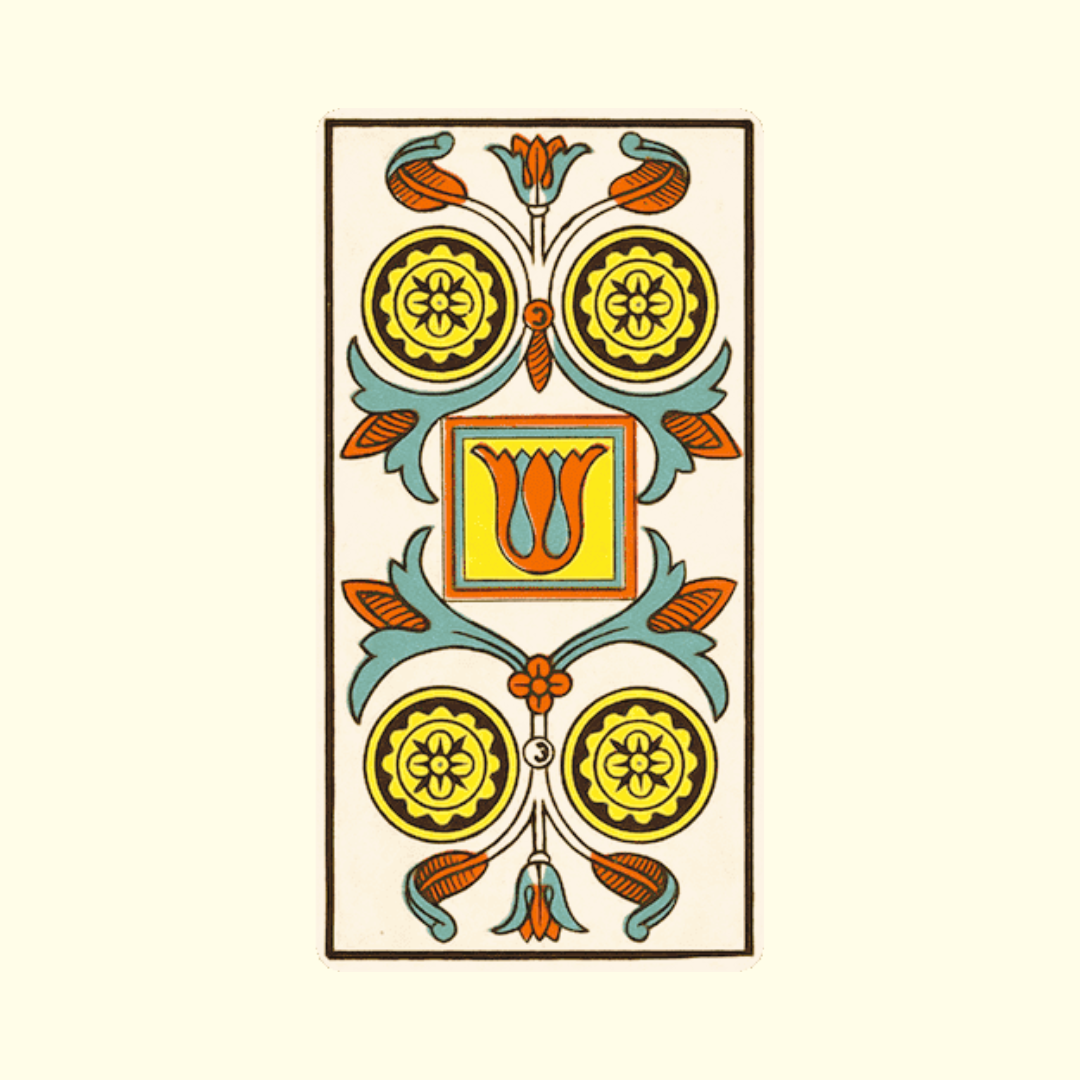

Four pentacles close a square around a center. In the Tarot de Marseille, this structure unfolds without an owner or a gesture of avarice. In the Waite-Smith, a crowned figure wears a pentacle on his head, clutches one against his chest, and holds the other two beneath his feet. The Four of Pentacles asks what possession protects, what it immobilizes, and how far the holder confuses security, control, and personal worth.
The card may represent reserve, assets, position, right, reputation, or territory. It supports conservation when this meets a real need and has a limit. It becomes tense when fear of scarcity prevents use, sharing, investment, or any development.
Avarice is not the only meaning transmitted. Mathers gives pleasure, cheerfulness, and satisfaction. The Golden Dawn speaks of earthly power, assured gain, rank, and domination, along with covetousness and discontent. Waite retains the security of possessions, gift, bequest, and inheritance. The card therefore concerns both the right to possess and the cost of that possession.
From the four pentacles to the crowned holder
In a Tarot de Marseille, four pentacles occupy the corners or quarters of the card. A flower, rosette, or vegetal motif fills the center. No character embraces or tramples them. The square composition may suggest organization, reserve, or enclosure, but it does not accuse anyone of avarice.
Smith places a crowned man before a city. One pentacle rests above his crown, another is clutched against his torso, and two are beneath his feet: four in all. The old entry incorrectly referred to a fifth pentacle. Waite writes that the figure clings to what he possesses and associates the card with the security of possessions, gift, bequest, and inheritance. The city behind him recalls the world from which his posture separates him.
Iconographic reference. The crowned and possessive figure belongs to the Waite-Smith. The Marseille presents four pentacles and a vegetal center, without a moral narrative. A reading can explore protection and closure in both decks, but the seated miser should not be projected onto a card that does not show him.
Divinatory transmission
Mathers attributed pleasure, cheerfulness, enjoyment, and satisfaction to the Four of Pentacles in 1888. Reversed, he cites obstacles and hindrances. This source contradicts the idea of a card that is solely miserly or anxious. Possessing something can provide legitimate satisfaction before becoming attachment.
Book T calls it “Lord of Earthly Power” and assigns it the Sun in Capricorn. Four pentacles are arranged at the points of a square around a rose. The text announces assured material gain, success, status, domination, and earthly power, but also adds an achievement that leads nowhere beyond itself, covetousness, suspicion, order, prudence, discontent, and weak initiative.
Waite emphasizes the security of possessions, attachment to what one has, and then giving, bequests, and inheritance. Reversed, the card indicates waiting, delay, and opposition. Preservation is therefore not inherently wrong: it becomes problematic when the asset can no longer circulate, serve a purpose, or be passed on.
Meaning in a spread
In a favorable reading
The Four of Pentacles protects a foundation. It favors building up a reserve, safeguarding a right, controlling expenses, preserving a tool, or formalizing ownership. It may also indicate an inheritance or an asset whose transfer needs to be organized.
The card supports a clear material “no”: do not lend beyond your means, refuse an expense, secure access, or request a guarantee. Protection remains healthy when it has a purpose, a duration, and conditions for reopening.
In a tension reading
The holder grips the resource so tightly that it can no longer fulfill its function. Money no longer funds anything, a position is defended against any successor, information becomes personal property, or a relationship is treated as an entitlement. Control provides immediate security at the cost of isolation and stagnation.
The Four may also show fear of scarcity, a blocked succession, delay, an abusive preservation clause, or a territorial conflict. It does not prove that someone is stingy. It asks you to examine the rules of access, the accounts, and the real possibility of passing something on.
Love, work, and finances
The Four preserves and limits. The area shows the protected resource, while the neighboring cards indicate whether this enclosure serves a project or becomes an end in itself.
| Area | Favorable reading | Tension aspect | Question to ask |
|---|---|---|---|
| Love | Clear material boundaries, an expressed need for security, a protected home-building project. | Possessiveness, taking the relationship for granted, measuring affection by possessions. | What does the boundary protect, and does it leave the other person genuine freedom? |
| Work | Stabilized position, secured access, preserved budget, clearly defined responsibility. | Information withheld, fear of delegating, territory defended against the team. | What resource must be passed on for the work to continue? |
| Finances | Precautionary savings, controlled spending, asset retained with a purpose. | Hoarding, opportunity refused out of fear, money immobilized without a strategy. | What threshold will make the reserve available? |
| Assets | Verified title, organized inheritance, planned upkeep, protected property. | Blocked succession, property dispute, burden retained out of attachment. | Who owns it, who uses it, and who pays for its upkeep? |
| Social life | Respected boundaries, confidentiality, refusal of an excessive request. | Isolation, controlled access, generosity used as an instrument of power. | Is the rule the same for every person concerned? |
Reading associations
The Four holds back the card accompanying it. It shows what is being kept, the fear that closes access, or the condition allowing the resource to circulate again.
| Association | Possible dynamic | Point of vigilance |
|---|---|---|
| Four of Coins + Ace of Coins | New resource placed in reserve or secured acquisition. | Define its future use now. |
| Four of Coins + Six of Coins | Balancing keeping and giving, assistance subject to conditions. | The gift must not purchase dependence. |
| Four of Coins + Emperor | Assets, territory, or budget protected by a firm rule. | Centralized control can make any succession impossible. |
| Four of Coins + Tower | Material security shaken, reserves mobilized after a rupture. | Protect immediate needs before defending prestige. |
| Four of Coins + Devil | Possession, debt, or contract used to maintain control. | Check clauses, access to resources, and the possibility of withdrawal. |
| Four of Coins + World | Stabilized assets then transferred, material cycle completed. | A successful closure requires identified documents and beneficiaries. |
Correspondences according to the schools
The old chart attributed the Moon, autumn, tourmaline, hazel, and Dalet. Book T instead gives the Sun in Capricorn. Stones, plants, seasons, and letters added without a source should be excluded from the historical table.
| Reference | Attribution | Historical scope |
|---|---|---|
| Family | Minor Arcana, Four of Coins | Fourth numbered card of the suit. |
| Tarot of Marseille | Four coins around a central botanical motif | Card without a proprietor or scene of greed. |
| Mathers, 1888 | Pleasure, cheerfulness, enjoyment, satisfaction | Reversed: obstacles and impediments. |
| Golden Dawn | Lord of Earthly Power | Title of Book T. |
| Element | Earth | Occult attribution to the suit of Pentacles. |
| Astrology | Sun in Capricorn | Third decan of Capricorn in the Golden Dawn grid. |
| Waite-Smith | Crowned figure, four pentacles, and a city in the background | Scene published in 1909. |
| Hebrew letter | No letter specific to the card | Dalet belongs to the Empress in the Golden Dawn system. |
| Stone, plant, season | No common historical correspondence | Tourmaline, hazel, and autumn do not come from the cited sources. |
| Reading words | Reserve, possession, security, control, inheritance, transmission | Purpose and duration distinguish protection from immobilization. |
Reading advice
Draw three columns: what must be protected, what must remain available, and what can be passed on. Add a threshold or date for each resource. Without a condition for reopening, the reserve risks becoming a permanent closure.
For an estate-planning question, verify titles, beneficiaries, encumbrances, and taxes with qualified professionals. In a relationship, replace the vocabulary of possession with that of consent and commitment. A framework can be protected; a person cannot be owned.
Sources and reference texts
For the history of the suits and decks: Victoria and Albert Museum, A History of Tarot Cards; British Museum, reproduction of Nicolas Conver’s Tarot of Marseille.
For divinatory and occult texts: S. L. MacGregor Mathers, The Tarot, 1888, card meanings; Liber LXXVIII, “The Lord of Earthly Power,” publication of material from Book T; Arthur Edward Waite and Pamela Colman Smith, The Pictorial Key to the Tarot, Four of Pentacles, 1911.










