



















































































































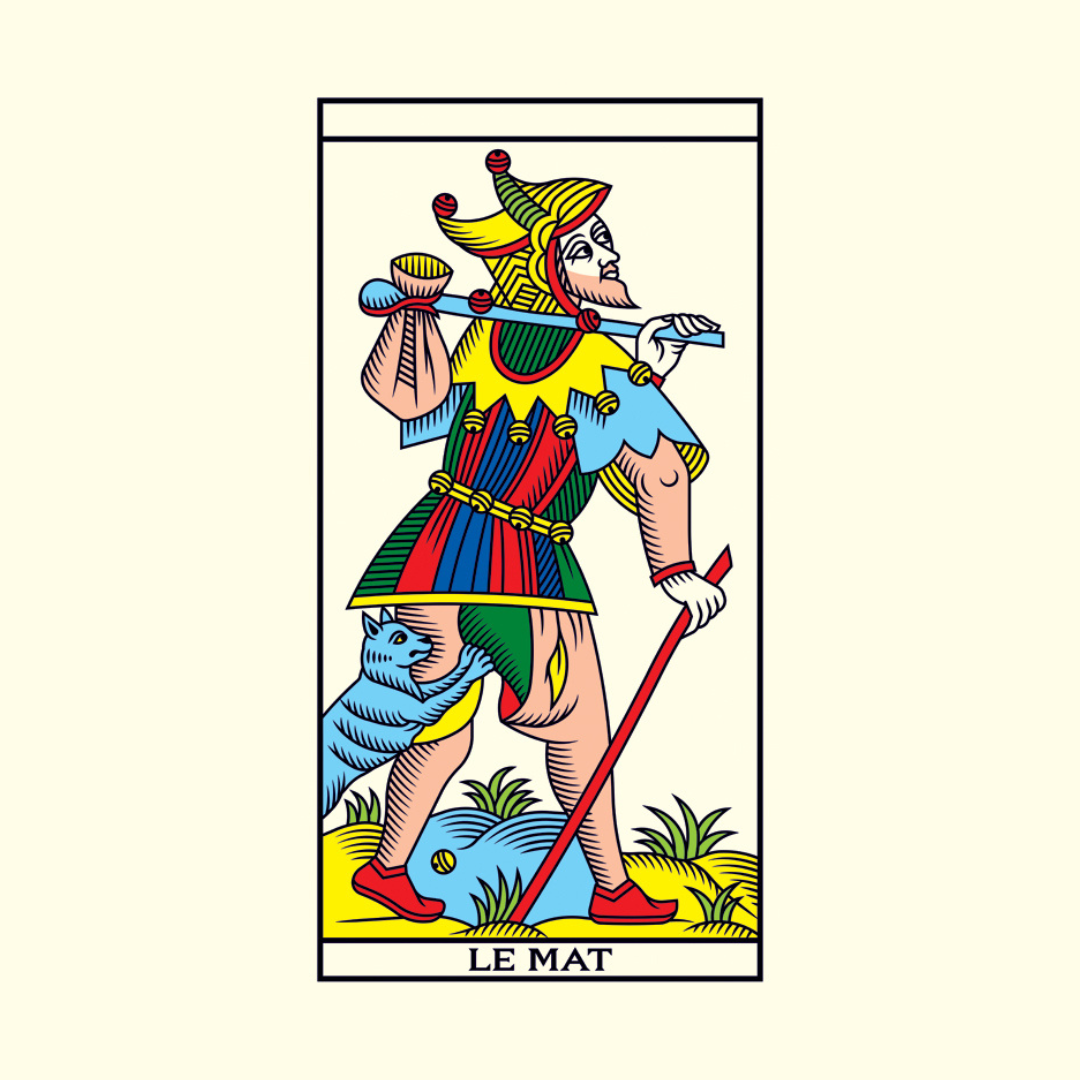

The Fool walks beyond assigned places. He carries little, leaves a familiar setting, and accepts that the journey will transform his plan. In a reading, this card speaks of departure, freedom, experience, mobility, and daring. It also carries their downside: recklessness, escape, wandering, and refusal to face the consequences. Its message is not to jump without looking, but to know what you are leaving behind, what you are taking with you, and what risk you are truly willing to accept.
The character has changed considerably. The Visconti-Sforza Fool is a man in rags, wearing feathers and holding a staff. The Fool of the Tarot de Marseille becomes a traveler pursued or held back by an animal. The Waite-Smith shows an elegant young man at the edge of a precipice, accompanied by a white dog. The bright interpretation of a new beginning comes largely from this latter deck; it does not sum up the entire history of the card.
The Fool in the earliest tarot decks
In the Milan Visconti-Sforza, painted in the 15th century, a bearded man stands against a gold background. Feathers are stuck in his hair, his clothes are torn, and he holds a staff. The Morgan Library simply describes him as the Fool. No dog, precipice, sun, embroidered bag, or white rose appears. Description and reproduction of the Visconti-Sforza Fool, Morgan Library & Museum.
The structure of the deck helps explain its place. The Visconti-Sforza contains twenty-one trumps and a Fool set apart. The old cards do not all bear the numbering that later became familiar. Before becoming a hero who begins his journey, the Fool therefore belongs to a deck of cards and a social order in which his clothing, poverty, and lack of rank distinguish him from rulers, virtues, and cosmic powers.
Iconographic marker. The precipice and the white dog belong to the Waite-Smith. The Visconti-Sforza Fool is a man in rags holding a staff; the image does not yet present the radiant departure popularized in the 20th century.
From the vagrant to the Waite-Smith traveler
In the Tarot de Marseille, The Fool remains unnumbered. He advances with a staff and carries a bundle at the end of a pole resting on his shoulder. An animal clings to the back of his clothing or bites him. The species of this animal varies according to the decks and drawings: systematically calling it a dog adds a detail that not all cards provide. The scene links movement to concrete pressure, as if departure already had its price.
Pamela Colman Smith transforms the vagabond into a richly dressed young traveler. He holds a white rose, carries a small bag at the end of a staff, and raises his face toward the sky while a dog leaps beside him. The rocky ledge, the sun, and the mountains frame a scene of beginnings. Waite describes a spirit in search of experience, but he also publishes a much harsher divinatory list. The two registers must remain distinct.
The card's position changes between schools. Papus treats it as the twenty-first card, left unnumbered, and assigns it Shin; The World then receives Tau as the 22nd letter. The Golden Dawn moves The Fool to the beginning, under the number 0, with Aleph and Air. The Waite-Smith retains this zero. None of these occult distributions should be presented as the original numbering of all tarot decks.
What the old authors attribute to it
Mathers calls the card "the foolish man." He gives it madness, atonement, and hesitation; reversed, it expresses instability and the difficulties that result from it. Papus sees in its uncontrolled movement instinct, relative duration, and passion no longer restrained. These interpretations retain the moral harshness that the 19th century associated with the figure of the fool or vagabond.
Waite offers two very different faces. His commentary on the image describes a traveler in search of experience, carried by expectation and momentum. His cartomantic list gives madness, extravagance, intoxication, delirium, and frenzy; reversed, negligence, absence, carelessness, apathy, and vanity. The card's current meaning of a new beginning therefore emerges from a selection within this legacy, not from a constant meaning since the 15th century.
Meaning in a spread
In a favorable reading
The Fool indicates a departure, reclaimed freedom, a move, an experience attempted outside a framework that has become too narrow, or the openness necessary for learning. It favors exploration, mobile projects, a change of environment, and decisions that restore a person's ability to act.
His strength comes from carrying little. He helps distinguish what is necessary from what holds one back out of habit. The card does not ask us to scorn all preparation: it invites us to prepare just enough to begin, then let experience correct the route. Movement is worthwhile when it answers to a direction, even a provisional one.
In an unfavorable reading
The card may signal aimlessness, impulsiveness, negligence, an abandoned promise, a departure used to avoid responsibility, or someone needlessly putting themselves in danger. It also shows a refusal to ask for advice under the pretext of freedom. The objective, resources, limits, and consequences for others must then be checked.
Love, work, and finances
| Area | Favorable reading | Shadow aspect | Question to ask |
|---|---|---|---|
| Love | A free-spirited encounter, a relationship that breaks from old patterns, a new beginning embraced. | Avoidance of commitment, unstable bond, desire to leave without speaking clearly. | What freedom can exist without breaking trust? |
| Work | Career change, mobility, independence, learning on the job. | Hasty departure, framework ignored, mission abandoned without a handover. | What resources need to be secured before moving? |
| Finances | Streamlining, revised spending, a budget adapted to a change in life. | Impulsive purchase, no reserve, neglected conditions. | What real cost comes with this choice? |
| Project | Prototype, exploration, light launch, a new path tested quickly. | Changing objective, dispersion, lack of follow-up, poorly measured risk. | What first milestone will make it possible to choose what comes next? |
How to read its associations
The Fool sets the situation in motion and removes the protections of the old framework. The neighboring card indicates whether this departure receives tools, responds to a choice, gains direction, encounters an obligation, calls for distance, frees a dependency, or follows an already completed cycle.
| Association | Possible dynamic | Point of caution |
|---|---|---|
| The Fool + Magician | A departure with available tools, a first attempt, an activity launched. | Choose one measurable action from the outset. |
| The Fool + Lovers | A choice that changes the route, a relationship outside the usual patterns, a desire for freedom. | Clearly state what this choice entails. |
| The Fool + Chariot | Travel, moving house, rapid mobility, hard-won independence. | Set the direction before speeding up. |
| The Fool + Justice | A regulated departure, freedom confronted with a contract or rule. | Settle your obligations before leaving. |
| The Fool + Hermit | Solitary path, searching, voluntary withdrawal to learn. | Keep a reference point, a deadline, and a reliable contact. |
| The Fool + Devil | Escape driven by desire, freedom asserted in the face of dependency. | Identify what is truly driving the movement. |
| The Fool + World | A new beginning after an accomplishment, a journey, a passage into a broader space. | Close one chapter and move on before setting out. |
Correspondences according to the schools
| Reference point | Attribution | Historical significance |
|---|---|---|
| Tradition | Special card placed alongside the twenty-one trumps | Distinct position in the earliest tarot decks. |
| Ancient figure | Man in rags, feathers in his hair, and staff | Image from the 15th-century Visconti-Sforza deck. |
| Tarot de Marseille | The Fool without a number, bundle, staff, and animal in the background | The card remains outside the numbered sequence. |
| French occultism | Shin; movement, instinct, and lack of stability | Papus treats it as the twenty-first unnumbered card. |
| Golden Dawn | Aleph and Air | The Fool's displacement to the beginning of the series. |
| Waite-Smith | Number 0, young traveler, rose, dog, and precipice | Composition published in 1911. |
| Number | No number, 0, or another rank depending on the deck | There is no numbering shared by all traditions. |
| Stone, plant, and season | No attribution shared by the older schools | Contemporary lists vary according to their authors. |
| Reading keywords | Departure, freedom, movement, exploration, learning, autonomy | Experience begins outside the usual framework. |
| Shadow aspect | Wandering, escape, recklessness, negligence, dispersion, instability | Freedom does not erase consequences. |
Choosing the tarot deck that suits you
To work with the arcana in a complete deck, compare the Tarots de Marseille, the Rider-Waite-Smith, and all of our divination tarot decks. If you are just starting out, the guide How to Choose Your First Tarot Deck? will help you distinguish between the systems.
Sources and reference texts
Morgan Library & Museum, The Fool, Visconti-Sforza Tarot ; The Metropolitan Museum of Art, Before Fortune-Telling: The History and Structure of Tarot Cards ; The Metropolitan Museum of Art, structure of the Visconti-Sforza deck with twenty-one trumps and a Fool ; S. L. MacGregor Mathers, symbolism of the Fool in The Tarot, 1888 ; S. L. MacGregor Mathers, divinatory meanings of the Fool ; Papus, The Tarot of the Bohemians, chapter devoted to the Fool and Shin ; Oswald Wirth, The Tarot of the Medieval Image Makers, 1927 ; Arthur Edward Waite, The Pictorial Key to the Tarot, 1911, card 0 ; Arthur Edward Waite, divinatory meanings of the Major Arcana.










