




























































































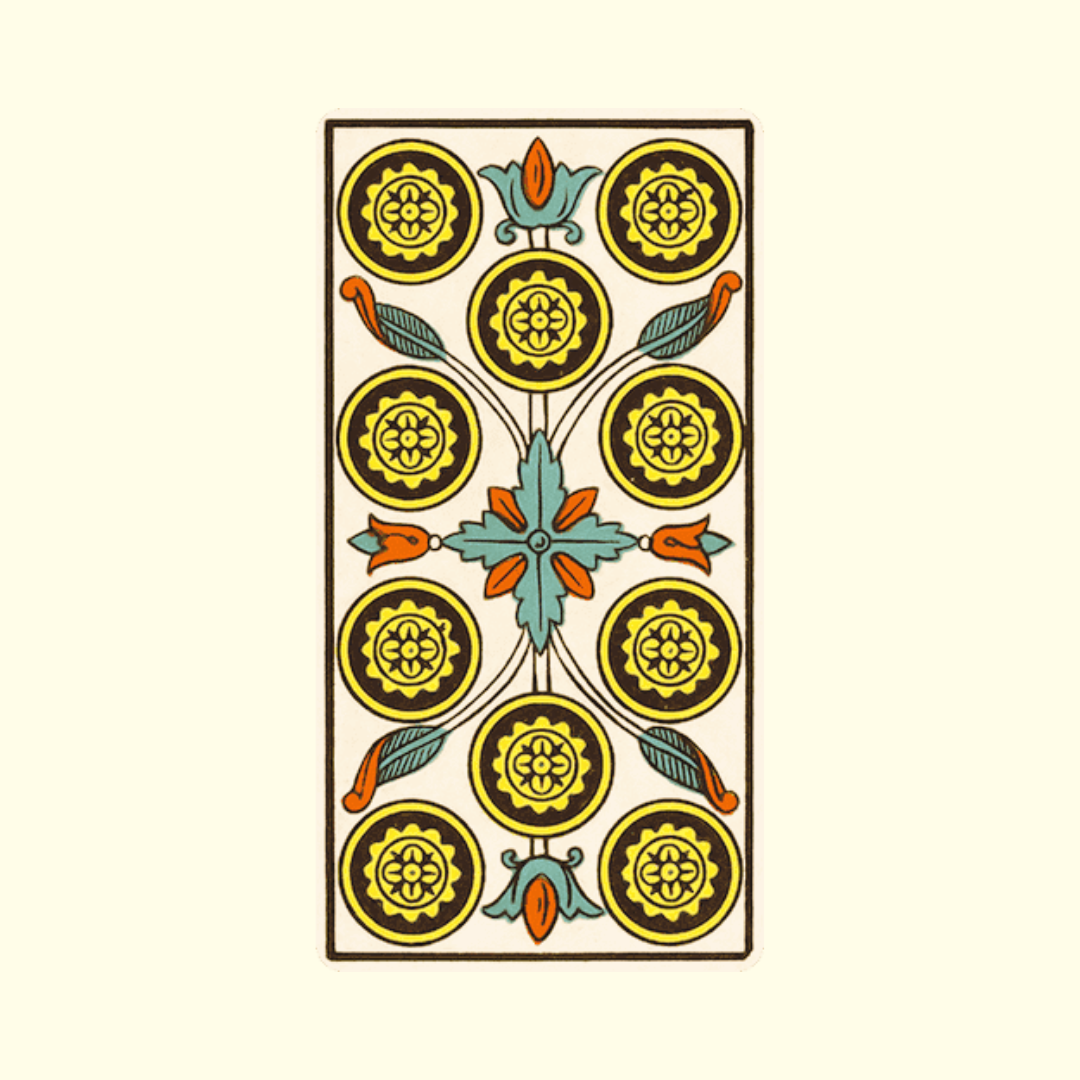

Ten coins close the series and give gain a lasting form. In the Tarot de Marseille, they fill the card according to a completed order. In the Waite-Smith, an arch brings together a dwelling, a couple, a child, two dogs, and an aged figure beneath a network of pentacles. The Ten of Coins speaks of assets, home, archives, and transmission; it asks what will survive the person who owns it today.
The earlier article presented a family gathered around a table laden with riches, a scene absent from Smith's card. It also promised family harmony and inheritance. The sources are more restrained. Mathers gives house, dwelling, and family. The Golden Dawn describes the completion of material gain, which has reached its peak but has no development beyond it. Waite adds archives, family origin, and abode.
The Ten can therefore concern real estate, a business, a name, a trade, a documentary collection, social protection, or an organization that spans generations. It guarantees neither harmony among relatives nor an advantageous inheritance. Every transfer has rules, beneficiaries, burdens, and people whom the established order may leave at the door.
From ten coins to the house passed down
In a Tarot de Marseille, ten coins are arranged with a regularity that varies according to the deck model. Vegetal ornaments separate and connect the pieces. No child, ancestor, or animal tells a story of family continuity. The Ten appears above all as the suit's numerical endpoint: matter has reached its full form and must now be distributed, preserved, or put back into circulation.
Smith sets the scene beneath an arch that provides access to a house and its grounds. A man and a woman stand with a child; two dogs approach an aged figure seated in the foreground. The ten pentacles form the structure of the Tree of Life over the scene. Waite mentions gain, riches, family affairs, archives, ancestry, and abode. The image shows several generations present in the same space without indicating the quality of their relationships.
Iconographic reference. The arch, the dogs, the child, the aged figure, and the cabalistic arrangement of the pentacles belong to the Waite-Smith. Marseille conveys the suit's numerical term without a domestic narrative. Reading the family in a Marseille constitutes a cartomantic extension, not a visible scene.
Divinatory transmission
Mathers associates the Ten of Pentacles with the home, housing, dwelling, and family. Reversed, it gives gambling, dissipation, theft, and loss. His list connects wealth with the place where one lives and those who depend on it. It also reminds us that assets can leave the household through poorly measured risk, negligence, or appropriation.
Book T names the card “Lord of Wealth” and attributes Mercury in Virgo to it. The roses touch the ten pentacles, with no additional bud. The text speaks of material gain that has reached its peak, then adds old age, inertia, heaviness, partial loss, and skill in financial transactions. The summit closes a progression: to continue, wealth must change form or holder.
Waite gives gain, wealth, family affairs, archives, origin, and the family home. Reversed, the card points to chance, fate, loss, theft, and gambling; it can also suggest a gift, dowry, or pension. These terms shift the reading from simple abundance toward the mechanisms through which an asset changes hands: contract, lineage, institution, donation, annuity, or written record.
Meaning in a reading
In a favorable reading
The Ten signals a structure capable of lasting beyond a single transaction. Accounts are organized, knowledge is passed on, an activity becomes a business, or a place receives clear rules of use. The card favors pooling resources when everyone knows their rights, duties, and the share at their disposal.
In a family reading, it can show the weight of a shared history, property to administer, or a decision that affects several generations. Its strength comes from continuity. A person does not need to start everything over: they receive resources, habits, and archives that they can preserve, reform, or pass on.
In a tension reading
The household becomes a closed system. Status, inheritance, or reputation imposes a way of behaving; responsibilities go unspoken; one person controls access to shared resources. The card can also signal illiquid assets, a disputed inheritance, financial maneuvering, or an organization that appears prosperous but is unable to evolve.
The Ten does not announce an inheritance or a death. For questions about succession, property, a pension, or a family business, consult the relevant documents and qualified professionals. Tarot helps identify the relationships between continuity, power, and responsibility; it establishes no legal rights.
Love, work, and finances
The Ten places material matters within a collective continuity. The reading examines what is passed on, according to which rules, to whom, and with what obligations.
| Area | Favorable reading | Tension aspect | Question to ask |
|---|---|---|---|
| Love | A life plan rooted in a home, family, or lasting organization. | A relationship shaped by status, family money, or an inherited norm. | What common rule was chosen rather than accepted without discussion? |
| Work | Structured company, trade passed down, solid institution, professional memory preserved. | Rigid hierarchy, poorly prepared succession, or privilege granted through belonging. | Who can take over responsibility if the central person steps down? |
| Finances | Organized assets, sustainable income, protection or transmission prepared with supporting documents. | Illiquid asset, hidden costs, risky bet, ownership dispute. | What net value and what obligation accompany the asset? |
| Home | Stable home, clear rules of use, several generations able to coexist. | House controlled by one person or material inheritance that perpetuates a conflict. | Who decides, who pays, and who can actually live in the place? |
| Decision | Choice designed for the long term, archives consulted, collective consequences assessed. | Decision made to preserve the group’s image at the expense of its members. | What will remain of this choice in five or ten years? |
Reading associations
The Ten closes the journey through the Pentacles and gives the result a collective scope. The neighboring card shows what will be passed on, contested, transformed, or lost.
| Association | Possible dynamic | Point of vigilance |
|---|---|---|
| Ten of Pentacles + Justice | Deed, inheritance, ownership, or division governed by an explicit rule. | Verify actual rights instead of relying on the family’s word. |
| Ten of Pentacles + Tower | Patrimonial structure upended; sale, separation, or truth that changes the established order. | Protect people before saving the system’s appearance. |
| Ten of Pentacles + Hermit | Former keeper of knowledge, archive, or heritage requiring an inventory. | Memory can disappear if it remains held by a single person. |
| Ten of Pentacles + Three of Pentacles | The transmission of a trade; a team maintains a lasting work or place. | Formalize training, compensation, and responsibility. |
| Ten of Pentacles + Five of Pentacles | Wealth is present but access is unequal; expenses weaken part of the group. | Do not confuse overall wealth with each member’s security. |
| Ten of Pentacles + Wheel of Fortune | A possession or status changes hands; an economic cycle reaches a family or institution. | Anticipate change instead of considering the order permanent. |
Correspondences according to the schools
Mercury in Virgo comes from the Golden Dawn. The network of pentacles placed over a family scene belongs to the Waite-Smith. Older French decks assign the Ten neither its own planet, an illustrated family, nor a Hebrew letter.
| Reference | Attribution | Historical scope |
|---|---|---|
| Suit | Minor Arcana, Ten of Pentacles | Term in the numbered series of Pentacles. |
| Marseille Tarot | Ten of Pentacles and botanical decoration | Court card without a family scene. |
| Mathers, 1888 | House, dwelling, residence, family | Reversed: gambling, dissipation, theft, loss. |
| Golden Dawn | Lord of Wealth | Title from Book T. |
| Element | Earth | Occult attribution to the suit of Pentacles. |
| Astrology | Mercury in Virgo | Third decan of Virgo in the Golden Dawn framework. |
| Waite-Smith | Arch, home, couple, child, dogs, and elderly figure | Scene published in 1909, covered by ten pentacles. |
| Hebrew letter | No letter specific to the card | Yod belongs to the Hermit in the Golden Dawn system. |
| Stone, plant, season | No common historical agreement | Jade, linden, and spring do not come from the cited sources. |
| Reading keywords | Heritage, home, family, archives, transmission, continuity | Wealth can support the group or entrench its hierarchy. |
Reading advice
Take stock of what endures over time: assets, debts, contracts, documents, skills, habits, and stories. Identify the legal holder, the actual user, and the person who bears the costs. These three roles do not always coincide, and the gap between them provides a more precise reading than the word “abundance”.
If the Ten represents a family, do not assume either happiness or unity. Look at who appears in the spread, who remains absent, and what resource connects the people. If the card represents a business or a place, ask what enables its continuity after the founder’s departure: procedure, archive, training, contract, or governance.
Sources and reference texts
For the history of the cards and suits: Victoria and Albert Museum, A History of Tarot Cards; British Museum, reproduction of Nicolas Conver’s Tarot of Marseille.
For divinatory and occult texts: S. L. MacGregor Mathers, The Tarot, 1888, card meanings; Liber LXXVIII, “The Lord of Wealth”, publication of material from Book T; Arthur Edward Waite and Pamela Colman Smith, The Pictorial Key to the Tarot, Ten of Pentacles, 1911.