





























































































The pentagram is a five-pointed star whose power lies as much in its geometry as in the depth of its history. The same design has been associated with health in the Pythagorean tradition, with measure and number, with protective uses, and later with the human microcosm and the elements in Western occultism. Its meaning is therefore not contained in the design alone: it depends on the era, orientation, medium, and system in which it is used.
| Form | Regular five-pointed star formed by five intersecting segments |
|---|---|
| Historical name | Pentalpha, referring to the five shapes of the letter alpha visible in the design |
| Ancient reference | Pythagorean tradition, in which the figure is associated with health |
| Major occult interpretation | Microcosm, number five, then correspondence with the four elements and spirit |
| To distinguish | The pentacle, which refers to a figure or talismanic medium of varying composition |
How exactly is a pentagram constructed?
The pentagram is the stellated polygon obtained by connecting every other vertex of a regular pentagon. The line creates five points around a central pentagon, then continues into a structure in which the same proportions are repeated. This geometry explains why the figure attracted the attention of mathematicians at an early date: the diagonals of the pentagon reveal the ratio now called the golden ratio, and the relationship between the segments is reproduced from one scale to another.
This property should be separated from the occult interpretations later added to it. The golden ratio is not proof of any supernatural quality of the pentagram; it describes a real mathematical relationship between the lengths of a regular pentagon and its diagonals. Symbolic fascination begins precisely when this measurable structure encounters systems that assign the number five a cosmological, human, or ritual value.
The term pentalpha appears in scholarly tradition to describe the figure as an arrangement of five alphas. This way of naming the star emphasizes the design itself. It reminds us that before becoming a religious, magical, or cultural emblem, the pentagram remains a highly precise geometric construction. A five-branched star filled in like the one on a flag and a linear pentagram are therefore not exactly the same graphic object, even if common usage brings them together.
Why is the pentagram linked to the Pythagoreans?
The association between the pentagram and the Pythagoreans is one of the oldest points in its Western history. Works devoted to the history of pentagons and pentagrams connect the figure with the Pythagorean interest in the geometry of the pentagon and in proportional relationships. An ancient and later tradition also presents it as a sign of recognition and associates it with hygieia, health.
This link with health explains why part of the pentagram’s history developed far from the modern image of the “magical” symbol. Jan Schouten’s study of the pentagram as a medical emblem shows the persistence of this theme into 16th- and 17th-century Europe. The figure could then appear in a scholarly world in which medicine, number, natural philosophy, and symbolism remained closely connected.
Nevertheless, this association should not be turned into a linear narrative. The pentagram did not retain the same meaning from ancient Greece to the Renaissance. A geometric sign can move between schools, monuments, manuscripts, talismans, and literary works while changing function. The history of the symbol therefore cannot be reduced to an origin from which everything else mechanically follows.
How does the pentagram become a symbol of the microcosm?
During the Renaissance, the number five assumed an important place in correspondences between the human body, numbers, and the cosmos. In his Occult Philosophy, Heinrich Cornelius Agrippa devotes several passages to geometric figures and attributes to the pentangle a power connected with the number five. In this intellectual world, the pentagram can be read in relation to the human being: one head, two arms, and two legs, forming a human figure spread across the star.
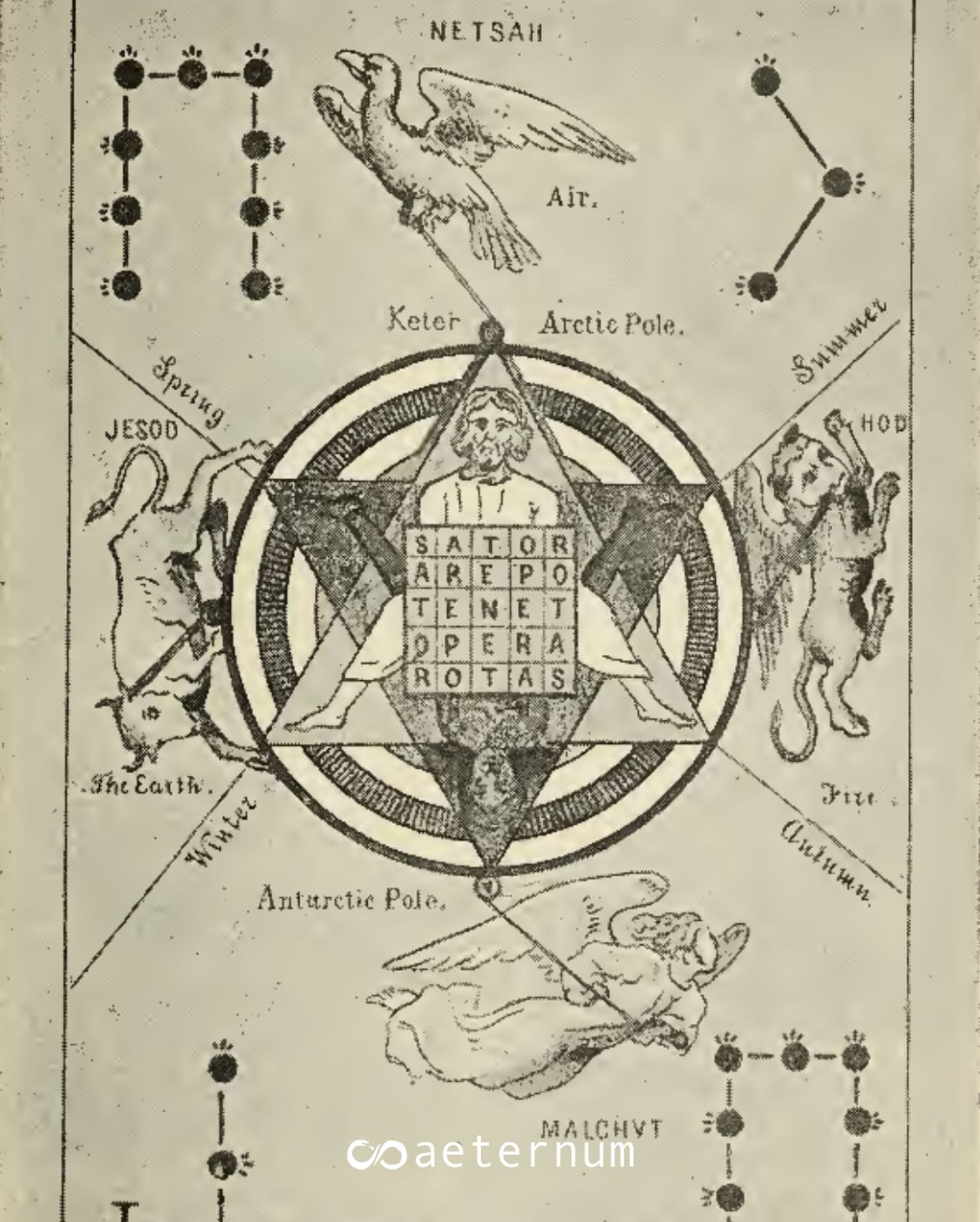
This reading of the microcosm prepared some of the interpretations of modern occultism. Human beings became a reduced image of the world, and geometry served to express an order among bodies, numbers, and qualities. In the 19th century, occult authors systematized this reading even further. The pentagram then became charged with elemental correspondences: earth, water, air, fire, and, at the fifth point, spirit or a higher principle.
Modern ceremonial magic made the pentagram a major operative sign. In Golden Dawn systems and traditions derived from them, rituals use it to organize elemental correspondences, mark ritual space, and distinguish invocation from banishing. This function is historically late compared with the age of the figure. It has nevertheless strongly shaped the contemporary image of the pentagram in esotericism.
The connection with the elements naturally links it with the alchemical signs of fire, water, air, and earth. These elemental triangles do not originate from the pentagram, but modern occultism brings them together within the same language of correspondences.
What changes when one point faces upward or downward?
Geometrically, nothing changes the nature of the sign: a pentagram remains a pentagram when rotated. Historically, however, its orientation has been given particular interpretations. In several modern occult systems, one point facing upward has been associated with spirit governing the four elements. Two points facing upward could be interpreted as the reversal of this order, with matter dominating spirit, or as a goat-like figure.
This opposition is not an ancient rule valid across all cultures. It became established mainly in 19th-century European esotericism, then in 20th-century currents that gave the inverted pentagram a specific religious or counter-religious identity. Automatically reading every ancient inverted star as a sign of evil would therefore be a methodological error.
The medium remains decisive. An engraved star on an archaeological object, drawn in a geometry treatise, incorporated into a talisman, or worn as a contemporary emblem calls for four different readings. Orientation provides information, but it is never enough on its own to identify a tradition or intention.
Pentagram, pentacle, and Seal of Solomon: what are the differences?
The pentacle is not simply a historical synonym for pentagram. In European magical literature, a pentacle can be a talismanic figure composed of divine names, letters, verses, characters, and geometric forms. Some pentacles contain a five-pointed star, while others do not. The modern reduction of the pentacle to a pentagram inscribed in a circle is a convention that has become widespread, but it does not account for the word’s entire history.
The Seal of Solomon calls for the same caution. In Western tradition, Solomon’s legendary seal may have been represented by a pentagram; in medieval Arab traditions and in much of later iconography, it takes the form of a hexagram. The legend of the seal is therefore older than the standardization of a single geometric form.
The pentagram thus remains an excellent example of what a serious grimoire of symbols should do: begin with the form, identify the historical contexts, distinguish the uses, and only then examine the interpretations. Its richness comes less from a fixed definition than from the meeting of geometry, number, health, ceremonial magic, and intellectual history.
Sources and historical references
For the geometry and long history of the pentagon and pentagram, see the Mathematical Association of America presentation of Eli Maor’s book. For the association of the pentagram with health and its history as a medical emblem, see Jan Schouten, The Pentagram as a Medical Symbol. For the Renaissance interpretation of the pentangle and the number five, see Agrippa’s text in the online edition of Occult Philosophy, Book II.