



















































































































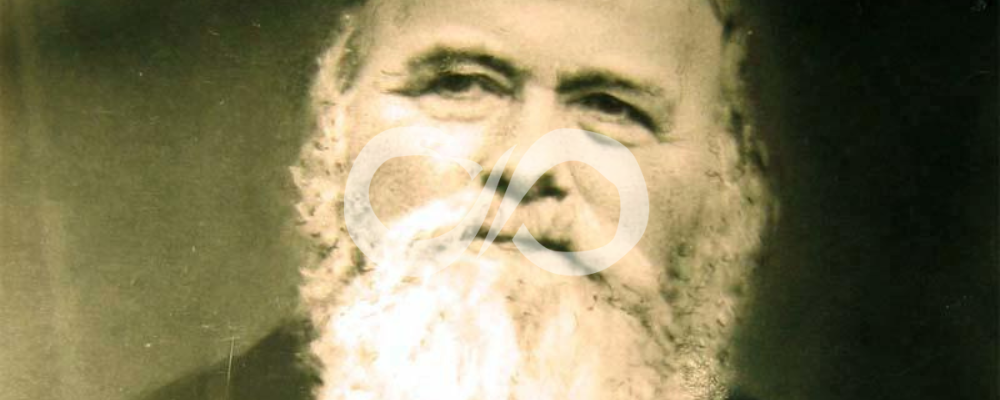
The name Abbé Julio conceals Julien-Ernest Houssay, a French priest born in 1844, religious polemicist, publisher, faith healer, and future bishop of a Church independent of Rome. His collections of blessings, exorcisms, and pentacles still circulate, but his life has been covered by approximate accounts that obscure his true path. To understand the man and his work, one must return to the established dates, his publications, and the religious context of the late 19th century.
From Cossé-le-Vivien to the priesthood
Julien-Ernest Houssay was born on March 3, 1844, in Cossé-le-Vivien, in Mayenne. Biographical notices present him as the son of a masonry contractor. He chose an ecclesiastical vocation and was ordained a priest in 1867. His first ministries took place in western France, in rural parishes including Juvigné and Javron.
In 1870, he was serving as a curate in Grand-Oisseau when the Franco-Prussian War began. He joined the Volunteers of the West assembled by General Henri de Cathelineau and served as a chaplain. Accounts of this campaign praise his devotion to the combatants and the wounded. This episode played a role in shaping his image: before the author of pentacles and the dissident churchman, there was a young priest engaged in the field, confronted with war, suffering, and death.

Abbé Julio, whose real name was Julien-Ernest Houssay (1844-1912).
A priest in conflict with the hierarchy
Houssay subsequently continued his ministry in Paris. His combative temperament, social concerns, and criticism of ecclesiastical practices gradually distanced him from his superiors. The break became public around 1885. It did not result from an abandonment of Christianity: it concerned Roman authority, clerical discipline, and the place accorded to the faithful in religious life.
His first books belong more to the pamphlet tradition than to the devotional manual. Gorin et Cie, société d’exploiteurs, published in 1886, L’Archevêque de Paris et les dames de Carreau, published in 1887, and then Un forçat du bagne clérical, in 1888, testify to an author who denounced the abuses he attributed to the authorities of his time. He also advocated social Catholicism and a less centralized ecclesiastical organization.
This work was carried out through the press. From 1888 to 1889, he edited La Tribune populaire, presented as an organ of religious democracy and the defense of the clergy. In 1898, L’Étincelle religieuse-libérale was published, a monthly newspaper devoted to religious freedom and the union of the churches. The Bibliothèque nationale de France preserves records of it through October 1912. This publishing activity helps demonstrate the coherence of his career: Abbé Julio was not merely a healer known for his remedies, but a journalist engaged in the religious debates of his time.
From Roman Catholicism to Neo-Gallicanism
Abbé Julio moved closer to neo-Gallican circles, which sought to establish French Catholic churches independent of Roman jurisdiction. This late-19th-century neo-Gallicanism should not be confused with the Gallican doctrine of the Ancien Régime alone. It brought together autonomous communities, clergy who had broken with Rome, and several episcopal lines descended from Old Catholic or independent churches.
On December 4, 1904, in Tiengen in Baden, Paolo Miraglia-Gulotti consecrated Houssay as a bishop. Houssay then took the head of the Free Catholic Church of France. This consecration belonged to an independent succession and received no recognition from the Roman Catholic Church. The title of “Monsignor” bestowed on him by his disciples falls within this autonomous ecclesiastical framework.
In June 1911, he in turn consecrated Louis-Marie François Giraud, a figure destined to play a lasting role in French Gallicanism. This transmission shows that his work was not limited to a personal undertaking. He helped establish a religious lineage that would outlive him, even though the groups descended from these successions later adopted different names, doctrines, and organizations.
Pont-de-Ruan and the story of the rediscovered benedictional
The biographies of Abbé Julio place a decisive stage of his life in Pont-de-Ruan, in Touraine. They recount that he discovered an old benedictional in the presbytery there and began drawing material from it for his future collections. This episode has taken on a major place in the account passed down by his readers, but its details vary from one version to another: the manuscript’s date, its exact title, and the circumstances of its discovery are not reported consistently.
One fact remains indisputable when reading his books: Houssay worked from a vast body of liturgical material. He gathered blessings, psalms, exorcisms, prayers, and formulas drawn from ancient Catholic rituals. He translated, classified, commented on, and adapted them. These texts were joined by popular prayers, signs, talismanic practices, and vocabulary marked by the magnetism and spiritualism of the 19th century.
His work therefore constitutes neither the simple reproduction of a rediscovered manuscript nor an entirely personal invention. It is based on a process of compilation and rewriting. Abbé Julio makes texts previously reserved for ecclesiastical libraries or liturgical books accessible, then incorporates them into his own conception of efficacious prayer.
Jean Sempé and Healing Through Prayer
Toward the end of the 1880s, Abbé Julio met Jean Sempé, a Christian magnetizer to whom he would dedicate a biography. This encounter strengthened his interest in the laying on of hands, magnetism, and religious healing. Houssay did not, however, abandon Christian language. He placed the action of Christ, prayer, and priestly authority at the center of his method.
In the preface to Grands Secrets merveilleux, he forcefully asserts prayer’s ability to defend, console, and heal. He does not present the priest as the autonomous source of power. According to his doctrine, the action comes from God and passes through faith, invocation of Christ, blessing, and the commitment of the person who prays.
This position explains the mixed reception of his books. For his readers, they extend a Christian tradition of intercession, spiritual care, and protection. For the Roman Church, the private use of exorcism formulas, recourse to magnetism, and the exercise of authority outside his jurisdiction raise doctrinal and disciplinary problems. Reading Abbé Julio requires keeping these two dimensions together: he remains Christian in his references, but his Christianity now develops within an independent institution and in contact with contemporary occultist currents.
The Great Marvelous Secrets
Published in 1907 in Vincennes, Grands Secrets merveilleux pour aider à la guérison de toutes les maladies physiques et morales became his most famous work. The volume brings together prayers, blessings, exorcisms, notes devoted to Christian figures, ritual procedures, and signs intended for various situations in everyday life.
The title uses the word “secrets” in the sense found in old books of religious and magical recipes. The reader will not find a medical treatise here, but rather a repertory of spiritual practices. Illness is addressed using the religious categories of the period, blended with magnetism, fluids, and the struggle against harmful influences. These texts belong to the history of religious healing; they are not a substitute for a diagnosis or medical treatment.

An old edition of the collections attributed to Abbé Julio.
The book’s success lies in its practical usability. Houssay lists the prayers, signs of the cross, blessings, and supports associated with each intention. He adopts the solemn language of the rituals while opening it to a lay readership. This dissemination beyond the clergy alone is one of the most striking features of his work.
The Secret Book of Great Exorcisms and Blessings
In 1908, Abbé Julio published The Secret Book of Great Exorcisms and Blessings in Vincennes. The first edition ran to more than six hundred pages. Its full title announces ancient prayers, formulas, recipes, signs, and pentacles drawn from several collections. A substantial section associates David’s 150 psalms with specific applications.
Here, the word “exorcism” has a broader meaning than the spectacular image popularized in the 20th century. The collection contains adjurations against evil spirits, but also blessings intended for people, animals, houses, crops, or objects. It thus extends the ancient world of Christian sacramentals, in which prayer accompanies every area of existence.
Houssay does not, however, simply reproduce the Roman ritual. He juxtaposes several periods and several registers, then supplements the texts with commentaries and applications. It is precisely this mixture that explains the book’s position at the boundary between Christian devotion, ritual magic, and healing traditions. To place these practices within a broader framework, our article on bewitchment and unbewitchment helps distinguish religious legacies from modern interpretations.
The Abbé Julio’s pentacles
The pentacles form the most recognizable part of his legacy. They bring together crosses, monograms, divine names, Latin, Greek, or Hebrew letters, angelic figures, symbolic animals, and biblical verses. Each figure is assigned an application: protection, healing, peace in the home, defense against adversity, success, or assistance in a trial.
It would be inaccurate to present each drawing as a creation born from Houssay’s imagination. Several motifs belong to Christian iconography, ancient talismans, grimoires, and books of blessings. His contribution lies in their selection, recombination, the prayers that accompany them, and the system of use he proposes.
The number of pentacles varies according to the editions. Historical and modern collections announce forty-four, while recent publications present forty-six after expanding or reorganizing the corpus. This editorial difference makes it impossible to claim that he created a set fixed once and for all at an indisputable number. Our article devoted to the difference between pentacle and pantacle also sheds light on the vocabulary used in these works.

Pentacle of success attributed to Abbé Julio.
In his system, the pentacle does not function as mere decoration. It accompanies a prayer, a blessing, and a specific intention. It may be worn, kept in a place, or placed near a person. The Complete Guide to Abbé Julio’s Pentacles and Prayers now makes it possible to study this corpus in an illustrated edition.
A Christian, occult, and social work
Classifying Abbé Julio as a simple country priest erases a large part of his journey. Reducing him to an occultist creates another distortion. His thought is shaped at the intersection of three commitments: Christianity, religious reform, and healing through prayer.
Christianity provides its primary language. God, Christ, the Virgin, the angels, the saints, the psalms, and the cross structure his collections. Religious reform directs his struggle against Roman centralization and his work within independent Churches. Healing, finally, leads him toward the laying on of hands, magnetism, and the use of signs to which he attributes an active function.
This combination corresponds to a specific moment in French history. At the end of the 19th century, magnetism, spiritualism, Theosophy, dissident churches, and the occult revival shared certain audiences and forums for debate. Abbé Julio moved through this world without renouncing his identity as a priest. His historical originality lies in this determination to hold Christian priesthood together with methods that Rome rejected or reserved for its own clergy.
What His Books Are Not
The reprints helped make Abbé Julio an almost legendary figure. They also encouraged questionable attributions. A prayer published today under his name does not necessarily come from his pen: it may originate in an earlier ritual, a later compilation, or an editorial adaptation. A quotation must therefore be linked to a title, edition, and page before being presented as his exact words.
Nor do his collections constitute a system separate from Christianity. Even when he uses the word “occult,” speaks of fluids, or prints a pentacle, Houssay invokes divine authority and places his actions within a Christian theology. The object, sign, and formula remain subordinate to prayer.
Finally, his independent episcopal consecration does not allow him to be presented as a bishop recognized by Rome. Abbé Julio belongs to the history of dissident Catholic movements and Neo-Gallicanism. This qualification does not diminish his role; on the contrary, it makes it possible to understand why he was able to publish his own rituals, organize his religious activity according to his convictions, and transmit a succession outside the Roman framework.
The Final Years Near Geneva
From 1910 onward, the headquarters of L’Étincelle moved to the Geneva region. Houssay settled in Aïre, near Geneva, where he had an estate and a chapel. That same year saw the publication of L’Empire du mystère, a work devoted to sleep and dreams, written with Gaston Bourgeat.
Julien-Ernest Houssay died in Geneva on September 27, 1912, at the age of sixty-eight. His funeral was celebrated according to the Catholic-Christian rite, and he was buried in Vernier Cemetery. His death in Geneva, rather than Paris, brought to a close a life spent between parish ministry, editorial battles, ecclesiastical dissent, and the publication of ritual texts.
Why is Father Julio still read?
The lasting relevance of his work comes first from its form. His books provide access to a heritage of prayers and blessings in a practical presentation. The reader encounters a religion that is not confined to Mass or catechism: it enters the home, accompanies illness, protects the traveler, supports work, and responds to fear.
It also stems from the place given to the reader. By disseminating texts once reserved for the clergy, Father Julio enabled laypeople to read and use them. This gesture explains both his success and the criticism directed at him. He shifted ritual authority from the sanctuary to the book and from the institutional priest to the person who prays.
His legacy nevertheless calls for a historical reading. The real man was neither the popular saint described in certain commercial notices nor a mage detached from Christianity. He was a priest in revolt against his hierarchy, a religious journalist, an independent bishop, and a compiler who transformed ancient rituals into a library of spiritual action. This trajectory, more complex than the legend, explains the enduring strength of his name.
Sources
National Library of France, record of The Religious-Liberal Spark, Vincennes then Pougny-Aïre, 1898-1912.
National Library of France, bibliography of Father Julio (1844-1912).
HathiTrust Digital Library, record of the first edition of The Secret Book of Great Exorcisms and Blessings, Vincennes, 1908.
Lyon Municipal Library, digitized copy by Google Books, Great Marvelous Secrets to Help Heal All Physical and Moral Illnesses, 1907 edition.
Robert Ambelain, Father Julio: Bishop Julien-Ernest Houssay, 1844-1912, His Life, His Work, His Doctrine, La Diffusion scientifique, 1962.

Par Olivier of Aeternum
Passionate about esoteric traditions and the history of the occult from the earliest civilizations to the 18th century, I share some articles on these topics. I am also co-creator of the online esoteric shop Aeternum.













Bon texte mais de grandes erreurs quant à la biographie du saint Abbé, qui n’a jamais vécu dans le Grand Est – si l’on excepte la Suisse à la fin de sa vie (l’abbé Julio est mort à Genève, et non pas à Paris) – mais bien au contraire dans le Grand Ouest (Mayenne, Orne, Sarthe) et effectivement en région parisienne.