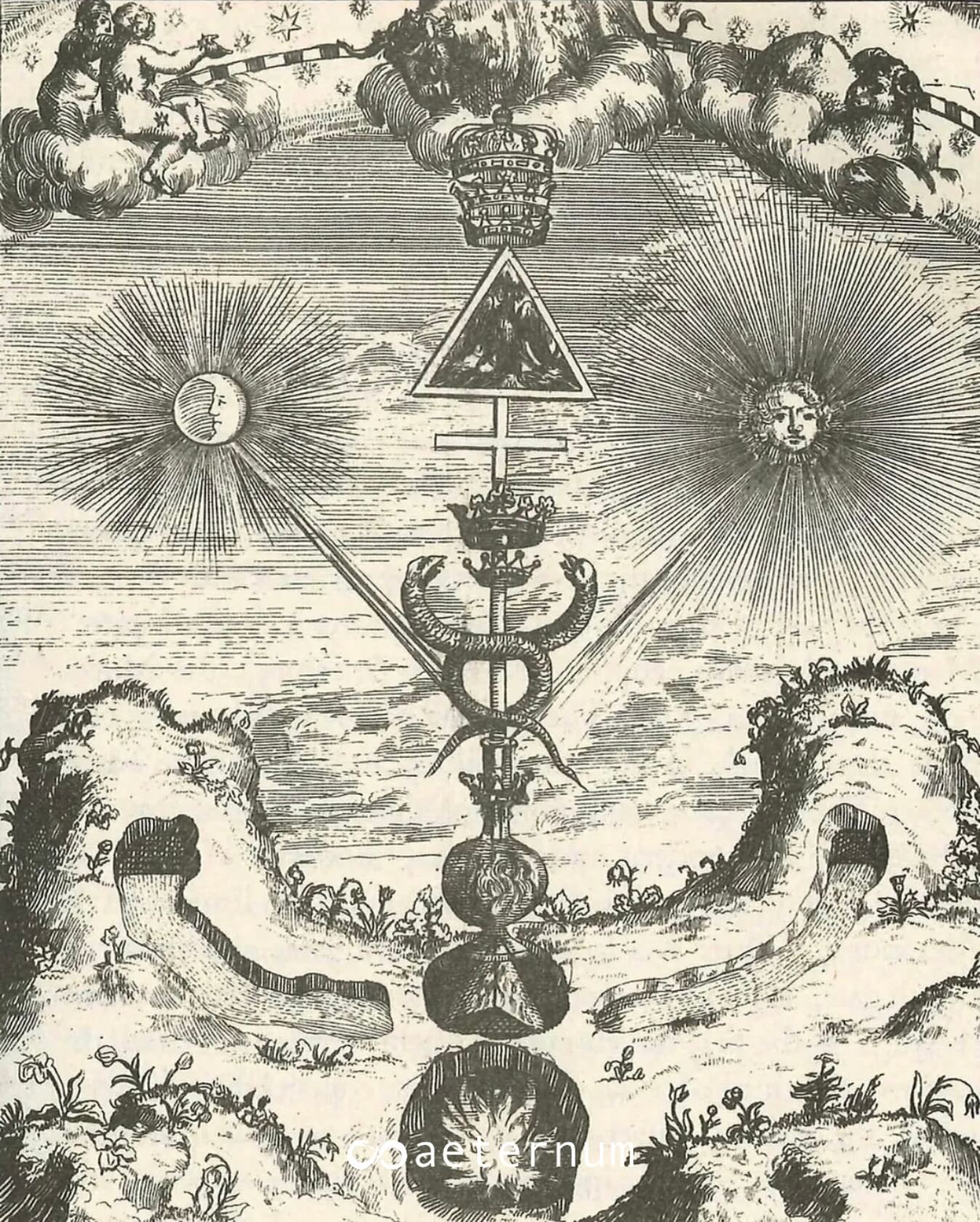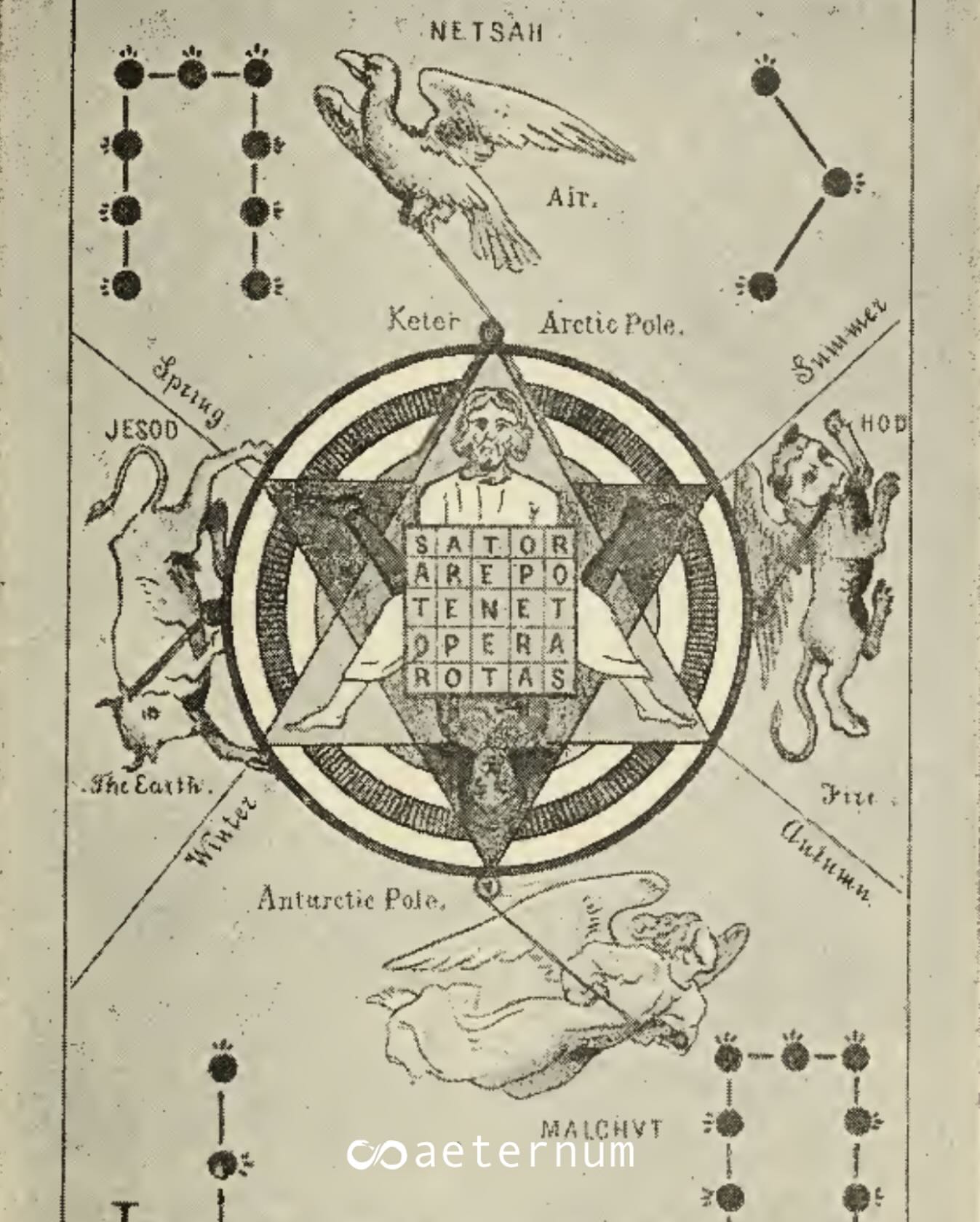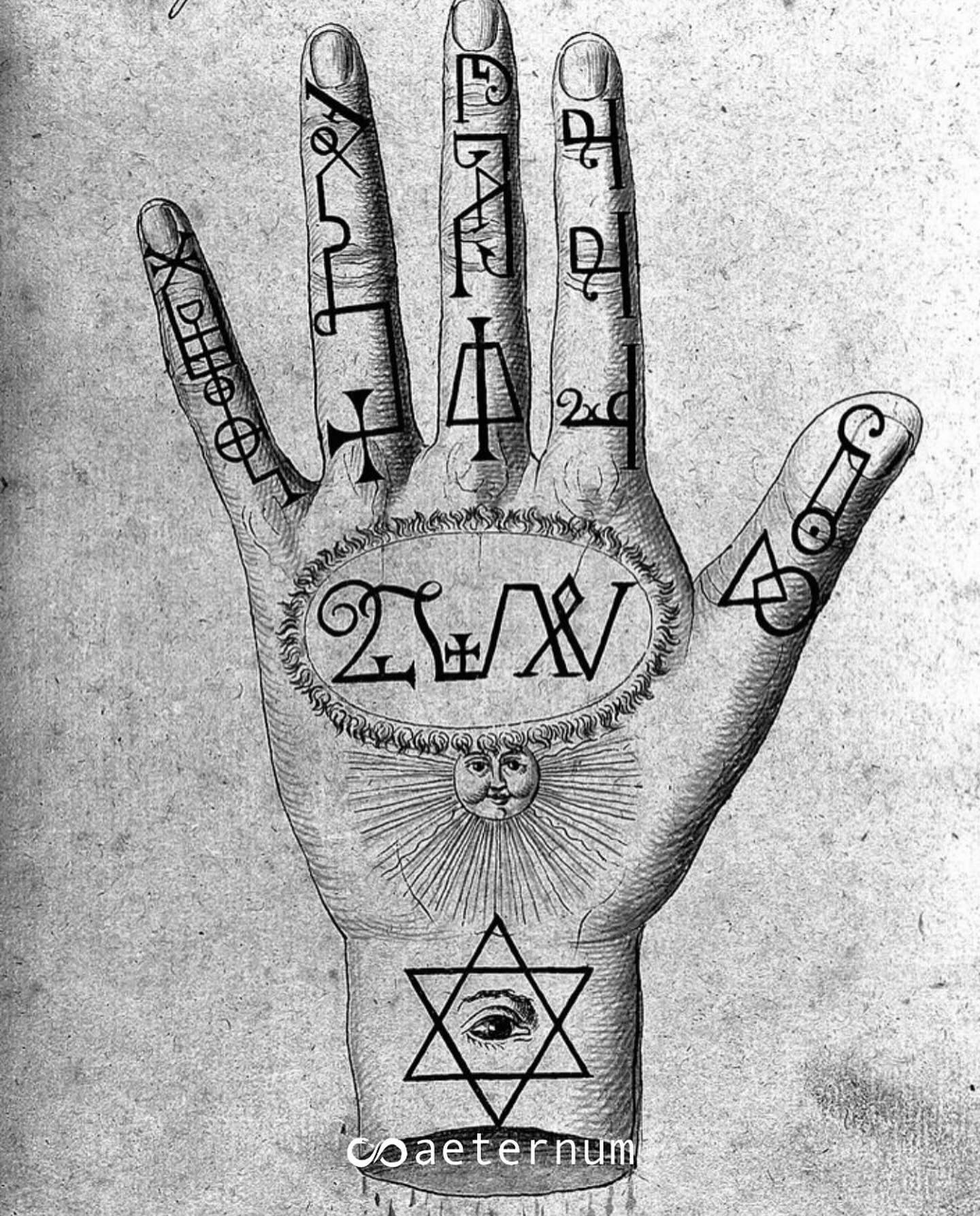



























































































Heinrich Khunrath belongs to that generation of late-16th-century alchemists for whom the transformation of metals, medicine, Christian Kabbalah, prayer, and contemplation of nature still formed a single path. Born in Leipzig in 1560 and deceased in 1605, trained as a physician, a reader of Paracelsus, an admirer of John Dee, and the author of the extraordinary Amphitheatrum Sapientiae Aeternae, he left one of the most fascinating books in the whole of Western alchemy.
His work never reduces the Great Work to a laboratory recipe. For Khunrath, the alchemist must purify matter, but also his intellect, his will, and his relationship with God. The philosopher's gold is therefore not sought only in the furnace: it is prepared in the oratory, through study, the reading of Scripture, and direct experience of nature. His great circular plates convey this conviction in images with rarely equaled power.
German and French bibliographic authorities place his birth in Leipzig in 1560. The older forms of his name vary: Heinrich Khunrath, Henricus Khunrathus, Kunrath, Khunrat, as well as Latinized forms and pseudonyms used in certain printed works.
His family belonged to Leipzig's urban world. The name Conrad Khunrath also appears in the sources; he was a physician and alchemist active at the same time. Family ties between the two men have been accepted by several biographical traditions, even though the documents do not allow every detail to be reconstructed with equal clarity.
A physician before becoming an alchemical author
Khunrath's medical training is firmly established. He enrolled at the University of Basel in May 1588 and received his doctorate in medicine on September 3 of the same year. His theses already addressed the question of natural signatures. This theme is crucial: in Paracelsian medicine, created things bear marks that enable the informed reader to recognize their virtues. Nature becomes a book that the physician must learn to decipher.
Khunrath's medicine therefore does not oppose alchemy. It leads toward it. Healing requires understanding the visible and invisible qualities of matter, the separations produced by fire, the principles that compose bodies, and the correspondences that connect the human microcosm to the world.
Khunrath clearly belongs to the broad Paracelsian movement that transformed medicine and alchemy in the German-speaking lands of the 16th century. Paracelsus had emphasized experience, mineral remedies, signatures, and a theological reading of nature.
In Khunrath’s work, this orientation took on an even more explicitly theosophical form. Matter possesses its secrets because God placed them within it. The laboratory makes it possible to extract them; Scripture and prayer make it possible to understand their meaning. The true alchemist must therefore unite several qualities: physician, reader of nature, experimenter, theologian, and interpreter of symbols.
1589, the encounter with John Dee
One episode in his life is particularly valuable for the history of Western magic. On June 6, 1589, Khunrath visited John Dee in Bremen. The encounter is recorded in the English scholar’s journal, which notes the visit of Dr. Heinrich Khunrath of Hamburg.
Dee had just returned from his years of angelic conversations and wanderings through Central Europe. Khunrath, already a physician and alchemist, therefore met a man whose research combined mathematics, Christian Kabbalah, alchemy, sacred geometry, and angelic revelation.
We do not know the exact content of their conversation. Its intellectual effect, however, is perceptible. Khunrath would cite Dee with admiration and adopt several elements of his symbolic universe.
John Dee’s Monas Hieroglyphica made a lasting impression on Khunrath. The symbol of the Monad appears in the graphic constructions of the Amphitheatrum, integrated into a universe that is nevertheless not a simple copy of Dee’s.
The Monas allowed Dee to bring the Sun, Moon, elements, planets, numbers, and alchemy together in a single sign. Khunrath recognized in this ambition something very close to his own pursuit: reducing the world’s multiplicity to a hidden unity. The 1589 encounter thus formed one of the most interesting bridges between Elizabethan mathematical magic and the Christian alchemy of the Germanic lands.
After receiving his doctorate, Khunrath traveled extensively. The sources place him in Hamburg, Bohemia, Magdeburg, Berlin, and Dresden. Some of these journeys followed the major centers where physicians, princes, alchemists, and collectors exchanged manuscripts and experiments.
Bohemia occupied a major place in this geography at the time. Rudolf II’s court in Prague attracted astrologers, artisans, alchemists, and scholars from across Europe. Khunrath belonged to the same intellectual world, even when the documentation does not allow every stay to be identified as an official position at the imperial court.
In 1591, Khunrath entered the service of Guillaume de Rosenberg, a powerful Bohemian nobleman, in Třeboň. The place was steeped in alchemical history: John Dee and Edward Kelley had already worked there several years earlier.
Khunrath therefore arrived in an environment where laboratory operations, research into transmutation, and debates surrounding natural philosophy were not mere private curiosities. Princes genuinely invested in this work.
Medicine and alchemy meet here once again: the physician may be responsible for the prince's body while also participating in research into medicines, metals, and the secrets of nature.
Biographical tradition also places Khunrath in contact with Edward Kelley, who remained in Bohemia after breaking with John Dee. Even when the details of their exchanges remain fragmentary, their geographical proximity is significant.
Kelley embodies the operative alchemist who promises transmutation and attracts the interest of the powerful. Khunrath follows a different path: he never separates the furnace from the oratory. For him, the philosopher's stone has meaning only if the operator himself is engaged in a transformation.
A Christian and Lutheran alchemist
Khunrath wrote in a world shaped by the Reformation. His theosophy is fully Christian and situated within a Lutheran environment. Christ occupies the center of his system. Divine names, Scripture, prayer, and the figure of the Cross appear repeatedly throughout his work. Alchemy does not aim to replace Christian Revelation, but to show that material creation itself bears witness to divine order.
This alliance between the Bible and the laboratory distinguishes his language from that of an alchemy reduced solely to metallic transmutation. Khunrath was also familiar with the tradition of Christian Kabbalah developed since the Renaissance by authors such as Reuchlin and Cornelius Agrippa.
He uses divine names, Hebrew letters, and speculations on the Tetragrammaton from a Christian perspective. This Kabbalah is not Jewish Kabbalah in its own historical context; it belongs to a Western reinterpretation in which letters and sacred names become the keys to a theology of Christ and nature. Our Introduction to Kabbalah makes it possible to distinguish these traditions.
Khunrath is not satisfied with commenting on ancient authorities. One formula recurs throughout his work: experience must accompany reason. The laboratory is therefore indispensable. Heating, distilling, dissolving, separating, recombining, and observing make it possible to put what the books announce to the test.
This emphasis on experience gives his alchemy a very concrete dimension. The symbols of the Amphitheatrum do not float in an abstract world: they surround furnaces, alembics, scales, and physical operations.
Khunrath uses a language that seeks to unite natural philosophy and chemical work. He speaks of a physico-chemical science in which the general principles of the world must be rediscovered in the transformations of matter.
Sulfur, mercury, and salt belong to this Paracelsian universe. They do not always designate simple laboratory substances: they also express principles. Matter has a visible structure and a hidden structure. The alchemist works on both.
In 1596, a Confessio devoted to physico-chemical chaos, Azoth, and the prima materia of the world was published. Wellcome Collection now preserves a digitized edition of this text. The prima materia represents the formless beginning from which forms can be drawn. Azoth becomes one of the names for this universal power capable of passing through transformations.
Khunrath associates these notions with medicine, cosmology, and the Great Work. The prima materia is not merely an ingredient hidden in an ore: it belongs to a reflection on creation itself. In 1595, the extremely rare first edition of his masterpiece was published in Hamburg: Amphitheatrum Sapientiae Aeternae, the Amphitheater of Eternal Wisdom.
The full title already announces the program: the work is “Christiano-Kabbalistic,” “divino-magical,” and “physico-chemical.” Few Renaissance books so candidly declare their intention to bring together theology, magic, and alchemy. Khunrath does not construct a linear treatise. He builds a symbolic space in which text and image must be explored together.
The image of the amphitheater suggests a place where wisdom can be viewed from several directions. Truth cannot be reduced to a single discipline. The reader must move from the Bible to alchemy, from Kabbalah to medicine, from image to text, from the oratory to the laboratory.
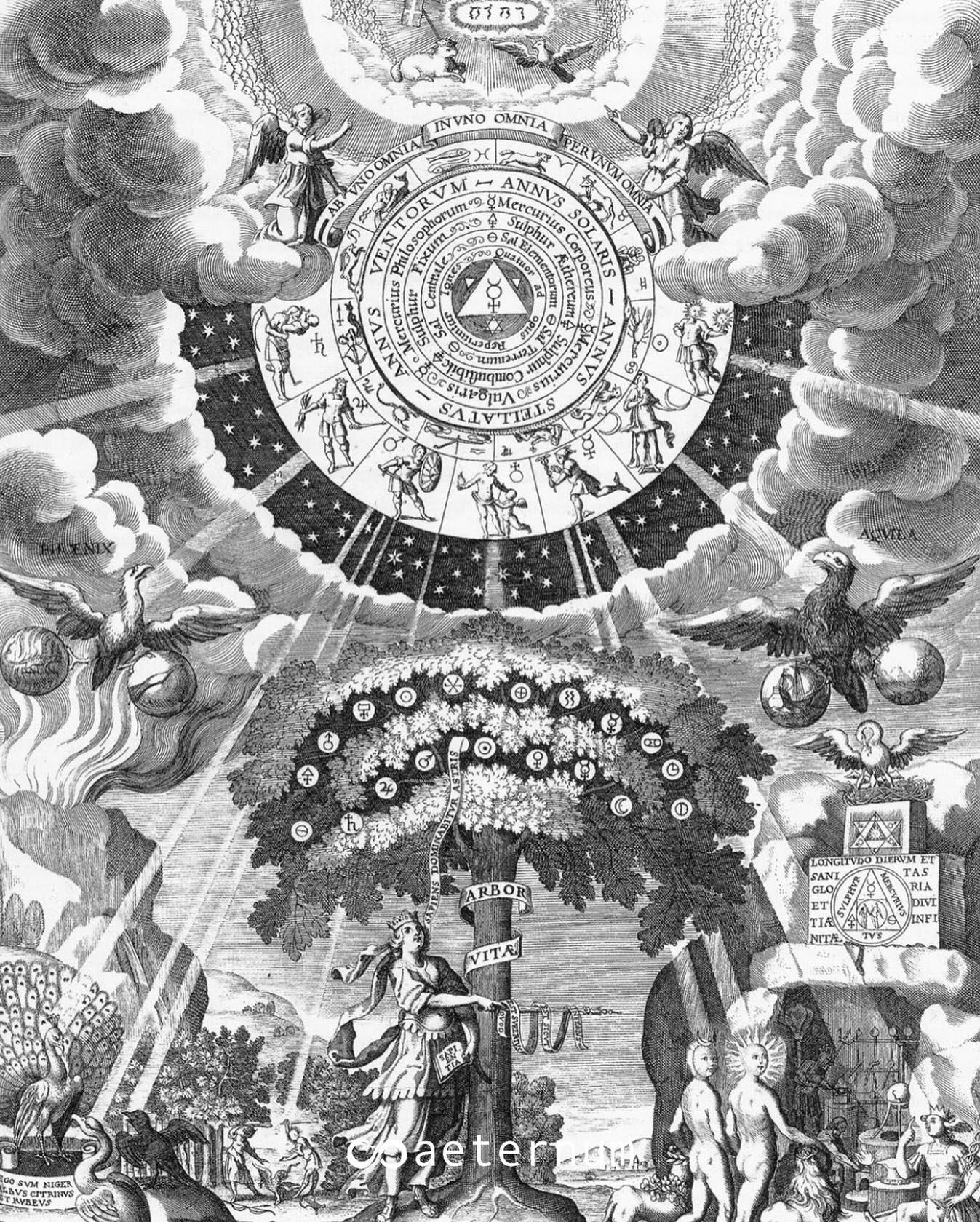
The fame of the Amphitheatrum is due in large part to its extraordinary engraved plates. Several are circular and surrounded by inscriptions that compel the reader to turn the book, shift their gaze, and follow pathways. The device is not decorative. Reading becomes an operation.

The Oratorium and the Laboratorium
The most famous plate depicts the alchemist’s oratory and laboratory. It already appears in the 1595 edition. On the left, a man kneels in prayer in a space almost enclosed by curtains. Above him is the Tetragrammaton. On the right, the laboratory contains the instruments, vessels, furnaces, and materials needed for the work. Between the two, the central space holds books and musical instruments.
Khunrath’s entire thought is contained in this architecture: the alchemist must pray, study, and work. The engraving contrasts the oratory and the laboratory less than it unites them. Material work without prayer can become blind; prayer without experience can remain sterile.
On the side of the laboratory, the words connected with reason and experience remind us that alchemical knowledge must not merely be repeated from books. True wisdom requires the agreement of the spiritual and the operative.
Musical instruments rest at the center of the scene. Their presence surprises anyone who would expect only alembics and crucibles. For Khunrath, music contributes to harmony. It regulates the soul, drives away certain inner states, and recalls that the cosmos itself can be understood as proportion.
The alchemical laboratory thus also becomes a sound-filled space. The room on the right explicitly bears the name laboratory. Flasks are arranged on the shelves; the furnaces await the operations; the inscriptions recommend patience and perseverance. The matter must mature. The alchemist does not brutally command nature. He works with its timing. This patience belongs as much to the Work as to inner perfection.
On the left, prayer is not a prelude external to alchemy. It is part of the operation. Khunrath considers the gift of wisdom to come from God. Whoever seeks only wealth, prestige, or curiosity does not possess the required disposition. The oratory therefore prepares the laboratory. Several large plates in the Amphitheatrum place the name of Christ at the heart of alchemical structures.
The philosopher’s stone itself can become an image of Christ: mediator, rejected then exalted stone, principle of regeneration, and universal medicine. This reading allows Khunrath to unite the alchemy of metals with a theology of salvation.
The philosopher’s stone
The Metropolitan Museum of Art holds a large circular engraving from the world of the Amphitheatrum, devoted to the philosopher’s stone. The stone appears at the center of a network of texts, figures, and transformations. The image combines matter, fire, the elements, alchemy, and Christian language.
The stone is therefore never, for Khunrath, merely a machine for making gold. It is the point where medicine, transmutation, and regeneration converge. Another great plate depicts alchemy as a fortress. The citadel has many doors, but many lead to dead ends.
At the center lies the secret of the Great Work, guarded by the language of mercury, the dragon, the stone, and transformation. The image teaches that not all practices that call themselves alchemical lead to the same result. The true path is narrow.
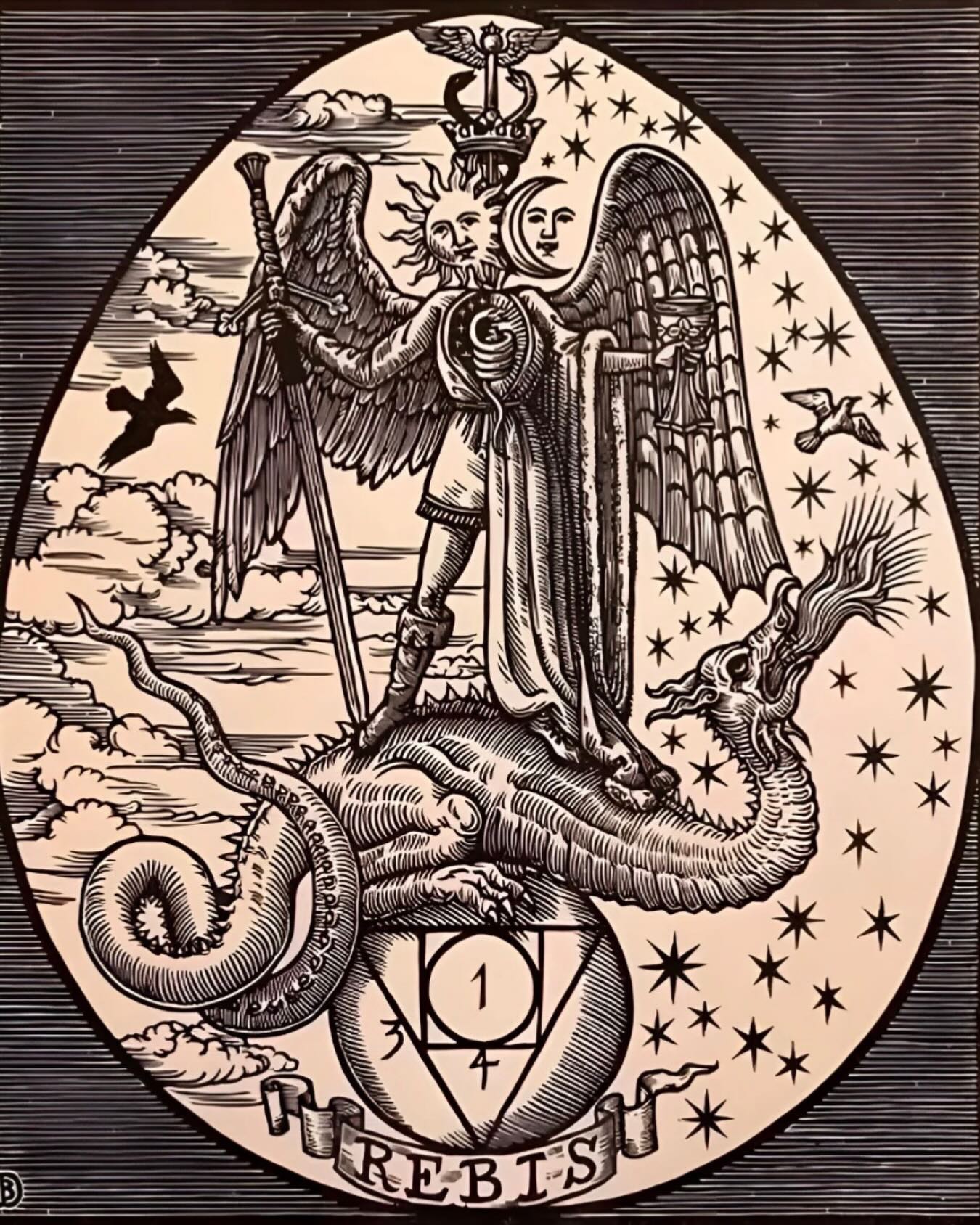
The dragon holds a remarkable place in Khunrath’s iconography. Recent research into the alchemical imagination shows how these figures can represent the dangerous and fertile power of mercury. The dragon unites several opposing qualities: it burns and poisons, destroys and generates, crawls on the earth but can also bear wings.
It becomes an ideal image of alchemical matter, which must die, dissolve, and be reborn. The Metropolitan Museum also preserves a plate devoted to a diagram of Christian Kabbalah attributed to Peter van der Doort after Hans Vredeman de Vries.
Divine names, circular architecture, and hierarchies allow Khunrath to connect creation to God. The aim is not to practice Kabbalah as a Jewish rabbi would, but to integrate it into a Christian theology of nature.
Agrippa is one of the great predecessors of this project. His De occulta philosophia had organized magic into several levels: the elemental, celestial, and intellectual worlds. Khunrath takes up this taste for synthesis but transforms it through Paracelsian alchemy. Correspondences are not used only to make talismans or interpret the stars; they also enter into the chemical transformation of matter.
Khunrath speaks of John Dee with remarkable respect. To him, the Englishman represents a hermetic scholar capable of bringing together mathematics, magic, and theology. Modern research has shown that Dee’s Hieroglyphic Monad appears in several of Khunrath’s constructions.
Their meeting in Bremen thus becomes more than an anecdote: it belongs to a genuine European circulation of occult symbols. His “divine magic” is not stage magic. It seeks the forces that God placed in creation.
This vision echoes the resurgent magia naturalis: knowing nature’s sympathies, virtues, and hidden properties makes it possible to act without departing from the created order. Khunrath nevertheless adds a very strong Christian requirement: the practitioner must remain oriented toward God.
Here, the word theosophy refers to a wisdom of God, long before the movements that would use this term in the 19th century. Khunrath sought to know God through Scripture, but also through the created world. Matter therefore became a second surface of revelation.
This theosophy prepared several Germanic currents of the early 17th century. The Amphitheatrum found an echo in circles of Lutheran spirituality. The theologian Johann Arndt, author of influential devotional texts, knew Khunrath’s work and devoted a commentary to him.
This point is important: Khunrathian alchemy did not exist solely within the secret circles of transmuters. It also engaged with religious currents seeking an inner regeneration of Christianity.
Did Khunrath foreshadow the Rosicrucians?
The Rosicrucian manifestos appeared after his death, beginning in 1614. Khunrath therefore cannot be presented as a member of an already established Rosicrucian organization. But his language seems strikingly close to what would emerge a few years later: reform of knowledge, inner Christianity, alchemy, medicine, Kabbalah, the secrets of nature, and the transformation of humanity.
Frances Yates saw in him a link between John Dee and the Rosicrucian world. More recent scholarship makes this connection less mechanical, but the affinity remains remarkable. The intellectual climate preceding the manifestos was filled with comparable projects. Paracelsian physicians, Lutheran theosophists, and alchemists sought a reform of Christian knowledge.
Khunrath belongs to this world. His Amphitheatrum shows what a high-level Christian alchemy could be before the name Rosicrucian became the sign of a European movement. At the end of the 1590s, several of Khunrath’s texts appeared concerning the stone, the athanor, philosophical magnesia, and physicochemical principles.
These titles testify to an author who does not live solely in symbolic commentary. He takes an interest in fire, the furnace, materials, and the conditions of the experiment. Spirituality never replaces the laboratory.
The athanor represents a furnace capable of providing steady, prolonged heat. In alchemy, it quickly becomes more than technical equipment. The continuous fire symbolizes sustained effort, patience, and maturation.
Khunrath devotes a text to the true philosophical athanor, demonstrating the importance he attaches to this union between material apparatus and the operator’s discipline. Alchemical fire has several levels. There is the visible flame that heats the vessel, but also the more secret fire that activates the transformation.
Khunrath also devoted a work to this fire of the Magi and philosophers. The image corresponds perfectly to his system: behind the visible operation lies a more inward power that must be recognized.
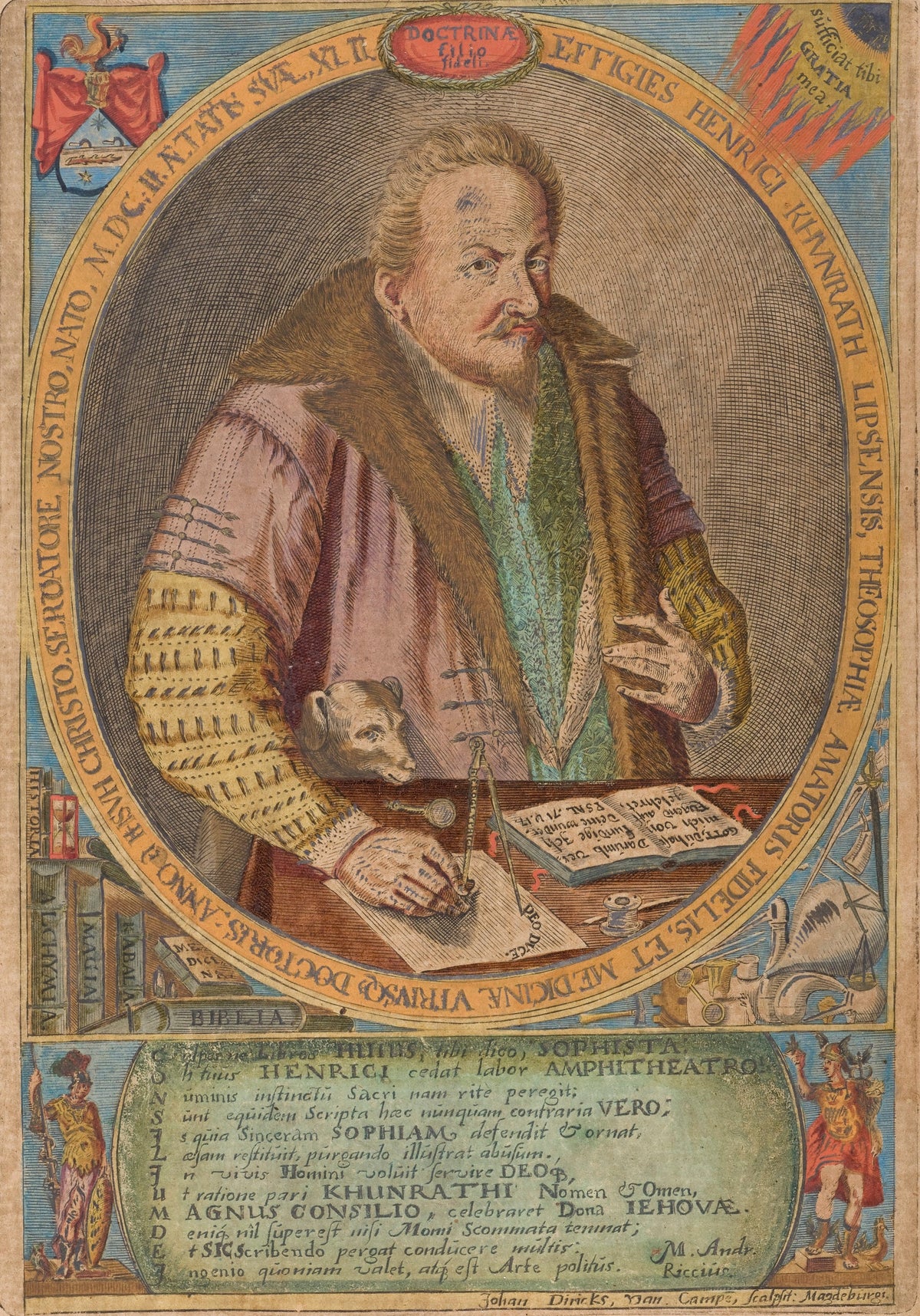
An engraved portrait of Khunrath dated 1602 depicts him surrounded by the signs of his intellectual identity. This likeness was reused in the posthumous edition of the Amphitheatrum. The portrait used on the cover of this article comes from this iconographic tradition and is preserved in the Wellcome collections.
Khunrath appears there as a physician and philosopher, not as a fictional character. The open book, instruments, and inscriptions place him directly within the world he himself constructed.
Death in September 1605
Heinrich Khunrath died on September 9, 1605. The Bibliothèque nationale de France gives Leipzig, with Dresden as another location cited by the sources; the Deutsche Biographie gives Dresden. This slight geographical discrepancy contrasts with the precision of the date. The alchemist died at about forty-five, leaving a work still in progress.
He would therefore not see the major edition of his book. In 1609, a considerably expanded edition of the Amphitheatrum Sapientiae Aeternae was published in Hanau. The Wellcome Collection preserves several copies, some with mounted and colored plates.
Princeton describes a volume of more than two hundred pages accompanied by twenty-two plates, several of them foldouts. This edition brought the work into the history of European alchemy.
The posthumous edition owes much to Khunrath's circle, particularly Erasmus Wolfart, who took part in preparing and transmitting the text. Without this editorial work, the book might have remained a very rare object known through a few copies from 1595.
Khunrath's legacy therefore also depends on those who recognized the value of his project after his death. The large engravings in the Amphitheatrum are associated with Peter van der Doort and, for several architectural compositions, with Hans Vredeman de Vries.
The Metropolitan Museum preserves several of these prints, notably the Laboratory, the Philosopher's Stone, and a diagram of Christian Kabbalah. Khunrath's work is therefore also a monument in the history of esoteric printmaking.
The circle expresses totality, return, and unity. It also forces the eye to leave ordinary horizontal reading. In several plates, the text radiates around the central image. Reading involves moving around the center, physically or mentally. Iconography becomes a practice of concentration. Khunrath is constantly seeking a center. The center of creation, the center of the symbol, the center of the stone, the center of the Christian.
This quest explains the geometric density of his plates. The visible world may seem scattered, but alchemy must show the unity behind oppositions. Sun and Moon, masculine and feminine, matter and spirit, laboratory and oratory must be brought together.
An alchemy of opposites
The union of opposites runs throughout the entire work. The androgyne, the alchemical hermaphrodite, and the double figures show that the Great Work does not eliminate oppositions: it reconciles them. Divided matter must recover a form of unity.
The Rebis represents alchemy’s dual being, produced through conjunction. In Khunrath’s universe, this figure can incorporate elements drawn from Dee’s Monad, the Hermetic tradition, and Christian symbolism. The Rebis is not merely an iconographic curiosity. It announces that the Work has overcome an initial opposition.
What was separate can now act as a single body. Khunrath’s Hermetic universe remains inseparable from the tradition attributed to Hermes Trismegistus, and in particular from the famous correspondence between above and below.
The alchemist seeks in the vessel an image of the transformations of the cosmos. The laboratory becomes a microcosm. Our article devoted to the Emerald Tablet places this Hermetic maxim within its history.
Twenty years after Khunrath’s death, the Amphitheatrum encounters institutional opposition in France. In 1625, the Sorbonne censures the work in the context of debates surrounding alchemy and Paracelsianism. The mixture of Christian Kabbalah, divine magic, biblical interpretation, and physico-chemistry crosses the boundaries that some theologians then wished to impose.
This censorship does not prevent the work from circulating. It even helps place the book among the texts most charged with the aura of Christian alchemy. Because it refuses easy separations. It cannot be classified solely within the history of chemistry, theology, magic, or art.
The reader encounters all of this at once. It is also a book that does not reveal itself quickly. The large plates require returning to them, comparing the inscriptions, and searching for correspondences.
No. This formula would be too narrow. Khunrath genuinely practices and thinks through chemical operations. But he refuses to accept that material experience is sufficient. Physical transformation must be accompanied by a transformation of the operator and a Christian orientation.
His alchemy is therefore material and spiritual in a single movement. From this perspective, the laboratory itself can be read as an image of the human being. The furnace is the place of fire; the vessels receive and contain; distillation separates the subtle from the gross; recomposition gives a new body. The operations of the laboratory become the verbs of an inner transformation.
The presence of the oratory reminds us that the adept does not work alone. Khunrath emphasizes grace, divine assistance, and moral disposition. The musical instruments in the large plate are not a decorative detail. They remind us that inner work also proceeds through attunement.
A disordered soul receives knowledge poorly. Music can restore proportion and measure. Here Khunrath joins a very ancient Pythagorean and Platonic conception of the cosmos as harmony. Several inscriptions in the laboratory recommend not working hastily and repeating what has been attempted with intelligence. Alchemy demands endurance.
Why does Khunrath remain important to Western occultism?
Because he occupies an exceptional crossroads. Behind him stand Paracelsus, Agrippa, Reuchlin, and John Dee. After him came the Rosicrucian manifestos, Michael Maier, Robert Fludd, and much of the theosophical alchemy of the 17th century. He transmitted ancient forms but also invented a new visual language.
His plates turn the page itself into a space of initiation. He should be read as a Christian physician-alchemist of the late Renaissance, not as a modern chemist disguised as a mage, nor as an author who had abandoned matter in favor of allegories.
For him, the furnace is real, prayer is real, Christ is real, matter is real, and so is the symbol. It is precisely this coexistence that gives the Amphitheatrum its power.
Heinrich Khunrath did not found a known initiatory order and did not leave behind an organized school bearing his name. He did something else: he showed what a complete alchemy could look like.
In his amphitheater, the physician, the Kabbalist, the Christian, the natural philosopher, and the laboratory operator are not several men. They are the faces of a single seeker of eternal Wisdom.
Sources and reference points
The Bibliothèque nationale de France identifies Heinrich Khunrath as a theosopher, alchemist, and physician, born in Leipzig in 1560 and deceased on September 9, 1605, in Leipzig or Dresden.
The Deutsche Biographie also gives 1560-1605, Leipzig as his birthplace, Dresden as his place of death, and documents his doctorate in medicine, obtained in Basel in 1588.
Carlos Gilly's research on the Amphitheatrum Sapientiae Aeternae provides a much more detailed chronology of Khunrath's life. It notably reproduces the entry in John Dee's journal attesting to Khunrath's visit to Bremen on June 6, 1589.
Wellcome Collection holds several copies of the 1609 Hanau edition of the Amphitheatrum, with a portrait, tables, and large symbolic plates. The institution also holds the 1596 Confessio de chao physico-chemicorum and several other works by Khunrath.
The Princeton University Library holds a 1609 edition comprising more than two hundred pages and twenty-two leaves of engraved plates.
The Metropolitan Museum of Art holds the large engraving of the laboratory, attributed to Peter van der Doort after Hans Vredeman de Vries, as well as the plates of the Philosopher's Stone and Christian Kabbalah.
The academic presentation by the Frankfurt University Library on the Oratorium/Laboratorium confirms that this plate already appeared in the rare 1595 edition and details its place in the iconographic cycle.
For modern study of his iconography, Peter J. Forshaw and Urszula Szulakowska have devoted several works to Khunrath's alchemy, Kabbalah, light, and images. The recent edited volume The Mage’s Images: Heinrich Khunrath in His Oratory and Laboratory, published by Brill, further renews the analysis of his engravings.
The cover uses the engraved portrait of Heinrich Khunrath reproduced in the edition of the Amphitheatrum Sapientiae Aeternae, now held by Wellcome Collection and in the public domain. The large interior illustration of the laboratory also comes from the Amphitheatrum and is held by the Metropolitan Museum of Art.

Par Olivier of Aeternum
Passionate about esoteric traditions and the history of the occult from the earliest civilizations to the 18th century, I share some articles on these topics. I am also co-creator of the online esoteric shop Aeternum.