




























































































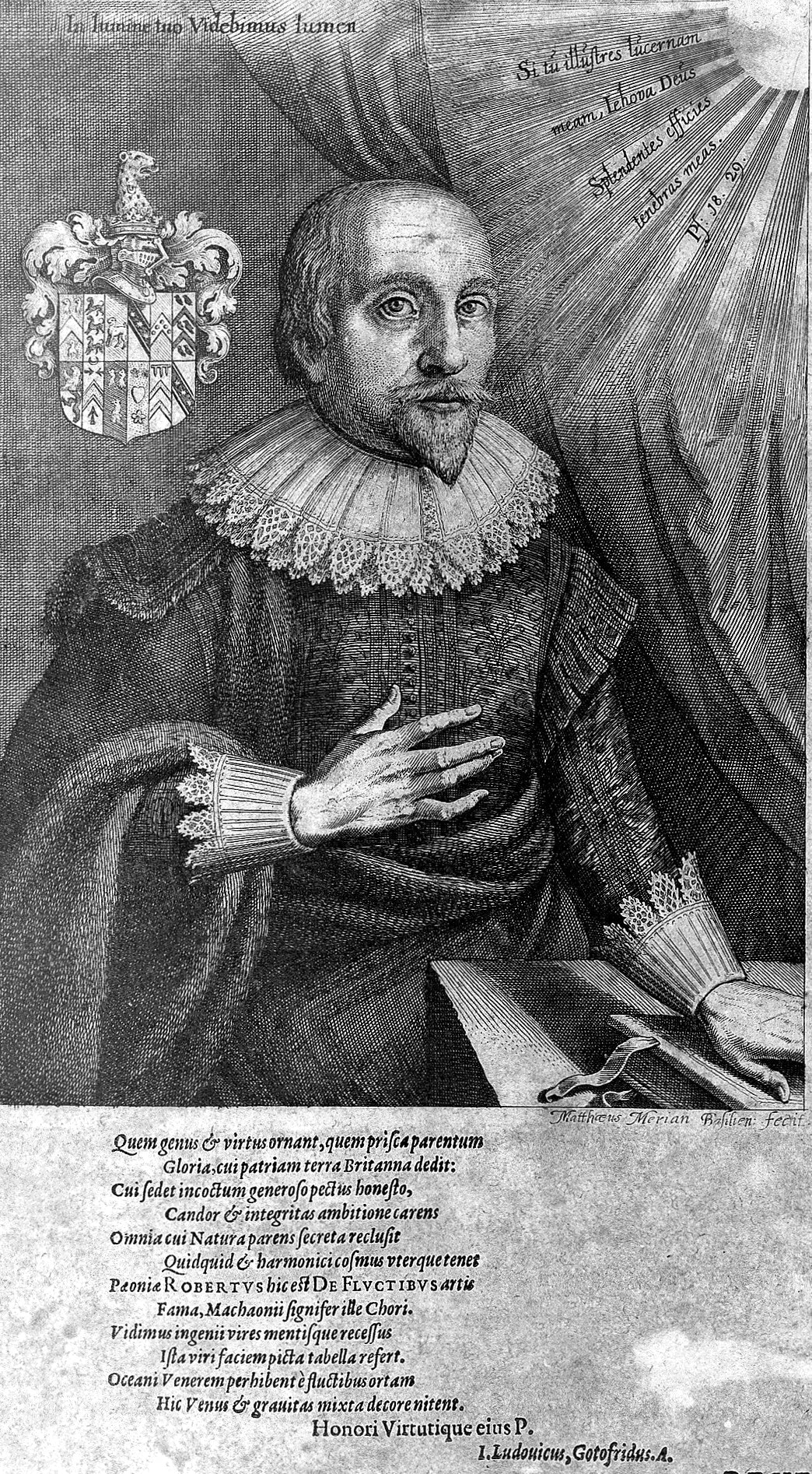
Robert Fludd is one of the most striking figures of early 17th-century England. An Oxford-trained physician, member of the College of Physicians, alchemist, Christian Kabbalist, defender of the Rosicrucians, musician of the cosmos, and author of a vast illustrated body of work, he spent his life seeking to show that a single order connects God, the stars, the elements, the human body, music, medicine, and the arts.
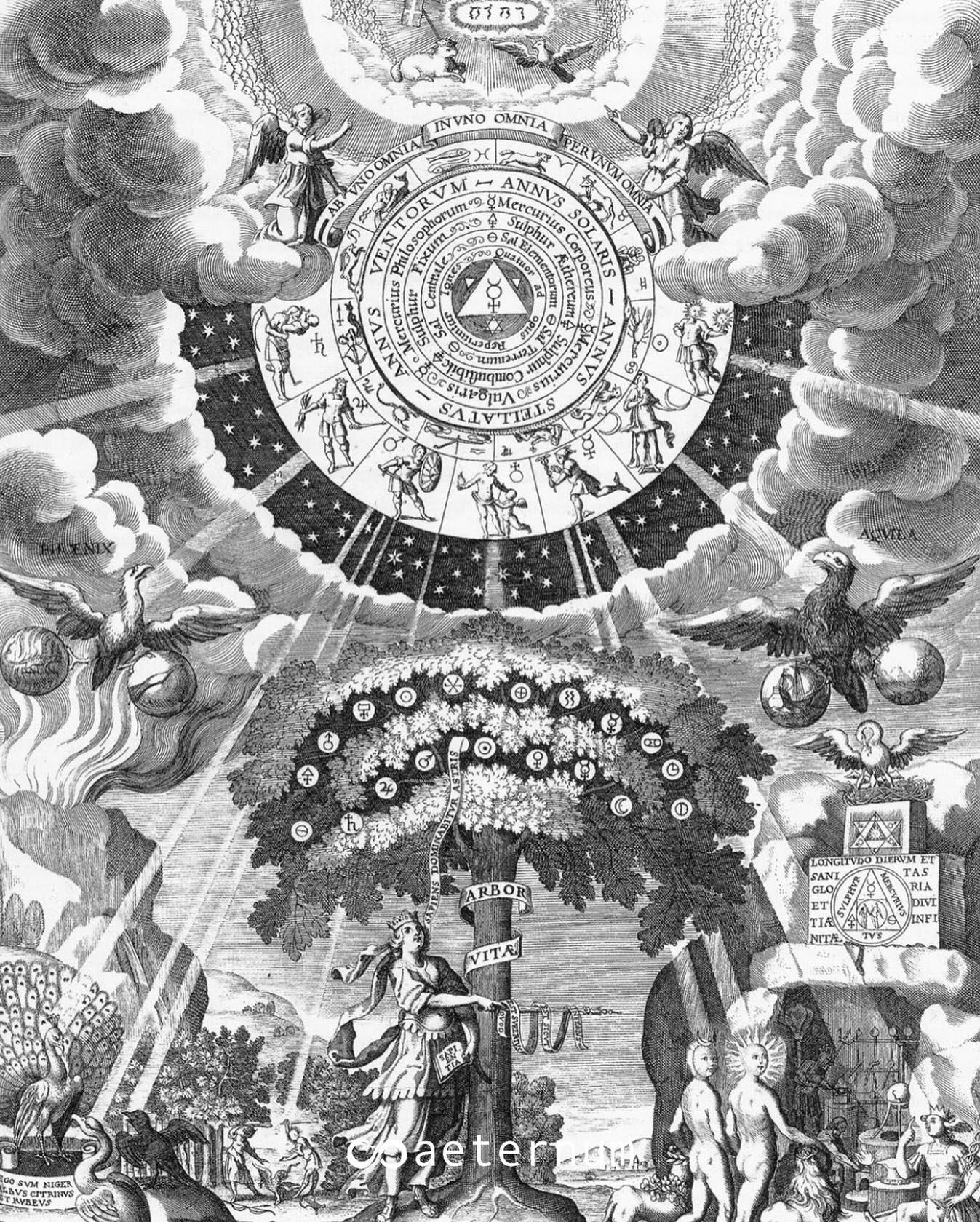
His world was that of the macrocosm and the microcosm. The entire universe forms a great being attuned by the divine hand; man reproduces its proportions on another scale. Blood, the pulse, the humors, the planets, numbers, and sounds are therefore not realities foreign to one another. They are part of a single architecture. This is the architecture that Fludd attempted to draw in his books, with some of the most extraordinary engravings in the entire history of Western esotericism.
Robert Fludd was born in 1574 at Milgate, in the parish of Bearsted, Kent. His father, Sir Thomas Fludd, served the English monarchy and notably acted as a military treasurer under Elizabeth I.
Robert therefore belonged to a family with genuine ties to the royal administration. This environment would later give him social access quite different from that of an unconnected provincial physician. In his Latin works, he often signed himself Robertus de Fluctibus, the learned Latinization of his name.
1591, entry into St John’s College, Oxford
Fludd entered St John’s College, Oxford, in 1591. The Royal College of Physicians preserves a precise chronology of his education: Bachelor of Arts in 1597, Master of Arts in 1598, and then Doctor of Medicine in 1605.
Oxford gave him a solid university education, but he would not remain confined to the schools' Aristotelianism alone. His travels and reading would lead him toward Paracelsus, Christian Kabbalah, natural magic, and the philosophies of the macrocosm.
After earning his first degrees, Fludd traveled for nearly six years through several European countries. This period remains less documented than his London years, but it played a decisive role in his education. He encountered different medical traditions, court circles, readers of Paracelsus, and networks in which alchemy, chemical medicine, and the reform of knowledge were already highly active.
The future defender of the Rosicrucians was thus formed in a Europe that was preparing precisely for the Rosicrucian explosion of the 1610s. One of the era's major medical conflicts pitted physicians attached to Galenic methods against advocates of a chemical medicine inspired by Paracelsus.
Fludd clearly belongs to the second camp. He is interested in chemical remedies, hidden virtues, natural signatures, and the idea that medicine must take the whole person and their relationship to the cosmos into account. This orientation will lead to several tensions with the London medical authorities.
On May 16, 1605, Fludd receives his medical doctorate from Oxford as a member of Christ Church. He then seeks to practice in London and appears before the College of Physicians. The archives of the Royal College of Physicians show that his first examination in November 1605 goes badly. The examiners criticize him in particular for his answers on Galenic and chemical medicine. During a second examination, on February 7, 1606, the censors judge that he does not fully satisfy all the questions but acknowledge that he is learned. He receives permission to practice.
This scene already foreshadows his entire career: Fludd knows university medicine but refuses to be confined to a single tradition. In 1609, Robert Fludd becomes a Fellow of the College of Physicians. The physician whom his examiners had initially received with reservations thus officially enters one of the principal medical institutions in England. He will practice in London while continuing an immense intellectual activity.
Fludd practices medicine among a clientele that provides him with a comfortable livelihood. His portrait and work show a man established enough to finance costly publications and work with the leading printers of the German-speaking world. His medicine is never separate from his cosmology. The patient is a microcosm. The physician must understand not only the body but also its rhythms, humors, correspondences, and environment.
The Book of Nature
One idea runs throughout his work: God can be known through Scripture, but also through the great book of Nature. The stars, the elements, the human body, musical proportions, and the transformations of matter bear the traces of the same Author.
This reading brings Fludd closer to the Renaissance magia naturalis and the syntheses of Cornelius Agrippa. The macrocosm is the great world: the universe, the spheres, the elements, the stars, and the powers that govern them.
The microcosm is man. Fludd considers the small human world to reproduce the principles of the great world. Everything found in the cosmos has an equivalent in the body, soul, or human faculties.
In Fludd’s cosmology, the universe is alive, traversed by forces, and organized through correspondences. Divine light descends through several degrees. Forms multiply as one moves away from the source, but they remain connected.
The entire cosmos becomes a hierarchy of participation. Fludd uses a very strong opposition between light and darkness to describe creation. Divine light orders, animates, and reveals. Darkness represents obscure matter, chaos, and distance from the higher principle. Creation arises from their tension and separation.
Fludd reads the Kabbalah through the Christian tradition of the Renaissance. Hebrew letters, divine names, the Tetragrammaton, and numerical speculations become part of his understanding of the world. As with Agrippa or Marsilio Ficino, these elements are reinterpreted within a Christian framework. The divine name becomes a principle of structure and manifestation.
The Rose Cross Appears in Europe
In 1614, the Fama Fraternitatis appears, soon followed by the Confessio Fraternitatis and then the Chymical Wedding of Christian Rosenkreutz. These texts announce a secret fraternity of Christian sages, physicians, and reformers of knowledge.
They immediately provoke immense intellectual upheaval. Fludd becomes one of the first great English defenders of the Rosicrucian cause. In 1616, he publishes an abridged apology for the fraternity, then expands his defense in a more substantial treatise in 1617.
He responds in particular to the attacks of Andreas Libavius, who suspects the Rosicrucians of errors, illusions, or dangerous doctrines. Fludd, for his part, sees their project as a Christian reform of knowledge and medicine. In his defense of the Rosicrucians, Fludd pays particular attention to the word “magic.” He refuses to conflate all magic with necromancy or evil sorcery.
For him, there is a natural and divine magic, founded on the forces that God placed in creation and on a proper reading of the Book of Nature. Fludd writes as a man convinced that the fraternity represents a reality worthy of being defended.
The first Rosicrucian manifestos do not, however, provide a membership register comparable to that of a modern organization. It therefore remains difficult to turn doctrinal proximity into a membership card in the administrative sense. His historical role is nevertheless beyond ambiguity: he is one of the greatest public defenders of Rosicrucianism at the beginning of the 17th century.
Michael Maier and Fludd are the two major names associated with the reception of Rosicrucianism in the English- and German-speaking world of the 1610s. Maier came from the court of Rudolf II, wrote in Latin, and worked with emblems and music. Fludd, an English physician, constructed an immense cosmology of the macrocosm and microcosm. Their works gave the Rose Cross considerable philosophical and alchemical stature.
Utriusque Cosmi Historia
Beginning in 1617, Fludd published his monumental work: Utriusque cosmi maioris scilicet et minoris metaphysica, physica atque technica historia, a metaphysical, physical, and technical history of the two worlds, the great and the small. Wellcome Collection preserves several copies of the volumes published in Oppenheim and Frankfurt between 1617 and the 1620s. The project is gigantic: to recount the cosmos, humanity, the arts, and techniques as parts of a single structure. The first great section describes the higher world and creation.
The engravings show celestial spheres, elements, angels, light, music, and relationships between the levels of being. The drawing does more than illustrate the text. It makes it possible to see Fludd’s thought in diagrammatic form. The second world is man. Anatomy, faculties of the soul, senses, imagination, memory, and spirit are placed within the same cosmic order.
Human beings become a living reduction of the universe. One of Fludd’s most famous images depicts a man inscribed within the circles of the cosmos. The human body occupies the center of a system in which elements, natural kingdoms, arts, and celestial spheres are ordered around it. Man is a small world because he receives within himself the levels of the great world.
Fludd devotes part of his great work to the arts and techniques. He takes up the ancient formulation of art as the “ape of nature.” Human beings imitate natural operations: they build machines, pumps, instruments, automata, hydraulic systems, and musical devices. Technique itself becomes a way of understanding creation. His books show mills, instruments, organs, mechanisms, measuring devices, and hydraulic systems.
Fludd therefore does not oppose esotericism to mechanics. Music occupies a major place in his system. Fludd inherits the Pythagorean tradition, according to which musical proportions express the relationships that structure the cosmos. The scale is not merely an organization of sounds. It becomes a model of universal order.
The most famous image of this cosmology is the monochord of the world. A hand emerges from the clouds and tunes a string stretched across the levels of the universe. The string passes through the material and celestial degrees. Musical intervals organize the distance between them. God thus appears as the one who stretches, measures, and tunes.

The monochord functions as a map of being. At one end are the most material levels. At the other lies divine light. Between them extends all of creation, connected by proportion. For Fludd, speaking of harmony means speaking of the right relationship. A healthy body, an ordered cosmos, and an instrument in tune obey analogous principles. This conviction would also guide his medicine.
Kepler versus Fludd
In 1619, Johannes Kepler publishes Harmonices Mundi and directly criticizes Fludd’s approach. The two men share the idea of a harmonious universe, but their methods diverge. Kepler seeks mathematical ratios linked to observable planetary movements. Fludd reasons more through correspondences, analogies, symbolic geometry, and metaphysical hierarchy. The debate represents one of the great intellectual confrontations of the early 17th century. It would be too simple to portray Kepler as modern and Fludd as archaic.
Kepler himself remains strongly influenced by the Pythagorean tradition and by the idea of a celestial harmony. The difference lies in how it is demonstrated. Kepler wants to calculate the ratios; Fludd wants to show their place within a symbolic whole.
Fludd responds to Kepler in 1621 in Veritatis Proscenium, the “proscenium of truth.” He defends his method and argues that reality cannot be exhausted by number applied only to measurable phenomena.
For him, visible quantity does not reveal everything about inner quality. The controversy continues with the Monochordum Mundi Symphoniacum, published in the following years and reproduced in a 1623 volume held by the Wellcome Collection. Fludd returns to the monochord to defend the coherence of his musical universe. The image held by the Deutsche Fotothek belongs to this phase of the debate.
The French religious scholar Marin Mersenne also criticized Fludd. He rejected part of his Hermeticism, Christian Kabbalah, and explanations based on analogy. Fludd responded vigorously. These controversies show how much his work stood at the center of the intellectual transformations of the 17th century: ancient languages of correspondence, new mathematics, experimentation, and theology confronted one another there.
Catholic medicine
At the end of the 1620s, Fludd developed an extensive Medicina Catholica, or “universal medicine.” Here, the word catholic means universal. He sought to bring diagnosis, bodily signs, pulse, urine, pathological meteors, and cosmic influences together in a single medicine. Fludd paid great attention to the pulse.
The rhythm of the body appears to him as an expression of vital movements. Measuring and interpreting the pulse amounts to listening to the inner music of the microcosm. His medicine thus remains faithful to the monochord: health and harmony belong to the same language.
In 1631, a section of his medical work devoted to the signs of disease and the examination of urine was published. The Wellcome Collection preserves this work under the title Integrum morborum mysterium. The various sections deal in particular with the pulse and medical uromancy. In ancient medicine, the color, density, and sediment of urine were used to read the patient’s internal condition. Fludd never entirely separates pathology from the influences of the world. The stars, air, seasons, humors, and spiritual movements can all contribute to health together. This conception fully belongs to the cosmological medicine of his time.
The weapon salve
In 1631, Fludd became embroiled in a remarkable controversy over the weapon-salve, the “weapon salve.” The principle holds that a wound can be treated by applying a preparation not directly to the wound, but to the weapon that caused it or to an object bearing the injured person’s blood.
The method relies on a remote sympathy between the wound and its support. For Fludd, action at a distance is not absurd. The magnet acts without apparent direct contact. The stars influence the Earth. The microcosm responds to the macrocosm.
The wound and the weapon can therefore remain connected by an invisible signature or sympathy. This medicine corresponds exactly to his cosmology. Pastor William Foster publishes a text denouncing the salve as magical and illegitimate. Fludd replies to him in 1631 in Doctor Fludds Answer unto M. Foster, preserved by the Wellcome Collection.
The book defends the possibility of sympathetic action without having to reduce it to a demonic pact. Fludd also reports an experiment conducted by his brother-in-law Sir Nicholas Gilbourne with weapon salve.
A contemporary medical study even reread this account as an early form of cross-trial, since different treatments were reportedly compared successively. The episode shows that Fludd's world combines experimental reasoning and the theory of sympathies rather than setting them against each other.
In sympathetic medicine, blood holds a major place because it maintains a link with the body from which it comes. An object stained with blood is not considered matter completely separate from the injured person. The part continues to respond to the whole.
Alchemy in Robert Fludd's Work
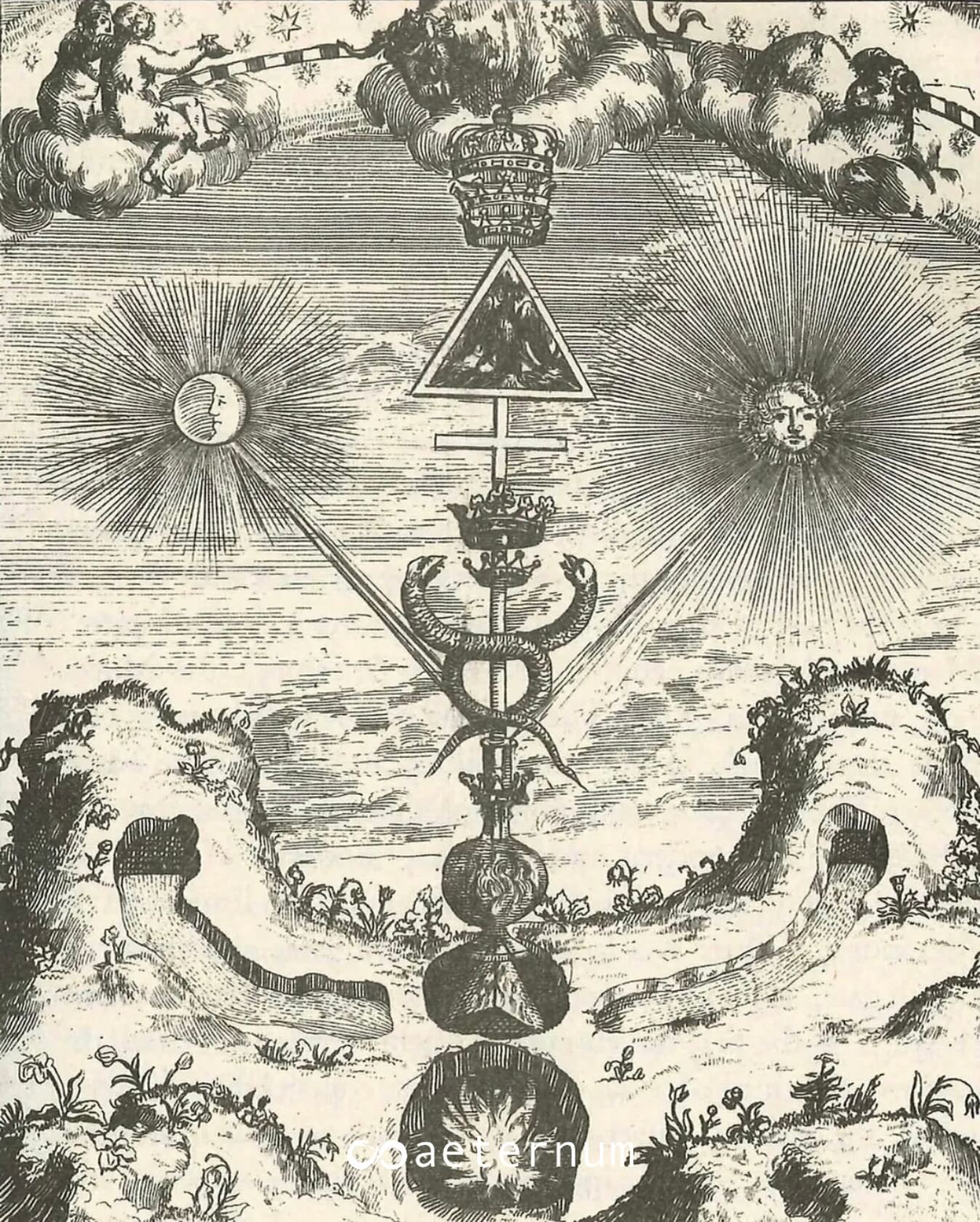
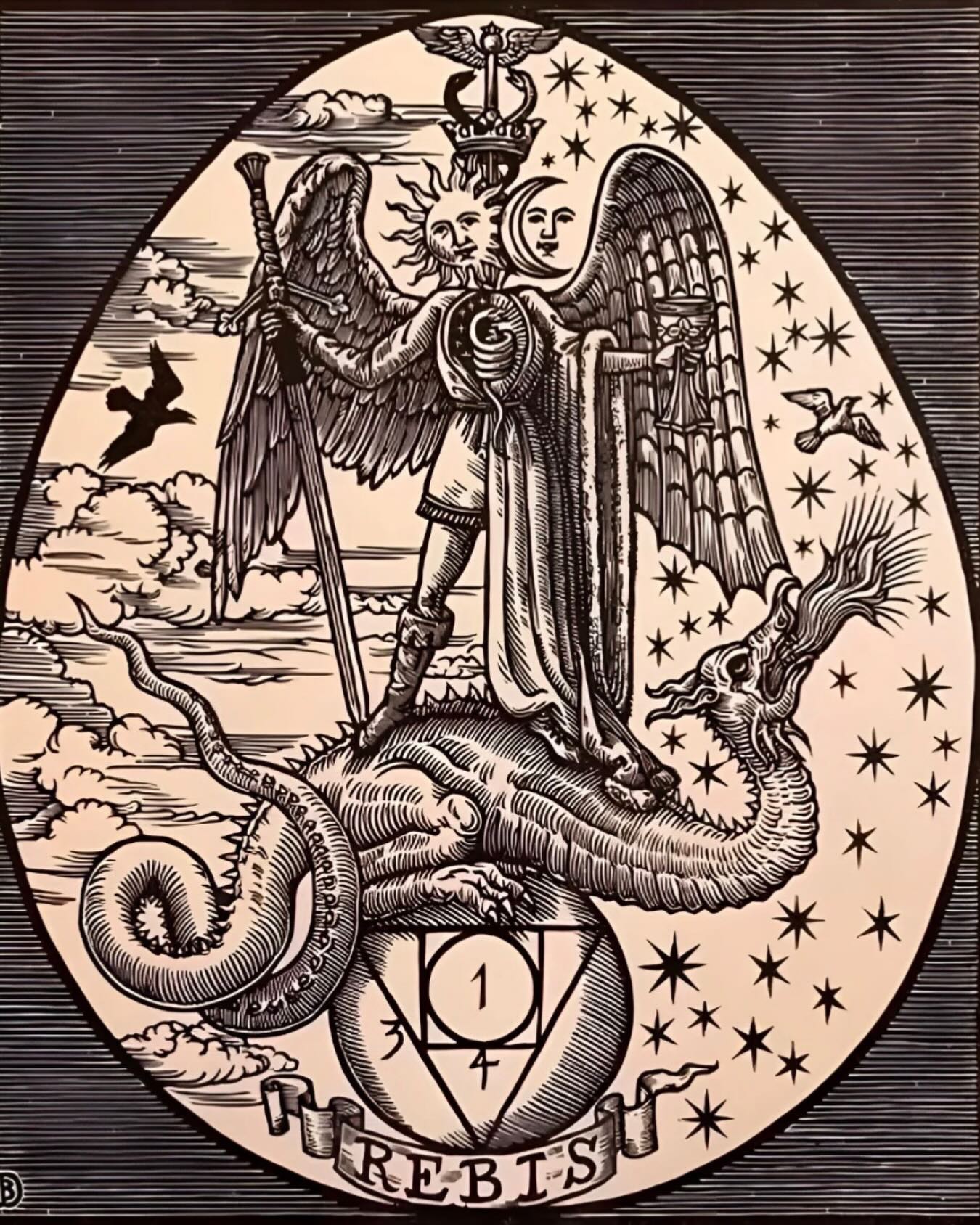
Fludd knew the alchemical tradition and used its images, principles, and operations. Yet he did not devote his entire work to metallic transmutation. Alchemy is integrated into a broader philosophy of separation, purification, and recomposition.
It constitutes one of the ways of reading nature's action. Paracelsus's presence is everywhere: chemical medicine, signatures, magnetism, sympathy, the action of the heavens on the body, and the use of remedies prepared through art.
Fludd nevertheless adapts Paracelsianism to his own Christian cosmology. The result is a highly personal system. Many of Fludd's engravings use extremely strong visual oppositions: light and darkness, center and periphery, above and below, visible and invisible. These contrasts give his books an immediately recognizable intensity.
The reader understands the cosmology even before deciphering all the Latin. In several diagrams, God appears as a source of light, hand, name, or higher principle. Fludd's universe is never autonomous. Every proportion receives its order from a divine principle.
Fludd takes up and transforms Neoplatonic traditions of the world soul. The cosmos possesses a living mediation between the divine source and bodies. This soul makes sympathies between the different levels of creation possible. Marsilio Ficino had already developed a philosophy in which the world soul, the spiritus mundi, the stars, music, and medicine all formed part of the same whole.
Fludd belongs to this long Renaissance lineage. But he combines it with Paracelsianism, the Rosicrucians, and an iconography specific to the 17th century. Heinrich Khunrath died before Fludd published his major works, but their worlds strongly echo one another. Both sought a Christian alchemy in which prayer, Nature, Kabbalah, and experience came together. Khunrath placed the oratory beside the laboratory; Fludd placed the microcosm inside the macrocosm.
Machines in an occultism book
One of the surprises of Fludd's work comes from the abundance of machines. Pumps, fountains, organs, automatons, and mechanisms appear in his volumes. Fludd's occultism is therefore not an escape from the material world. It includes mechanics as an imitation of nature. Like several inventors of his time, Fludd was interested in devices that seemed capable of sustaining their own motion. These projects belong to the history of Renaissance machines and research into natural forces. The idea of self-sustaining motion also accords with his dream of a cosmos permeated by perpetual vitality.
Devices related to the expansion of air also appear in the technical tradition associated with Fludd. It would be excessive to make him the sole inventor of the modern thermometer, but his drawings contribute to the history of instruments designed to make changes in air and heat visible.
Here again, making the invisible visible remains the common gesture. This phrase could summarize his work. The pulse makes vital movement visible. The thermoscope makes heat visible. The monochord makes harmony visible. The diagram makes the cosmic hierarchy visible. Fludd knew that some relationships are easier to understand through a drawing than through a lengthy demonstration.
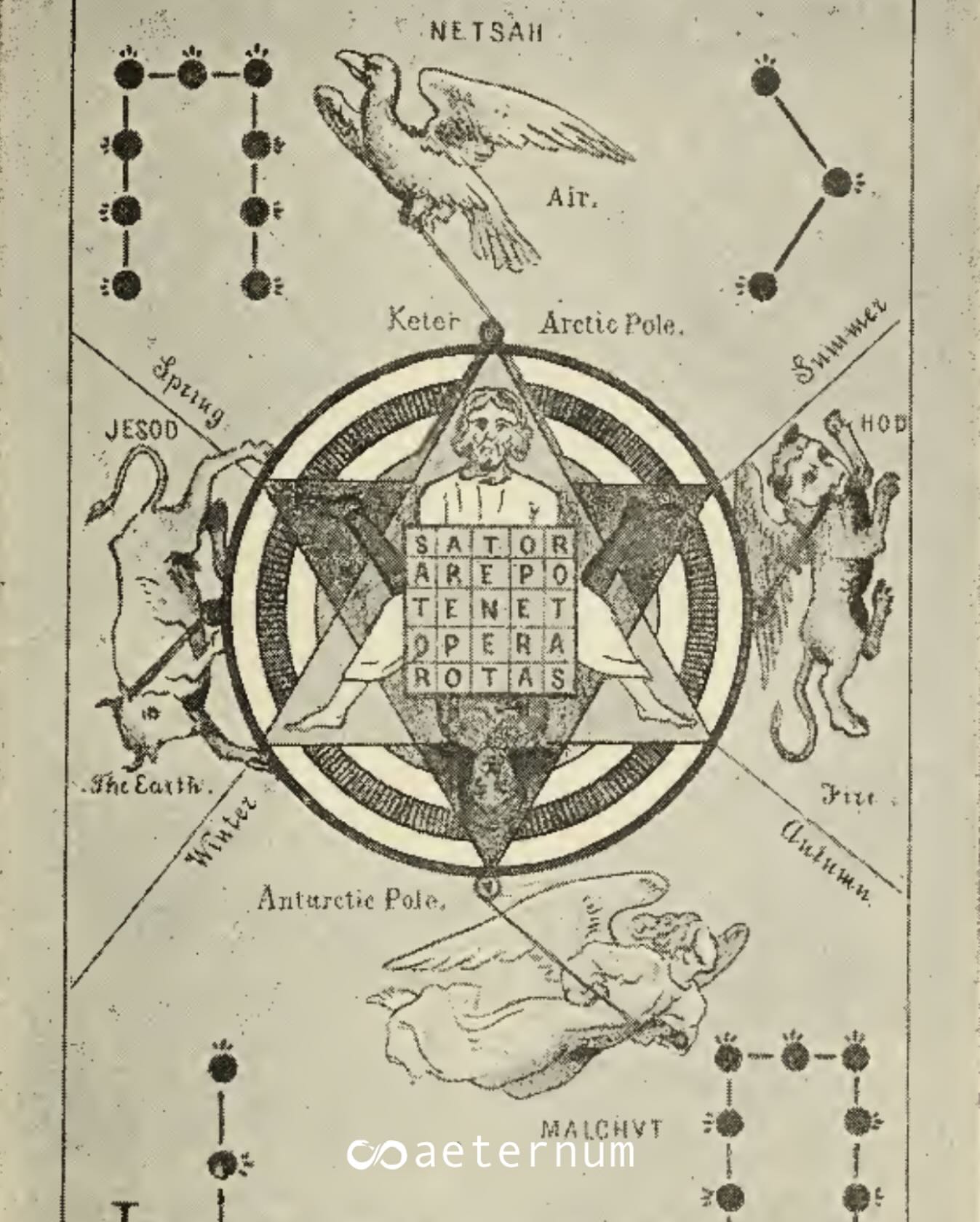
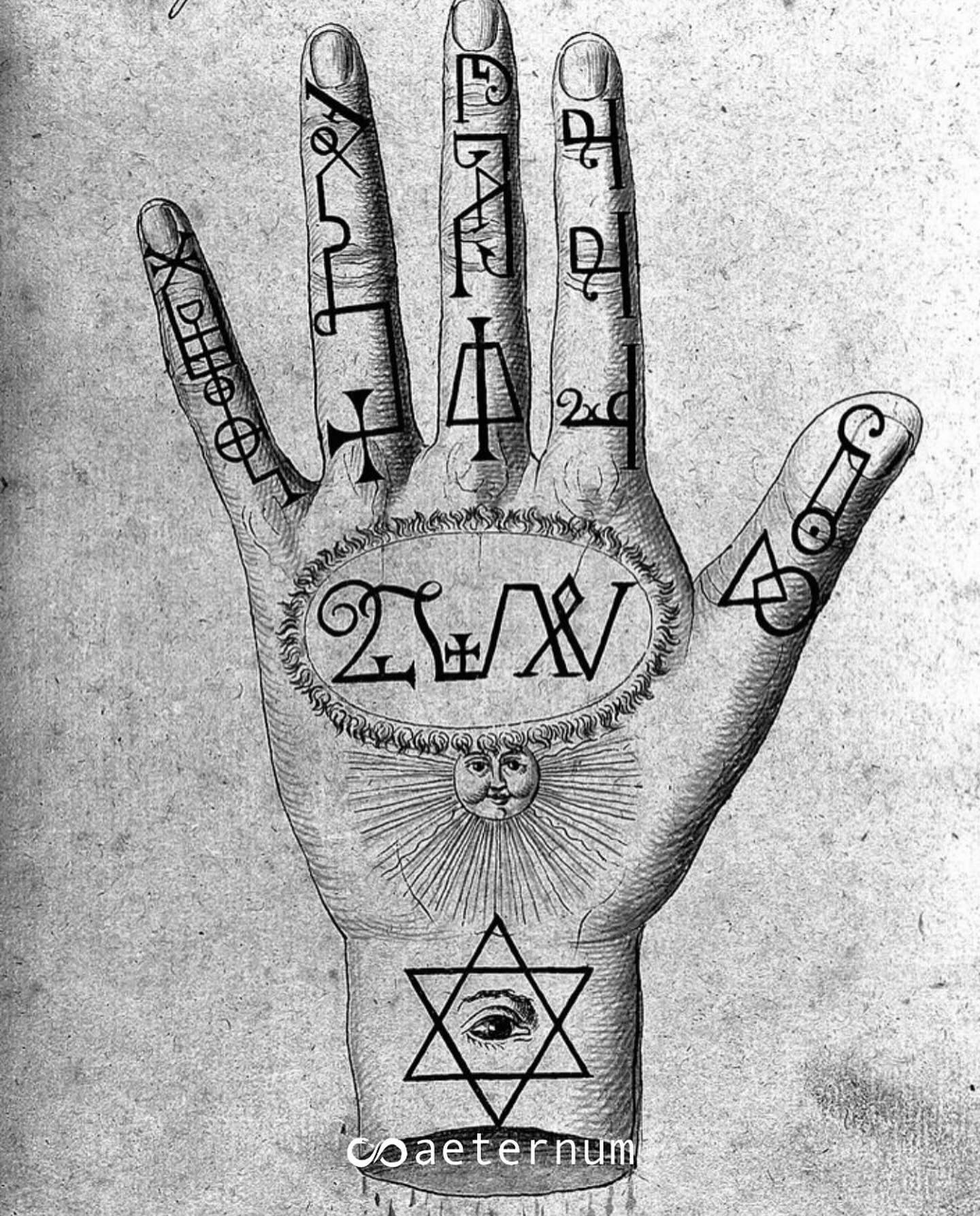
The concentric circles, cords, rays, and human figures allow the reader to grasp structures at a glance. His work therefore belongs as much to the history of scholarly imagery as to that of occultism. Several of his books are associated with the great engraver Matthäus Merian and the publishing circle of Johann Theodor de Bry. The precision of these images contributes enormously to their lasting influence.
The portrait of Fludd used on the cover of this biography is also associated with Merian and appears in his work published in 1626. The portrait shows Fludd as a gentleman physician, his hand resting on his chest, with an open book before him. Divine rays descend from the upper corner of the image. An inscription evokes light and celestial protection. The portrait itself thus becomes a statement of philosophy.
Was Robert Fludd a member of the Rosicrucians?
The question will remain difficult as long as the first Rosicrucian decades are expected to have archives like those of a later Masonic order. Fludd presents himself as a defender of the fraternity, explains its principles, and takes up several of its themes.
He unquestionably belongs to the first intellectual circle to receive Rosicrucian ideas, whether this closeness is later interpreted as formal adherence or as doctrinal solidarity. Secrecy seems legitimate to him when it protects knowledge from ambition, pride, or dangerous use.
True wisdom is therefore not proven by displaying all its means. It is recognized by its effects: knowledge, healing, charity, and the reform of humanity. Caring for the sick occupies a major place in the Rosicrucian manifestos. Fludd, himself a physician, immediately understands the power of this ideal.
The true brother does not seek only the secret of metals. He seeks a medicine capable of serving others. His work is intensely Christian. Christ, Genesis, the Cross, the angels, and the divine names structure his thought. Legitimate magic must remain within this order. Fludd does not seek to circumvent God; he wants to understand the ways in which God acts in creation.
In 1626, Philosophia sacra et vere Christiana is published, a work in which Fludd further develops his Christian reading of nature. The Wellcome Collection holds this Frankfurt edition. The title summarizes his ambition: a sacred and truly Christian philosophy. His Philosophia Moysaica, published after his death in 1638, presents Moses as the possessor of a true wisdom of creation.
Mosaic physics becomes an alternative to the dominance of Aristotle. Reading Genesis then amounts to reading a cosmological text. Fludd considers that the opening chapters of the Bible contain wisdom about light, matter, order, and the stages of creation. Cosmology must therefore remain compatible with the sacred text.
This orientation distinguishes him from the new philosophies that seek to make nature increasingly autonomous from Scripture. During the 17th century, methods change. Mathematical physics, new forms of experimentation, and mechanistic programs gain influence.
The language of correspondences, the world soul, and signatures seems less convincing to a new generation of scholars. Yet Fludd does not disappear. He continues to be read by hermetic, Rosicrucian, alchemical, and theosophical currents.
In the 18th and 19th centuries, his name reappeared in histories of the Rosicrucians and Hermetic philosophy. His engravings became visual references for Western esotericism. Modern occultists see him as a witness to an age when the universe could still be represented as a living whole. Presenting him simply as a "precursor of science" would mean losing what gives his work its true coherence.
Fludd experiments, observes, and constructs devices, but he never separates these actions from his theology and his philosophy of correspondences. His interest lies precisely in this intermediate world where several ways of knowing still coexist.
The monochord perhaps sums up Fludd better than any definition. An instrument produces music only when its tensions are properly adjusted. Too loose, the string does not sound; too tight, it breaks.
The cosmos, the body, and the soul also require harmony. The physician does not replace nature. They attempt to restore a proportion, a rhythm, or a circulation. Healing means bringing the microcosm back toward a more just harmony. Because he refuses to choose between image and number, between medicine and alchemy, between Christ and Nature, or between machine and symbol.
His world may seem impossible to a modern reader accustomed to separating disciplines. For him, it was precisely this separation that would have been incomprehensible. One must enter his books as though entering a drawn cosmos. The diagrams are not decorations. They are the gateways to the system. Reading the text, looking at the image, and tracing the correspondences makes it possible to reconstruct the author's thought.
Fludd did not create a lasting school bearing his name. He left something more difficult to confine: a vision. In this vision, light descends from God, the spheres sing, humanity responds to the cosmos, medicine reads the signs of the body, and the arts imitate nature. To continue exploring this perspective, also see Michael Maier, Heinrich Khunrath, John Dee, Cornelius Agrippa, and our article on the Rosicrucians.
Sources and references
The Royal College of Physicians gives his dates as 1574 - 8 September 1637 and documents his birth at Milgate, entry to Oxford in 1591, degrees, 1605 doctorate in medicine, examinations before the College of Physicians, and admission as a Fellow in 1609.
Wellcome Collection holds a 1617-1618 edition of the Utriusque Cosmi Historia, with its volumes devoted to the macrocosm, the arts, and techniques. The institution also holds editions of his Philosophia Sacra, Medicina Catholica, and his 1631 response in the weapon-salve controversy.
The Stanford Encyclopedia of Philosophy, in its article on Renaissance natural philosophy, places Fludd among the Hermetic authors who considered the relationships between macrocosm, microcosm, medicine, and natural forces.
Luca Guariento's study, From monochord to weather-glass: musica speculativa and its development in Robert Fludd’s philosophy, University of Glasgow, 2015, analyzes the role of music throughout Fludd's thought and his debate with Kepler.
Brown University's academic project Furnace and Fugue places Fludd's monochord in the controversy with Johannes Kepler over cosmic harmony.
Regarding Rosicrucianism, Nicholas Goodrick-Clarke devotes a section of his history of Western esoteric traditions to Michael Maier and Robert Fludd, while Lyke de Vries's study of the Rosicrucian call for reform helps place their texts in the intellectual context of the 1614-1616 manifestos.
For sympathetic medicine, the recent medical article devoted to Sir Nicholas Gilbourne and the weapon-salve revisits the case published by Fludd in 1631 and makes it possible to follow the logic of remote treatment in concrete terms.
The cover uses the portrait of Robert Fludd engraved by Matthäus Merian and published in Philosophia Sacra in 1626, held by Wellcome Collection under a CC BY 4.0 license. The interior illustration of the cosmic monochord dates from 1623 and is held by the Deutsche Fotothek in the public domain.

Par Olivier of Aeternum
Passionate about esoteric traditions and the history of the occult from the earliest civilizations to the 18th century, I share some articles on these topics. I am also co-creator of the online esoteric shop Aeternum.