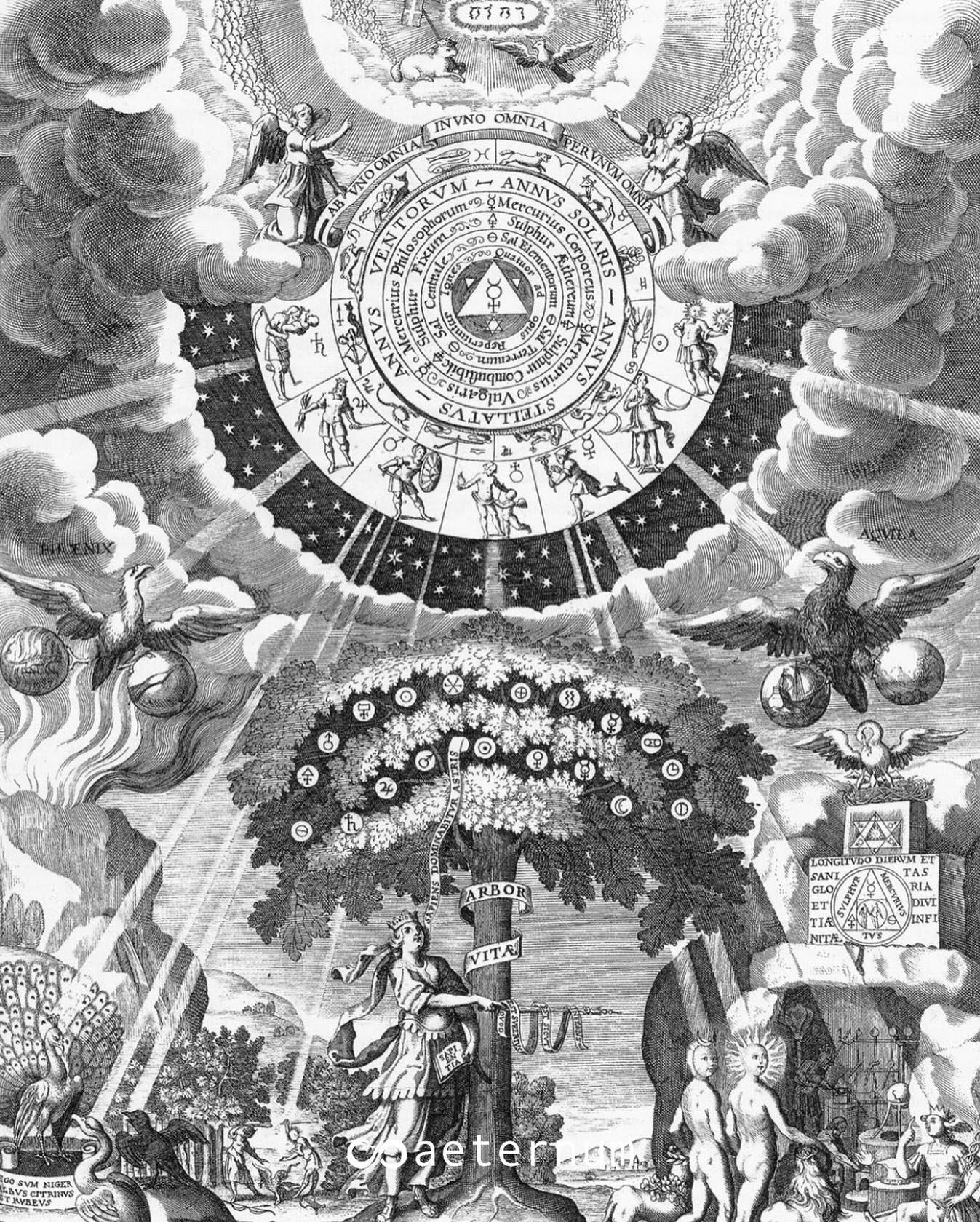





























































































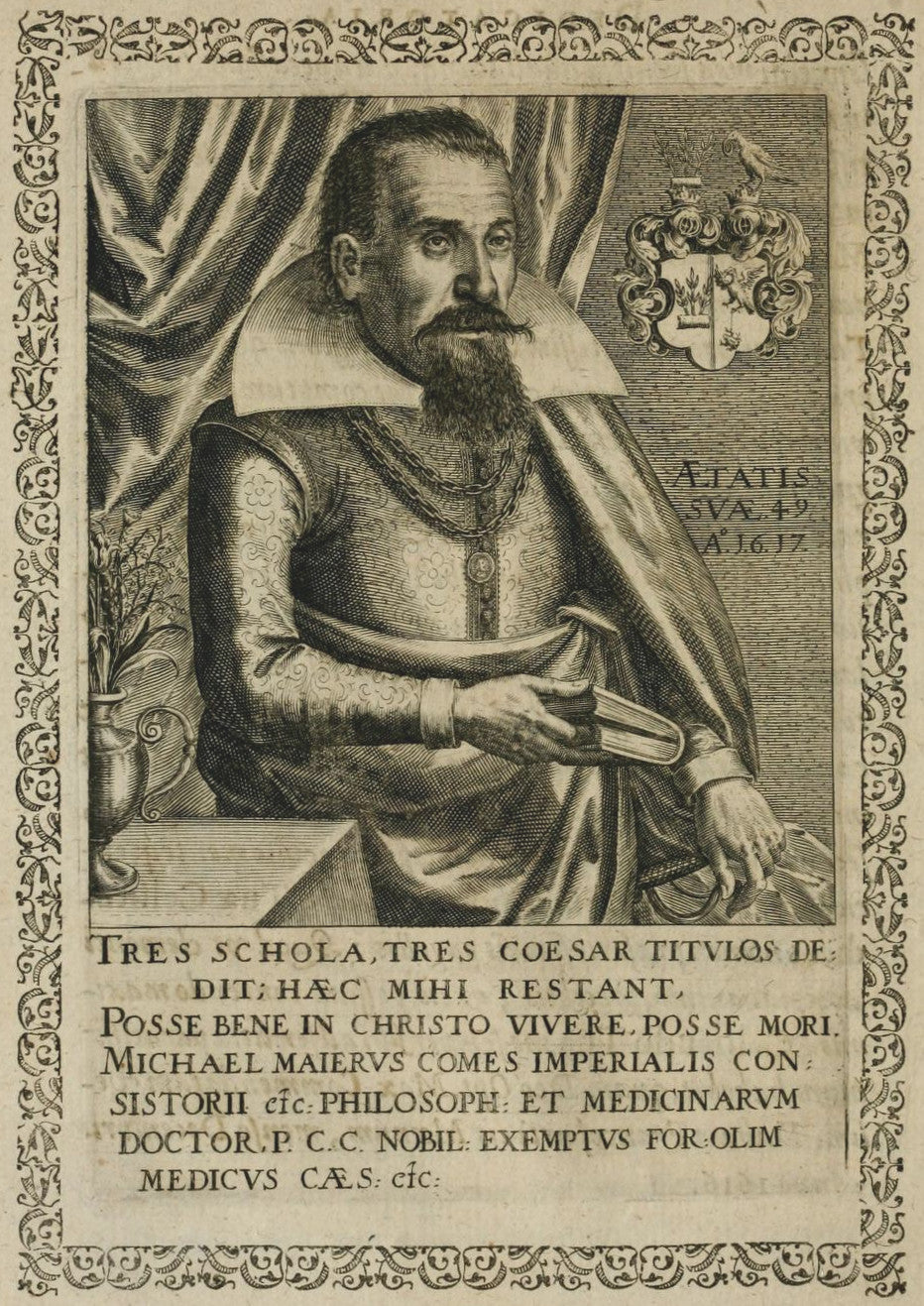
Michael Maier is one of the great figures of early 17th-century European alchemy. A physician, crowned poet, alchemist, emblem author, composer, court adviser, and passionate defender of the Rosicrucians, he witnessed the final splendors of Prague under Rudolf II, spent several years in England, worked in the circle of Landgrave Moritz of Hesse-Kassel, and published a series of books that gave alchemy an exceptionally rich literary and visual form.
His name remains chiefly associated with Atalanta fugiens, a book in which fifty alchemical emblems are accompanied by mottoes, epigrams, commentaries, and three-part fugues. In Maier's work, alchemy is not merely meant to be read: it must be viewed, sung, heard, and meditated upon. Greek mythology, the laboratory, Christianity, music, medicine, and the Rosicrucians come together in a single quest for transformation.
Michael Maier was born around 1568 in Schleswig-Holstein
The Deutsche Biographie places his birth around 1568 in Rendsburg or Kiel. Maier referred to himself as Chiloniensis, “of Kiel,” indicating that he grew up there or strongly identified with the city.
His father, Petrus Meier, worked as a gold embroiderer in the service of Heinrich Rantzau, the powerful Danish governor of Schleswig-Holstein. This proximity to court circles and to a cultivated patron such as Rantzau probably constituted one of the young Maier's first social environments.
He therefore grew up in a setting where the Germanic world, princely courts, maritime commerce, and humanist culture met. In February 1587, Maier enrolled at the University of Rostock to study philosophy. The university environment was shaped by late humanism, rhetoric, languages, and natural philosophy.
This education partly explains his later ease with ancient myths, Latin authors, and complex literary forms. Maier would never become a mere laboratory technician. He thought about alchemy using the tools of a humanist. His books are full of Ovid, mythology, allegories, quotations, and symbolic genealogies.
In the summer semester of 1592, Maier continued his studies at the University of Frankfurt an der Oder. There he received a master's degree and probably began moving more decisively toward medicine.
His laureate as a poeta laureatus also dates from this period. This title is important for understanding the later development of his work: Maier never writes about alchemy in a purely medical or technical language.
He wants to convince, seduce, narrate, and conceal all at once. For Maier, medicine and poetry will never be two separate careers. The first provides access to the body, remedies, humors, and substances. The second makes it possible to express what alchemy refuses to reveal directly.
The emblem, fable, music, and motto thus became instruments just as legitimate as the furnace or the alembic. On the advice of the physician Matthias Carnarius, Maier left for Italy in the autumn of 1595. He enrolled in Padua, one of Europe's major medical centers, and then moved on to Bologna in the spring of 1596.
This peregrinatio academica was part of the education of ambitious students of his time. Italian universities offered privileged access to anatomy, botany, medicine, and the scholarly traditions of the Renaissance. Maier absorbed this world without abandoning his hermetic interests.
1596, medical doctorate in Basel
In the winter semester of 1596, he enrolled in Basel and received his medical doctorate on October 27 under the supervision of Caspar Bauhin, a renowned anatomist and botanist. His dissertation concerned epilepsy. Maier's academic medical training is therefore real and perfectly documented.
This qualification would later allow him to serve princes and seek positions as a court physician. After Basel, Maier returned to northern Germany and worked as an itinerant physician. He also appears to have sold or prepared some remedies himself.
This mobile life suited both his temperament and his era. A learned physician could travel from city to city, enter a patron's service, offer a treatise, advise a nobleman, and then set off again in search of a better position. The quest for a patron would accompany Maier throughout his life.
At the end of 1601, the sources place him in Königsberg and Danzig. Maier thus moved through the Baltic's major commercial and university centers. This northern network would remain important to him. Even when he spent time in Prague or London, he remained a man formed in the Germanic and Baltic worlds.
It is difficult to pinpoint an exact moment. Medicine at the end of the 16th century naturally led toward chemical preparations and Paracelsianism. Maier belonged to a generation for whom mineral remedies, separations carried out by fire, and the search for more powerful substances became major concerns. But his alchemy gradually went beyond therapeutics. It became a way of reading history, myths, religions, and the destiny of humankind.
Paracelsus had paved the way for a chemical medicine and for viewing the body as a microcosm. Maier inherited this intellectual ground. Like Heinrich Khunrath, he did not separate alchemy from healing. Metals, salts, principles, and chemical operations could lead toward a more powerful medicine, but also toward an understanding of the world.
Around 1608, Maier arrives in Prague
Maier himself claimed to have arrived in Prague around 1608. Rudolf II’s capital was then one of the most extraordinary centers of scholarly Europe. The emperor collected works of art, automata, natural curiosities, and rare objects. Astronomers, astrologers, physicians, artisans, alchemists, and scholars revolved around his court.
Tycho Brahe and Johannes Kepler had already worked in this environment. Hermetic research found a place there that few European courts could offer with the same intensity.
Maier quickly gained access to the imperial circle. On September 19, 1609, Rudolf II officially took him into his service. A few days later, on September 29, he received imperial nobility.
Biographical traditions also attribute to him the titles of Count Palatine and private secretary. The most cautious sources confirm, at any rate, his exceptional social advancement and his connection with the sovereign. Their shared interest in the Hermetic sciences largely explains this favor.
Maier is presented as the physician of Rudolf II, although this position seems to have been less regular than that of a daily medical service. What mattered above all was access to the court. Prague offered Maier an environment in which he could develop alchemical texts, meet researchers, and observe the imperial collections.
Several autograph manuscripts appear to have been conceived during these years. The emperor’s political situation deteriorated rapidly. His brother Matthias gradually took power, and Rudolf lost his main prerogatives.
Maier left Prague before the final downfall of 1611. This departure marked the beginning of a new period of travel and efforts to find patrons. Maier tried to establish closer ties with Landgrave Moritz of Hesse-Cassel, a cultivated sovereign whose court was interested in chemical medicine, alchemy, and scholarly innovations. He offered his services, but did not immediately obtain the position he had hoped for. His connection with Moritz would nevertheless become important a few years later.
Amsterdam, then England
Maier passed through Amsterdam before making his way to England. In December 1611, he managed to present himself at the court of James Iᵉʳ. He would remain in the British world for nearly five years. This stay is one of the most intriguing episodes of his career, because England already possessed a strong Hermetic tradition, nourished by John Dee, court networks, alchemists, and the early debates surrounding the Rosicrucians. John Dee died shortly before Maier arrived in England. The two men therefore did not meet during this period.
But the Deeian universe remains present: mathematics, alchemy, the reform of knowledge, angels, empire, and Hermeticism have left a lasting mark on English scholarly circles. Maier arrives in an England where the questions Dee had raised have not disappeared.
Modern scholarship has examined the possibility of contact between Maier and Robert Fludd. The two men share obvious interests: alchemy, medicine, music, cosmic harmony, the Rosicrucians, and symbolism.
The direct encounter is not documented with the precision of a letter or a journal comparable to Khunrath’s visit to Dee. But their paths intersect in the same intellectual milieu.
They would become two of the most important defenders of the Rosicrucian cause in the years that followed. Maier publishes little during his stay in England, but his output almost immediately explodes after his return to the continent.
This concentration of publishing activity suggests a long period of preparation. Several major themes in his books - alchemical mythology, the defense of the Rosicrucians, music, and the genealogy of the sages - are already mature when he arrives at the printers in Frankfurt and Oppenheim.
1616, return to the continent
In mid-1616, Maier leaves England. He then enters the most fruitful period of his career. In Frankfurt and Oppenheim, he works with the publishing houses of Johann Theodor de Bry and Lucas Jennis, two major names in early 17th-century hermetic publishing.
The engraver Matthäus Merian the Elder contributes to several of his books. This editorial collaboration transforms the way Maier transmits his knowledge. The texts are accompanied by high-quality images, frontispieces, emblems, and layouts designed to guide the reader.
Alchemy does not remain locked away in an obscure manuscript. It becomes a printed object capable of circulating throughout Europe. In 1616, De circulo physico quadrato appears. The title already associates two fundamental forms, the circle and the square, with a reflection on gold and its medicinal virtue.
Maier never abandons his original identity as a physician. Alchemical gold is also linked to the question of a medicine capable of strengthening the body. That same year, Lusus serius appears, a text constructed as a symbolic dispute. Several representatives of the natural world debate their dignity before Hermes or Mercury is granted a sovereign place.
The title reveals a method Maier favors: knowledge can take the form of a game, but that game carries a serious meaning. This logic prepares his understanding of the Rosicrucians as a “serious game” capable of concealing the truth beneath a lighthearted appearance.
In Arcana arcanissima, Maier develops one of his most characteristic theses: the great Greek myths were veils behind which the ancient philosophers concealed the operations of alchemy. Osiris, Isis, Jason, the Golden Fleece, Hercules, Atalanta, and the gods of Olympus can therefore be read as chemical figures.
Maier does not regard these myths as mere tales. For him, they form a coded language. This idea enables Maier to reread all of antiquity as an immense repository of Hermetic teaching.
The monster becomes matter to be conquered. The hero becomes the operator. Death and resurrection describe dissolution and recomposition. The sacred marriage can represent the conjunction of Sulfur and Mercury. Ancient poetry is transformed into a laboratory book.
In 1617, Symbola aureae mensae duodecim nationum, “The Symbols of the Golden Table of the Twelve Nations,” is published. In it, Maier brings together twelve figures from alchemical history, drawn from different countries or traditions. The image of the golden table creates a fraternity of sages across time and borders.
The project gives alchemy a sacred history. The adepts are not isolated individuals: they form part of an international chain of transmission. This “table” is not merely a list of authorities. It almost resembles a banquet of philosophers.
Each nation contributes its voice, its master, and its contribution to the Art. Maier thus responds to criticism of alchemy by giving it a prestigious genealogy. The portrait used on the cover of this biography comes from the publishing world of the Symbola aureae mensae. Engraved by Matthäus Merian and published in 1618, it depicts Maier at about forty-nine years of age. He holds a book and bears the insignia of his rank. His coat of arms appears in the background. This image is one of the few direct historical portraits of a great alchemist of this generation.
The Rosicrucian manifestos
Between 1614 and 1616, the texts that would transform the European esoteric landscape appear: the Fama Fraternitatis, the Confessio Fraternitatis, and the Chymical Wedding of Christian Rosenkreutz. They announce a secret fraternity of sages, a reform of knowledge, and a Christian mission of regeneration.
The texts immediately provoke responses, pamphlets, adhesions, mockery, and passionate investigations into the mysterious fraternity. From 1616 onward, Maier publicly takes the side of the Rosicrucians. His commitment becomes increasingly clear.
Modern research, particularly that of Hereward Tilton, shows that he does not merely comment on the manifestos out of curiosity. He integrates them into his own Christian and alchemical vision. The Rose Cross appears to him to represent a fraternity of philosopher-physicians capable of serving the world without seeking glory.
In 1617, Silentium post clamores, “silence after the outcries,” appeared. In it, Maier responds to criticisms directed against the Fraternity. He also explains why the Rosicrucians might remain silent in the face of the countless people who claim to want to join them.
Silence becomes an initiatory sign. The fraternity does not reveal itself to anyone who demands it loudly. Maier fully accepts the idea that a real society could hide behind an absence of response.
For him, secrecy protects the work. The true brother is recognized less by a costume or a public register than by a medicine, a wisdom, and a way of acting. This interpretation would greatly contribute to the subsequent image of the Rose Cross as an invisible order.
The question remains open because the earliest Rosicrucian texts do not function like the archives of a modern obedience. There is no administrative register allowing one to verify membership as one would for a 19th-century lodge. But Maier writes as a convinced defender. He knows the fraternity’s rules, comments on them, justifies them, and gives them a place in his own thinking.
Some modern works go so far as to speak of his entry into the Order. Whether this entry is understood in an institutional or spiritual sense, his identification with the Rosicrucian cause is indisputable. In 1618, Themis aurea, devoted to the laws of the Fraternity of the Rose Cross, appeared.
Maier comments on the rules set out in the Fama: treating the sick free of charge, adopting the clothing of the country where one is staying, meeting periodically, choosing a worthy successor, and keeping the fraternity’s secret. These rules perfectly match his own ideal of the physician-alchemist: elevated knowledge, service, discretion, and brotherhood.
The medical dimension of the Rosicrucians naturally attracts Maier. The brothers’ first duty is to heal. Here, medicine becomes proof of genuine knowledge. Wisdom that provides no aid remains incomplete.
Maier thus embraces the old Paracelsian idea of the physician initiated into the secrets of nature. Between 1617 and 1618, the work that would make Michael Maier famous to this day appeared: Atalanta fugiens. The BnF catalogs a 1617 edition, while the Wellcome Collection preserves the Oppenheim edition of 1618.
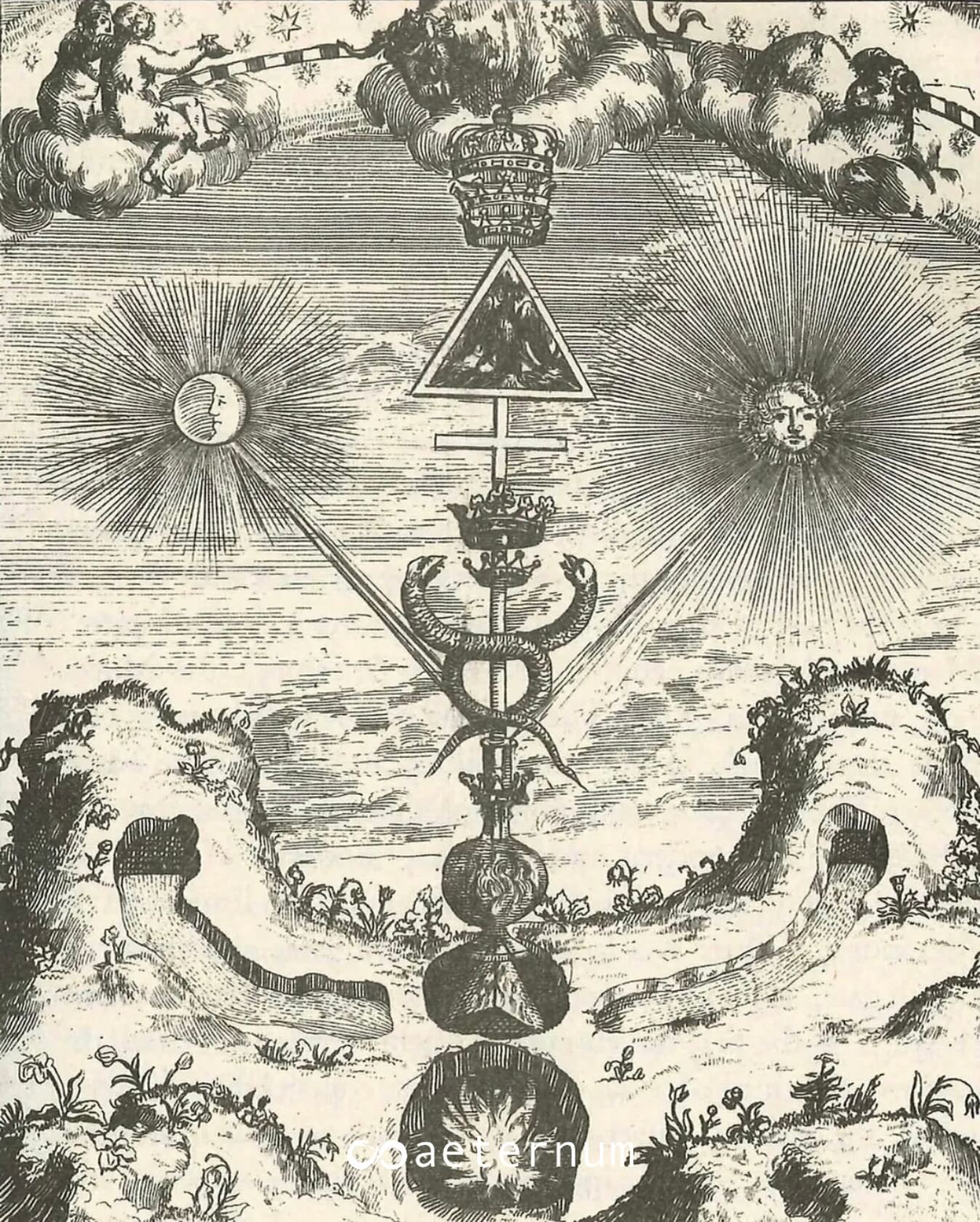
The book brings together fifty emblems devoted to the secrets of alchemical nature. The title explains the project: some parts are intended for the eyes and intellect through the engravings, maxims, epigrams, and commentaries; others are intended for the ears through the musical fugues.
Each emblem thus forms a complete whole. One looks at the image, reads the motto, meditates on the epigram, studies the discourse, and sings the music. The title comes from the myth of Atalanta and Hippomenes. Atalanta runs faster than her suitors. Hippomenes receives golden apples and throws them in front of her during the race. Atalanta slows down to pick them up; Hippomenes can then catch up with her. Maier transforms this story into a musical structure. One voice represents the golden apple, motionless. Another represents Atalanta fleeing. The third represents Hippomenes pursuing her.
Music becomes alchemy
The fugue therefore does not serve as mere sonic ornament. Its construction reproduces the myth. The musical pursuit becomes an image of the alchemical pursuit. The voices separate, follow one another, and come together like the principles that the Art must unite.
For Maier, counterpoint can make an operation understandable when prose alone is not enough to express it. Modern commentators have connected the three voices with alchemy’s great principles: Mercury, Sulfur, and Salt.
Maier himself emphasizes above all the correspondence between the musical movement and the myth of Atalanta. The listener therefore does not simply receive an “alchemical song.” They participate in a structure of pursuit and conjunction. The engravings in Atalanta fugiens are associated with Matthäus Merian the Elder, one of the great engravers of his time. Princeton describes the fifty copper engravings as works by Merian. The precise, readable style, rich in detail, gives each alchemical operation a memorable scene.

One of the first emblems shows a woman nursing a child in a landscape. The motto refers to the Hermetic formula according to which the Earth nourishes what must be born. The image connects alchemy with natural generation. The stone is not manufactured like an arbitrary artificial object: it must grow, be nourished, and mature.
Nature becomes the alchemist’s first teacher. Other emblems show the union of the Sun and the Moon, masculine and feminine, hot and cold, Sulfur and Mercury. Maier reads the Work as a conjunction. Opposites are not eliminated; they are led toward a union that produces a third state. Alchemical marriage thus becomes one of the book’s great themes.
Atalanta is only one example. Maier uses Hercules, Medea, Jason, the gods, monsters, and ancient stories to translate transformations of matter. This method rests on a conviction: the ancient sages concealed their science beneath fables.
Correctly reading mythology therefore amounts to recovering a veiled chemistry. Why not write the operations directly? Because Maier belongs to a tradition in which secrecy protects knowledge from indiscreet use.
Image, music, and allegory select the reader. One who seeks an immediate recipe remains on the surface. One who connects the levels begins to see the architecture of the Work.
In 1618, Maier also published the Tripus aureus. In it, he collects and translates three alchemical texts, including the famous Twelve Keys attributed to Basil Valentine and a text by Thomas Norton.
This editorial and translation work is crucial. Maier does not merely produce his own theories; he also transmits texts he considers part of the chain of adepts. In this way, he helps establish the alchemical canon of the 17th century. The same year, the Viatorium appears, devoted to the mountains of the seven planets or metals.
The theme links metals to the traditional stars: gold and the Sun, silver and the Moon, iron and Mars, copper and Venus, lead and Saturn, tin and Jupiter, mercury and Mercury. Celestial correspondences become a map of matter.
1618, finally in the service of Moritz of Hesse
In April 1618, Maier offered several of his books to Landgrave Moritz of Hesse-Cassel. This time, his approach succeeded. Moritz appointed him Medicus und Chymicus von Haus aus, physician and chemist attached to his household.
Recognition arrives just as Europe approaches the Thirty Years’ War. The connection is particularly interesting because the Rosicrucian manifestos had circulated in the same Hessian environment and several court figures were involved in alchemical and medical debates.
Maier therefore finds in Hesse-Cassel a context in which his defense of the Rosicrucians is not isolated. Court alchemy and Rosicrucian reform meet. In 1619, Verum inventum appears, a text devoted to the “gifts of Germany” passed on to the rest of the world. Maier thus contributes to promoting German culture and its inventions.
The reform of knowledge is not only ancient or biblical: it also has a national dimension. In 1620, Septimana philosophica organizes a series of philosophical conversations over several days. Maier retains his taste for dialogue, staging, and indirect pedagogy. In 1621, Civitas corporis humani appears, devoted in particular to gout and joint diseases.
This publication recalls that Maier never became merely a writer of emblems. He continued to think about the body, diseases, and remedies into his final years. Maier still tried to settle in Frankfurt, but his projects did not turn out as he hoped. Before 1620, he settled in Magdeburg. Nevertheless, he remained on the move and continued seeking protectors.
His entire life seems caught between two poles: the desire for a stable learned home and the necessity of traveling to find patrons, printers, and positions. Shortly before his death, Maier was still seeking the protection of the Danish crown prince Frederick, the future Frederick III. He envisioned a return to the North where he was born. This project would not come to fruition.
1622, died in Magdeburg
Michael Maier died in the middle of 1622 in Magdeburg. He left approximately thirty important works, almost all written in Latin, along with poems, medical texts, and translations.
This output is remarkable for a man whose life was so mobile. In 1624, Ulysses was published after his death, in which the figure of Ulysses becomes an image of wisdom passing through the shipwrecks of fortune.
The theme seems almost autobiographical. Maier himself traveled through courts, universities, and countries in search of an intellectual and material home. The traveling alchemist thus becomes, through Ulysses, a figure of the person seeking to return to a center.
His Rosicrucian texts would continue to be read as major documents on the manifestos’ early reception. Maier helped move the Rose Cross from an anonymous pamphlet into the European intellectual debate.
He gives it a learned, medical, and alchemical defense. Along with Robert Fludd, Johann Valentin Andreae, the circles of Hesse-Kassel, and the anonymous authors of the manifestos, Maier belongs to the small group of names that still define the Rosicrucian atmosphere of the early 17th century today.
Their positions are not identical. Maier represents a path in which alchemy occupies a particularly strong place. The ideal fraternity becomes a community of physician-philosophers capable of reading nature.
Separation is ill-suited to his era. Maier is genuinely interested in metals, medicinal gold, remedies, and laboratory operations. But he also sees in these processes images of a broader order.
Material transmutation and the transformation of humanity therefore belong to the same philosophy without being reducible to one another. For Maier, alchemy is not a field isolated from other forms of knowledge. It touches on medicine, mythology, history, music, the politics of knowledge, and religion.
This breadth explains his books. They seek less to provide a single recipe than to construct a vision of the world. The phoenix is one of the great figures in his universe. It dies in fire and is reborn from itself. For the alchemist, this image perfectly expresses dissolution followed by a higher recomposition. Hereward Tilton made it the title of his major study devoted to Maier: The Quest for the Phoenix.
Why does Michael Maier remain important?
Because he brought alchemy to an exceptional degree of artistic synthesis. With him, the emblem teaches, mythology conceals, music sets in motion, medicine provides a practical purpose, and the Rosicrucians offer an ideal of fraternity. Few authors have succeeded in making so many forms interact within a single project. The eye looks at the emblem. The ear follows the fugue. The voice sings the epigram. The intellect connects it all.
This structure turns the reader into a participant. The book does not merely convey information about alchemy: it compels the reader to experience an alchemical way of perceiving. The fugues from Atalanta fugiens have been performed and recorded in modern times. The BnF catalogs, among other things, modern interpretations of the work. This return of sound restores a dimension that silent reproductions of the engravings had caused us to forget.
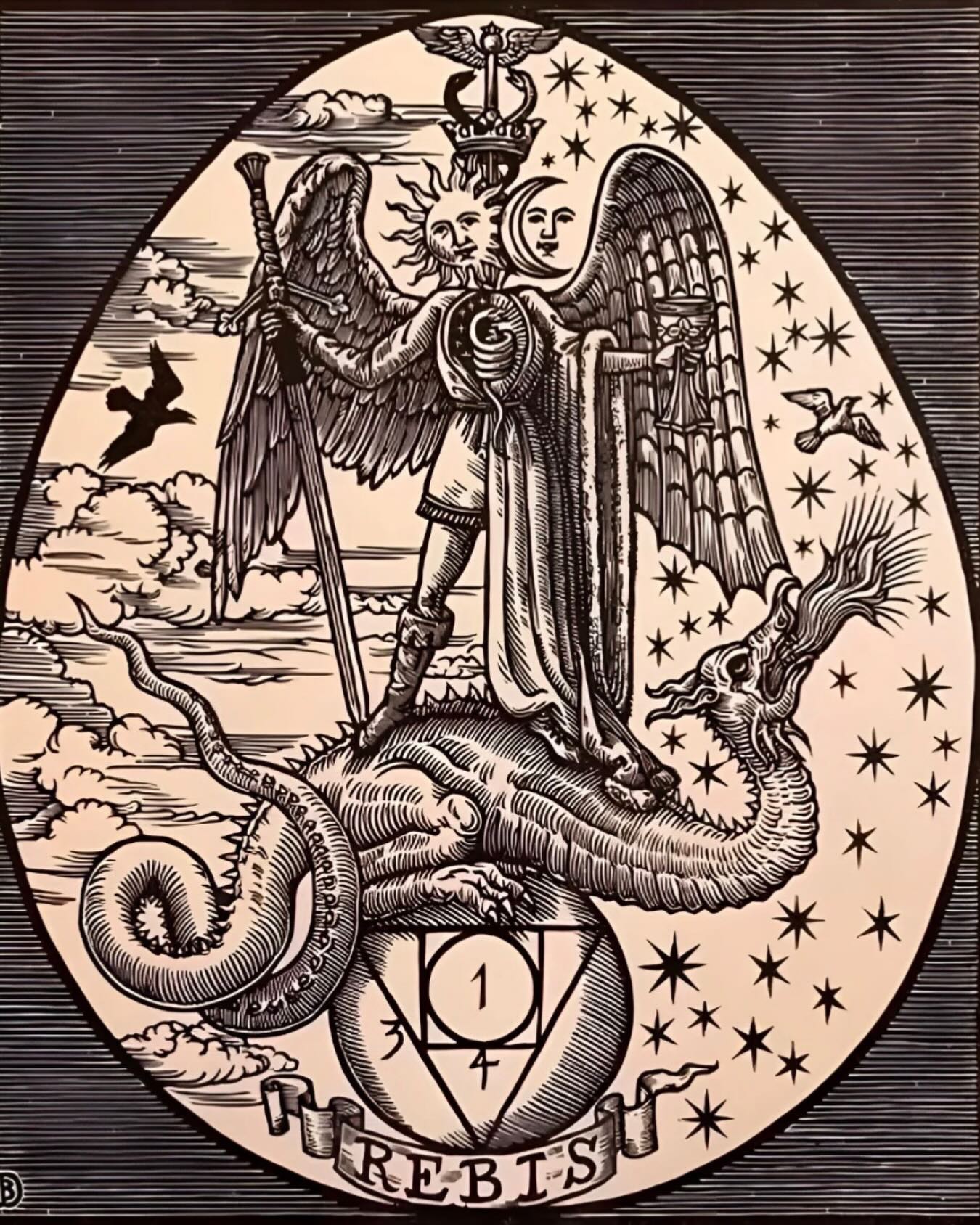
Maier genuinely wanted alchemy to be heard. Maier's emblems now rank among the most widely reproduced alchemical images. The Sun and Moon, the child nourished by the Earth, the philosophical egg, king, queen, dragon, and conjunction appear throughout books devoted to alchemy. He should be read as a physician-alchemist and humanist of the early 17th century, not as a modern chemist or as an author who would have transformed every laboratory into a mere metaphor.
For him, operations mattered, symbols mattered, myths mattered, and so did music. Michael Maier left behind the image of an alchemist seeking to connect what seemed separate: art and science, antiquity and Christianity, secrecy and the printed book, physician and poet, laboratory and music.
His work belongs to the period when European alchemy became one of the great symbolic languages of emerging modernity. To continue this exploration, also see Heinrich Khunrath, John Dee, Cornelius Agrippa, Paracelsus, and our article devoted to the Rosicrucians.
Sources and reference points
The Deutsche Biographie provides the most precise biographical account: born around 1568 in Rendsburg or Kiel, studied in Rostock and Frankfurt an der Oder, received his doctorate in Basel on October 27, 1596, entered the service of Rudolf II in September 1609, stayed in England from 1611, returned to the Continent in 1616, served Moritz of Hesse in 1618, and died in Magdeburg in 1622.
The major academic study is Hereward Tilton’s The Quest for the Phoenix: Spiritual Alchemy and Rosicrucianism in the Work of Count Michael Maier, De Gruyter, 2003. It places Maier in the courts of Rudolf II and Moritz of Hesse-Kassel, and covers his stay in England and his defense of the Rosicrucians.
The Bibliothèque nationale de France lists his principal original editions: De circulo physico quadrato, Lusus serius, Silentium post clamores, Symbola aureae mensae, Atalanta fugiens, Themis aurea, Tripus aureus, and several later works.
The Wellcome Collection preserves and digitizes a complete edition of Atalanta fugiens printed in Oppenheim in 1618, with 211 pages, an engraved title page, illustrations, and a portrait.
For the study of the iconographic and alchemical sources of Atalanta fugiens, the work by H. M. E. de Jong, Michael Maier’s Atalanta Fugiens: Sources of an Alchemical Book of Emblems, Brill, 1969, remains a major reference.
The Princeton University Library documents the fifty engravings attributed to Matthäus Merian and the work’s subsequent publication history.
The cover uses the engraved portrait of Michael Maier by Matthäus Merian, published in 1618 within the publishing context of Symbola aureae mensae. The interior image comes from Atalanta fugiens and depicts the emblem “The Earth is its nurse.” Both works are in the public domain.

Par Olivier of Aeternum
Passionate about esoteric traditions and the history of the occult from the earliest civilizations to the 18th century, I share some articles on these topics. I am also co-creator of the online esoteric shop Aeternum.