



















































































































Cosimo Ruggieri, whom French sources also call Cosme Ruggieri, Cosme de Rogier, or simply Ruggieri, belongs to the most obscure and fascinating sphere of the court of the last Valois. Florentine by origin, a judicial astrologer, horoscope writer, interpreter of planetary conjunctions, and sought-after adviser to Catherine de Medici, he lived through the reigns of Charles IX, Henry III, and Henry IV before dying in Paris in 1615. Almost all the ingredients that would create the Medici black legend gather around him: royal prophecies, wax figures, secret consultations, mirrors, accusations of bewitchment, political favor, and a scandalous death.
The historical figure certainly existed, and the archives are richer than one might think. Tuscan diplomatic dispatches describe his influence with Catherine de Medici; a letter preserved at the Bibliothèque nationale de France directly concerns the accusation that he had made a wax figure intended to act upon Charles IX; Italian astrological predictions are attributed to him in a 16th-century manuscript; his signature survives on a 1608 horoscope. But around this documentary core extends a second life, made up of oracles, secret chambers, mirrors, and stories transmitted by Brantôme, Pasquier, the chroniclers, and later Balzac and Dumas. In Ruggieri's case, history and legend do not cancel each other out: they echo one another.
Cosimo Ruggieri, a Florentine at the Valois court
Cosimo Ruggieri's date of birth is not known precisely. The Bibliothèque nationale de France lists him as “Ruggieri, Côme (15..-1615)” and records his death in 1615. Tradition says he was born in Florence, which fits his place within the wider world of Italians brought to France in the Medici entourage.
Several early biographies name a “Ruggieri the Elder,” a physician and astrologer who supposedly served Lorenzo II de' Medici, Catherine's father, as his father. Balzac would also attribute to him a brother named Lorenzo. These genealogies fostered the image of a genuine dynasty of Florentine astrologers. The most reliable documents shed less light on this family than on Cosimo's own career, but the idea of an early Italian education remains at the heart of his tradition.
The chronology is less straightforward than it has long been presented. A diplomatic dispatch from 1574 gives the impression that he had only recently attracted notice at court, and several biographies place his arrival in France around 1571. Yet the Catalogue collectif de France lists two “astrological predictions addressed to a prince,” in Italian, dated around 1561-1562 and attributed to Cosimo Ruggieri.
This attribution is not enough to establish all his movements, but it opens up a fascinating possibility: Ruggieri may have been active in French political circles earlier than the traditional accounts suggest. In any case, by the early 1570s, he clearly already belonged to the court landscape.
To understand his position, one must forget the modern image of the entertainment astrologer. During the Renaissance, judicial astrology claimed to read in celestial configurations the tendencies of a reign, a war, a birth, a marriage, or an illness. Princes commissioned charts, observed eclipses, consulted conjunctions, and asked mathematicians to compare the movements of the heavens with human affairs.
Ruggieri therefore moved in a world where astronomy, mathematics, and astrology remained closely intertwined. Catherine de' Medici was not the only sovereign of her time to consult the stars, but her reputation in this field would become particularly strong. Nostradamus, Luca Gaurico, and several Italian and French astrologers were associated with her court.
Catherine de' Medici and the man who “had her ear”
A dispatch from the Tuscan diplomat Vincenzo Alamanni, dated April 26, 1574, describes Ruggieri as a man who professed to know astrology, and above all that judicial astrology devoted to prediction. The text indicates that he had gained such credit with Catherine de' Medici that he continually had the queen mother's “ear.”
This wording conveys the extent of his position. Ruggieri was not merely a man who cast charts in a study: he was close enough to the queen to hear court affairs and esteemed enough for his astrological judgment to be sought.
The same dispatch explains that he had also been chosen to teach the Tuscan language to the Duke of Alençon, François of France, Catherine's younger son. This teaching role gave him direct access to one of the most restless princes of the dynasty.
Another dispatch, dated September 2, 1572, reports a particularly revealing scene. A few days after the St. Bartholomew's Day massacre, Catherine de' Medici publicly asked Ruggieri what course of action to take toward the Protestant princes being held at court.
The scene shows that astrology and political counsel could openly intersect. Ruggieri was not in a hidden laboratory: he intervened in the immediate vicinity of decisions involving the Valois, the Bourbons, and Huguenot leaders.
The 1572 massacre remains one of the most violent events of the Wars of Religion. Ruggieri was not its instigator, but his presence in the conversations that followed reveals the genuine closeness between the astrologer and the queen mother.
The Médicis Column, Between Architecture and Astrological Tradition
At the heart of Paris, one of the monuments most closely associated with the memory of Catherine de’ Medici still stands today: the so-called Médicis Column, attached to the present-day Bourse de Commerce. Paris Musées notes that it was erected in the courtyard of the Queen’s residence, built for Catherine between 1572 and 1578. The hollow column contains a spiral staircase leading to a platform and once communicated with the sovereign’s apartments.
Tradition very early turned it into an astrological tower. It is said that Ruggieri climbed up there to observe the sky and that Catherine joined him there to consult the stars away from indiscreet ears. Architectural documents do not state in black and white: “Ruggieri’s observatory.” But the existence of the platform, private access from the palace, and the court’s astrological reputation were enough to make this column one of the great sites of Paris’s occult imagination.
Whether it regularly served Ruggieri or later became the repository of his legend, it remains an extraordinary material vestige of a time when the fate of princes could still be contemplated by looking to the sky.
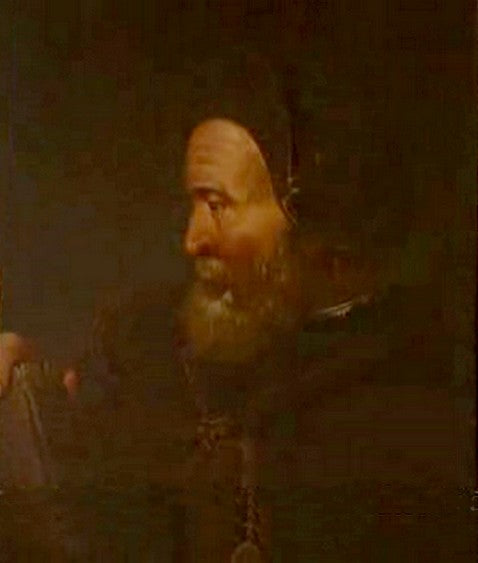
The Château de Chaumont-sur-Loire also preserves the astrologer’s memory. A “room known as Ruggieri’s” is presented there in the historic apartments. The estate also preserves a presumed portrait of Côme Ruggieri, an anonymous 17th-century oil painting.
This portrait, used on the cover of this biography, is unsigned, and its identification remains traditional. Nevertheless, it shows how Ruggieri was preserved in the château’s memory: an elderly man with a full beard, a dark skullcap, a focused gaze, and a hand resting on a book or document.
At Chaumont, local memory converges with stories of Catherine de’ Medici, astrology, and dynastic oracles. It is here that legend places one of the queen’s most striking consultations.
The Mirror of Chaumont and Catherine’s Three Sons
One of the great scenes in the tradition tells how Catherine, worried about the future of her sons after Henri II’s death, asked Ruggieri to show her what fate held in store for the Valois. The ritual was said to have taken place at Chaumont-sur-Loire, in a dark room, using a mirror, a circle, or a method of visionary divination.
Versions vary depending on the authors. Brantôme links a similar prophecy to Nostradamus; André Favyn and Nicolas Pasquier connect it to Ruggieri. In some versions, the future kings appear in a mirror and spin around as many times as they will reign for years. François II appears briefly, Charles IX for longer, and Henri III longer still. After him, nothing: the Valois male royal line comes to an end.
The story has the perfection of a retrospective oracle, but that is also what explains its power. Catherine's three sons would indeed reign one after another, and Henry III would die without a male heir in 1589. The Chaumont mirror thus became, in the French occult memory, one of the most powerful symbols of the announced end of a dynasty.
Another tradition holds that an astrologer warned Catherine that she would die “near Saint-Germain.” According to different versions, the author of the oracle was Ruggieri or Luca Gaurico. The queen is then said to have avoided places bearing that name and to have become concerned about the proximity of Saint-Germain-l'Auxerrois to the Tuileries.
Catherine eventually died at Blois on January 5, 1589. The story then adds its twist: the religious figure summoned to her bedside was said to be named Julien de Saint-Germain. The prophecy came true not through the place, but through the man.
Historians of architecture give other reasons for the gradual abandonment of some of Catherine's projects at the Tuileries. But the astrological version remains one of the oldest and most persistent. Above all, it illustrates how closely the idea of destiny was associated with the queen and her celestial advisers.
1574, the La Môle affair and the wax image
In 1574, Ruggieri found himself drawn into a much more dangerous affair. The kingdom was experiencing a political crisis: Charles IX was seriously ill, François d'Alençon was plotting with the Malcontent faction, and several gentlemen were seeking to remove the princes from the authority of the king and Catherine.
Joseph Boniface de La Môle and Annibal de Coconas were arrested. The investigation brought to light a wax figure associated with the ailing king. Sympathetic magic, in which an image represents a person and undergoes operations intended to affect or influence them, immediately became a matter of lèse-majesté.
The documentation is remarkable: a manuscript in the National Library of France preserves a letter from Catherine de' Medici “concerning the Florentine Cosme Ruggier, accused of having made a wax image to bewitch Charles IX.” The affair is therefore not an invention of a 19th-century novelist. The accusation of bewitchment lies at the very heart of the 1574 crisis.
Warned that they were seeking to arrest him, Ruggieri found refuge with the Tuscan ambassador Vincenzo Alamanni. The affair became embarrassing for Florentine diplomacy. Ruggieri escaped and was later found in the forest of Saint-Germain, disguised according to the accounts.
La Môle and Coconas were condemned and executed in the Place de Grève on April 30, 1574. Ruggieri, for his part, escaped the death penalty. He was sentenced to the galleys and sent toward Marseille. The difference in treatment struck contemporaries. The astrologer had considerable protection, and behind it the shadow of Catherine de’ Medici appears almost inevitably.
The sentence to the galleys seems to have been only partially carried out, if at all in the form one might imagine. Ruggieri quickly regained a remarkable freedom for a man implicated in a case of bewitching the king.
In 1585, he received the commendatory abbacy of Saint-Mathieu in Brittany. He thus became a commendatory abbot: he benefited from the abbey’s revenues without being a religious living according to the monastic rule.
The contrast is striking. The man accused a few years earlier of preparing a wax image against Charles IX now bears an abbatial title. In the logic of royal favors, this situation is not impossible; in the popular imagination, it further reinforces the idea of an astrologer protected by powers that transcend ordinary rules.
An old interpretation holds that he also served as an informant for the Duke of Alençon. His position was ideal: language tutor, astrologer, familiar with conversations, and discreet enough to hear what others could not approach.
It is difficult to draw a clear line between political intelligence and astrological service in a courtly environment. A good astrologer receives confidences, observes rivalries, and knows the concerns of those who ask him for a horoscope. His knowledge of the heavens is necessarily matched by a knowledge of people. This may be one of the keys to his influence: Ruggieri could advise because he read the stars, but also because he knew the princes.
1598, a new wax image under Henry IV
A new case of bewitchment was attributed to him in 1598, when Henry IV was now ruling France. According to Jacques-Auguste de Thou and the later biographical tradition, Ruggieri is said to have been questioned in Nantes after the discovery of a wax figure associated with the king.
The astrologer then defended himself by recalling that, on the contrary, he had supported Henry of Navarre during the events of 1572. Henry IV is said to have recognized this earlier goodwill and ordered his release.
Forty years after his early years at court, Ruggieri still seems to be surrounded by the same signs: horoscopes, royal protection, and suspicions of sympathetic magic. This longevity is remarkable. Many of Catherine’s servants disappear with the Valois dynasty. Ruggieri survives their wars, successions, and changes in favor.
His art perhaps enables him to move from one world to another without abandoning his identity. Astrology remains in demand under Henri IV, just as it was under Charles IX. The language of conjunctions, eclipses, and natal charts does not depend on a single dynasty.
Jean Querberus and the almanacs of 1604
Toward the end of his life, Ruggieri also leaves printed traces. Under the name Jean Querberus, he publishes an almanac in 1604 and a lengthy prognostication devoted to the great conjunction of Jupiter and Saturn that occurred on December 24, 1603, as well as to the eclipses and events expected during the year.
The text presents Querberus as a mathematician and constructs the authority of his predictions according to the astrological practices of the time. This pseudonym adds a new identity to the Florentine already known under several French forms of his name.
A signature by Ruggieri dated 1608 also survives on an astrological chart, very concrete evidence that, as an old servant of the Valois, he continued to draw up celestial figures during the early years of the 17th century.
After the assassination of Henri IV in 1610, Marie de Medici's regency brings an Italian entourage back to the forefront. Ruggieri grows closer to the circle of Concino Concini and Léonora Dori Galigaï, whose reputation will itself be burdened, a few years later, by suspicions of witchcraft and occult influence.
The old Florentine thus finds, at the evening of his life, a world that in some respects resembles Catherine's: a Medici queen, Italian favorites, court quarrels, and a France where astrology continues to exist alongside politics.
1615, a death worthy of his legend
Côme Ruggieri dies in Paris on March 28, 1615. The account of his final moments is preserved by the Mercure françois and repeated by several 17th-century authors. Priests and Capuchins come to offer him the last rites. Ruggieri sends them away. The Mercure attributes to him a statement of almost theatrical violence, in which he rejects the existence of devils from the other world and recognizes as true powers only the enemies who torment men and the princes capable of granting honors and riches.
Whether spoken exactly this way or reconstructed by chroniclers, these words are enough to cause a scandal. To an opinion already inclined to see him as an impious mage, they sound like a final confession.
Popular anger seizes his corpse. Accounts say that he is dragged through the streets and treated as an atheist, a sorcerer, or a man devoted to the devil. His death gives rise to sensational pamphlets, including Gruesome Stories of Two Magicians Who Were Strangled by the Devil in Paris during Holy Week.
The title says everything about the speed with which the real man is transformed into a demonic exemplum. Barely dead, Ruggieri is no longer merely Catherine's astrologer: he becomes the magician punished by the powers he is said to have served.
The categories do not overlap neatly. To his contemporary diplomats, Ruggieri is an educated man who knows judicial astrology. To his enemies, he makes bewitched images. To his protectors, he is a useful adviser. In the pamphlets of 1615, he becomes almost a damned man.
His intellectual world partly eludes us. His few surviving texts mainly speak the language of astrology. But the 1574 affair shows that the practices involving wax figures were not attributed to him solely by later novelists. The boundary between learned astrology and operative magic was then far less impermeable than it would become in modern classifications.
The wax image placed at the center of the La Môle affair belongs to a very ancient logic of sympathetic magic: acting upon a representation in order to reach the person represented. Medieval and Renaissance Christianity severely condemned such operations when they targeted an individual's health or life.
In a royal affair, the charge becomes political. Bewitching the king's image could be interpreted as an attempt to act directly upon his body and therefore upon the order of the kingdom. The wax figure thus links Ruggieri to a history of magic very different from that of the simple horoscope. It explains why his name would remain associated for centuries with the word “sorcerer” as much as with “astrologer.”
The phrase is late, but it admirably sums up his legacy. Catherine de Médicis herself was enveloped by a black legend in which poison, magic, astrology, and Machiavellianism were intertwined. Ruggieri naturally becomes her nocturnal double: the one who reads the sky while the queen rules the earth.
This image owes much to literature, but it does not arise from nothing. Diplomatic dispatches attest to the closeness; manuscripts attest to the accusation of bewitchment; almanacs attest to the astrologer. Literature merely brought these fragments together into a coherent figure.
Balzac transforms Ruggieri into a great mage
In the 19th century, Honoré de Balzac plays an immense role in this transformation. In Sur Catherine de Médicis, and particularly in the accounts related to the Ruggieri family, he turns Cosme into an almost philosophical character: astrologer, alchemist, supreme adviser, and possessor of a secret science of the world.
Balzac invents or attributes relationships, a brother, and scenes to him that the documentation does not always confirm. But his Ruggieri becomes so powerful in literary terms that it feeds back into the historical image of the figure.
The Maison de Balzac also preserves an engraving plate depicting Cosme Ruggieri, produced in the 20th century to illustrate this literary world. Alexandre Dumas also reworks Ruggieri. In Henri III and His Court, first staged at the Comédie-Française in 1829, Côme Ruggieri appears in the first act in a nocturnal study, gazing at the sky and waiting for the auspicious hour for a magical experiment.
This theatrical scene fixed the image of the Medici astrologer for generations: lamp, night, tower, celestial calculations, spirits, and masked queen. The 16th-century courtier becomes a quintessentially Romantic character.
The portrait preserved at Chaumont-sur-Loire and now reproduced on Wikimedia Commons is dated to the 17th century, and its author is unknown. It is traditionally identified as Côme Ruggieri.
The dating is close enough to his lifetime to make the image particularly valuable, but the identification remains presumed. That is precisely what suits Ruggieri: even his face reaches us through a veil.
Ruggieri’s prophecies are regularly attributed to Nostradamus, and vice versa. This can be explained by the memory of Catherine de Medici, around whom the two names became linked.
Nostradamus is above all the printed author of the Centuries and the almanacs that brought him European fame. Ruggieri is more the courtier, the close adviser, whose predictions became entangled with the immediate affairs of power. One speaks from Salon-de-Provence and his books; the other acts just a few steps from the queen.
How should we read Côme Ruggieri today?
Reducing him to a charlatan would obscure astrology’s real place in Renaissance politics. Turning him into an all-powerful sorcerer would make us forget the dispatches, diplomatic networks, and positions he held at court.
Ruggieri is most interesting at the point where these two dimensions meet. He was an astrologer who was genuinely consulted, a man implicated in a genuinely documented bewitchment case, and a figure whose memory absorbed the great magical fears of his century.
His story helps us understand a world in which one could be a language master, commendatory abbot, astrologer, adviser, and suspected sorcerer without these identities seeming entirely incompatible.
Côme Ruggieri did not leave behind a body of work comparable to that of Agrippa, Nostradamus, or Paracelsus. His legacy lies elsewhere: in the very figure of the court astrologer, who remained close enough to power for his calculations to become a matter of state.
The Medici Column, the Chaumont chamber, the 1574 wax image, Querberus’s almanacs, the prophecy of Saint-Germain, and the Valois mirror now form an almost ritual ensemble. They all tell the same story: at Catherine’s court, the heavens were never far removed from politics.
To explore further this history of magic and power in France, you can read our biography of Nostradamus, that of La Voisin, our article on Cornelius Agrippa, as well as our feature Occultism, a History of France.
Sources and reference points
The Bibliothèque nationale de France identifies Côme Ruggieri with the dates “15..-1615” and preserves several documents related to his activities. The BnF manuscript Français 23356 notably contains a letter from Catherine de Médicis concerning the Florentine “Cosme Ruggier,” accused in 1574 of making a wax image intended to bewitch Charles IX.
The Catalogue collectif de France also records astrological predictions in Italian addressed to a prince around 1561-1562 and attributed to Ruggieri. The document mentions Catherine de Médicis, the Prince of Condé, and the Catholic triumvirate.
For the Tuscan diplomatic dispatches of 1572 and 1574, Négociations diplomatiques de la France avec la Toscane, published in the 19th century from archival materials by Abel Desjardins, preserves the testimonies of Petrucci and Vincenzo Alamanni concerning Ruggieri's astrological activity and his standing with Catherine.
Eugène Defrance's work, Catherine de Médicis, ses astrologues et ses magiciens-envoûteurs, published by Mercure de France in 1911 based on numerous archival documents, remains an important compilation for the 1574 affair, the magic mirror, and the occult traditions associated with the Valois court.
Paris Musées documents the Medici Column, erected in the courtyard of the Queen's residence and connected to Catherine's apartments by a door. Its astrological function belongs to the tradition associated with the monument.
The cover uses a portrait believed to depict Côme Ruggieri, an anonymous 17th-century oil painting held at the Château de Chaumont-sur-Loire. The work and its faithful reproduction are in the public domain.

Par Olivier of Aeternum
Passionate about esoteric traditions and the history of the occult from the earliest civilizations to the 18th century, I share some articles on these topics. I am also co-creator of the online esoteric shop Aeternum.













Interessant .