





























































































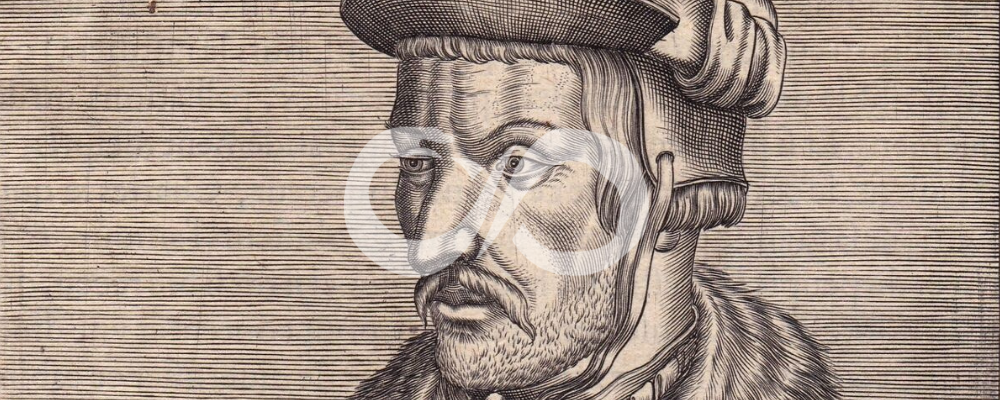
Cornelius Agrippa (1486-1535) was a Renaissance scholar, physician, philosopher, and mage who devoted his life to uncovering the secrets of the visible and invisible worlds. In his masterwork De Occulta Philosophia (Occult Philosophy), published in 1533, he presents a striking picture of the universe in which every element of nature is connected to hidden forces. Here is an explanation.
Agrippa's Vision
The ambition is as grand as it is difficult to define: to synthesize all the occult knowledge of his time into a vast, coherent system reconciling ancient heritage, science, theology, and the magical arts. For Agrippa, the cosmos is not an inert mechanism but a living network permeated by spiritual influences, a great web linking heaven and earth. He asserts that angels, demons, stars, and planets all exert their influence on the material world, forming a continuous chain from the divine to the earthly. Far from viewing them as separate domains, Agrippa conceives of three interwoven “worlds” – the elemental world of visible nature, the celestial world of the stars, and the spiritual world populated by angels and spirits – that communicate constantly. Each level acts upon the one below it according to the principle of universal correspondences. Understanding these correspondences means reading the great book of creation that God has given humanity. Driven by a profound faith in the unity of knowledge, Agrippa urges the reader to enter this sanctuary of occult knowledge, as though it were a true “philosophy of nature” illuminating the mysteries of life and the soul.
A Universe Woven with Invisible Connections from Heaven to Earth
Agrippa imagines the universe as a hierarchy of forces emanating from God and descending to the humblest creatures. At the summit are God and the celestial intelligences (angels), intermediaries of the divine; lower down, the wandering stars – planets and stars – radiate their influences; finally, at the very bottom, the elemental world is governed by these occult influxes. Nothing exists in isolation: every plant, every stone, every animal, and even every part of the human body bears the secret mark of the star or spirit that governs it. Agrippa explains that celestial influences “shape every being and every object on earth, giving it its properties as well as outward signs that reveal them to the mage's trained eye.” For those who know how to decipher these hidden “signatures,” all of nature becomes a coded book in which the imprint of the stars can be read.
This holistic vision of the cosmos draws on the Hermetic tradition, Neoplatonism, and Christian Kabbalah, which the mage integrates into a unified system. De Occulta Philosophia presents itself as an encyclopedia of natural and celestial magic organized into three books corresponding to the three worlds. Agrippa displays extraordinary learning, compiling both ancient knowledge (Plato, Aristotle, Pythagoras) and the recipes of Arab alchemists and the esoteric teachings of the Middle Ages. With the fervor of an encyclopedist, he catalogues the elements, plants, minerals, animals, and even the parts of the human soul, specifying for each the planetary or spiritual influence to which it belongs. For example, a medicinal herb may be placed under the tutelage of Venus because of its affinity with love, while a metal may correspond to Mars because of its martial harshness, and so on. Occult Philosophy describes an enchanted nature in which every physical phenomenon has an occult cause. Agrippa insists that nothing happens “by chance”: earthly events reflect the interplay of celestial forces. Thus, mastering occultism means understanding these subtle mechanisms. He therefore asserts that no one can become a true mage without mastering astronomy and astrology, the sciences of the heavens that reveal the plan of destiny. The world according to Agrippa is an organic whole in which the visible and invisible are continually interwoven, guided by divine Providence.
Humanity, the Microcosm between Earth and Heaven
In this Agrippian cosmology, the human being occupies a central place. Humans are conceived as a microcosm, a “small universe” reflecting within itself all the layers of Creation. Human beings possess a physical body composed of earthly elements, a soul governed by the stars and cosmic influences, and an immortal spirit linked to the divine. Thus, humanity stands at the crossroads of the material and the spiritual, receiving the influxes of the heavens while aspiring to rise toward God. For Agrippa, the vocation of the wise person (the magus) is precisely to serve as a conscious link between earth and heaven. By studying the occult arts, the mage learns to harmonize these three dimensions within themselves – body, soul, and spirit – in order to act in accordance with the cosmic order.
Agrippa describes the mage's path as a true quest for personal and spiritual perfection. The practitioner of magic must accumulate knowledge: they must understand the movements of the stars, the secret properties of plants and stones, sacred mathematical symbols, and also master religious symbols and the language of the angels. This theoretical knowledge is not enough – it must be accompanied by a transformation of the self. Agrippa emphasizes that the authentic mage must display great moral purity and rigorous discipline in life. He writes that the adept needs asceticism and self-mastery, for the culmination of their art consists in communicating with angelic spirits. Thus, magic is not a simple technique: it is a path of elevation. By deciphering the secret laws of the universe, human beings hope to approach divine wisdom. Agrippa views occult philosophy as a path leading “toward knowledge of God while exploring every order of beings on earth.” This double orientation – ascending toward the divine and descending into the depths of the sublunary world – gives the magician's life its full meaning. Their task is to transform their own nature and improve the world in accordance with the divine will. In De Occulta Philosophia, Agrippa also proposes numerous ways to ward off harmful influences and strengthen the beneficial influences acting upon human destiny. Through prayer, knowledge of natural secrets, and the use of sacred symbols, people can protect themselves from evil and draw the favor of celestial powers toward them. According to Agrippa, life takes on a sacred dimension: every everyday action (healing oneself, sowing, traveling…) can be harmonized with cosmic cycles to attract a favorable outcome. It is a vision in which faith and science become one, with humanity acting as God's collaborator in administering the wonders of the world.
Stars, Angels, and Spirits: The Role of the Invisible
For Agrippa, the stars are not merely physical bodies; they are sources of spiritual influences. Following the ancient and medieval tradition, he asserts that each astrological planet (Saturn, Jupiter, Mars, Sun, Venus, Mercury, Moon) is animated by invisible entities. “For each planet, God has appointed an Intelligence for good and a Spirit for evil,” Agrippa explains. In other words, a benevolent angel (called an Intelligence or genius in his terminology) governs the planet's positive influences, while a lower, more earthly spirit reflects its negative aspect. These planetary entities serve as mediators between the divine world and the material world. Saturn – the star of melancholic wisdom – possesses, according to Agrippa, a ruling angel named Agiel and a spirit named Zazel, both linked to the vibration of the number 45, which is the mystical sum of the magic square of Saturn. Likewise, Jupiter, the planet of benevolence and expansion, is under the aegis of the archangel Sachiel and the genius Hismael, whose Kabbalistic names correspond numerically to the number 136, the sum of Jupiter's square. Everything in Agrippa's system is interconnected: sacred numbers, the names of spirits, and graphic symbols echo one another, expressing the same reality on different planes.
Knowing the name and character of a planetary angel allows the mage to invoke its influence. Agrippa, like his medieval predecessors, details the rituals for making contact with these invisible forces. He recommends proceeding at the astrologically auspicious time: “on the day and at the hour of the planet concerned,” with the appropriate incense, prayers, and offerings, in order to attract the attention of the planetary genius being addressed. A magical working associated with Mars should ideally be performed on a Tuesday (Mars's day) during the Martian hour, burning a pungent red resin corresponding to this planet and reciting prayers addressed to its angel. When these conditions are met, the channel between the earthly world and the astral world opens. The mage can then obtain the desired favor from the planetary Intelligence – whether the contemplative wisdom of Saturn, the protection of Mars, or love under the aegis of Venus. Of course, Agrippa warns that all cosmic energy is ambivalent. If improperly invoked, or in an unfavorable astrological context, a planet's influence may turn into harmful effects. This is why the occultist insists on the need to act in harmony with the luminous side of the stars (their angelic Intelligences) rather than with their dark spirits. Agrippa's invisible world is not Manichaean but polarized: it is up to human beings to choose to direct their actions toward the light. By respecting the sacred laws of astrology and theurgy (the art of invoking celestial entities), the mage becomes the collaborator of the angels. They gain access to a network of cosmic alliances: nature itself – stars, elements, and spirits – then becomes their ally.
Pantacles and Seals: The Art of Harnessing Occult Forces
Agrippa does not merely describe invisible influences theoretically – he also provides practical means of working with them. His entire Occult Philosophy is also a manual of operative magic. To manipulate subtle forces, the mage has an array of sacred tools, which the work details precisely: talismans, pentacles (or pantacles), charms, figures, seals, invocations… These duly consecrated objects and signs serve as receivers and transmitters of occult influences. Agrippa thus offers his readers a multitude of methods for diverting harmful influences and strengthening beneficial ones. Among the most impressive are the planetary tables (or magic squares). These are grids of numbers arranged so that their rows and columns always produce the same sum – each planet having its own square. Agrippa devotes an entire chapter of Book II to these seven planetary squares inherited from ancient tradition, which he calls the “sacred tables of the planets,” attributing to them great celestial virtues consistent with the divine harmony of numbers. Each magic square is associated with a planet, a key number, divine and angelic names, as well as the corresponding mystical seals and characters. The square of Saturn (3×3) gives the sum 15 in every row and column, and its total of 45 appears in the sacred names linked to Saturn; from this square are derived a geometric symbol (called the character of Saturn) as well as two seals – that of the Intelligence Agiel and that of the Spirit Zazel – graphically summarizing Saturnian power. Likewise, the square of Jupiter (4×4) has a magic constant of 34 and a total of 136, corresponding to the names of the angel Yophiel and the genius Hismael, and it generates a seal belonging to Jupiter, formed by connecting certain numbers according to a precise sequence. These figures are not merely numerological speculation – Agrippa explains how to use them concretely as talismans.
Each pantacle or talisman must be made according to the rules of the art, respecting the correspondences of the planet concerned. The material, the time of manufacture, and the sacred inscriptions – everything is codified. The mage engraves the magic square on a metal associated with the planet, during a favorable astrological hour, and then consecrates the talisman with prayers. Thus, “the square of Jupiter is engraved on tin (the metal attributed to Jupiter), preferably on a Thursday at Jupiter's hour, when the planet is astrologically fortunate.” Such a talisman is reputed to attract luck, wealth, and divine favor, bringing success, honors, health, and inner peace to its wearer. Agrippa also reports that “if the square of Jupiter is impressed on a silver plate when Jupiter dominates the sky, it brings profit, love, and harmony; engraved on coral, it destroys evil enchantments.” Likewise, the square of Saturn engraved on lead will protect its wearer from curses and sadness – provided it is made when Saturn is well disposed; otherwise, the effect could be reversed into obstacles and curses. The pantacle is therefore a condenser of influences: when properly used, it attracts the beneficial planetary essence and repels harmful influence.
In addition to magic squares, Agrippa describes a host of other occult symbols. Planetary seals, obtained by drawing lines connecting certain sacred letters or numbers, capture the spirit of the planet and serve to mark talismans. Divine and angelic names drawn from the Kabbalah are engraved around the talismans to invoke celestial protection. Agrippa also provides squares of letters forming mystical words, geometric figures expressing cosmic harmony, and talismanic images (for example, the representation of a lion for the Sun, a bull for Venus, and so on) intended to bring the object into resonance with the targeted force. Every element matters: the color of the candle used, the incense burned, the sacred word spoken during the ritual… By combining these ingredients, the mage creates a material vessel in which invisible influences can reside. Agrippa's philosophy takes on a highly practical form here: by carefully preparing pantacles and seals, the adept equips themselves with objects of power capable of acting at a distance on people and events. For Agrippa, magic is an operative science that makes it possible to “change the course of things” in accordance with the universal order. The mage is not an illusionist but a technician of the sacred who knows how to harness and direct the occult currents diffused throughout Creation.
The world according to Agrippa thus appears as a great temple in which everything, from the stars to the stones, possesses meaning and influence. In this temple, the mage officiates as a priest of nature, using the symbolic keys handed down by tradition to open the doors of mystery. This vision of the world, in which nature teems with divine secrets and the human spirit can commune with angels, has exerted a lasting fascination. Certainly, even in his own time, Agrippa had to face skeptics and concerned theologians, but his Occulta Philosophia became over the centuries a foundational text of Western esotericism. To believe with Agrippa is to accept that the visible is only part of reality, and that behind the movement of the planets or the growth of plants operates an intelligence waiting to be deciphered. It is to adopt a sense of wonder toward creation, where the marvelous exists alongside the everyday.

Par Olivier of Aeternum
Passionate about esoteric traditions and the history of the occult from the earliest civilizations to the 18th century, I share some articles on these topics. I am also co-creator of the online esoteric shop Aeternum.