




























































































In the 18th century, Europe was fascinated by men who promised to open invisible doors. Courts welcomed alchemists, salons discussed magnetism, Masonic lodges multiplied initiatory systems, physicians confronted healers who claimed different knowledge of the body, and accounts from Egypt nourished an imagination of lost wisdom. Amid this world appeared a man whose name eventually circulated from London to Saint Petersburg, from Strasbourg to Lyon, from Paris to Rome: Alessandro, Count of Cagliostro.
His reputation is not based on a single discipline. He treats people, prepares remedies, speaks of alchemy, practices clairvoyance, organizes séances in which children serve as intermediaries for visions, frequents lodges, and founds his own Masonic system, the Egyptian Rite. He receives nobles, prelates, bourgeois, the sick, and the curious. His admirers see him as a man bearing ancient knowledge. His enemies describe him as a skilled impostor. Between these two images, the documentation reveals an even more interesting figure: an initiatory adventurer capable of understanding with remarkable precision what Europe of his time expected from a mage.
Cagliostro does not merely talk about occultism. He constructs himself as an occult figure. His origins become uncertain, his travels take on extraordinary tales, his remedies become part of a sacred vision of medicine, his Masonic rite claims to restore a tradition from Egypt, and his own identity seems gradually to detach itself from that of Giuseppe Balsamo, the man born in Palermo in 1743. This transformation partly explains the fascination he still exerts today.
Yet it would be too simple to portray him either as a saint of tradition or as a fairground charlatan. Cagliostro's life is caught between court documents, defensive writings, hostile pamphlets, testimonies from admirers, and a mass of later accounts. For the occultist, it is precisely this mixture that deserves attention. Cagliostro belongs to that zone where history, initiation, traditional medicine, esoteric Freemasonry, and the creation of a personal legend converge.
From Giuseppe Balsamo to Count Cagliostro
Giuseppe Balsamo was born in Palermo on June 2, 1743, into a modest family. Italian biographical works give his father's name as Pietro Balsamo and his mother's as Felicita Bracconieri. His father died while he was still a child. He subsequently received his education at the San Rocco seminary and then, in 1756, at the Fatebenefratelli monastery in Caltagirone. This monastic period played an important role in his trajectory, as it is said to have brought him into contact with the monastery's dispensary and with knowledge of pharmacy, substance preparation, and practical medicine.
This early training helps explain what followed. Cagliostro would never present himself solely as a seer or alchemist. Healing would remain at the heart of his persona. His remedies, elixirs, powders, regimens, and way of combining plants, minerals, words, and gestures belong to a vision of care in which matter and the invisible are not separate. This way of viewing medicine was not unusual in 18th-century Europe, which still preserved Paracelsian, alchemical, and astrological legacies alongside academic medicine.
Balsamo's youth is more difficult to trace with certainty. Some of the accounts come from the case assembled against him by his adversaries and the Roman Inquisition, while his own defense memoir transforms his youth into an almost fabulous initiatory journey. In it, he refers to an Eastern origin, distant stays, Malta, Egypt, Arabia, and masters whose names are difficult to verify. This autobiography cannot be read as a simple civil registry. It already forms part of the construction of Cagliostro.
This point is essential. In initiatory traditions, public identity and spiritual identity may not coincide. New names, titles, symbolic lineages, and origin stories serve to place a man within a chain of transmission. With Cagliostro, this logic reached exceptional proportions. Giuseppe Balsamo gradually became Alessandro Cagliostro, then the “Grand Copt” of his Egyptian Freemasonry. The civil man did not disappear, but a second identity was superimposed on him until it became the one remembered by history.
In Rome, he married Lorenza Feliciani in 1768. She would play a far more important role than that of a wife accompanying her husband's travels. Under the name Serafina, she took part in Cagliostro's initiatory world and held a prominent position in the female structures of his Egyptian Rite. The couple then traveled through several European cities and used different names. This mobility helped obscure their tracks while creating a network of relationships.
London marks a turning point. Around 1776, Balsamo permanently adopts the name Cagliostro and comes into contact with Masonic circles. Eighteenth-century Freemasonry does not form a uniform bloc. Alongside more restrained lodges, there are systems of high degrees and Christian, chivalric, alchemical, Hermetic, and theosophical currents. The researcher Nicholas Goodrick-Clarke has shown how these currents served as vehicles for Rosicrucian, theosophical, and alchemical legacies. Cagliostro therefore arrives in terrain already prepared to receive a new system.
His genius lies in not proposing just another variant. He presents a path that claims Egypt as its source, a prestigious source of wisdom since Antiquity and even more so since the Hermetic Renaissance. Cagliostro’s Egypt is not the Egypt that modern archaeology would later reconstruct. It is initiatory Egypt, the repository of a sacred science predating the European schools. This choice immediately places his rite above ordinary lodge disputes: it claims to return to the source.
To place this stage in context, our article on the history and principles of Freemasonry helps explain the institutional framework in which Cagliostro operated, while The Legacy of Egyptian Magic sheds light on the immense prestige Egypt held among European esoteric movements.
The Grand Copt and Egyptian Freemasonry
Cagliostro’s Egyptian Rite is not merely an exotic decoration added to Freemasonry. It carries an ambition of regeneration. In his system, initiation must transform the human being, restore their faculties, and draw them closer to a lost state. This idea of regeneration runs through much of Western esotericism: ordinary human beings are incomplete, scattered, or fallen, and initiation aims to reorder them.
Cagliostro places himself at the summit of this structure under the title of Grand Copt. The term evokes Christian Egypt and reinforces the idea of an Eastern transmission. He therefore does not merely claim to administer an order; he embodies the initiatory authority that guarantees the system’s validity. His travels across Europe serve to establish groups, attract influential members, and disseminate this new Masonic architecture.
The years that follow take him notably to Courland, Russia, Poland, and then into the German- and French-speaking world. Not all stages are alike. In some cities, he arouses enthusiasm; elsewhere, he encounters hostility or expulsion. Catherine II’s Russia proves unwelcoming to him. Strasbourg, by contrast, becomes one of the high points of his career.
When he arrived in Strasbourg in the early 1780s, Cagliostro received patients and offered his treatments. Accounts recorded by biographers emphasize the free care given to the poor and his generosity. Official medicine viewed him with suspicion, but his success quickly surpassed the mere reputation of an itinerant healer. He attracted the Swiss banker Jean-François de Sarasin, the thinker Johann Kaspar Lavater, and above all Louis-René-Édouard de Rohan, cardinal and prince-bishop of Strasbourg.
His relationship with Rohan changed the scale of his influence. The cardinal belonged to the highest aristocracy and lived in close contact with royal power. He was interested in alchemy, secret sciences, and promises of regeneration. Cagliostro found in him a convinced protector, while Rohan saw in the Sicilian mage a man capable of accessing knowledge unavailable to official culture.
Cagliostro once summed up his medical art with the Latin phrase “in verbis, in herbis, in lapidibus”: in words, herbs, and stones. This sentence perfectly captures the world to which he belonged. Healing did not depend on an isolated substance. Word, plant, and mineral acted together within a conception in which the visible body was part of a vaster order.
This conception resonated with entire strands of the European magical tradition. Plants possessed specific virtues; stones had qualities linked to their nature, color, the stars, or signatures; sacred words commanded, blessed, or directed action. Cagliostro did not create these principles. He brought them together in a personal practice combining healing, magnetism avant la lettre, pharmacopoeia, and initiatory authority.
After Strasbourg, Lyon became another major center. The city was then home to an especially rich Masonic milieu, shaped by the Élus Coëns, Jean-Baptiste Willermoz, and high-degree systems. Cagliostro established the mother lodge of his Egyptian Rite there, “Triumphant Wisdom.” The choice of Lyon was far from incidental: it was one of the great European centers of esoteric Freemasonry.
In Paris, his Egyptian Rite took on a spectacularly worldly dimension. A lodge called “Isis” welcomed women; Serafina, that is, Lorenza, served as its grand mistress. This female presence distinguished Cagliostro’s system from much of regular male Freemasonry. The couple thus offered a complete structure, with its own language, degrees, officers, regenerative practices, and Egyptian imagery.
The Philalethes, a Parisian Masonic circle passionate about researching the origins and secret doctrines of Freemasonry, sought to attract him to their grand convent. Cagliostro refused to place himself on the same level as the other schools. He demanded recognition of the authority of his Egyptian Rite, making agreement impossible. This refusal reveals a constant trait of his character: he did not want to be one participant among others. He intended to be recognized as the custodian of a higher path.
The importance of this phase extends beyond Cagliostro himself. It shows that Enlightenment Europe was not simply moving toward a uniform rationalism. At the same time that academies were codifying the sciences, some members of the elite were seeking systems capable of bringing together religion, nature, medicine, alchemy, and initiation. Magnetism, high Masonic degrees, Rosicrucian revivals, and Hermetic currents all responded to the same need to rediscover a science of humanity that did not separate the visible from the invisible.
The thaumaturge of salons and consulting rooms
Reducing Cagliostro to Freemasonry would mean overlooking much of what explained his success. The public also knew him as a healer, alchemist, seer, and performer of clairvoyant phenomena. He presented himself as a man of practical knowledge. People came to see him for an illness, a consultation, an extraordinary experience, or to join his circle.
Healing occupies a central place. Even hostile sources acknowledge the extent of his clientele. In Strasbourg, he received large numbers of patients, and his free practice among the poorest contributed to his reputation as a benefactor. Historians cannot establish the exact nature of every reported healing, but the social fact is clear: people said they felt relieved, and his name spread through them.
His medical art combines material remedies with personal action. The laying on of hands, words, plant and mineral preparations, diets, and elixirs all form part of the same whole. We must avoid imposing our contemporary categories on him. In the 18th century, the boundary between recognized medicine, empirical medicine, alchemy, and occult arts remained marked by conflict. Cagliostro operated precisely on this boundary.
He also practiced scrying. Accounts describe the use of young subjects, called “pupils” or “doves,” placed before a carafe of water, a mirror, or a surface intended to make images appear. The logic is close to catoptromancy and crystallomancy: a shiny or transparent surface serves as a medium for vision, while a receptive subject describes what appears.
This practice was not invented by Cagliostro. The arts of scrying through a mirror, water, or crystal have a very ancient history. Our article on catoptromancy allows you to trace their roots and uses. What distinguishes Cagliostro is the public place he gives these experiences in European salons and the way he incorporates them into his authority as a mage.
The spectacle must not make us forget the magical structure. In a traditional scrying session, the seer is not necessarily the person directing the operation. An operator may organize the space, formulate the request, and guide a subject who receives the images. This separation of roles is found in several traditions of ceremonial and divinatory magic. Children, considered less burdened by adult passions or more receptive, appear in several ancient texts as scrying mediums.
Cagliostro also employed alchemy, not only as a promise of transmutation but as a language of regeneration. Gold, the elixir, purification, and the renewal of the body form a coherent whole with his Egyptian Rite. For him, alchemy is not merely a secret metallurgy. It becomes both an image and a means of human transformation.
This brings him closer to the Hermetic tradition, in which the transformation of matter and that of the operator mirror one another. Readers who wish to place this dimension within a broader history can continue with Alchemy or the Art of Transmutation and Everything You Need to Know About Hermeticism.
Cagliostro’s fame therefore stems from the combination of several roles that our era keeps separate. He is at once an initiatory leader, therapist, seer, experimenter, alchemist, and man of society. This combination is not a mere biographical detail; it reflects a traditional conception of the mage as someone capable of reading several levels of reality and acting upon them.
His personal magnetism also played a role. Witnesses spoke of his gaze, his presence, his confidence, and his ability to impose an atmosphere. He knew how to stage himself without giving the impression of putting on a performance in the modern sense. His attire, titles, language, silences, and the stories surrounding him all contributed to the same construction. An 18th-century mage exists not only through what he knows; he also exists through the way he makes his knowledge perceptible.
This commanding presence explains why the question “swindler or initiate” is too simplistic. An impostor can lie about his origins without all his knowledge being false. A man convinced of his mission can embellish his biography. An operator can achieve results that his era interprets through several competing frameworks. Cagliostro cannot be reduced to a label because his career unfolded precisely in this ambiguous space.
The Queen’s Necklace and the Parisian Downfall
In 1785, Cagliostro was at the height of his Parisian fame. His protector, Cardinal de Rohan, was then implicated in one of the most explosive affairs of the late Ancien Régime: the Affair of the Queen’s Necklace. The fraud centered on a sumptuous diamond necklace that jewelers sought to sell to Marie Antoinette. Jeanne de La Motte persuaded Rohan that she could bring him closer to the queen and led him to participate in acquiring the jewel on behalf of a royal connection that did not exist.
Cagliostro was drawn into the affair because he was close to the cardinal. This proximity was enough to fuel suspicion. The man already possessed everything a scandal loves: an uncertain title, occult activities, an international reputation, an origin shrouded in contradictory stories, and a powerful protector. He therefore became an ideal suspect.
He was arrested in August 1785 and taken to the Bastille. The event transformed his legend. Until then, his adversaries could accuse him of charlatanism or suspicious practices. From then on, his name became entangled in an affair that directly affected the monarchy, Cardinal de Rohan, and Marie Antoinette’s image.
Cagliostro’s defense is documented by the printed briefs published in 1786, now preserved notably at the National Library of France. His lawyer, Jean-Charles Thilorier, published a memorandum intended to demonstrate that no serious evidence linked Cagliostro to the necklace fraud. The text also served to defend his public persona and present his career in a favorable light.
The Parliament of Paris acquitted him. This fact is crucial, as it corrects the popular image of a Cagliostro convicted as an accomplice in the Affair of the Diamond Necklace. Historical sources instead indicate that he was implicated without solid grounds and released. His exit from the Bastille even became a moment of public triumph: a crowd cheered him.
The legal victory nevertheless did not allow him to remain in France. A royal order required him to leave the kingdom. The man who had fascinated Paris was expelled just as his acquittal seemed to seal his triumph. This contradiction helped strengthen the legend. In the eyes of his supporters, he appeared to be a man unjustly struck down by the authorities; to his enemies, his departure offered an opportunity to destroy his reputation.
He went to London. There, the journalist Théveneau de Morande published attacks in the Courrier de l’Europe intended to identify Cagliostro as Giuseppe Balsamo and expose the least glorious episodes of his past. His civil name thus became a weapon. Saying “Balsamo” meant tearing away the mask of “Cagliostro” and reducing the Grand Copt to the Palermo adventurer.
This battle over the name is fascinating from an occultist perspective. Every initiation involves work on identity. The name received or chosen marks a status, a function, and a lineage. Cagliostro’s adversaries instinctively understood that attacking him over his name meant striking at his authority. They were not merely disputing his actions; they wanted to show that the initiatory persona rested on a fabricated identity.
Cagliostro responded with letters and public statements. He defended his honor, maintained uncertainty about his origins, and refused to let himself be confined by his enemies’ narrative. His career then became a war of texts. Pamphlets, legal memoirs, caricatures, and testimonies constructed several competing Cagliostros.
The British Museum holds a Masonic caricature from 1786 in which he is ridiculed in the middle of a London lodge. The engraving is valuable because it shows that his reputation had already extended beyond the realm of occultism: Cagliostro had become a European figure whom people could recognize, admire, or mock. His silhouette belonged to the public culture of his time.
This fame also explains his presence in Occultism, a History of France, where he appears amid an 18th century divided between fascination with the secret sciences and the rise of new rationalist discourses. He embodies this tension all by himself.
Rome, the Inquisition, and the birth of a legend
After London, Cagliostro took to the road again. He passed through several European territories before returning to Italy. In 1789, he settled in Rome, a dangerous choice for a man who led a Masonic rite and claimed spiritual powers in the Papal States. Freemasonry was forbidden there, and the Inquisition viewed this type of activity with absolute hostility.
Cagliostro nevertheless attempted to establish his Egyptian Rite. He was arrested at the end of 1789 and imprisoned in Castel Sant'Angelo. The Roman trial was the last great scene of his life. The authorities were not merely judging Giuseppe Balsamo for possible deceptions; they were also judging the leader of a Masonic system that the Church considered dangerous.
The Holy Office dossier subsequently became one of the main sources on his youth and activities. It must therefore be read with caution. An inquisitorial trial seeks to establish wrongdoing and classify behavior according to the tribunal's categories. The accounts it contains are valuable, but they do not constitute a neutral biography.
In 1791, Cagliostro was sentenced to death. The sentence was commuted to life imprisonment. On April 21, 1791, he was transferred to the fortress of San Leo, in the Papal States. His cell was extremely harsh and almost completely cut the prisoner off from the outside world. The surviving administrative reports describe a gradual deterioration in his physical and mental condition.
The contrast is brutal. Just a few years earlier, he had frequented Parisian salons, received nobles, founded lodges, treated crowds, and established his name throughout Europe. In San Leo, the Grand Copt no longer had disciples around him, a circle to lead, or a public stage. He remained imprisoned under surveillance until his death on August 26, 1795.
His disappearance did not put an end to Cagliostro. On the contrary, it freed the character from the real man. Some accounts claim that he escaped from prison, survived under another identity, or used his knowledge to cheat death. These legends have no solid historical basis, but they show how much the figure constructed during his lifetime had become stronger than Giuseppe Balsamo.
The 19th century and then the 20th century would successively make him an impostor, a great initiate, a novel hero, a mage, a conspirator, a healer, and a forerunner. Each era chooses its own Cagliostro. Rationalists retain the adventurer; occultists retain the initiate; historians of Freemasonry study the Grand Copt; enthusiasts of the Affair of the Diamond Necklace see the prisoner of the Bastille.
For us, his interest lies precisely in the whole. Cagliostro shows what a European mage could be at the end of the 18th century when he was not limited to a single specialty. He connected medicine, alchemy, clairvoyance, initiation, Egyptian symbolism, and work on identity. He regarded these fields as the branches of a single tree.
His Egyptian Rite disappeared in its original form, but the idea of an Egyptian Freemasonry would outlive him and nourish other systems. His image as an initiated healer would also influence how modern occultism envisioned the traditional master. Even his enemies contributed to his legacy by multiplying the texts, caricatures, and accusations that fixed his face in the European memory.
Cagliostro ultimately reminds us of one essential thing: magical knowledge was never transmitted solely through books. It travels through people, orders, journeys, consultations, initiations, reputations, and encounters. It can pass from a dispensary to a lodge, from an aristocratic salon to a sickroom, from one city to another, before transforming yet again. Cagliostro’s life is one of the most spectacular examples of this circulation.
It remains difficult to know exactly where Giuseppe Balsamo ends and Alessandro Cagliostro begins. But perhaps that is the wrong boundary to seek. The historical man created a magical identity powerful enough to travel across Europe, attract patrons, provoke courts, and survive his own death. Two centuries later, this name continues to open the same door: that of an 18th century when magic, initiation, and the search for lost knowledge could still enter palaces.
Sources and references: Dizionario Biografico degli Italiani, entry “Balsamo, Giuseppe, alias Alessandro Cagliostro”; Nicholas Goodrick-Clarke, The Western Esoteric Traditions, chapter devoted to high-degree Freemasonry and Illuminism; Bibliothèque nationale de France, legal briefs from the Affair of the Diamond Necklace; British Museum, Masonic caricature of Cagliostro, 1786; BnF archives and entries devoted to portraits and writings by Cagliostro.
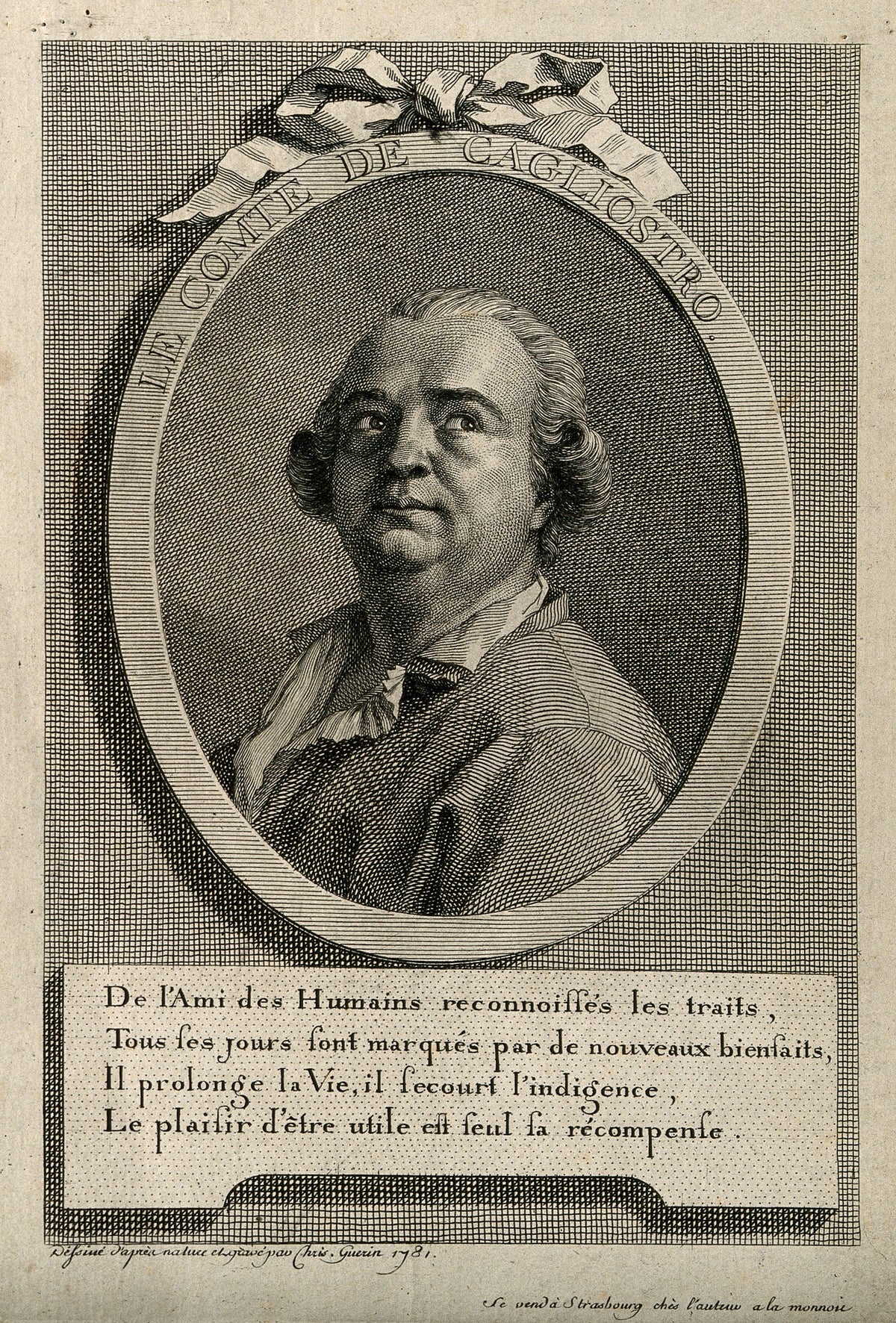
Illustration: portrait of Giuseppe Balsamo, known as Cagliostro, engraved by Christophe Guérin in 1781, Wellcome Collection, CC BY 4.0 license.

Par Olivier of Aeternum
Passionate about esoteric traditions and the history of the occult from the earliest civilizations to the 18th century, I share some articles on these topics. I am also co-creator of the online esoteric shop Aeternum.