



















































































































Contents...
|
1. The foundations of Hermeticism |
If you consult historical esoteric texts, you will inevitably find references to the tradition known as Hermeticism. This is not surprising, as it is an ancient spiritual philosophy from Egypt that has inspired numerous esoteric and philosophical traditions over the centuries. But where did it come from? And what exactly is Hermeticism? Here are the explanations.
1. The foundations of Hermeticism
1.1. Hermes Trismegistus
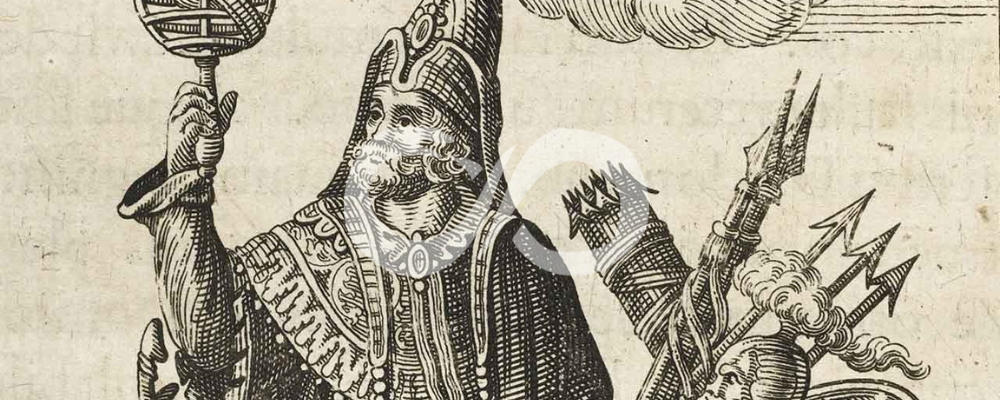
It is impossible to discuss Hermeticism without mentioning Hermes Trismegistus (literally, the "thrice-great"). Rather than a "simple" scholar, Hermes Trismegistus is generally regarded as a symbolic figure, the father of alchemy, and a fusion of two gods: Hermes, the messenger of the gods in Greek mythology, associated with wisdom and the occult arts, and Thoth, the Egyptian god of writing, knowledge, and magic.

The figure of Hermes Trismegistus thus emerged in Late Antiquity, in a context where Greek and Egyptian cultures blended, particularly in Alexandria, an intellectual and spiritual center of the time. The writings attributed to him, such as the Corpus Hermeticum and the Emerald Tablet, were written by various anonymous authors between the 2nd and 3rd centuries, seeking to convey spiritual, philosophical, and alchemical ideas.
According to legend, Hermes Trismegistus lived three distinct lives in Egypt. In the first, before the Flood, he is described as the inventor of astronomy. During his second life, he is regarded as the great builder of Babel, as well as a physician and philosopher. Finally, in his third life, he synthesized the knowledge of the first two by becoming an expert in alchemy and amassing fabulous treasures in his palace of Kamtar, a mysterious city of magicians lost in the desert. This triple knowledge is said to have earned him the title "thrice-great."
1.2. The foundational texts of Hermeticism
Hermeticism thus emerged from three foundational texts attributed directly to Hermes Trismegistus, which established the foundations of this tradition:
-
The Corpus Hermeticum: this collection of treatises, written between the 2nd and 3rd centuries, explores themes such as the nature of the universe, divinity, and the pursuit of wisdom.
-
The Emerald Tablet: A brief and enigmatic text that summarizes the main principles of alchemy and Hermetic philosophy. It is particularly known for the aphorism "That which is below is like that which is above."
-
The Asclepius: this philosophical discourse complements the Corpus Hermeticum and addresses questions related to the universe, the gods, and the nature of the human soul.
It is said that the works of Hermes Trismegistus were so extensive that he supposedly wrote more than 36,000 works, of which very few traces remain. In summary, and to ensure a better understanding, Hermeticism can be considered the collection of principles related to alchemy.
2. The principles of Hermeticism
Hermeticism rests on seven fundamental principles, set out in the Kybalion, a work published in 1908 by the "Three Initiates." These principles offer an understanding of the universal laws governing reality and human consciousness.
2.1. The principle of Mentalism
The principle of Mentalism states that "The All is Mind; the Universe is Mental." This means that the entire universe is a creation of the mind, and that physical reality is merely a manifestation of universal or divine thought. Thus, our thoughts and state of mind directly influence our reality, and by changing our thoughts, we can transform our life experience.
2.2. The principle of Correspondence
The principle of Correspondence is expressed by the formula "As above, so below; as below, so above." It indicates that harmony and correspondence exist between the different planes of existence: the physical, mental, and spiritual. What happens on one plane is reflected on the others, making it possible to understand the hidden mysteries of nature by studying their reflections across the different levels of existence.
2.3. The principle of Vibration
The principle of Vibration states that "Nothing rests; everything moves; everything vibrates." According to this principle, everything in the universe is in constant motion and possesses a specific vibrational frequency. The differences between the various manifestations of matter, energy, and spirit simply result from different vibrational rates. By mastering the principles of vibration, one can change their vibrational state and thus transform their life experience.
2.4. The principle of Polarity
The principle of Polarity states that "Everything is dual; everything has two poles; everything has two extremes." This principle explains that opposites are actually the two extremes of the same thing, separated by different degrees. For example, hot and cold, light and darkness, love and hatred are manifestations of the same phenomenon at different degrees. Understanding this principle makes it possible to move beyond apparent dualities and find the underlying unity.
2.5. The principle of Rhythm
The principle of Rhythm states that "Everything flows, out and in; everything has its tides; all things rise and fall." It describes the constant back-and-forth movement in the universe, similar to the swinging of a pendulum. There is action and reaction, advance and retreat, elevation and decline. This principle recognizes the existence of cycles and regular movements in nature, influencing human events and experiences.
2.6. The principle of Cause and Effect
The principle of Cause and Effect states that "Every cause has its effect; every effect has its cause." It teaches that nothing happens by chance, and that every action or thought produces a corresponding result, while every result has a previous cause. Understanding this principle makes it possible to see that everything that happens in our lives results from causes that we have set in motion, consciously or unconsciously.
2.7. The principle of Gender
The principle of Gender states that "Gender is in everything; everything has its Masculine and Feminine principles." This principle indicates that masculine and feminine exist in all things, and that their interaction is essential to creation and manifestation. It does not refer solely to biological sex, but to energies or qualities present in everything that exists. Understanding and balancing these energies makes it possible to harmonize the creative and receptive aspects of our being.
3. Hermeticism and the concept of God
Hermeticism is sometimes perceived as monotheistic, but its conception of the divine is distinctive and does not strictly correspond to the categories of monotheism or paganism. In Hermeticism, the concept of God is central, but this God is described as a universal intelligence, called "The All" or "The One." This divine presence does not necessarily correspond to a single anthropomorphic figure, but rather to a source of universal energy and consciousness that permeates everything.
For Hermeticists, "The All" is the very essence of existence, an infinite source encompassing all dimensions of the universe, from spirit to matter. This conception of the divine is holistic: it does not separate matter from the spiritual, but sees them as different manifestations of the same divine energy. The idea is that all creation, including the human soul, is part of this divine unity and an expression of it.
Unlike polytheistic or pagan religions, Hermeticism does not offer a pantheon of distinct gods. However, some Hermetic texts draw on pagan symbols or figures from Egyptian and Greek mythology (such as Hermes or Thoth, of course), but these figures are used symbolically to represent universal concepts and archetypes rather than individual deities.
4. The influence of Hermeticism throughout history
During the Middle Ages, Hermeticism influenced alchemy and philosophy. Medieval alchemists, in pursuit of the transmutation of metals and the elixir of long life, relied on these teachings. These texts provided a theoretical and symbolic foundation for their practices. Hermeticism thus offered a unified vision of the universe, in which matter and spirit were intrinsically linked, thereby influencing the philosophical conceptions of the time.

Source: Rosicrucian Library
The Renaissance marked a significant resurgence of Hermeticism. In 1460, a manuscript of the Corpus Hermeticum was brought to Florence, where Cosimo de' Medici commissioned Marsilio Ficino to translate it into Latin. This translation played an immense role in spreading Hermetic ideas throughout Europe. Thinkers such as Giordano Bruno and Paracelsus incorporated Hermetic concepts into their work, thereby blending science, philosophy, and spirituality. Hermeticism also influenced Renaissance art and literature, inspiring symbolic works such as The Birth of Venus and Primavera by Botticelli, and, according to some historians, even The Creation of Adam in the Sistine Chapel.
During the 18th and 19th centuries, Hermeticism continued to influence various esoteric movements. Secret societies, including Freemasonry and the Hermetic Order of the Golden Dawn, incorporated Hermetic teachings into their rituals and doctrines. In the 20th century, Hermeticism inspired movements such as theosophy and neo-paganism.
5. Practical applications of Hermeticism
Now that we have explored the history and theory of Hermeticism, you may be wondering what its practical application might be.
Divinatory tarot, for example, incorporates Hermetic symbols and concepts, offering a tool for exploring the unconscious and universal archetypes. Likewise, astrology, as a reflection of the principle of Correspondence, is used to understand cosmic influences on individual life. In addition, practices such as spiritual alchemy, Hermetic Kabbalah, and ceremonial magic draw on Hermetic teachings to facilitate personal transformation and spiritual realization.
For an even more concrete example, you are undoubtedly familiar with The Matrix or Doctor Strange: they offer a fairly clear explanation of certain Hermetic principles concerning the existence of parallel realities, Mentalism, and spiritual transformation.
That concludes this introduction to Hermeticism, which I hope will help you better understand the concepts or ideas disseminated today, and even decipher certain symbolic iconography. One piece of advice: keep your eyes open!

Par Olivier of Aeternum
Passionate about esoteric traditions and the history of the occult from the earliest civilizations to the 18th century, I share some articles on these topics. I am also co-creator of the online esoteric shop Aeternum.













