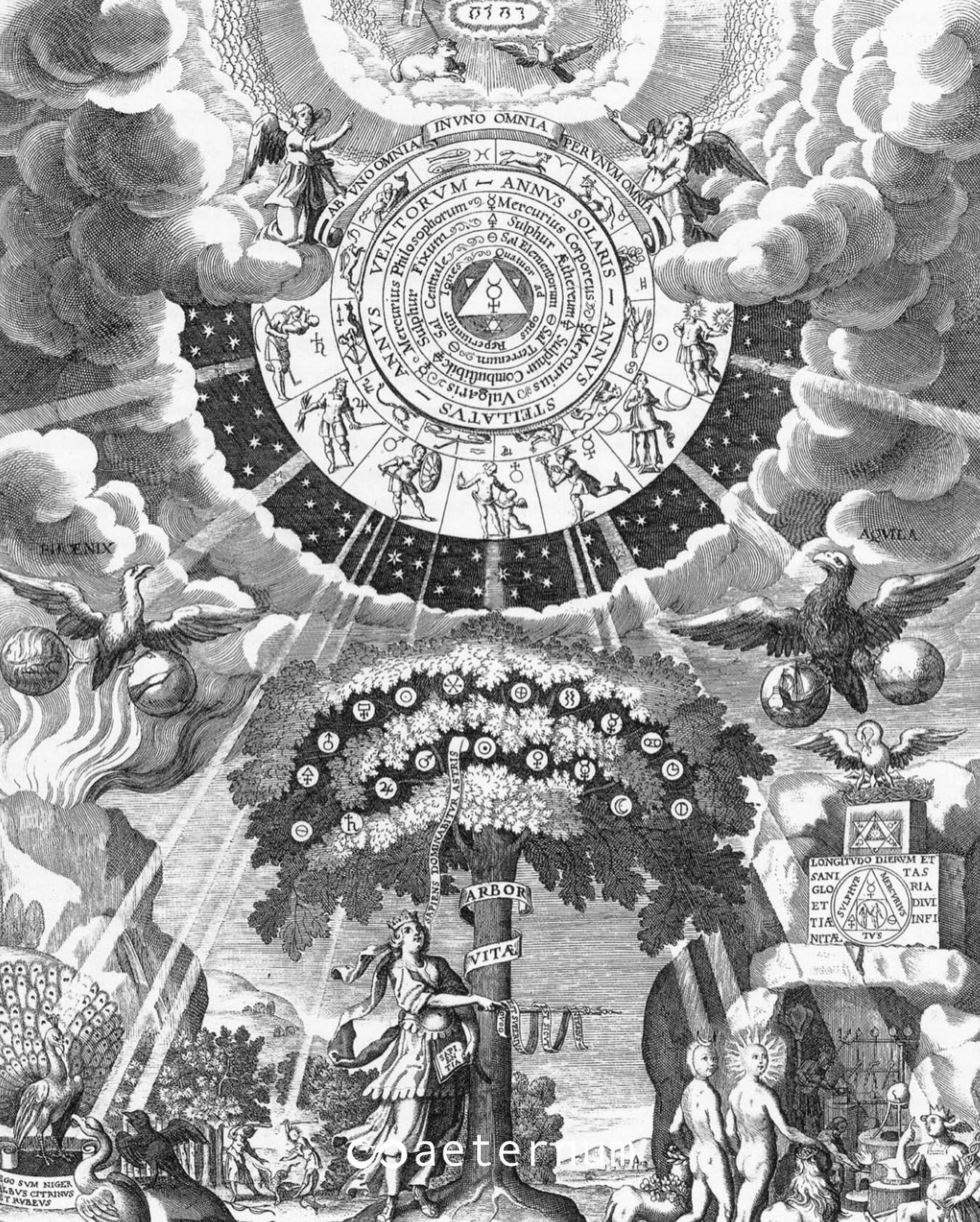
































































































Opening an old grimoire means entering a language in which words no longer serve merely to describe. Between a familiar prayer and a Latin conjuration appear names such as Adonai, Sabaoth, Agla, or Tetragrammaton, followed by sequences of syllables that no dictionary can translate with certainty. Some are Greek, Hebrew, or Aramaic. Others preserve traces of an Egyptian language transcribed in a foreign alphabet. Still others have passed through so many copies that their original form can no longer be recovered.
The modern reader might see it merely as a means of impressing people or obscuring the ritual. Ancient authors attributed a much more precise function to these words. The invoked name established a relationship with the power it designated; its recitation placed the operator within a sacred order; its inscription fixed that order in the circle, pentacle, or talisman. The word of power was therefore not added to the ritual. It formed one of its structures.
When speech no longer describes, but acts
In ordinary life, a word makes it possible to speak of an absent thing. In ritual, speech receives another function: it consecrates, blesses, adjures, forbids, calls, or commands. Speaking no longer merely conveys an idea. The spoken formula performs an act because it is uttered by the right person, within the required framework, and according to a recognized form.
Ancient religious traditions already knew this power of utterance. The priest proclaimed a divine name, recited a hymn, or declared that an offering now belonged to the god. Speech then separated common space from consecrated space. It gave a new destiny to an object, a place, or a person. Magical texts preserved this conception and applied it to a wide range of operations: protection, healing, divination, constraint, the appearance of a spirit, or the making of a talisman.
This efficacy did not depend on the isolated word. A formula drew its power from several elements brought together: the authority it invoked, the operator's state, the chosen time, the gestures, the fumigations, the signs drawn, and fidelity to the transmitted text. A sacred name recited outside this framework did not represent an automatic mechanism for ancient authors. It was the densest point of a ritual whole.
This distinction also helps explain the difference between prayer and conjuration. The former addresses a request to a power recognized as superior. The latter binds its request to an authority, an oath, or a name before which the summoned being must answer. The vocabulary may overlap, but the position adopted by the speaker is not the same.
The First Voices of Greco-Roman Egypt
The Papyri Graecae Magicae, or Greek Magical Papyri, constitute one of the major bodies of evidence for observing words of power before their entry into European grimoires. These manuscripts come from Greco-Roman Egypt and span several centuries, from the end of the Hellenistic period to Late Antiquity. They bring together recipes, prayers, invocations, protections, oracular requests, and operations intended to establish contact with a power.
Greek dominates a large part of these texts, but their ritual language is not limited to Greek. It includes Egyptian names, forms derived from Hebrew or Aramaic, divine epithets, palindromes, sequences of vowels, and words whose lexical meaning is no longer apparent. Scholars refer to them by the Latin expression voces magicae, “magical voices” or “magical words.”
This designation does not mean that all these words were devoid of meaning from the beginning. A syllable opaque to a Greek copyist could transcribe an Egyptian word. A Hebrew name could be adapted to a Greek ear and then altered by another scribe. A formula could also combine several languages to produce a ritual utterance that no longer belonged entirely to any of them. The language of the papyri thus appears as a reflection of a world in which gods, cults, and techniques circulated between Egypt, the Levant, and the Mediterranean basin.
Names such as Iaô, Adonai, or Sabaôth appear alongside Greek and Egyptian deities. Their presence does not attest to a uniform theology. Rather, it reveals the search for names considered ancient and powerful, and capable of being heard beyond a single community. In this context, accumulating several titles did not mean uncertainty about the god’s identity. The rite approached a power through several aspects and progressively narrowed its address.
The Ephesian letters and the words without translation
Long before the composition of the great papyri of Late Antiquity, the Greek world already knew the Ephesia grammata, the “Ephesian letters.” The most famous formula brings together six words transmitted in several forms: askion, kataskion, lix, tetrax, damnameneus, aision. Testimonies associate them with protection, deliverance, and the power attributed to the sanctuary of Artemis at Ephesus.
Ancient authors attempted to give these words meaning. Some recognized in them shadow, light, earth, the year, the sun, and a favorable power. Yet these later explanations are not sufficient to restore a certain translation. Their strength lay precisely in their sonic stability, their antiquity, and the fact that they seemed to come from a language situated outside everyday speech.
The Ephesian letters show that the word of power is not limited to a god’s personal name. An entire sequence could be carried on one’s person, inscribed on an object, or recited as a protection. The formula acted as a unit. Separating it, translating it freely, or replacing one of its terms amounted to breaking the received form.
This logic explains the presence, in later texts, of long chains that no word-for-word reading can account for. A formula can derive its efficacy from rhythm, repetition, the alternation of sounds, and the relationship it maintains with a gesture or figure. It is less a sentence to be understood than a word to be enacted.
Why did the ancients speak of “barbarian” names?
Theurgy texts use the expression “barbarian names” to designate certain sacred words foreign to Greek. The term did not have exactly the pejorative meaning it acquired in the modern language. It initially indicated a non-Greek origin: Egyptian, Chaldean, Persian, Hebrew, or derived from another language considered ancient.
At the beginning of the 4th century, Iamblichus defended these names in the treatise known by the title On the Mysteries of Egypt. His interlocutor objected that a translation should preserve the same thought and produce the same result. Iamblichus rejected this idea. According to him, sacred names do not arise from an interchangeable human convention. They correspond to the nature of divine beings and lose their distinctive power when they pass into another language.
This position sheds light on the status of foreign words in theurgy. Their obscurity is not a flaw to be corrected. It protects them from common usage and preserves the form in which they were received. Everyday language changes with its peoples; the ritual name, by contrast, seeks immutability. The mage does not claim to improve the transmitted word. He strives to enter into its order.
However, an overly simple conclusion should be avoided. Not every unintelligible syllable in a manuscript is necessarily an intact divine name. Respect for sacred languages coexisted with reading errors, abbreviations, and transformations. Theory asserts the name’s immutability; the history of manuscripts shows how difficult that immutability was to preserve.
The True Name and the Language That Belongs to It
The conviction that a name preserves a real relationship with the being named extends beyond theurgical circles. Around the middle of the 3rd century, Origen sets it out in his treatise Against Celsus. He reports that specialists in incantations attribute efficacy to a formula recited in its own language, whereas its translation becomes weak. He also emphasizes names such as Sabaoth, Adonai, Michael, Gabriel and Raphael, whose form and function cannot be replaced arbitrarily.
The testimony is remarkable because it comes from a Christian author engaged in combating accusations of magic directed at his religion. Origen does not confuse Christian prayer with the operations of magicians. Nevertheless, he shares with his opponents a conception of the name that is not limited to a label. The name possesses a quality, a history and an appropriateness to what it names.
In this view, translating Michael as a simple periphrasis does not amount to pronouncing the archangel’s name. Etymology can explain the name, but it cannot replace it. In the same way, translating a divine title informs the intellect without necessarily reproducing its ritual function. Meaning and form remain connected without being identical.
This distinction runs throughout the history of words of power. The reader may seek the origin of a term, recognize its roots and understand its place in a tradition. The ritual operation, however, preserves the received form because that form represents the continuity of transmission.
The Entry of Hebrew Names into Grimoires
Medieval and Renaissance grimoires give a major place to the Hebrew names of God. Adonai, Elohim, El Shaddai, Sabaoth, Eheieh and the Tetragrammaton appear in prayers, on circles, around pentacles and at the heart of conjurations. They are not used as interchangeable synonyms. Each name expresses a quality, a rank or a particular way of conceiving divine action.
The Tetragrammaton designates the four consonants of the divine name revealed in the Hebrew Bible. Jewish tradition surrounds its reading with rules that cannot be reduced to the modern search for a lost pronunciation. In Latin magical texts, Tetragrammaton itself becomes an operative name. The Greek word meaning “four letters” is pronounced and written in place of the name it describes. This transformation shows how a tradition can receive a new form without entirely erasing its origin.
The name Agla follows another path. It is generally understood as a notarikon, a word formed from the initials of a Hebrew formula: Atah Gibor Le-olam Adonai, “You are mighty forever, Lord.” The formula belongs to the second blessing of the Amidah; its abbreviation entered amulets and then Christian magic. In the construction of the magic circle, it can be placed alongside Adonai, El, and the Tetragrammaton. Four letters then contain an entire proposition and concentrate a liturgical utterance in a brief sign.
This passage requires a historical distinction. Christian grimoires did not simply reproduce Jewish tradition. They selected names, modified their spellings, and integrated them into a theology and practice of their own. The Christian Kabbalah of Johann Reuchlin, followed by the synthesis of Cornelius Agrippa, played a major role in this reinterpretation. Reading these names in a grimoire therefore means observing several layers of transmission, rather than a continuity that has remained intact.
From prayer to the conjuration of spirits
In ceremonial magic grimoires, the divine name provides the operator with an authority he does not possess by himself. The mage does not command a spirit in the name of his own will alone. He adjures it by the Creator God, by His attributes, by the angels, by the power of Creation, and by the sacred events to which the text links each name.
The Heptameron, printed in the 16th century under the name of Pietro d'Abano, clearly shows this architecture. The names change according to the day, hour, season, angels, and regions of the air concerned. Four divine names must be inscribed in the circle. During the conjuration, the operator invokes the Tetragrammaton, the living God, and the names before which the celestial, terrestrial, and infernal powers are declared to tremble.
The Clavicle of Solomon follows a comparable logic. The names do not form a collection placed randomly in the text. They organize the space and support the word of command. El can be placed in the East, Yah in the West, Agla in the South, and Adonai in the North. Writing thus gives the name an orientation; recitation gives the figure a voice; the circle brings the two together.
A conjuration may seem repetitive to the modern reader because it multiplies titles and biblical narratives. In reality, this repetition constructs a chain of authority. The text recalls who created the world, which name was invoked by a patriarch, which angel governs the present time, and in the name of which power the spirit is summoned. The words do not merely seek to attract its attention. They state the jurisdiction under which it must appear.
Agrippa and the Occult Science of Names
In the third book of his Occult Philosophy, published in 1533, Heinrich Cornelius Agrippa brings together the ancient, Neoplatonic, Christian, and Kabbalistic conceptions that explain the place of names in learned magic. The chapters devoted to divine names do not present them as mere sounds endowed with an impersonal energy. Their virtue descends from God through the intermediate powers, the angels, the stars, and lower realities.
Agrippa follows Iamblichus and Origen when he asserts that sacred words must not be translated or altered. He goes further, however, by specifying that their power does not come from words considered as mere words. Divine powers act through them in the spirit of the person who unites with them through faith, purity, and an invocation conforming to the order received.
This precision rules out reducing the word of power to a mechanical formula. For Agrippa, the name becomes a conduit. Its form matters, but so does the state of the person who pronounces it. Voice, intellect, and religious disposition must be in harmony. The operator who recites without understanding the order being invoked possesses the sound, but not necessarily the authority attributed to it by the text.
Agrippa's thought thus makes it possible to grasp the heart of the magic of the Word. The world is conceived as a hierarchy connected to its source. Sacred names make this hierarchy present in the operation. They do not create the power; they open a regulated channel through which it can be summoned.
When Scribes Transform Sacred Words
Grimoires circulated in manuscript form for centuries. Each copy could introduce a faulty letter, confuse two signs, expand an abbreviation incorrectly, or adapt a foreign word to the scribe's habits. Hebrew names suffered particularly during this process when a copyist did not know the alphabet or was working from an already distorted Latin copy.
The Heptameron offers a revealing example with the name transmitted in the forms Helioren, Heliorem, or Elyorem. A single final letter varies according to the editions and manuscripts. Other sequences, such as Beralanensis, Baldachiensis, or Paumachiae, have received divergent readings because the copyists no longer recognized their origin or grammatical construction.
The phenomenon does not mean that everything in grimoires is false. It shows that material transmission is part of their history. A strange word may be an ancient formula preserved faithfully; it may also be the transliteration of a foreign language, a compound name, an abbreviation, an error that became traditional, or the remnant of a passage that is now illegible. These possibilities must be examined before attributing to it an angelic origin or a certain translation.
Critical editions make it possible to compare variants and, in some cases, recover an older form. They cannot always settle the matter. Respect for a tradition does not require concealing this difficulty. On the contrary, it calls for recognizing the difference between the attested form, the probable reconstruction, and the later interpretation.
Pronouncing a word that the manuscript no longer lets us hear
A grimoire rarely indicates precisely how its author pronounced a foreign name. Latin changes according to countries and centuries; Hebrew passes through Christian transliterations; Greek may be known through a Latin edition; the vowels of a word are added, removed, or displaced. A written form therefore does not always reproduce a voice.
This difficulty justifies neither free invention nor paralysis. The first step is to identify the possible language, the date of the witness, and the known variants. A biblical name is not treated like a vox magica from the papyri. An acronym such as Agla is not read like a Latin sentence. A sequence of vowels does not follow the same rules as a compound name or a formula transcribed from another language.
The historical usage must also be distinguished from reconstruction. An erroneous form may have circulated long enough to become the form of a specific ritual tradition. Correcting it according to a supposed etymology then changes the transmitted text. Conversely, repeating a printing error while presenting it as an age-old name gives it no authority. The choice depends on the aim: studying a source, reconstructing an earlier state, or following a particular school.
The silence of the manuscripts therefore imposes a discipline. When no pronunciation can be established, it is better to acknowledge that than to manufacture certainty. The word of power demands more attention than confidence.
What the word of power actually accomplishes in the rite
Across these traditions, the word of power fulfills several functions that converge. It identifies the power invoked, recalls its rank, connects the operation to a sacred narrative, and transforms individual speech into authorized speech. When written, it orders the space of the circle or talisman. When recited, it gives the action rhythm and direction. When it remains obscure, it separates ritual language from ordinary conversation.
The word can also serve as a sonic seal. A palindrome closes in on itself; repetition establishes continuity; a series of vowels stretches the breath; an accumulation of names gradually raises the address to supreme authority. Lexical meaning is then only one part of the operation. Form, position, and manner of speaking all participate in the rite.
There is, however, no universal magical language concealed behind all grimoires. The similarities arise from transmissions, translations, borrowings, and shared conceptions of the sacred. The Greco-Egyptian papyri, Neoplatonic theurgy, Jewish traditions, Christian liturgy, and Solomonic magic cannot be fused into a single system without losing their history.
Words of power retain their intellectual and ritual force when their place remains clear. They are neither absurd syllables that should be cast aside nor automatic keys capable of opening every door indiscriminately. They bear witness to a demanding conception of speech: naming commits one, pronouncing establishes a relationship, writing fixes authority, and transmitting requires not distorting what has been received.
In a grimoire, power therefore never resides in sound alone. It arises from the accord between the name, the voice, the text, the operator, and the power invoked. This is the accord that ancient authors sought to preserve when they forbade translating sacred names. Behind the obscurity of their syllables lies a simple yet formidable idea: some words do not merely speak about the world; within the ritual order, they act in it.

Par Olivier of Aeternum
Passionate about esoteric traditions and the history of the occult from the earliest civilizations to the 18th century, I share some articles on these topics. I am also co-creator of the online esoteric shop Aeternum.