




























































































Iron is not a neutral material in the magical history of Europe. Long before the horseshoe became a good-luck charm sold as a decorative object, the metal itself was placed at thresholds, held near the body, slipped into houses, fixed to doors, or associated with tools whose function went beyond their everyday use. It was meant to prevent an influence from entering, keep a presence at a distance, protect a child, safeguard an animal, block a passage, or oppose an invisible force with a material considered hostile to its action.
This reputation did not arise from a learned theory formulated in a single place. It runs through very different layers of European culture. Ancient texts already attribute protective abilities to the iron nail. Christian and folk traditions place the metal at thresholds. Stories about fairies and nocturnal beings grant it a disruptive effect. Smiths acquire a special stature because they master fire and transform matter. Then planetary magic gives iron a clear place in the order of Mars, the planet of strength, cutting, confrontation, and defense.
Yet it would be misleading to seek a simple origin for all of this. The peasant’s iron, the Roman nail, the horseshoe fixed above a door, the martial sword of learned systems, and objects hidden in buildings do not always stem from the same reasoning. What brings them together is a shared intuition: iron acts as a boundary material. It cuts, fastens, immobilizes, resists, and marks a passage. This is the function that folk magic retained with remarkable consistency.
Our era tends to sharply separate the practical object from the magical object. Ancient practices did not work that way. A nail can hold a board together and serve as protection. A pair of scissors can cut fabric and be placed near a newborn. A horseshoe protects an animal’s hoof and can then be nailed to a door. The material retains its history, its work, its use, and the symbolic force attributed to it. That is what makes iron one of the most interesting materials for understanding European folk magic.
When Iron Becomes a Boundary
The protective idea associated with iron already appears in ancient sources. The texts do not yet describe the horseshoe as it would later become famous in modern Europe, but they show that metal and nails could be used in operations intended to stop, fasten, or drive away an influence. An archaeological study published in the journal Antiquity notes that ancient authors mention the use of nails in protective and funerary contexts. Pliny the Elder specifically reports the use of a nail from a tomb, fixed to a threshold, against nighttime attacks.
The gesture is already revealing. The threshold is never an ordinary place. It is the exact point where the outside becomes the inside. It is through it that residents, visitors, animals, goods, and, in the magical imagination, influences pass. Protecting a threshold therefore means working on a boundary. Iron fixed in this place does not merely protect a piece of wood: it marks the border between what may enter and what must remain outside.
The nail itself has a function that lends itself to this logic. It penetrates matter and immobilizes it. In ancient magic, nails also appear in contexts of constraint, particularly in connection with certain curse tablets. The meaning is then no longer protective but coercive: a name, an action, or a will is fixed in place. This shows that the nail's power does not come from an abstract idea of “good luck.” It comes from the gesture it embodies: piercing, fixing, holding in place.
We have already devoted an article to the brief history of nails and needles in magic. Iron nevertheless deserves broader treatment, because the nail is only one of its forms. In the home, metal becomes a lock, hinge, blade, tool, hook, poker, scissors, or horseshoe. Each of these objects has a material function that is immediately understandable, and this function nourishes its symbolic use.
Iron is also the blacksmith's metal. Before modern industry, obtaining an iron object involved technical knowledge, intense fire, a hammer, an anvil, and a visible transformation of matter. The metal reddens, softens, receives blows, and then hardens. For a traditional culture, it is difficult to view this process as an operation without significance. The blacksmith knows how to give lasting form to matter extracted from the earth through fire. This mastery gives him a special position in many societies.
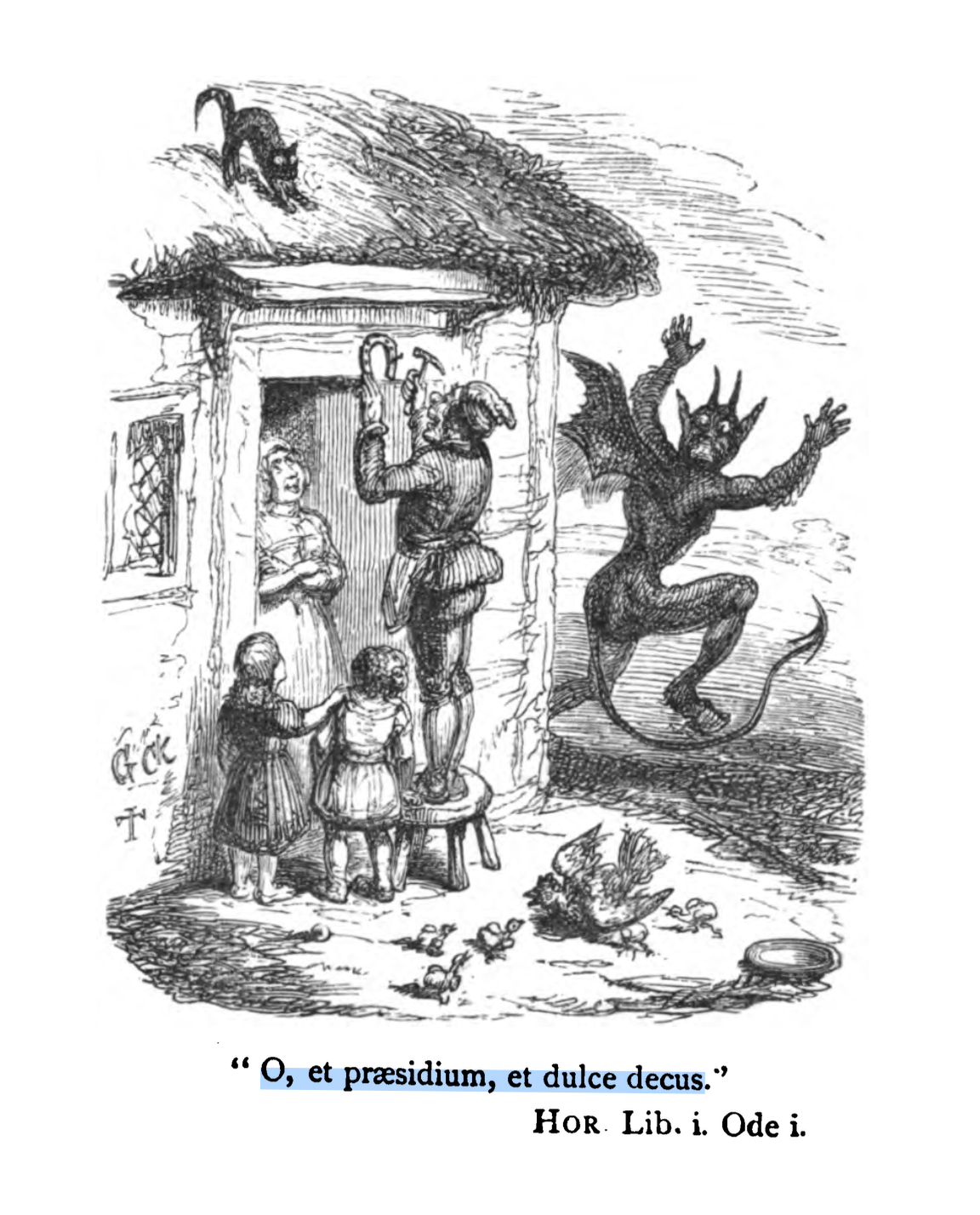
It should not be inferred that every European blacksmith was regarded as a mage. That would be excessive. But the forge brings together several elements that magical thinking understands very well: fire, metal, noise, physical strength, the spark, and the creation of a tool capable of cutting or defending. The legend of Saint Dunstan and the Devil, which became famous in the English-speaking world, rests on exactly this association. The saintly blacksmith masters the demon through his craft, and the horseshoe becomes the sign of this victory.
This legend is late in the forms in which it circulates today, but it shows how popular Christianity may have absorbed a reputation already attached to the metal. Iron is not presented as a power rivaling the sacred. It becomes an instrument through which the Christian order triumphs over an evil presence. This is a common mechanism in European traditions: an ancient material retains its function, but its interpretation is reorganized within a Christian framework.
The iron thus becomes a material and spiritual boundary. It need not be precious. On the contrary, its strength also comes from its ordinary nature. Domestic protection does not necessarily require a rare object. It can use what the household already has: a blade, a nail, a key, a pair of scissors, or a piece of worked metal.
The threshold, the nail, and the horseshoe
The horseshoe alone embodies a large part of this history. Its success as a sign of good luck eventually concealed its older protective function. A crucial testimony comes from John Aubrey, a 17th-century English antiquarian. In his Miscellanies, published in 1696, he notes that it is very common to nail horseshoes over thresholds to prevent witches’ power from entering the house. He even specifies that, according to a reported tradition, the object must have been found.
We therefore have something other than a later reconstruction here. At the end of the 17th century, a scholar describes installing a horseshoe on the thresholds of London houses as a common practice. The object is clearly interpreted as a defense against witchcraft. This information is cited today by the Museum of Witchcraft and Magic in Boscastle, which keeps several objects of this type in its collection devoted to protective charms.
The horseshoe’s position has prompted much discussion. With the points facing upward, it is said to hold luck like a container; with the points facing downward, it would spread luck or create a protective arch. These explanations vary according to region and period. It would be unwise to present one orientation as the universal original rule. Historically, what matters lies elsewhere: the horseshoe is placed over a passageway, up high or on the threshold, where the entrance must be controlled.
Choosing a horseshoe that has already been worn by a horse adds another dimension. The object has been used. It has struck the ground, borne the animal’s weight, traveled along roads, and protected a hoof. In the logic of folk magic, an object charged with use is not equivalent to a freshly manufactured piece of metal. Its former function matters. The horseshoe has already protected; it can therefore be transferred from the animal to the home.
This idea of continuity between material and magical function can be found in many objects. A key opens and closes; it therefore becomes a symbol of access. A knife cuts; it becomes a tool of separation. A nail fastens; it can therefore serve to fasten an intention or symbolically close a passage. A horseshoe protects a vulnerable part of the animal; it can therefore become a sign of general protection.
The Museum of Witchcraft and Magic also mentions a donkey shoe wrapped in red cloth, suspended above a bed to protect against nightmares, as well as rings made with horseshoe nails. These objects remind us that protection is not limited to the front door. It may concern sleep, animals, health, or the domestic space. The material remains the same, while the placement specifies the intention.
The threshold should here be connected with what we developed in our article devoted to apotropaic magic. Apotropaic protection does not necessarily seek to destroy an influence. It seeks to divert it, drive it away, or prevent it from entering. The horseshoe perfectly reflects this logic. It does not pursue the hostile force; it defines the point where it must stop.
This function also explains the presence of metal around openings: doors, windows, chimneys, cradles, and passageways. In ancient architecture, these places are both useful and vulnerable. A chimney allows smoke to escape, but it also creates an opening. A door provides access to the house. A window brings the inside into contact with the outside. The protective deposit is therefore placed where the boundary seems most fragile.
The horseshoe is therefore only a particularly visible form of a broader principle. In the traditional home, the protective object works together with the architecture. It is not placed just anywhere. It is placed where something passes through.
The metal that keeps nocturnal beings at bay
In the traditions of the British Isles and several European regions, iron is also used against fairies, spirits, and nocturnal beings. The English expression cold iron has become famous in literature, but it is based on an ancient body of stories and practices in which contact with the metal breaks the influence of a non-human being.
Texts collected in the 19th and 20th centuries describe knives, scissors, tongs, or simple pieces of iron used near people considered vulnerable. The newborn occupies a special place. In changeling tales, the human child may be replaced by a being from the fairy world. Iron placed near the cradle then acts as a defense. What matters is not its economic value, but its material.
This tradition deserves to be read without turning it into a uniform rule applicable throughout Europe. The stories vary enormously from one region to another. The names given to the beings change, as do their behaviors, and the means of protection are not identical everywhere. What recurs regularly is the idea that iron establishes an incompatibility with certain presences.
Why iron? The explanations proposed since the 19th century are numerous. Some authors see it as the memory of a conflict between populations using stone or bronze and populations skilled in working iron. Others emphasize the fire of the forge, the sound of the hammer, the metal’s ability to produce weapons, or its association with Mars. None of these hypotheses can be turned into a demonstrated general origin.
Another possibility is simpler: iron represents human order transformed. It is neither a branch picked up nor a stone found as it is. It results from complex labor. Ore is extracted, heated, beaten, and then transformed into a tool. Setting iron against the invisible thus amounts to setting a material mastered by humans against what escapes their control.
Scissors are particularly revealing. Closed, they are a household object; open, they form a cross and become two blades capable of cutting. In several traditions, they appear near beds and cradles. The logic does not require a theoretical treatise: the object cuts what must be separated and opposes iron to whatever seeks to cross the boundary.
The knife has a comparable function. In certain Scottish tales, throwing or brandishing an iron blade is enough to break the hold attributed to the fairies. The gesture does not have the sophistication of a learned ceremony, but it rests on a clear understanding: the metal interrupts the connection. The same principle appears in stories in which an iron object is placed under a pillow, near a door, or close to a threatened person.
This way of thinking is not foreign to ceremonial magic, even though the systems are different. All protective magic works with boundaries, incompatibilities, and authorities. The circle protects because it demarcates. The sacred name protects because it places the operator under an authority. Iron protects because its material is recognized as hostile to certain influences. The means change, but the logic of separation remains.
It should also be noted that iron is not always positive. In planetary, martial, or alchemical traditions, it can carry violence, war, injury, and destruction. It is precisely this ambivalence that strengthens its protective value. A material capable of attacking can also defend. A blade that wounds the enemy can bar an entrance. Iron is not gentle; it protects because it imposes resistance.
Iron hidden in houses
The archaeology of old buildings has greatly renewed our understanding of domestic magic. For a long time, objects discovered beneath a floor, in a wall, near a chimney, or behind a ceiling were treated as accidental waste. Recent research has shown that many of these deposits may follow a protective logic. Worn shoes, clothing, desiccated animals, engraved marks, and metal objects appear in places that correspond precisely to the house’s areas of passage or vulnerability.
Historic England notes that objects were concealed in chimneys, beneath floors, above ceilings, and around openings from the late Middle Ages and throughout the early modern period. Researchers use the term apotropaic deposits to designate some of these practices. One should not automatically attribute a magical function to every object found in a wall, but the recurrence of certain locations and assemblages makes a protective intention credible in many cases.
Iron occupies a place in this material landscape. Nails, blades, tools, and horseshoes may be placed in a house to reinforce a boundary. When an object is deliberately hidden, its visual disappearance does not eliminate its function. On the contrary, the protection may work unseen. This idea is crucial to understanding domestic magic: a hidden object is not necessarily forgotten; it may be hidden precisely because its position is structural.
The hearth and chimney contain a large share of these deposits. The chimney is a vertical opening that runs through the house. It carries smoke outside, but its nature as a passage also gives it symbolic vulnerability. Placing a protective object nearby amounts to defending an entry axis. Thresholds, lintels, and corners play the same role.
This archaeology shows that protection was not reserved for recognized specialists. A house may incorporate ritual actions into its construction or renovation. The carpenter, owner, mason, or blacksmith may take part in a deposit without leaving any explanatory text. Matter thus becomes the archive of an action that written documents failed to preserve.
Researchers today stress the importance of not drawing too sharp a distinction between official religion and domestic practices. A Christian family may go to church, have its house blessed, and at the same time place a protective object in a wall. These actions are not necessarily experienced as contradictory. They belong to the same world, where divine protection, inherited habits, and material objects can work together.
This helps us better understand the enduring presence of iron. The metal is not adopted instead of prayer or a Christian sign. It can accompany them. The horseshoe above a door, the cross engraved on a beam, and the blessed object placed in the house all take part in several layers of the same defense. Popular magic frequently works through accumulation: a place is strengthened with whatever is available and recognized as effective.
The hidden iron also recalls the thunderstones studied in the previous Notebook. Here again, an object may have an initial utilitarian or material life and then receive a second function. The prehistoric axe becomes a talisman; the worn horseshoe leaves the hoof to protect the house; the nail removed from an old assembly may be kept for its material and history.
Popular magic therefore does not need to constantly create new objects. It knows how to shift a function. This is one of its most interesting traits: everyday life and ritual are not two separate worlds.
Mars, the Blacksmith, and the Authority of Metal
Learned magic gives iron another interpretive framework: that of Mars. In the planetary correspondences of the Western tradition, the metal of Mars is iron. Cornelius Agrippa states this clearly in the 16th century in his De occulta philosophia: among the metals placed under the power of Mars are iron and red copper. In his second book, the operations associated with the square of Mars also use an iron plate or a sword.
This correspondence should not be projected retroactively onto every horseshoe fixed to a farmhouse door. The peasant woman who nails a horseshoe to the threshold does not necessarily have Agrippa in mind. Yet the connection is instructive because the learned system and popular practices both attribute compatible qualities to the metal. Mars governs combat, strength, blood, weapons, and cutting action. Iron is the material of the blade, nail, and tool. The two worlds therefore speak a related language, even when they are not transmitted through the same channels.
John Aubrey offers a remarkable example of this encounter. After describing the horseshoe nailed to the threshold against witches, he reports another practice in which an iron object is put into the fire when a witch enters and adds the formula that “Mars is the enemy of Saturn.” This explanation belongs to traditional astrology: Saturn is associated with forces of restriction, old age, and darkness, while Mars acts as a power of opposition and attack.
The importance of the passage does not lie in the idea that it discovered the origin of the protective horseshoe. Rather, it shows that in the 17th century, an observer could connect a domestic custom with planetary reasoning. Folk magic and learned magic do not exist in hermetically sealed worlds. They can intersect, comment on one another, and be reinterpreted.
This martial correspondence also sheds light on the figure of the blacksmith. The smith works with fire, the hammer, and the metal of Mars. He makes the weapons, tools, nails, and horseshoes that structure the material world. In traditional tales, the blacksmith may acquire a reputation for power because he transforms what others use without knowing how to produce it.
Iron thus brings together three forms of authority. It possesses material authority because it resists and endures. It possesses social authority because it depends on the knowledge of the forge. It possesses symbolic authority because tradition attributes to it a power of separation and defense. When these three levels overlap, the metal naturally becomes an object of magic.
This perspective helps avoid a common mistake: reducing iron to a simple “lucky charm.” The term is too weak. In traditional practices, iron does not merely attract some vague kind of luck. It protects a boundary, drives away, fixes, cuts, or imposes resistance. A horseshoe placed on a house is not the equivalent of a favorable trinket. It is a material sign of defense.
The same nuance applies to planetary correspondences. Working with Mars has nothing to do with making a general appeal for luck. Mars shapes operations of courage, confrontation, defense, and cutting. We have already discussed the role of time and planetary forces in our guide to planetary hours. Iron belongs to this martial order with remarkable consistency.
Ancient magical knowledge is precisely made up of this kind of continuity. A material is not defined solely by its chemical composition. It has a history of use, a place within correspondences, a relationship with trades, and a memory passed down through gestures. The iron of the forge, the threshold nail, the blade used against fairies, and Mars’s metal are not four unrelated objects. They are several expressions of the same idea: certain materials impose their law on the invisible.
This is why iron remains so prominent in European protective traditions. It does not need to be rare to be powerful. Its strength comes from what it does. It holds a door, cuts a rope, secures a beam, arms a hand, protects a hoof, and emerges from the fire stronger than it entered. Folk magic simply recognized in this material what everyday experience already showed: iron is made to withstand.
Sources and references
John Aubrey, Miscellanies Upon Various Subjects, 1696. Aubrey describes a horseshoe nailed to the threshold to prevent witches from entering and reports the association between iron, Mars, and protection.
Museum of Witchcraft and Magic, object 1584, “Horseshoe: Good Luck Charm”. A description devoted to the protective uses of the horseshoe and related objects preserved in British collections.
Maarten van Driessche et al., “Magical practices? A non-normative Roman imperial cremation at Sagalassos”, Antiquity. The study recalls several ancient sources on iron nails used as objects of neutralization or protection.
Historic England, “Discovering Witches’ Marks”, on objects concealed in buildings and protective devices placed around openings.
Ceri Houlbrook, “Ritual, Recycling and Recontextualization”, Cambridge Archaeological Journal, on the archaeology of concealed protective objects in houses.
Heinrich Cornelius Agrippa, De occulta philosophia, Book I, Chapter 27, and Book II, for the traditional correspondence between Mars and iron.
Illustration: George Cruikshank, frontispiece of The True Legend of St. Dunstan and the Devil, 1871. Public-domain work, held on Wikimedia Commons. Alternative text: “Saint Dunstan, the Devil, and a horseshoe in an 1871 engraving by George Cruikshank”.

Par Olivier of Aeternum
Passionate about esoteric traditions and the history of the occult from the earliest civilizations to the 18th century, I share some articles on these topics. I am also co-creator of the online esoteric shop Aeternum.