



















































































































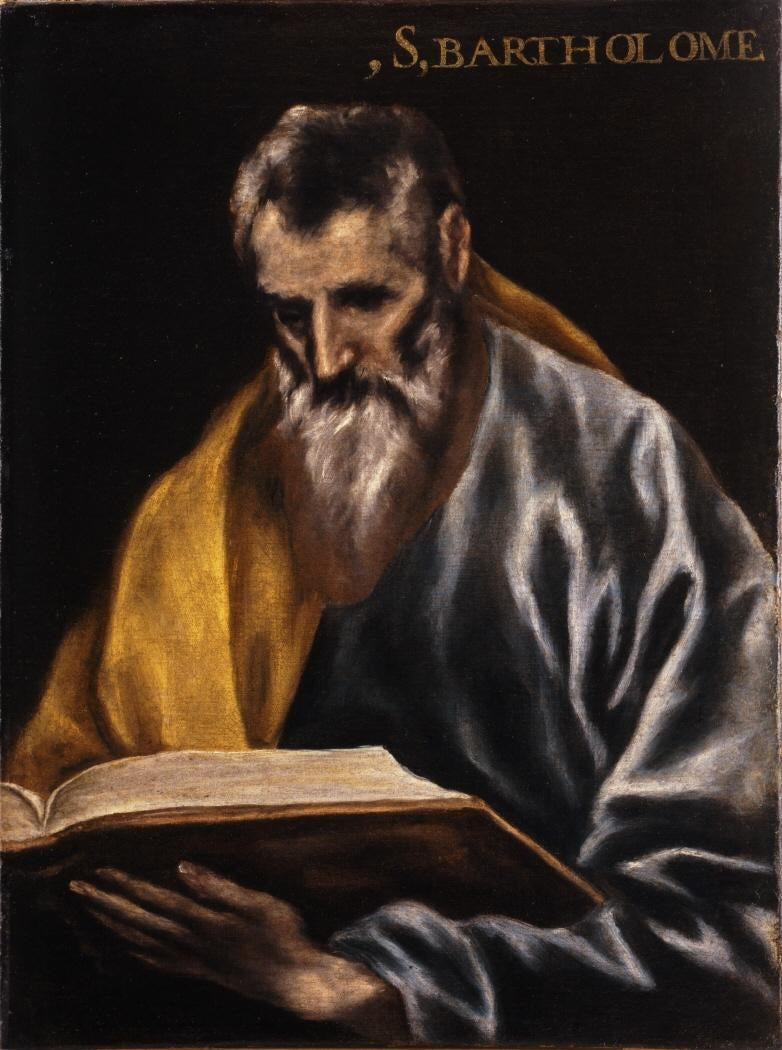
Simon the Zealot is one of the members of the Twelve whose name the New Testament preserves without developing an individual account. He should not be confused with Simon Peter. Matthew and Mark describe him as a Cananaean or Cananite, depending on the translation, while Luke and Acts use the term Zealot. This difference is explained by forms derived from a Semitic vocabulary meaning zeal. It is not enough to prove that Simon belonged to an organized revolutionary party. His figure provides an opportunity to explore the religious circles of Galilee in the 1st century, the highly varied composition of the group of the Twelve, and the missionary traditions that would later associate him with Jude Thaddeus.
| Name | Simon, distinct from Simon Peter |
|---|---|
| Nicknames | Cananaean or Cananite; Zealot according to the Gospels |
| Sources | Matthew 10; Mark 3; Luke 6; Acts 1 |
| Meaning of the nickname | Zeal, according to a Semitic root |
| Later mission | Associated with Jude in various traditions |
| Feast day | October 28, with Jude Thaddeus |
Two Simons among the twelve apostles
The apostolic lists mention two disciples named Simon. The first is Simon Peter, Andrew’s brother and a central figure in the Gospel accounts. The second has a nickname that distinguishes him: Mark and Matthew use a designation rendered in English as Cananaean or Cananite, while Luke and Acts speak of Simon the Zealot. None of these lists reports a scene in which this second Simon personally takes part.
The presence of identical names among the disciples is not surprising in 1st-century Judaism. Nicknames help identify people and prevent confusion. Simon’s is particularly interesting because it relates to a religious disposition and, according to some interpretations, to a political milieu.
Membership in the Twelve remains the essential fact attested by the New Testament. The group brings together men of different professions and sensibilities, called to follow Jesus despite their individual histories.
Why Cananaean does not necessarily mean an inhabitant of Canaan
The Greek term used by Mark and Matthew is generally explained as a transcription of an Aramaic or Hebrew word connected with zeal. It should not automatically be read as a geographical indication meaning “from Cana” or “an inhabitant of Canaan.” Some ancient traditions proposed such interpretations, but the connection with Luke’s designation points toward the meaning of an ardent or zealous man.
Luke uses a Greek term, Zēlōtēs, which directly conveys this idea. The two forms are therefore not necessarily contradictory: in two languages, they may convey the same nickname. This situation illustrates the linguistic exchanges of the world in which the Gospels were written and transmitted.
The vocabulary of names must be studied in the manuscripts, since graphic variants circulated. French translations have not always chosen the same expression, which can give readers the impression that they refer to different characters.
Did Simon belong to the political movement of the Zealots?
Simon’s nickname has led many authors to attribute to him membership in the Zealot movement, associated in the history of ancient Judaism with resistance to Roman rule. The connection may seem plausible, but the Gospels provide no information about any specific political activity by Simon before his calling.
The vocabulary of zeal existed in Jewish religious traditions independently of any partisan organization. It could express devotion to the Law, to God, or to the identity of the people. The formation and development of the groups designated as Zealots in the 1st century are themselves subjects debated by historians.
It would therefore be excessive to present Simon as an underground fighter whose career is documented. His nickname reveals a quality or reputation, but not necessarily an organized affiliation. This distinction preserves the force of the name without adding an invented biography to it.
A tax collector and a zealot within the same group
Simon’s presence alongside Matthew has received an important interpretation in Christian tradition. Matthew is associated with tax collection, a profession connected with administrations that were widely contested. Simon, for his part, bears a nickname evoking zeal for Jewish tradition. The two designations may suggest circles whose interests and attitudes differed considerably.
This opposition should be expressed cautiously: the sources do not prove a personal conflict between the two men. But their presence in the same group reminds us that Jesus did not choose only disciples who already shared the same customs and concerns. The Twelve had to learn a common life founded on their relationship with Christ.
The earliest Christian communities would later have to address questions of coexistence, meals, the Law, and openness to the nations. The range of apostolic backgrounds provides an interesting backdrop for understanding these debates.
Pentecost and the silence of Acts
Acts 1 mentions Simon the Zealot among the disciples gathered after the Ascension, awaiting Pentecost. The following chapter recounts the outpouring of the Spirit and the proclamation of the Resurrection. Simon thus belongs to the community of witnesses, even though Acts gives no speech specifically attributed to him.
This silence must be respected. His absence from later accounts does not allow us to conclude that he abandoned the disciples or received a secondary mission. Acts focuses mainly on the journeys of a few figures, notably Peter, Stephen, Philip the Evangelist, and Paul. Their selection does not constitute an exhaustive chronicle of each of the Twelve’s lives.
Simon’s memory therefore developed mainly through later traditions that sought to recount the apostles’ dispersal and missions. These works have significant religious importance, without possessing the documentary status of the passages directly preserved in Acts.
Missionary traditions with Jude Thaddeus
Later Christian accounts associate Simon with Jude Thaddeus in missions to the East, particularly Persia. The details of their journeys and martyrdom vary according to the passion narratives. This association gave rise to a shared feast day and to depictions in which the two apostles appear side by side.
Simon’s attributes may include a saw, a spear, or a book. The saw is linked to a martyrdom tradition that assigns him a particular torture. The Gospels do not describe it: the object belongs to the saint’s hagiographic reception and serves to distinguish him from the other apostles in artistic representations.
The existence of several versions of his martyrdom shows the gradual development of his memory. Studying these accounts helps us understand exchanges between the Churches of East and West, but does not provide a historically certain itinerary for Simon after Pentecost.
The feast day of October 28 and the meaning of his nickname
Simon is celebrated with Jude on October 28 in the Roman calendar. His feast recalls his membership in the group of the Twelve and the importance of apostolic witness, even when the Gospels have preserved little personal information about a disciple.
Statues portray Simon in apostolic robes, carrying a book or the traditional instrument of his martyrdom. The image makes it possible to recognize his place in cycles devoted to the Twelve. But his character cannot be fully inferred from the objects artists have given him over the centuries.
A comparison of Matthew 10, Mark 3, Luke 6, and Acts 1 offers the best starting point. It shows that the same person can be identified by nicknames derived from different languages. The zeal conveyed by his name then becomes a testimony to the diversity of those called to follow Jesus, without needing to reconstruct a political career that the sources do not attest.
Sources and references
Gospels: Matthew 10:4; Mark 3:18; Luke 6:15.
Acts of the Apostles, chapter 1:13, Simon the Zealot with the disciples.
Benedict XVI, general audience of October 11, 2006, on Simon and Jude Thaddeus, meaning of the nickname and diversity of the Twelve.
Encyclopedia of the Bible, entry “Cananaean”, history of the Greek and Aramaic forms of the designation.
Historical illustration: El Greco, portrait of the apostle, circa 1590, Oviedo cycle, Museum of Fine Arts of Asturias, public-domain work.










