



















































































































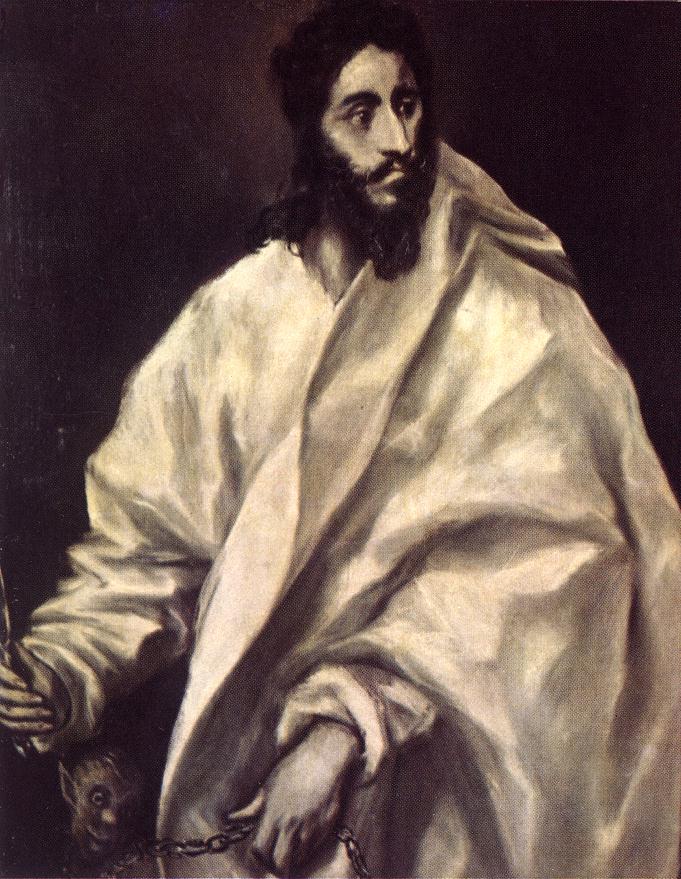
The apostle Bartholomew is named among the Twelve, but none of the Synoptic Gospel episodes gives him an individual role. This reticence encouraged a tradition identifying him with Nathanael, a character in the Gospel of John from Cana who was brought to Jesus by Philip. The connection is ancient and has shaped preaching, without being explicitly affirmed by the texts. Bartholomew's story then continues in the missionary traditions of the East and accounts of his martyrdom, where the motif of flaying appears. The knife and the skin, made famous by Michelangelo's painting, belong to this memory dating from after the apostolic age.
| Name | Bar-Tolmay, probably “son of Tolmay” |
|---|---|
| Canonical sources | Lists of the Twelve; traditional connection with John 1 and 21 |
| Associated character | Nathanael of Cana, without explicit identification |
| Reported missions | The East, according to ancient Christian traditions |
| Attributes | Knife, skin, book and palm |
| Feast day | August 24 |
A name in the lists of the Twelve
Matthew, Mark, Luke and the Acts of the Apostles mention Bartholomew in the lists of the disciples called by Jesus. His name generally appears near Philip, except in certain arrangements of the list in Acts. None of these books, however, recounts a personal intervention by Bartholomew comparable to those of Peter, John or Thomas. The directly preserved information is therefore very limited.
The name appears to be an Aramaic patronymic: Bar-Tolmay probably means “son of Tolmay.” It does not necessarily identify the character's usual first name. This particularity explains why commentators have sought to determine whether the apostle might appear elsewhere under another designation. Tradition has particularly retained the name Nathanael.
The absence of an individual account does not mean that the character held a secondary place beside Jesus. The lists express membership in the group of the Twelve, whose collective function has great symbolic importance in the Gospels.
Nathanael of Cana and his objection about Nazareth
The first chapter of the Gospel according to John recounts that Philip invites Nathanael to meet Jesus. He initially expresses reservations about Nazareth, the town from which the teacher is presented as coming. Philip responds by proposing a personal encounter. The account thus transforms an objection about geographical origin into a confession of faith.
John then specifies that Nathanael is from Cana in Galilee when he names him among the disciples present in chapter 21. This location helped shape his identity in Christian tradition. However, the fourth Gospel never explicitly says that Nathanael is Bartholomew.
The connection stems in particular from the relationship with Philip and the position of the names in the apostolic lists. It is an ancient and coherent interpretation for many readers, but it should not be presented as an equivalence materially attested by the Gospels.
The dialogue with Jesus under the fig tree
When Nathanael approaches Jesus in John 1, the conversation concerns the fact that he was seen under a fig tree even before the encounter. The text does not provide a complete description of what happened under that tree. Christian commentators have proposed different interpretations: a place of prayer, study or solitude, or a sign of knowledge that goes beyond appearances.
The scene concludes with a confession by Nathanael and a promise from Jesus concerning greater things that he will see. The connection between the fig tree, recognition of Christ and the mention of angels ascending and descending recalls the account of Jacob and the ladder in Genesis. The passage therefore has a biblical and theological dimension that cannot be reduced to an individual conversation.
In traditions that identify Nathanael and Bartholomew, this dialogue becomes the apostle's principal account of vocation. However, the distinction between the names must be maintained to respect the way the Gospel of John constructs its testimony.
Nathanael's presence in John 21
The final chapter of John names Nathanael among several disciples gathered near the Sea of Tiberias after the events of Easter. Peter proposes going fishing, and the others join him. The encounter with the Risen One and the meal on the shore recall important motifs of the apostolic vocation: the nets, unexpected abundance and the mission entrusted to the witnesses.
Nathanael does not deliver a great speech here. His presence nevertheless confirms that he belongs to the Johannine circle of those who knew Jesus and took part in the Easter accounts. The traditional connection with Bartholomew seeks precisely to link this figure to one of the Twelve named in the other Gospels.
The passage should be studied without turning an identification hypothesis into explicit information. The group's collective function and the manifestation of the Risen One remain at the center of the scene.
The earliest traditions of missions to the East
Early Christian authors attributed missionary journeys to Bartholomew in various regions, particularly India and Armenia. Eusebius of Caesarea reports a tradition according to which Pantaenus found an associated Gospel in an eastern region connected with the apostle's preaching. This notice should be situated within the history of the spread of Christianity and its founding narratives.
Armenian traditions also hold an important place in his memory. Several Eastern Churches honor Bartholomew as one of their earliest witnesses. The details of his travels, companions and death vary according to the texts, making it impossible to reconstruct a continuous itinerary from information contemporary with the apostle.
These accounts are not without interest. They show how communities sought to connect their history with the witnesses of Christ. It is simply necessary to recognize that their documentary value also concerns the centuries during which they were composed and transmitted.
The knife and the tradition of flaying
Western tradition describes Bartholomew's martyrdom as flaying. The apostolic passions gave this episode different narrative forms, but the image of the body stripped of its skin became established in art. The knife thus became his principal attribute, sometimes accompanied by the skin that the saint holds himself.
Michelangelo depicts Bartholomew holding his skin in the Last Judgment of the Sistine Chapel. The work became particularly famous because the skin held by the apostle was interpreted as a self-portrait of the artist. This reading belongs to art history and should not be presented as information about the martyr's historical appearance.
The Gospels do not recount this death. The knife scene is connected with the hagiographic reception of Bartholomew and the language of faithfulness in the face of persecution. Its place in European art helps explain why an apostle scarcely described in the Bible became immediately recognizable in churches.
August 24 and the legacy of a discreet apostle
The feast of Saint Bartholomew is celebrated on August 24. Traditions concerning his relics and cult found an important place in both the East and the West. In Rome, the church of Saint Bartholomew on the Island bears witness to this memory in a pilgrimage site dedicated to the martyrs.
Bartholomew's attributes are almost entirely connected with the traditions of his martyrdom, while the New Testament information mainly concerns his membership in the group of the Twelve. The page devoted to Saint Bartholomew explores the spread of his cult and the history of his representations.
To learn about the character from the sources, the best approach is to read the apostolic lists, then John 1 and 21, while taking into account the distinction between Bartholomew and Nathanael. Their connection illustrates how Christian traditions sought to establish continuity between witnesses named in different accounts.
Sources and references
New Testament: Matthew 10 and Mark 3, lists of the Twelve; John 1 and John 21, Nathanael.
Benedict XVI, general audience of October 4, 2006, on Bartholomew, names, connection with Nathanael and traditions.
Eusebius of Caesarea, Ecclesiastical History, V, 10, testimony concerning Pantaenus and Eastern traditions.
Historical illustration: El Greco, Saint Bartholomew, painting circa 1608–1614, public domain.










