



















































































































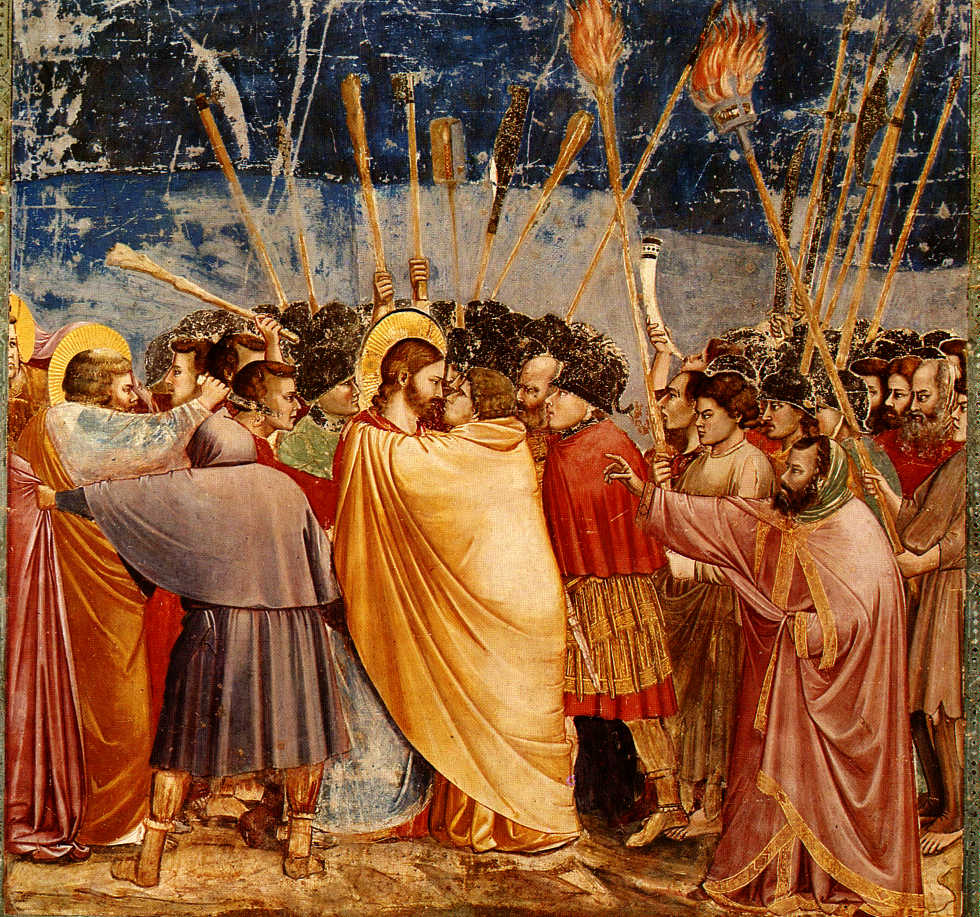
Judas Iscariot belonged to the group of the Twelve chosen by Jesus, but his name has become inseparable from Christ's arrest. All four Gospels present him as the one who hands his master over to the authorities, while offering accounts and interpretations that do not entirely overlap. Matthew mentions thirty pieces of silver and remorse; John connects him to the disciples' common purse; Luke emphasizes Satan's role in the events. Judas' end is also recounted differently in Matthew and Acts. To understand this figure, each of these testimonies must be read precisely, invented psychological explanations must be avoided, and the responsibility of a disciple must be distinguished from any collective accusation against the Jewish people.
| Identity | Member of the Twelve before the Passion |
|---|---|
| Name | Judas, called Iscariot, disputed etymology |
| Sources | Mark 14; Matthew 26–27; Luke 22; John 12–13 and 18 |
| Decisive act | Hands Jesus over to the authorities during the Passion |
| Accounts of his death | Matthew 27 and Acts 1, distinct presentations |
| Apostolic succession | Matthias chosen according to Acts 1 |
Judas, a disciple counted among the Twelve
The Synoptic Gospels name Judas Iscariot in their lists of the twelve apostles, generally in last place. This position is connected to the way the authors retrospectively recount his role in Jesus' arrest. Judas is nevertheless not an outsider who appears only at the time of the Passion: he was chosen from among the disciples and shared their itinerant life.
His nickname Iscariot remains difficult to explain with certainty. One hypothesis connects it to Kerioth, a Judean locality, and suggests it could mean “man of Kerioth.” Other proposals link it to vocabulary referring to a dagger or the Sicarii. None of these etymologies alone makes it possible to establish his career, political convictions, or exact origin.
It is also essential to distinguish Judas Iscariot from Jude Thaddeus, another disciple whose ancient names may resemble each other. John 14 expressly clarifies that the Judas who asks a question at the Last Supper is not Iscariot.
The Bethany meal and the question of the purse
John 12 recounts a meal in Bethany during which Mary pours perfume on Jesus' feet. Judas protests the cost of the perfume and mentions the possibility of giving the money to the poor. The narrator interprets this objection by stating that Judas held the common purse and misused it. This portrayal appears in the Fourth Gospel and serves a particular function in its narrative.
The Synoptic Gospels also present a scene of anointing at Bethany, but the characters who object to the gesture and the way in which the episode is situated differ. Bringing these accounts together requires respecting their literary construction. The variations should not be transformed into a single scene in which every detail would be identical from one book to another.
Money becomes a major theme in the memory of Judas, but the New Testament does not provide a complete psychological analysis of his motives. The texts primarily seek to recount the approach of the Passion and the contrast between the fidelity expected of the disciples and the act of the one who is going to hand Jesus over.
The Thirty Pieces of Silver in Matthew
Matthew 26 recounts that Judas went to the chief priests and agreed on a sum of thirty pieces of silver to hand Jesus over. This detail belongs to the distinctive narrative of the First Gospel and would be taken up in a large part of Christian art. The coins and the purse thus became attributes immediately associated with Judas.
The number and its relationship to the ancient Scriptures have prompted numerous commentaries. Matthew connects the events of the Passion with prophetic texts and images from the Old Testament. The sum mentioned must therefore be read within this literary context, without claiming that it provides an exhaustive explanation of all Judas’s intentions.
Mark and Luke also recount the decision to hand Jesus over, but develop the circumstances differently. Luke 22 particularly emphasizes Satan’s entry into Judas. These formulations have their own theological significance and do not authorize us to construct a completely certain modern psychology of the character.
The Last Supper and the Gesture Involving the Bread
The accounts of the Last Supper show Jesus among the disciples as the Passion approaches. The Synoptic Gospels mention the revelation that one of the guests will betray him. Each person must then question his own fidelity. The account emphasizes the seriousness of a rupture coming from Christ’s inner circle.
John 13 constructs the scene in a particularly detailed way. Jesus washes his disciples’ feet and then announces the betrayal. The disciple whom Jesus loved asks about the identity of the one who is going to act; Jesus gives Judas a piece of bread. Judas then leaves the meal in a scene that the narrator imbues with profound symbolic meaning.
The gesture involving the bread and Judas’s departure have inspired many works, but they must be read within the context of the Johannine discourse on love and service. Judas is the one who breaks with the community at the very moment when Jesus gives his disciples teaching on fidelity and self-sacrifice.
The Kiss and the Arrest of Jesus
The Synoptic Gospels describe Judas coming to the garden with those who must arrest Jesus. The kiss by which he identifies his master becomes one of the most striking motifs of the Passion. This gesture, ordinarily associated with closeness and friendship, takes on the opposite meaning when it serves to betray the one he identifies.
John 18 also recounts Judas’s arrival with the men tasked with arresting Jesus, but presents the scene with a different structure and does not place the kiss at the center of the identification. The Gospel accounts thus express, through different choices, the same fundamental event: the arrest of Jesus in the context of the Passion.
It would be erroneous to use Judas’s act to attribute collective responsibility to the Jewish people. Jesus, Judas, and the first disciples themselves belonged to the Jewish world of the 1st century. The scenes of the Passion concern individuals and authorities situated within a particular history, not the hereditary guilt of a people.
Judas’s death according to Matthew and according to Acts
Matthew 27 reports that Judas feels remorse after betraying Jesus. He tries to return the thirty pieces of silver, then takes his own life. The account associates the money with a field acquired by the religious authorities, which receives the name “field of blood.” The narrative emphasizes the gravity of the consequences of his act and his inability to find a way out.
Acts 1 gives a different presentation. Peter recalls Judas’s role, then refers to his end and the acquisition of a field in terms that do not correspond in every detail to Matthew’s account. The two passages have been harmonized in certain traditions, but readers benefit from knowing their differences rather than concealing them behind a reconstruction presented as certain.
None of these texts allows us to claim knowledge of Judas’s entire inner experience. The question of his ultimate fate belongs to theological reflection, not to a fact that the reader could deduce from a few scenes. Scripture recounts his act and its consequences without providing an exhaustive psychological biography.
Matthias replaces Judas among the Twelve
At the beginning of Acts, the community gathered in Jerusalem seeks to restore the number of Twelve after Judas’s disappearance. Peter recalls the requirements for this apostolic witness: having accompanied Jesus from the beginning of his ministry through the events of Easter. Two men are proposed, Joseph called Barsabbas and Matthias. After prayer, the lot designates Matthias.
The account shows the symbolic importance of the number Twelve in relation to Israel. The choice of Matthias represents not only the administrative replacement of a leader; it expresses the desire to continue bearing witness to Jesus in a community structured by the memory of the apostles.
This distinction explains why some depictions of the Twelve show Matthias rather than Judas Iscariot. The two lists do not refer exactly to the same moment in history: one to the earthly life of Jesus and the other to the community gathered after Easter.
The reception of Judas in art and later writings
Western artists have depicted Judas holding a purse, set apart from the other disciples, or leaving the table at the Last Supper. Some works give him distinctive clothing to make him identifiable. These conventions developed in different religious and social contexts and do not constitute historical portraits of a 1st-century man.
Ancient and medieval Christian literature developed numerous accounts of his motivations and end. An apocryphal text known as the Gospel of Judas, composed in the 2nd century within a distinct religious milieu, offers the character a very different interpretation. It is evidence of debates subsequent to the canonical Gospels and cannot be read as the disciple's contemporary journal.
To understand Judas Iscariot, one must return to Mark 14, Matthew 26–27, John 13, and Acts 1. These sources present a figure involved in the story of the Passion and in the memory of the early communities. Careful reading makes it possible to grasp the gravity of his role without attributing intentions or a fate to him that the texts do not establish.
Sources and references
Gospels: Mark 14; Matthew 26; Matthew 27; John 13, different accounts of the betrayal.
Acts of the Apostles, chapter 1, verses 15–26, Judas's death and the choice of Matthias.
Benedict XVI, general audience of October 18, 2006, on Judas Iscariot and Matthias.
Second Vatican Council, Nostra aetate, no. 4, rejection of collective Jewish guilt for the Passion.
Historical illustration: Giotto, The Kiss of Judas, fresco circa 1304–1306, public-domain work.










