



















































































































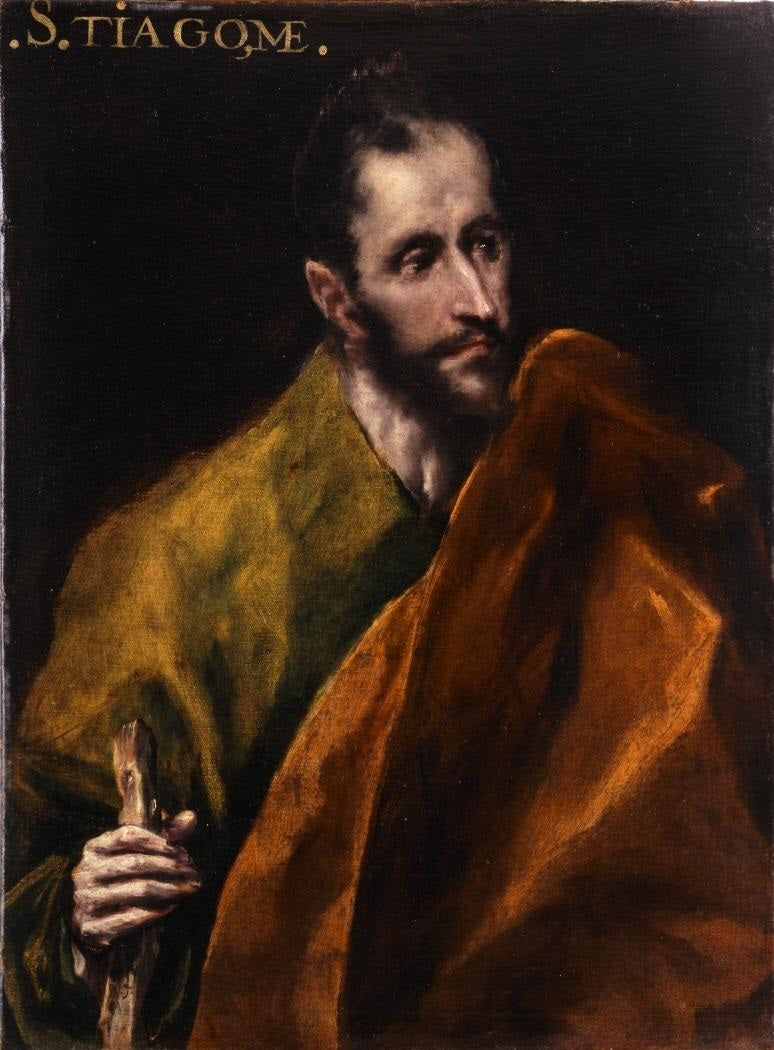
James the Less was part of the group of the Twelve under the name James, son of Alphaeus. Unlike James, son of Zebedee, the Gospels devote no developed personal account to him. His memory nevertheless became enriched through his association with two other figures: James “the Little,” mentioned among the women present at the Passion, and James “brother of the Lord,” leader of the Jerusalem community. These identifications belong to an ancient history of Christian interpretations, but they are not unanimously accepted. The figure of James the Less is therefore particularly interesting for understanding how apostolic lists, family traditions, and the earliest accounts of the Church were brought together over the centuries.
| Canonical name | James, son of Alphaeus |
|---|---|
| Certain texts | Mark 3; Matthew 10; Luke 6; Acts 1 |
| Traditional name | James the Less |
| Discussed identifications | James the Little; James brother of the Lord |
| Associated epistle | Letter of James, historical authorship debated |
| Feast | May 3 with Philip, in the Roman calendar |
James, son of Alphaeus, in the lists of the Twelve
The Synoptic Gospels and the Acts of the Apostles name a James identified by his father’s name, Alphaeus. This mention distinguishes him from James, son of Zebedee, brother of John. The presence of two men called James is consistent with the frequency of the name in 1st-century Judaism, where it corresponds to the Greek form of the patriarch Jacob’s name.
The lists give James son of Alphaeus neither a profession, nor a birthplace, nor an individual episode comparable to the Transfiguration. His membership in the group of the Twelve is therefore the most certain New Testament information about him. The evangelists’ silence does not allow us to reconstruct the disciple’s character or movements.
The designation “the Less” comes from traditions seeking to distinguish the different Jameses. It does not mean that he was morally inferior or less important in the community. The qualifier primarily served the need to avoid confusing several people with the same name.
James the Little, son of a Mary present at the Passion
Mark 15 mentions a Mary presented as the mother of James the Little and Joses among the women who witness the crucifixion. Depending on the translation, the qualifier may be understood as “the little” or “the younger.” Other passages speak of the same Mary near the tomb. Ancient commentators sought to associate this James with the son of Alphaeus.
The text nevertheless does not explicitly establish this equivalence. The James mentioned as the son of Mary and the one named as the son of Alphaeus may be identified by tradition, but the indications preserved are not sufficient to demonstrate without debate that they were one and the same man. This caution becomes important when other family relationships are subsequently added.
Some authors have associated the mother of “the Little” with Mary of Clopas, mentioned in John 19. The Gospels likewise do not present this identification as an explicit correspondence. Comparison of the texts must therefore respect the way each author names the characters.
Is James, brother of the Lord, the same man?
In Galatians 1, Paul mentions a James whom he calls “brother of the Lord.” This figure plays a central role in the history of the Church of Jerusalem. Chapter 15 of Acts shows him speaking in a discussion concerning the reception of non-Jews and the requirements of the Law. He clearly belonged to the leaders of the first Christian community.
Ancient Latin tradition, particularly in Jerome, identified this James with James son of Alphaeus and James the Less. Other Christian interpretations and many modern scholars distinguish the figures or regard their identification as uncertain. The question also concerns how to understand the word “brother” in the context of Jesus’ family relationships.
It would therefore be inaccurate to automatically attribute to the son of Alphaeus every episode in Acts concerning the leader of Jerusalem. The associations transmitted by tradition may be presented, but the difference between the textual data and identification hypotheses must be maintained.
The leader of Jerusalem and the debate concerning the nations
In Acts 15, James speaks during a meeting devoted to non-Jewish believers. The disciples must determine under what conditions these people may join the community without first adopting all the requirements of the Law of Moses. James proposes an approach intended to preserve communion among groups with different practices.
This intervention certainly belongs to the figure of James who led Jerusalem, also known from Paul’s letters. If the traditional identification is followed, it may be attributed to James the Less; if the figures are distinguished, it concerns another James. Historical caution does not require erasing the episode, but clarifying whom the text associates with it.
The question of welcoming the nations was decisive in the birth of the Church. It shows that the first leaders had to make decisions about customs, communal life, and the relationship between the traditions of Israel and the new communities.
The Letter of James and its teachings
The New Testament contains an epistle of James that opens by presenting its author as a servant of God and of the Lord Jesus Christ. The letter speaks of patience in trials, the use of speech, justice toward the poor, and the relationship between faith and works. Its style belongs to a tradition of wisdom and moral exhortation.
The author does not explicitly identify himself as the son of Alphaeus. The attribution of the letter to the leader of Jerusalem or to a tradition linked to this name is the subject of historical debate. The canonical place of the epistle should therefore not be turned into direct proof of the identity of James the Less.
The letter’s exhortations remain essential for understanding the life of the earliest communities. They remind us that religious speech must be accompanied by consistent conduct, particularly toward people who are poor or deprived of social consideration.
The martyrdom of James and Josephus’s testimony
The historian Flavius Josephus recounts the execution of a James presented as the brother of Jesus called Christ, under the high priest Ananus in 62. This testimony appears in the Antiquities of the Jews, Book XX. It provides a source outside the New Testament concerning a Christian leader in Jerusalem.
Identifying this James with the son of Alphaeus depends precisely on the question discussed above. It therefore cannot be stated as an established historical fact that Josephus’s testimony automatically concerns the apostle James the Less. Hagiographical traditions subsequently developed several accounts of martyrdom and iconographic attributes.
The fuller’s club, associated in art with Saint James the Less, belongs to these later accounts. It represents the traditional torture of the figure identified with James the Just, but it is not mentioned in the apostolic lists of the Gospels.
May 3 and the memory of James the Less
In the Roman calendar, Saint Philip and Saint James are celebrated together on May 3. This liturgical association does not depend on a biblical account in which the two men carried out a particular mission together. It belongs to the history of their veneration and of the sanctuaries dedicated to the apostles.
James the Less appears in iconography with a book or a club recalling his traditional martyrdom. Images may combine features attributed to the son of Alphaeus and to James, brother of the Lord. This fusion has a real history in Christian tradition; it must nevertheless be distinguished from the information provided by each book of the New Testament.
To discover James accurately, one must read the lists of the Twelve and then the passages devoted to the leader of Jerusalem while retaining the question of their identification. This method makes it possible to understand why a briefly mentioned figure became the center of a particularly rich literary, liturgical, and theological tradition.
Sources and references
Gospels: Mark 3:18, James son of Alphaeus; Mark 15:40, James the Little; Matthew 10, the Twelve.
Letters and Acts: Galatians 1:19, James brother of the Lord; Acts 15, leader of Jerusalem; Letter of James.
Benedict XVI, general audience of June 28, 2006, on James the Less, traditional identifications.
Flavius Josephus, Antiquities of the Jews, XX, 200, account of the death of James, brother of Jesus; not to be attributed to the son of Alphaeus without discussion.
Historical illustration: El Greco, portrait of the apostle, circa 1590, Oviedo cycle, Museum of Fine Arts of Asturias, public-domain work.










