



















































































































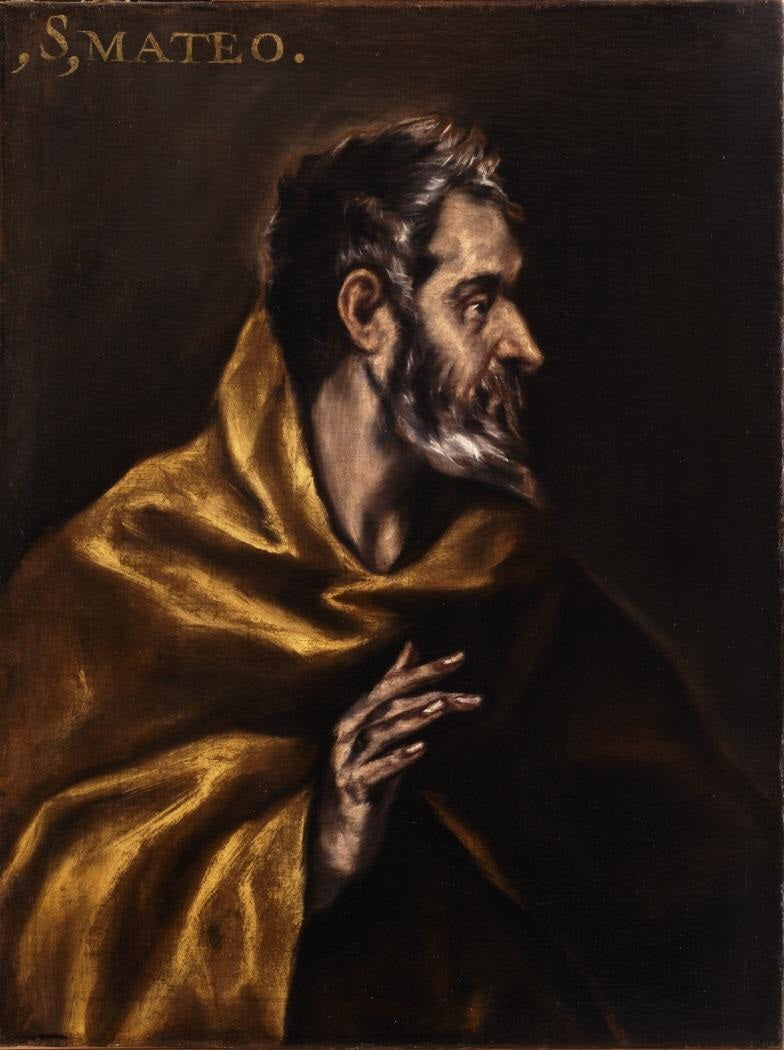
The apostle Philip is one of the disciples whose development can be followed in the Gospel of John. Originally from Bethsaida, he receives Jesus’ call, goes to Nathanael, and invites him to experience the encounter for himself. He also appears at the multiplication of the loaves, conveys with Andrew the request of Greeks who wish to see Christ, and asks a decisive question at the Last Supper: he wants Jesus to show them the Father. These episodes compose the portrait of a man who moves forward by seeking to understand and opening the way for others. Philip’s story also requires distinguishing him from another figure in the New Testament, the evangelizing deacon in the Acts of the Apostles.
| Origin | Bethsaida, in Galilee |
|---|---|
| Rank in the lists | Fifth among the Twelve |
| Major texts | John 1, 6, 12, and 14 |
| Distinct person | Philip the evangelist in Acts 6, 8, and 21 |
| Later tradition | Hierapolis, in Asia Minor |
| Feast | May 3, with James in the Roman calendar |
A Greek Name in a Family of Galilean Disciples
The lists of the Twelve place Philip fifth. The Gospel according to John specifies that he came from Bethsaida, like Andrew and Peter. His Greek name draws attention in a Jewish setting in Galilee: it reflects the circulation of several languages and cultural traditions in the region. This detail is not enough to reconstruct his education or claim that he spoke several languages with equal fluency.
John’s narrative introduces Philip at the beginning of Jesus’ ministry. Christ addresses him with a direct call, and the disciple immediately begins looking for someone with whom to share his discovery. This narrative structure gives him a particular role: he receives the word and becomes an intermediary for another man, Nathanael.
Philip is therefore not presented merely as a name in an apostolic list. His successive interventions show how he learns to move beyond his initial ideas and recognize what the person of Jesus means to him.
Philip Leads Nathanael to Jesus
In John 1, Philip tells Nathanael that he has found the one spoken of by the Law and the prophets: Jesus of Nazareth. Nathanael responds with an objection concerning the man’s Galilean origin. Philip does not try to answer with an endless demonstration; he invites his friend to come and see for himself. The narrative then moves from received testimony to personal encounter.
This episode explains Philip’s important place in the tradition of the calling. The disciple does not impose a conclusion on Nathanael; he invites him to meet the one he proclaims. The Gospel thus presents Christian testimony as a word that leads toward Christ without taking the place of the relationship that each person must establish with him.
Tradition identifies Nathanael with Bartholomew, who is named in the lists of the Twelve. This identification is not explicitly stated by John. It should therefore be presented as an ancient association, not as a second designation affirmed by the text of the encounter.
The two hundred denarii and the hungry crowd
In chapter 6, Jesus asks Philip how to feed a large crowd. Philip responds by referring to the considerable cost of the bread required. The detail of the two hundred denarii makes tangible the gap between ordinary resources and the needs of those present. The evangelist specifies that Jesus already knows what he is going to do and that the question puts the disciple to the test.
Andrew then steps in to point out a boy who has five loaves and two fish. The two disciples respond differently to the same difficulty: Philip calculates the necessary resources, while Andrew presents what is available. The account does not disparage attention to material realities, but leads the reader toward the sign through which Jesus reveals an abundance that exceeds human expectations.
Philip’s presence in this scene is important because he does not merely witness a miracle. He is questioned and must explain what he understands about the situation. John’s Gospel gives his question a pedagogical significance.
The Greeks who ask to see Jesus
In John 12, Greeks who have come to Jerusalem to celebrate a festival wish to meet Jesus. They first approach Philip, who informs Andrew; the two disciples pass on the request. The scene occurs at a point when the Gospel is moving toward the Passion and emphasizes the broader significance of Christ’s work.
Philip's selection may be connected with his Greek name, but the text gives no explicit explanation for the reasons behind this step. The encounter is nevertheless interesting for understanding how the first Christian communities conceived of non-Jews' access to Jesus' message. The disciples become mediators between those who seek and the one they want to see.
The narrative also reveals continuity with the first chapter: Philip takes part in encounters that move from a proclamation to the presence of Christ. This discreet role runs through several stages of his journey.
The request to see the Father at the Last Supper
Perhaps Philip's most important intervention is found in John 14. During the farewell discourse, he asks Jesus to show them the Father. Christ's response develops one of the great themes of the Johannine Gospel: whoever knows Jesus discovers in him the relationship with the Father. Philip thus expresses a question that readers themselves may ask as they encounter this discourse.
This scene does not present a man devoid of faith. Rather, it shows a disciple seeking to understand the word he has received. Jesus invites him to move beyond the idea of a manifestation separate from the Father and to recognize the meaning of his own presence. Throughout the Fourth Gospel, the disciples' questions become opportunities for teaching.
Philip's figure therefore has a real place in the theological development of the narrative. His name appears at moments when people seek to recognize Jesus' identity and the significance of his mission.
Philip the apostle and Philip the evangelist are different
The Book of Acts names another Philip, chosen among the Seven in chapter 6 and known as Philip the evangelist. He proclaims Christ in Samaria, meets an Ethiopian official on the road to Gaza, and accompanies him toward baptism in chapter 8. Later, Acts 21 presents him in Caesarea with his four prophesying daughters.
This figure should not be automatically identified with the apostle Philip of the Twelve. The book distinguishes the group of apostles from the Seven chosen for a specific task in the Jerusalem community. The identical names encouraged early associations, but the text provides clues that make it possible to distinguish the two paths.
This distinction is particularly useful for avoiding attributing the baptism of the Ethiopian dignitary to the apostle. This account belongs to the history of Philip the evangelist, a major figure in the earliest missions, but different from the man questioned by Jesus in the fourth Gospel.
The traditions of Hierapolis and iconography
Ancient tradition associates Philip with Hierapolis, a city in Asia Minor where his name is said to have been honored in the memory of Christian communities. Eusebius of Caesarea reports testimonies about a Philip and about women in his circle, but their exact identification with the apostle or the evangelist is debated. The history of the early Churches must take this similarity of names into account.
The apostle is depicted with a book, a cross, or a staff, depending on the traditions surrounding his mission and martyrdom. His attributes do not derive from a physical description preserved in the Gospels. On May 3, he is celebrated in the Roman calendar with James, as part of a feast linked to their apostolic memory.
To discover Philip, chapters 1, 6, 12, and 14 of John provide a particularly illuminating journey. They show a disciple who conveys an encounter, assesses a difficulty, and seeks to understand Christ’s relationship with the Father. His intermediary role and his questions give coherence to these episodes, which are far removed from one another.
Sources and references
Gospel according to John : John 1:43–51 ; John 6:5–7 ; John 12:20–22 ; John 14:8–11.
Acts of the Apostles: Acts 6, the Seven; Acts 8, Philip the evangelist; Acts 21, the family of that same Philip.
Benedict XVI, general audience of September 6, 2006, on Philip.
Eusebius of Caesarea, Ecclesiastical History, III, 31 and V, 24, traditions from Asia Minor concerning Philip and his family.
Historical illustration: El Greco, portrait of the apostle, circa 1590, Oviedo cycle, Museum of Fine Arts of Asturias, public-domain work.










