





























































































Dion Fortune, whose birth name was Violet Mary Firth, is one of the major figures in twentieth-century British occultism. Born in Llandudno, Wales, on December 6, 1890, she developed a body of work bringing together psychology, ceremonial magic, Hermetic Qabalah, esoteric Christianity, mediumship, and initiatory literature. She founded the group that became the Society of the Inner Light and left works such as Psychic Self-Defence and The Mystical Qabalah, which are still read in Western esoteric circles.
Her life nevertheless needs to be recounted methodically. Fortune herself describes visions, communications with “Masters,” and experiences that she interpreted within an occult framework. These accounts are fully part of her thought, but their status is not that of verifiable facts such as her involvement with the Alpha and Omega, her publications, or the founding of her school. Distinguishing these levels makes it possible to understand the author, the organizer, and the magician alike.
Violet Mary Firth, Born in Wales
Violet Mary Firth was born on December 6, 1890, in Llandudno. She grew up in a prosperous middle-class British family shaped by Protestant culture. Her parents were interested in Christian Science, a religious movement that places significant emphasis on the relationships between mind, faith, and healing.
Her future pseudonym comes from a family motto: Deo, non fortuna, “by God, not by fortune.” During her initiatory journey, Violet Firth transformed this formula into a magical name and then an author’s name: Dion Fortune.
Theosophical and occult biographies attribute unusual perceptions to her from childhood, including visions that she would later interpret as connected with Atlantis or past lives. These elements come primarily from Fortune and those around her.
It is more prudent to regard them as the first chapters of her spiritual autobiography. They would become important in the construction of her cosmology, without necessarily constituting events that can be independently established.
Studley Agricultural College and the Crisis That Shaped Her Thought
In the early 1910s, Violet Firth studied at Studley Agricultural College, an English institution dedicated to agricultural and horticultural training for women. There, she went through a severe psychological crisis amid conflict with the administration.
In her later writings, Fortune interpreted this episode as the effect of a psychic influence exerted against her. Whether this crisis is understood psychologically, occultly, or as both at once, it became for her a genuine initiatory ordeal and one of the starting points of her research into mental influence and psychic protection.
After Studley, Violet Firth turned to psychology. The Society of the Inner Light states that she studied at the University of London before working as a counselor at a psychotherapy clinic. She became familiar with the first British schools of psychoanalysis and read Freud, Adler, and Jung.
This training did not make her a psychologist in the modern professional sense, but it left a lasting mark on her vocabulary. Throughout her life, Fortune spoke of the unconscious, complexes, suggestion, imagination, and projection while also using the concepts of the astral plane, thought-form, and subtle body.
Fortune did not regard psychology and occultism as two incompatible worlds. She believed that some phenomena too quickly attributed to spirits could result from psychological processes, while certain spiritual experiences, in her view, could not be reduced to mental disorders. This middle position was one of the distinctive features of her work. She attempted to develop an occult psychology suited to the esoteric practices of her time.
During the First World War, Fortune worked in the agricultural sector and joined the Women's Land Army. She was also interested in producing soy-based products in the context of rationing.
This episode reveals a very practical side of her personality. The future occultist was not solely focused on visions and rituals: she had a genuine sense of organization that would later play a decisive role in the creation of her own order.
Toward the end of the war, Violet Firth met Theodore Moriarty, an Irish physician and occultist living in London. He led a small circle in which he taught an approach combining magic, psychology, and the study of psychic phenomena.
Moriarty became one of her first important teachers. Fortune acknowledged his great influence on the way she thought about occultism. She drew on him for the character of Dr. Taverner in her fantasy stories, in which an occultist physician deals with cases involving psychological disorders and invisible phenomena.
1919, the entry into the Golden Dawn tradition
In 1919, Violet Firth is initiated into a branch descended from the Golden Dawn. Susan Johnston Graf’s study specifies that she enters an Alpha and Omega temple led by J. W. Brodie-Innes.
This detail is important, because some biographies have her begin her journey directly with Moina Mathers. Fortune first passes through Brodie-Innes’s group before continuing her initiation in a temple associated with Moina Mathers.
In the Golden Dawn tradition, initiates adopt a magical motto. Violet Firth uses the family motto Deo non Fortuna. “Dion Fortune” emerges from this motto and gradually becomes her public identity as an occultist and writer. The change is not insignificant. It corresponds to the moment when the young woman trained in psychology truly enters the Western initiatory tradition.
The Golden Dawn primarily provides her with a symbolic framework. The Tree of Life, the ten Sephiroth, the twenty-two paths, the planets, the elements, the colors, and the correspondences become the foundations of her thought.
Fortune’s Kabbalah is a Western Hermetic Kabbalah. It should not be confused with Jewish Kabbalah in its religious history. It belongs to a tradition transformed by the Christian Renaissance, 19th-century occultists, and the Golden Dawn.
Fortune continues her training in a temple under the authority of Moina Mathers. The relationship between the two women gradually deteriorates. Fortune considers the order too rigid and seeks to create new forms of teaching.
In Psychic Self-Defence, she also recounts experiences that she interprets as hostile manifestations originating from another occultist, generally identified as Moina Mathers. Fortune experienced them as genuine attacks on the psychic plane; readers may approach them as occult accounts, inner experiences, or phenomena that remain open to interpretation.
Fortune maintains a particularly strong connection with Glastonbury, in Somerset. The abbey, the Tor, and the traditions associated with the Grail become a true initiatory landscape for her. She notably meets Frederick Bligh Bond, an architect and archaeologist famous for his excavations of the abbey and his controversial use of automatic writing. Fortune herself claims to receive communications concerning Avalon and the spiritual past of the place. Glastonbury would become one of the geographical centers of her own order and one of the enduring themes of her thought.
1924, founding of her own group
The Society of the Inner Light traces its foundation back to 1924. This is therefore the date to remember for the institutional beginnings of the group formed around Fortune. The organization successively bore several names, including Community of the Inner Light and then Fraternity of the Inner Light, before becoming the Society of the Inner Light. It seeks to transmit a Western tradition combining Hermetic Kabbalah, ceremonial magic, psychology, and esoteric Christianity.
Fortune did not wish to create a simple discussion circle. She established courses, meditations, ritual work, and a progression intended for students. The group had centers in London and Glastonbury. This institutional dimension explains part of its legacy. The Society of the Inner Light still exists and presents itself as the direct heir to her work. Fortune also maintained an important connection with theosophy. She knew the works of Helena Blavatsky and attended the Christian Mystic Lodge of the Theosophical Society.
She shared with theosophy the idea of spiritual masters, planes of consciousness, and an initiatory tradition that transcends individual religions. However, she distanced herself from the theosophical developments she considered too oriented toward India and sought to reaffirm the value of a Western path.
Fortune believed that a spiritual tradition should also speak the symbolic language of the culture in which it is practiced. She did not reject Asian teachings, but refused to import them without adaptation.
Her own school therefore draws more heavily on Kabbalah, esoteric Christianity, Arthurian legends, the Grail, and ceremonial magic. This position distinguishes it both from the most Eastern-oriented theosophists and from occultists who simply wish to reproduce the forms of the Golden Dawn.
In 1927, Violet Firth married Thomas Penry Evans, a Welsh physician. For a time, he took part in some of her circle’s activities. The marriage ended in the late 1930s. Occultist biographies surround this relationship with numerous psychological and esoteric interpretations, not all of which can be verified. It is enough to remember that this separation coincided with a period in which Fortune developed her own ritual and literary orientations more freely.
During the 1920s, Fortune and several collaborators conducted trance séances. She claimed to receive extensive cosmological teachings from intelligences belonging to the “inner planes.”
These teachings constitute the substance of The Cosmic Doctrine. The text initially circulated within the group and was not published until after her death, in 1949. For Fortune and those close to her, it originated from contacts established on the inner planes; for today's reader, it retains its full force as a record of a structured mediumistic practice and as the cosmological core of her school.
Psychic Self-Defence was published in 1930. WorldCat confirms this date for the first edition. The book became one of Fortune's best-known texts. In it, the author brings together personal accounts, testimonies, psychology, and occult concepts to describe the phenomena she associated with psychic influence. The work is therefore hybrid in character: part autobiography, esoteric essay, and collection of cases interpreted through her system.
It is best read in its occultist context. For Fortune, notions such as thought-forms, astral influence, and psychic vampirism were operative realities of the magical tradition; they described a subtle world that her work specifically sought to map, without conflating it with medical vocabulary.
In the 1930s, The Mystical Qabalah was published and is generally regarded as her major theoretical work. In it, Fortune presents the Tree of Life as a map for organizing the symbols and experiences of the Western magical tradition.
Each Sephirah is connected to forces, images, planets, and states of consciousness. The book makes a system previously transmitted mainly within initiatory circles much more accessible. This is one reason for its lasting success: Fortune had a genuine talent for teaching. She simplified the structure without entirely stripping it of its initiatory content.
Fiction as a Means of Teaching
Fortune regarded fiction as an extension of her esoteric work. Susan Johnston Graf emphasizes that, unlike several other members of the Golden Dawn who preferred to conceal their doctrines in their literary works, Fortune sought to make part of occultism accessible to the uninitiated.
Recent research by Mark S. Morrisson also shows that her novels of the 1930s bring together popular literature, psychotherapy, and initiation. The narrative allows the reader to experience a doctrine symbolically rather than merely read it in theoretical form.
The Demon Lover portrays a relationship in which magic, fascination, and psychological power become intertwined. The novel revisits several themes that Fortune would develop in her essays: mental influence, dependency, loss of will, and the search for inner autonomy. Fiction allowed her to explore these questions without claiming to provide a clinical account.
In her novels of the 1930s, Fortune became increasingly interested in instinctive forces and ancient religious symbols. Pan, ancient cults, and the powers of nature became ways of reflecting on the relationship between desire, morality, and consciousness.
This orientation does not make her a simple opponent of Christianity. On the contrary, her system seeks to integrate several layers of Western tradition within a single structure.
The Sea Priestess is one of her best-known novels. The character of Vivien Le Fay Morgan reactivates a lunar, maritime, and priestly imaginary. The book would exert a significant influence on several later magical and pagan currents.
Fortune gave literary form to an idea that runs throughout her work: ancient symbols are not dead, but can be reactivated as inner forces. The answer requires nuance. Fortune worked with Isis, Pan, Avalon, and lunar symbols, while remaining attached to esoteric Christianity and the figure of Christ.
Her occultism specifically sought to move beyond the simple opposition between Christianity and paganism. Ancient deities could represent powers or archetypes, while Christianity offered another form of initiation.
The Second World War and the Wartime Letters
From 1939 onward, Fortune organized collective meditations and visualizations related to the conflict within her network. The instructions circulated by correspondence and would be published much later under the title The Magical Battle of Britain.
These practices are historically documented. They show how a British occultist group sought to act spiritually at the heart of the war and support its members during the Blitz. Fortune and her companions conceived of them as a genuine defense on the inner planes; their significance belongs precisely to the realm where ritual, the collective imagination, and occult action meet.
Toward the end of her life, Fortune gave an increasingly prominent place to the Arthurian cycle. Arthur, Merlin, Guinevere, Avalon, and the Grail became elements of an initiatory path deeply connected to the British landscape.
She interprets some of these legends according to her mediumistic cosmology and associates them with a very ancient spiritual past. These interpretations belong to her esoteric teaching, not to the academic history of Arthurian traditions.
Fortune and Aleister Crowley both belong to the legacy of the Golden Dawn, but their systems and temperaments differ considerably. Fortune is critical of several aspects of Crowley.
During the Second World War, however, they maintain more cordial contacts. Their correspondence and meeting show that the British occult milieu continued to be marked by exchanges between figures who were nevertheless very different.
Fortune's position is remarkable in the context of the early 20th century. She is neither merely the disciple of a male master nor a medium serving a group. She builds her own school, directs its teaching, writes its doctrinal texts, and trains students. Like Moina Mathers before her, she occupies a central place in the history of women who exercised genuine doctrinal authority within Western occultism.
Death in January 1946
At the end of 1945, Dion Fortune becomes seriously ill. She dies of leukemia at Middlesex Hospital in London in January 1946, at the age of fifty-five. There is disagreement about the exact day. Some early sources give January 6. The Society of the Inner Light, along with a death notice published in The Times, leads to January 8, 1946, being accepted today.
Her body is transported to Glastonbury and buried in the town cemetery. The choice is particularly fitting for a woman who had made Avalon, the Grail, and the Glastonbury landscape central elements of her spiritual system. Her close collaborator Charles Loveday dies shortly afterward and is buried nearby.
The organization founded by Fortune outlives her and continues its activities under the name Society of the Inner Light. Her own writings remain at the heart of its teaching. This institutional continuity distinguishes Fortune from many occultists who left behind only books. It passes on a body of written work, a method, and an organization.
Its importance does not depend on whether her psychic experiences can be confirmed. It lies first and foremost in the way Fortune transforms the Golden Dawn's legacy, making it more pedagogical, psychological, and accessible.
She helped spread Hermetic Kabbalah beyond closed temples, brought the vocabulary of the unconscious closer to that of magic, built a lasting school, and used the novel as a genuine instrument of transmission.
Her books can be approached on several levels. They are major sources on British occultism between the two world wars, doctrinal texts belonging to a specific initiatory tradition, and original literary works.
Her accounts of the invisible planes, the Masters, and psychic phenomena should be presented as the beliefs and experiences she claimed. This distinction does not diminish her work; on the contrary, it makes it possible to understand how a woman trained in psychology built one of the most influential occult systems of the 20th century.
Sources and reference points
The Society of the Inner Light, the direct successor to her organization, provides the main information about her birth, studies, Theodore Moriarty, the Golden Dawn, Glastonbury, her works, and her death. Its page on the origins of the Society dates the group's founding to 1924.
Susan Johnston Graf's study, the chapter devoted to Dion Fortune in Talking to the Gods, published in the SUNY Series in Western Esoteric Traditions, notably confirms her initiation in 1919 into J. W. Brodie-Innes's Alpha and Omega and analyzes the relationship between her occultism and her fiction.
Mark S. Morrisson's research, published by Oxford University Press in “Dion Fortune’s Novels of the 1930s”, examines how her novels bring together popular literature, psychotherapy, and esoteric initiation. WorldCat, for its part, confirms the first publication of Psychic Self-Defence in 1930.
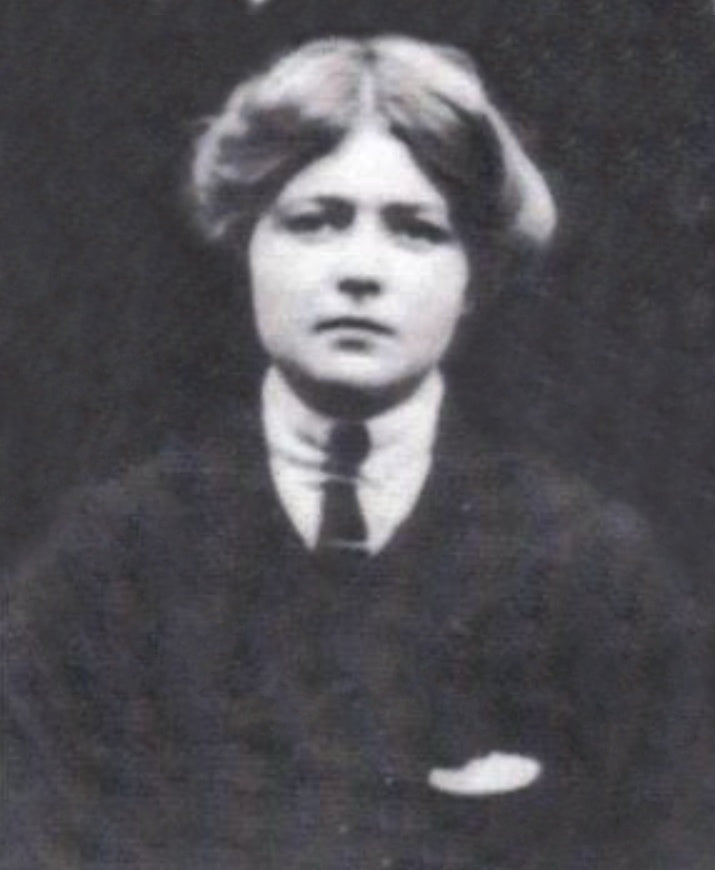
The cover uses an authentic photograph of Violet Mary Firth, known as Dion Fortune, taken before 1947 by an unidentified photographer. Wikimedia Commons classifies it as being in the public domain because of its age and the anonymity of its author.

Par Olivier of Aeternum
Passionate about esoteric traditions and the history of the occult from the earliest civilizations to the 18th century, I share some articles on these topics. I am also co-creator of the online esoteric shop Aeternum.