



















































































































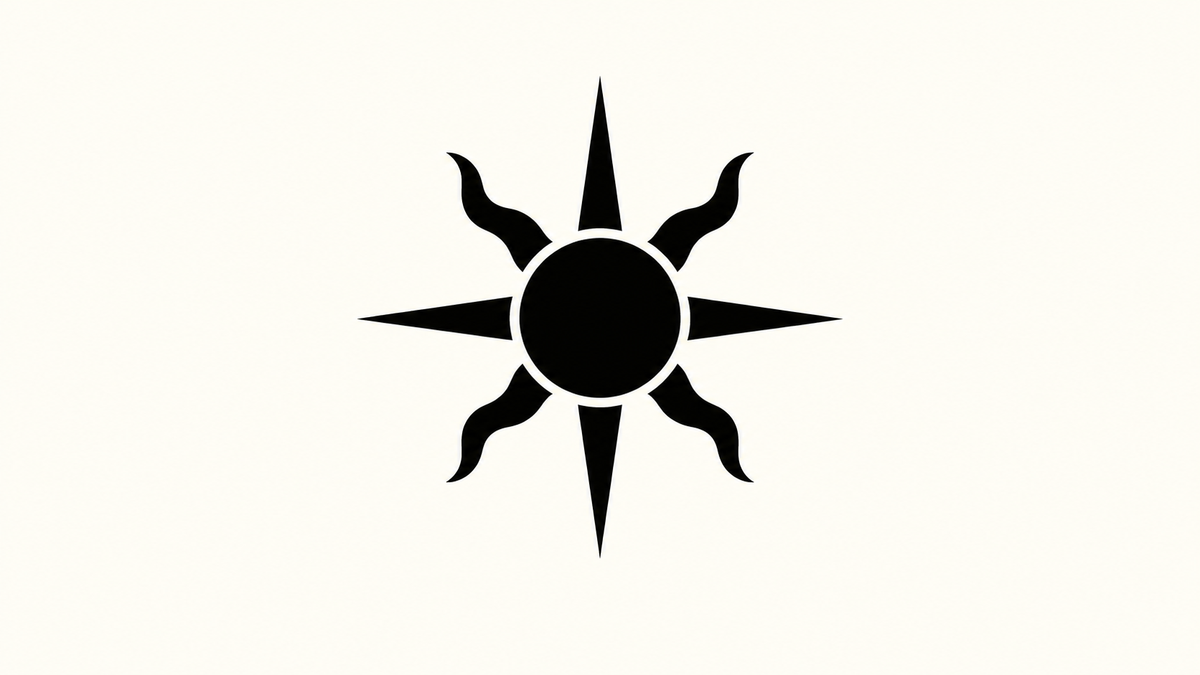
Shamash's solar disk is one of the major emblems of Mesopotamia. Shamash, the Sun god, is also associated with justice, truth, and judgment. His sign may take the form of a radiating solar disk placed above kings, priests, or ritual scenes. On the famous tablet of the Sun god from Sippar, the disk is installed before Shamash in his sanctuary and becomes the center of a religious arrangement devoted to his light and authority.
| Form | Radiating solar disk or winged disk, depending on the period |
|---|---|
| Deity | Shamash / Utu |
| Domains | Sun, justice, judgment |
| Cult center | Sippar |
| Astral ensemble | Associated with the signs of Sîn and Ishtar |
How can Shamash's symbol be recognized?
The sign may appear as a disk with rays, a solar star within a circle, or, in certain contexts, a winged disk identified with Shamash.
The British Museum displays this type of symbol on Neo-Assyrian steles, where several divine emblems are aligned above the king.
Why is the sun god linked to justice?
The sun illuminates and makes visible what was hidden. Shamash thus takes on the role of a judge capable of seeing human actions.
The Stele of Hammurabi places the king before Shamash as he receives the insignia of judicial authority.
Sunlight thus becomes a language of order and justice.
What does the tablet of the Sun god show?
The British Museum holds the tablet of Nabû-apla-iddina dedicated to the temple of Shamash at Sippar.
The god is seated in his sanctuary, and a large solar disk rests before him on a support held by divine figures.
The scene shows the symbol as the central object of worship, not as mere astronomical decoration.
Why does the disk accompany royal authority?
Mesopotamian kings present their power as granted and legitimized by the gods.
The symbol of Shamash, god of justice, is particularly suited to scenes in which royal authority is linked to law and order.
The rod and ring express this transfer of power even more directly.
How does it differ from the star of Ishtar and the crescent of Sîn?
The star of Ishtar refers to Venus and the goddess Ishtar. The crescent belongs to the moon god Sîn.
The three symbols appear together on several monuments, forming a true astral signature of the great deities.
Their coexistence confirms that they are not three variants of the same celestial symbol.
Historical sources and reference points
The British Museum houses the Tablet of the Sun God of Sippar with the disk of Shamash. An stele of Ashurnasirpal II also shows the symbols of Shamash, Sîn, and Ishtar above the king.










