

















































































































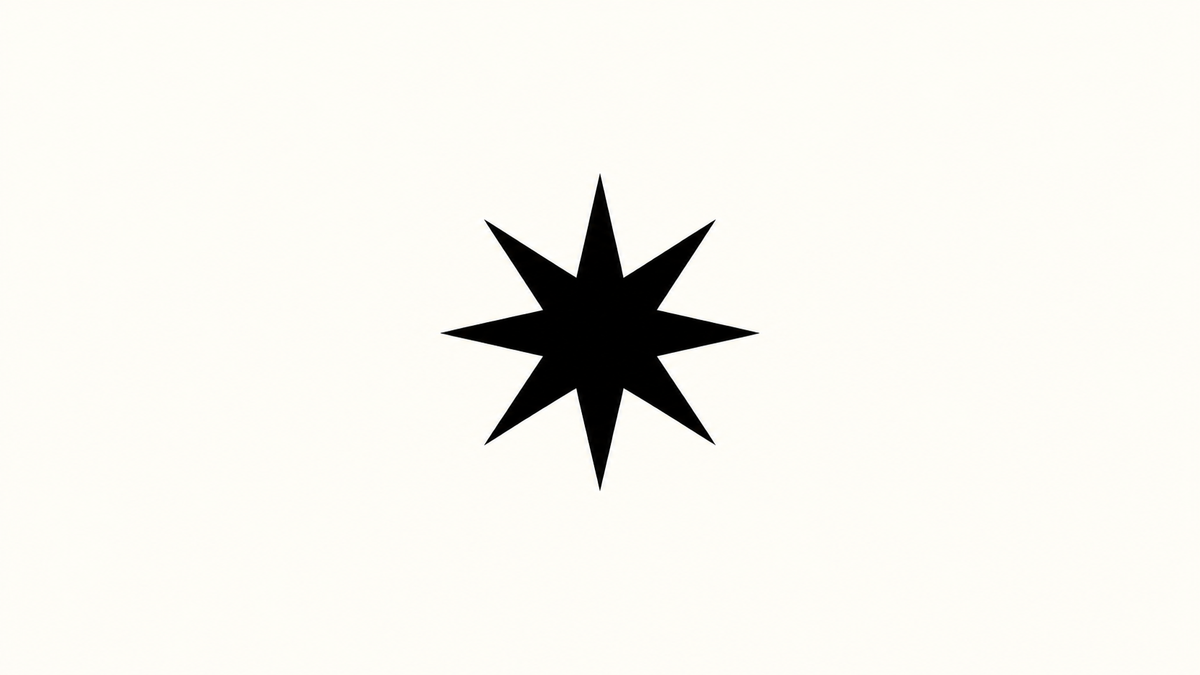
The eight-pointed star is one of the major emblems of the ancient Near East and is regularly associated with Ishtar, called Inanna in Sumerian traditions. Goddess of love, sexuality, war, and power, Ishtar is also connected to the planet Venus, the morning and evening star. Her stellar emblem appears on steles, seals, and reliefs alongside other divine signs such as Sîn’s lunar crescent and Shamash’s solar disk.
| Common form | Eight-pointed star |
|---|---|
| Deity | Ishtar / Inanna |
| Associated celestial body | Venus |
| Context | Mesopotamia and the ancient Near East |
| Point to note | The number of points varies in some ancient representations |
Why is Ishtar represented by a star?
Ishtar is one of the major Mesopotamian deities and has a pronounced astral dimension.
Assyrian steles place her star among the divine emblems that surround or surmount the king.
The British Museum houses a stele of Shamshi-Adad V in which the eight-pointed star is explicitly identified as a symbol of Ishtar.
What is the connection with the morning and evening star?
Ishtar is associated with Venus, visible before sunrise or after sunset depending on the phases of its cycle.
This identity of Venus as the morning star and evening star plays a major role in Mesopotamian traditions.
The entry can be compared with the modern astrological glyph for Venus, but the two signs belong to graphic systems separated by a considerable span of time.
Does the shape always have eight points?
The eight-pointed star is very strongly associated with Ishtar, but objects from the ancient Near East also show stars with other numbers of rays.
A British Museum stele thus attributes a six-pointed star to Ishtar in a specific context, while another clearly shows the eight-pointed star.
This variation makes it impossible to turn the octagram into an absolutely fixed code applicable to every Mesopotamian object.
How does the sign function among the divine emblems?
Mesopotamian kings are depicted before divine signs rather than before the gods themselves.
On some steles, Ishtar’s star appears alongside Sîn’s crescent, Shamash’s solar disk, Adad’s lightning bolt, or Ashur’s winged disk.
The symbol therefore acts as a true divine signature. It makes it possible to identify a power without depicting its human form.
Why is the octagram being reinterpreted today?
The eight-pointed star has become a popular motif in jewelry, tattoos, and movements inspired by Mesopotamia.
It is also conflated with octagrams from other traditions. An Iranian, Christian, or geometric eight-pointed star should not automatically be called the “star of Ishtar.”
The archaeological context remains the best criterion: in Mesopotamia, when associated with Venus and other divine emblems, identification with Ishtar becomes historically well founded.
Historical sources and reference points
The British Museum houses the stele of Shamshi-Adad V, where the eight-pointed star is identified as a symbol of Ishtar. The Sun God Tablet also associates Ishtar’s star with the emblems of Sîn and Shamash.










