

















































































































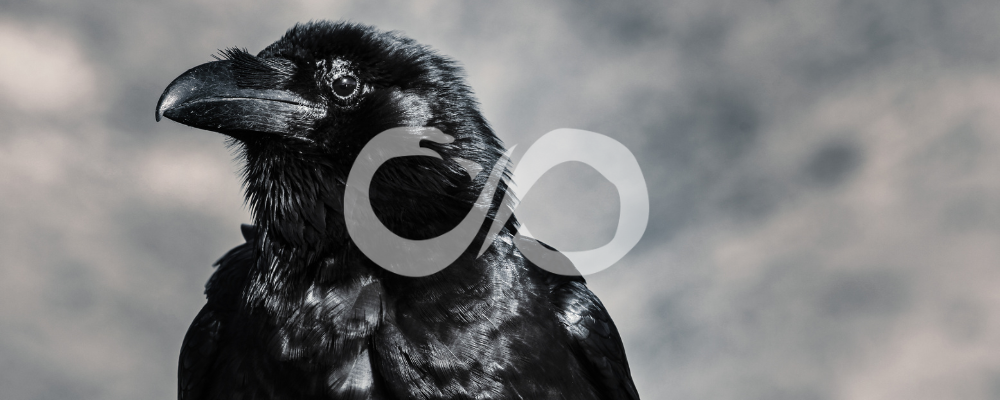
The crow... a sign of wisdom for some, or ominous for others. An inseparable companion of the witch, it is often associated with attributes related to death. In fact, the crow has a rather dark and, let's say, relatively mistaken reputation, much like the black cat, for example. Let's set things straight and you will know the true meaning of the crow in magic and witchcraft.
1. The crow, a talented animal
The intelligence of the crow is well documented, making this bird one of the smartest in the animal kingdom. Crows can solve complex problems, use tools, and demonstrate exceptional memory. They can remember human faces and distinguish those who have harmed them from those who have been friendly, adjusting their behavior accordingly. This remarkable intelligence allows crows to adapt to diverse environments and survive in harsh conditions. Researchers have observed crows devising strategies to obtain food and using objects to access otherwise unreachable resources. This adaptability and ingenuity inspire admiration and highlight the importance of advanced cognition in survival and social interaction.

Crows are also known for their insight and observational skills. They carefully watch their surroundings and learn from the behaviors of other animals and humans. This ability to monitor and analyze their environment allows them to anticipate dangers and exploit opportunities effectively. For example, they can follow predators to feed on the remains of their prey or observe humans to understand how to access food sources. This constant vigilance and quick learning ability show how capable crows are of adapting and thriving in various environments.
Finally, the raven is a remarkable bird for its loyalty, a trait that is especially evident in its social and family relationships. Ravens form long-lasting monogamous bonds with their partners, staying together for life. They are also very protective of their families, cooperating to raise their young and fiercely defending their territory. This loyalty and devotion manifest not only in marital relationships but also in community relations, where ravens show impressive solidarity, helping injured or struggling members.
This loyalty can also be expressed towards humans on rare occasions, and it is this bond that is represented between the witch and her raven, considered one of the favorite familiars.
2. The Raven in Mythology
2.1. Norse Mythology
In Norse mythology, the raven holds a special place as a divine messenger. It is represented by the ravens Huginn (thought) and Muninn (memory), who belong to the god Odin, the powerful ruler of Asgard. Each day, these ravens travel the nine worlds to bring news to Odin, providing him with essential information about the fate of men and gods. Their role as messengers embodies wisdom, insight, and esoteric knowledge, making the raven a sacred symbol of divination and mystical understanding in Norse mythology.
2.2. Celtic Mythology
In Celtic mythology, the raven is also revered as a messenger of the gods and spirits. It is often associated with the goddess Morrigan, a complex figure embodying sovereignty, war, and prophecy. Morrigan is sometimes depicted in the form of a raven or accompanied by ravens, symbolizing the raven's role as a harbinger of death and change, but also as a spiritual guide for heroes on the path of destiny. The raven in Celtic mythology carries omens and messages from the celestial realms, playing a crucial role in the cycles of life, death, and rebirth.
2.3. Chinese Mythology
In China, the raven is often revered as a symbol of light and knowledge. In Chinese mythology, the raven is associated with the sun god, symbolizing the power and clarity of the sun. It is also considered a celestial bird, capable of crossing the earthly and heavenly realms while carrying messages between gods and humans. In some Chinese traditions, the raven is also seen as a symbol of luck and good omen, bringing prosperity and protection to those who encounter it.
2.4. Native American mythology
In Native American cultures, the raven holds a special place as a mythical figure and creator of the world. In many tribes, the raven is considered a primordial being, endowed with magical powers and the ability to shape reality. It is often portrayed as a trickster, a mischievous spirit who challenges norms and brings valuable lessons through its pranks and adventures. For many Indigenous peoples of North America, the raven is a symbol of wisdom, creativity, and connection with the spiritual world, embodying the duality of light and shadow.
3. The raven, the witch’s advisor
The raven is often linked to the witch because of its symbolism of wisdom and occult knowledge. Ravens are known for their exceptional intelligence and ability to solve complex problems, making them powerful symbols of insight and deep understanding. In the context of witchcraft, where the pursuit of esoteric knowledge and wisdom is paramount, the raven becomes a natural ally for witches. These birds are often regarded as spiritual guides capable of revealing hidden truths and offering enlightening perspectives.
Its deep black plumage is often associated with magic and the occult, evoking mystery and wisdom hidden in the darkness. Moreover, the raven is often seen as a symbol of freedom and independence, encouraging practitioners to follow their own path and explore the darkest corners of their being.
Its image can be used in divination rituals to access esoteric knowledge and obtain answers to the soul's deepest questions. Some also use raven feathers in their magical work, believing they amplify the powers of manifestation and transformation. Additionally, the raven is often invoked as a spiritual guide during meditations and shamanic journeys.
People who feel drawn to the raven's energy often see it as a loyal companion on their spiritual path. They view it as a model of perseverance, adaptability, and inner strength, guiding them through life's challenges and transitions. Working with the raven as a spiritual guide often involves developing an intimate relationship with this emblematic animal, listening to its messages, and honoring its wisdom through ritual and meditative practices. By embracing the raven as a spiritual guide, contemporary witchcraft practitioners often find valuable support in their quest for personal growth and spiritual awakening.
4. The symbolism of the raven
4.1. Intelligence and insight
The raven is known for its exceptional intelligence and insight, attributes that make it valuable in witchcraft. This bird is known for its ability to solve complex problems, use tools, and even mimic human speech, positioning it as a symbol of wisdom and knowledge. In witchcraft, the raven's intelligence is often invoked to find solutions to challenges. Practitioners may meditate on the image of the raven or call upon its spirit to help reveal hidden truths and navigate the complex mysteries of life. The raven's insight is also associated with inner vision and the ability to see beyond illusions, offering practitioners a powerful tool for divination and psychic exploration. Working with the raven's energy can help sharpen the mind and develop a deeper understanding of oneself and the surrounding world.
4.2. The voice of the dead
The raven is closely associated with death and rebirth, two fundamental concepts in witchcraft. This connection is rooted in observations of this scavenger bird, often seen feeding on the remains of death, and by extension, becoming a symbol of the perpetual cycle of life and death. As a messenger from the realm of the dead, the raven is perceived as a guide who helps souls cross the boundaries between worlds, offering the living a valuable connection with ancestors and spirits. Witchcraft practitioners often invoke the raven during Samhain rituals or similar celebrations, when the veil between worlds is thinnest, to honor the dead and seek guidance in the mysteries of the beyond. The raven, as a symbol of death, also prompts reflection on the cyclical nature of existence, encouraging witches to embrace transformation and personal rebirth.
4.3. Transformation
The raven is a symbol of transformation and magic, embodying the ability to change, evolve, and manifest the heart's desire. In witchcraft, this bird is often associated with spells and rituals involving profound changes, whether for healing, personal growth, or the realization of new beginnings. The raven is seen as a master of the occult arts, capable of moving between worlds and accessing forbidden knowledge. Its presence in transformation rituals is perceived as a catalyst for spiritual metamorphosis and personal rebirth. Witches may use raven feathers, images, or talismans to strengthen their transformation spells, invoking the spirit of the raven to guide and protect during times of transition. The raven, with its ability to embrace both shadow and light, reminds practitioners of the importance of balance and integrating the multiple aspects of their being to achieve true transformation.
5. The Faces of the Raven
5.1. The Messenger
In witchcraft, the raven is often considered a bearer of messages and omens, connecting practitioners to the mysterious and invisible forces that influence their lives. This perception comes from many traditions where the raven is seen as a divine or spiritual messenger. Witches closely observe the behavior of ravens to interpret signs and omens, considering their appearances, cries, and flights as coded messages from the spiritual world. For example, a raven cawing near a house can be interpreted as a warning of imminent danger or a sign of change to come. In divination rituals, the raven is often invoked to bring clear visions and deep insights, helping practitioners navigate the challenges of their spiritual path. The raven, as a messenger, also encourages developing inner listening and receptivity to the subtle signs of the universe.
5.2. The Guardian
The raven also plays a crucial role as a protector or guardian in witchcraft. Its presence is often invoked to protect magical circles, homes, and sacred places from negative influences and malevolent spirits. Due to its association with death and the afterlife, the raven is seen as having the ability to see beyond the veil and detect invisible threats. Witchcraft practitioners use talismans and amulets bearing the image of the raven or work with raven feathers to strengthen protection. In protection rituals, the raven is often called upon to stand as a guardian, watching over the practitioner and offering its wisdom to avoid dangers. The raven, as a guardian, is also a guide who helps maintain the integrity of sacred spaces and preserve the balance between light and dark forces.
5.3. The Wise One
The raven is deeply revered as a symbol of wisdom and occult knowledge in witchcraft. Its reputation as an intelligent and cunning bird translates in magical practices to a quest for deep understanding and insight. Witches see the raven as a powerful ally for accessing the secrets of the universe and hidden knowledge. By meditating on the raven's energy, practitioners seek to awaken their own inner wisdom and reveal hidden truths. Ancient texts and grimoires often refer to the raven as the guardian of esoteric mysteries, symbolizing the quest for truth and mastery of occult arts. Working with the raven, witches can gain prophetic visions and dreams, as well as spiritual revelations that illuminate their path. The raven, as a symbol of occult knowledge, also inspires embracing the shadow and integrating unconscious aspects of the self to achieve a fuller and more balanced wisdom.
6. The raven's ominous reputation
The association of the raven with doom largely stems from its appearance and behavior. The raven's black plumage, often seen as dark and sinister, has historically evoked connotations of death and mystery. In many cultures, black is a color linked to death, mourning, and dark forces. Additionally, the raven's harsh and sometimes unsettling cries add to its image as a bird of "bad omen."
The scavenging behavior of the raven also strengthens its connection to death. Ravens are often seen feeding on carcasses, which places them directly in contact with death and decomposition. This role as nature's cleaner, although useful for the ecosystem, is often viewed negatively by humans, who may see this bird as a constant reminder of mortality. Seeing them frequent battlefields, cemeteries, and places of tragedy has amplified this grim perception.
7. Correspondence table
| Stones | Obsidian, onyx, jet, amethyst |
| Planets | Saturn, Mercury |
| Day | Wednesday (associated with Mercury) |
| Related deities | Morrigan (Celtic), Odin (Norse), Hecate (Greek) |
| Plants | Elder, yew, hemlock, mandrake |
| Signs | Scorpio, Aquarius |
| Direction | North |
| Sabbats | Samhain, Yule |
And there you have it, you now know everything about this animal with a somewhat mistaken reputation. So don't be afraid to come across one!

Par Olivier of Aeternum
Passionate about esoteric traditions and the history of the occult from the earliest civilizations to the 18th century, I share some articles on these topics. I am also co-creator of the online esoteric shop Aeternum.













Merci, Olivier d’Aeternum, pour ces informations sur les corbeaux. Je les vois souvent près de chez moi et je leur offre des noix et des fruits de temps en temps. J’ai beaucoup d’amitié envers eux. Et cette nuit j’ai rêvé que j’en sauvais un qui était blessé et allongé sur la petite rue où je vis. alors je vais leur porter une offrande dès que possible. Bonne continuation !
Bonjour !
Merci pour votre question. J’imagine que vous avez vu ce corbeau en forêt ou dans la nature (et non pas en ville). Dans ce cas, il n’est pas nécessaire de procéder à un rituel car son âme est ainsi déjà retournée auprès de la Terre Mère (cela aurait été différent si vous aviez vu ce corbeau en ville par exemple). Cela étant dit, votre ressenti est important : si vous sentez le besoin de symboliser son passage, vous pouvez lui offrir ce moment solennel pour son enveloppe physique comme un petit mot, un cercle de plantes (idéalement lavande ou rose pour la sérénité), un enterrement.
Contrairement à la croyance populaire, le corbeau a le rôle de passeur d’âme et symbolise la transformation (ou la fin d’un cycle). Il peut donc indiquer un changement important dans votre vie, un moment de transition personnelle. Ce n’est pas nécessairement un mauvais présage, mais plutôt un signe que quelque chose de nouveau est en train d’émerger.
J’espère avoir répondu à vos interrogations !
Olivier
Il y a quelques jours, j’ai vu un corbeau mort à l’endroit où j’ai campé, quelle serait la signification? Est-ce à moi de faire passer les âmes perdues? Est-ce un mauvais présage ou une continuation de son rôle qui n’a pas été accompli?