




























































































Anne Conway holds a unique place in the history of seventeenth-century spiritual philosophy. Born Anne Finch in 1631 and descended from a prominent English family, she received an intellectual education that the institutions of her time normally denied to women. Women could not study at Cambridge, but her half-brother John Finch opened another path for her: through him, she came into contact with Henry More, who initially taught her philosophy by correspondence before recognizing her as an interlocutor in her own right.
Yet her journey does not end with Cambridge Platonism. Over the years, Conway distances herself from several of More’s positions, encounters Francis Mercury van Helmont, studies Christian Kabbalah, associates with Quakers, and develops a metaphysics of her own. Her only surviving treatise, The Principles of the Most Ancient and Modern Philosophy, published after her death, attacks Descartes’s and More’s dualism, Hobbes’s materialism, and what she understands as Spinoza’s pantheism.
This brief body of work is enough to make her one of the most original voices in seventeenth-century English philosophy. She proposes a universe in which all creation is living, spiritual, and capable of transformation. Inert matter, absolutely separate from spirit, does not exist in her system. Creatures can change, purify themselves, draw closer to a more spiritual state, or move away from it. Evil itself is not conceived as an independent substance, but as a degradation from which the creature can emerge.
Anne Conway is therefore not merely a “forgotten woman philosopher,” a phrase that ultimately confines her to a secondary category. She intervenes at the heart of the major controversies of her time: What is the soul? What is matter? How does God act in the world? Are body and mind two entirely separate substances? Can suffering serve a transformative function? These questions lead her to engage with Platonism, Kabbalah, Christianity, van Helmontian medicine, and Quakerism without allowing herself to be absorbed by any of these currents.
A childhood between political power and university exclusion
Anne Finch was born in London on December 14, 1631. Her father, Sir Heneage Finch, a former Speaker of the House of Commons, died before her birth. Her mother, Elizabeth Cradock, also belonged to a high social class. Anne grew up in the family residence that would later become Kensington Palace, in a family where politics, law, and culture played an important role.
She is particularly close to her half-brother John Finch, who studies at Christ’s College, Cambridge. This relationship is decisive. English universities in the 17th century did not open their courses to women. Anne Conway therefore cannot follow the path that would have been available to a man of her rank. Her education takes place through the family sphere, reading, and correspondence.
The exact nature of her initial education remains difficult to reconstruct precisely. Modern sources nevertheless show that she acquired a sufficiently solid culture early on to follow the philosophical debates of her time. Her brother introduces her to Henry More, his former professor at Cambridge. More agrees to teach her philosophy remotely.
The course begins largely with Cartesianism. Descartes then represents a powerful new philosophy capable of challenging traditional scholastic frameworks. The distinction between thinking substance and extended substance offers a way to defend the soul against materialism. Anne Conway studies this system seriously, but she will not remain for long a mere student tasked with repeating its principles.
The surviving correspondence shows the gradual development of the relationship between More and Conway. The professor becomes a friend, then a correspondent. In 1653, More dedicates his Antidote Against Atheism to her, showing the importance he already attaches to their intellectual bond. For several decades, their exchanges address philosophy, religion, medicine, personal matters, and new readings.
This relationship is all the more remarkable because Conway holds no university position. Her philosophical work develops in a private setting, through letters, reading, and conversation. Her home soon becomes an intellectual hub where doctors, philosophers, and religious figures circulate. Her exclusion from the university therefore does not keep her away from the debates of her century; it forces her to build a different network.
Ragley Hall, Marriage, and a Life Dominated by Illness
In 1651, Anne Finch marries Edward Conway, who will become the third Viscount Conway. The couple settles, among other places, at Ragley Hall in Warwickshire. The Conway family owns a substantial library, and Edward does not seem to have tried to prevent his wife’s intellectual activities. Ragley Hall gradually becomes one of the centers of her philosophical life.
The couple has a son, Heneage Edward, who dies in infancy. This loss is compounded by another factor that marks Anne Conway’s entire life: a painful illness characterized by severe headaches and recurring attacks. The doctors of her time propose numerous treatments, without managing to provide her with lasting relief.
Physical suffering is not a peripheral detail of her biography. It helps explain her interest in medicine, theories of the body, the relationship between matter and spirit, and the forms of transformation of being. However, it would be reductive to derive her entire philosophy from her illness. Conway reads, discusses, and constructs arguments that belong to the most technical philosophical debates of her time.
Ragley Hall welcomes Henry More on several occasions. The circle expands to include physicians and thinkers seeking new approaches to nature and the body. The chemical medicine derived from Paracelsus and Jan Baptista van Helmont plays an important role in this context. It proposes models different from those of traditional Galenic medicine and takes an interest in the invisible processes that organize living matter.
This openness prepares the way for the decisive encounter with Francis Mercury van Helmont, the son of Jan Baptista. In 1670, Henry More asks van Helmont to meet Conway in the hope that he might treat her pain. The physician and philosopher later settles permanently at Ragley Hall. His presence transforms Conway's intellectual environment.
Francis Mercury van Helmont is not limited to medicine. He takes an interest in Jewish Kabbalah, Christian Kabbalah, sacred languages, the preexistence of souls, and several nonconformist religious currents. He is also close to Christian Knorr von Rosenroth, the future editor of Kabbala Denudata. Through him, Anne Conway gains access to traditions that will decisively alter her conception of spirit and creation.
From Henry More to the Kabbalah, a philosophy that emancipates itself
One of the great interests of Anne Conway's biography is seeing a student gradually move away from her teacher's system. Henry More defends a real distinction between matter and spirit. He rejects materialism, but retains a dualism in which body and spirit possess very different properties. Conway eventually comes to regard this separation as insufficient.
Her encounter with the Kabbalah plays a major role here. It is important to specify which Kabbalah is meant. Conway does not receive direct traditional rabbinical training. She mainly discovers Kabbalistic materials through van Helmont and Christian circles that interpret them within a European philosophical and theological framework. The result is therefore an already filtered, translated, and recomposed body of material.
This influence connects with certain themes she already knew through Platonism: the unity of creation, the degrees of reality, spiritual transformation, and the idea of a universe in which beings are not confined to entirely immobile categories. She also encounters themes related to the preexistence of souls and the final restoration of creatures.
Another point of contact with the esoteric world of her century comes from the way these traditions read creation as a living reality. This vision is far removed from purely passive matter. In a very different form, it recalls certain intellectual worlds encountered in Jakob Böhme, where creation is likewise understood as movement, transformation, and tension between several states of being. Conway does not adopt Böhme’s system, but the comparison reveals a European climate in which nature could still be understood as bearing a spiritual dimension.
The Kabbalah primarily gives Conway resources for moving beyond strict dualism. If every creature possesses a spiritual dimension and if the degrees of reality can transform, the body no longer needs to be conceived as a substance absolutely foreign to the spirit. This idea becomes the center of her system.
Henry More, for his part, remains more reserved about several aspects of Lurianic Kabbalah, which he discovers through the same networks. He fears that it contains tendencies incompatible with his philosophy. Their paths therefore begin to diverge. The friendship remains, but the former teacher-student relationship has clearly disappeared.
The Quakers and the Choice of Another Religious Life
Francis Mercury van Helmont also introduces Anne Conway to several Quakers. Ragley Hall receives George Fox, Robert Barclay, George Keith, and William Penn. These meetings are not a matter of mere curiosity. Conway gradually moves closer to the movement and eventually embraces it shortly before her death.
17th-century Quakerism emphasizes the inner light, direct experience of the divine, simplicity in worship, and criticism of ecclesiastical hierarchies. These themes find fertile ground in Conway. She had already distanced herself from confessional rigidities and was seeking a religion capable of giving concrete meaning to inner transformation.
Her growing closeness to the Quakers created a new distance from More. He respected her intelligence, but he was troubled by this movement. A letter from Edward Conway dated 1677 even indicates that the Quakers then had much more frequent access to Anne than More did, despite his being present at Ragley Hall during the summer.
It would be wrong to present this development as a sudden break with her entire previous life. Several themes she found among the Quakers extended questions that were already present in her journey: the direct relationship with God, the value of inner experience, moral transformation, and the possibility of a spiritual life that did not rest entirely on institutions.
Her conversion also had a social dimension. Quakers were still victims of persecution and hostility in England. Drawing closer to them was therefore not a social gesture. Conway used her position to offer them protection and hospitality. Her house became a meeting place where philosophy, medicine, Kabbalah, and religious dissent intersected.
This convergence explains why her work resists simple categories. She was neither an academic philosopher, nor an institutional theologian, nor an occultist in the sense of the initiatory societies of the 19th century. She belonged to an earlier world, in which philosophical inquiry could still proceed through theology, medicine, the study of Kabbalistic traditions, and religious life.
The Principles of the Most Ancient and Modern Philosophy
Late in life, Anne Conway wrote the work that would secure her posthumous reputation: The Principles of the Most Ancient and Modern Philosophy. The text was written in English, probably in the final years of the 1670s. It was not published during her lifetime. After her death, the manuscript circulated through van Helmont and was translated into Latin.
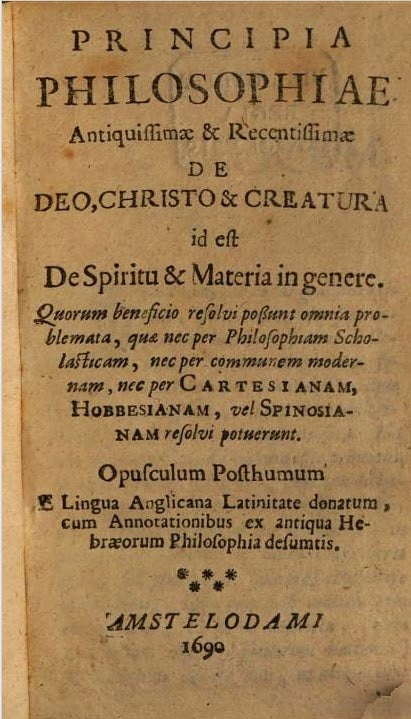
In 1690, it was published anonymously in Amsterdam under the title Principia philosophiae antiquissimae et recentissimae. An English version appeared in London in 1692, translated from the Latin. The editorial path is therefore unusual: an English text became Latin, then returned to English. This transmission explains several vocabulary difficulties and makes the exact reconstruction of certain formulations delicate.
The book begins with God, then examines Christ, and finally creation. Conway thus maintains an explicitly Christian architecture. God is absolutely perfect, immutable, and good. Creation, by contrast, is changing. Between the two stands Christ, whom her system uses as a mediator between the immutable and the world of creatures.
The most original point concerns the nature of creation. Conway rejects the idea of dead and purely passive matter. Everything created possesses a form of life and spirit. For her, the differences between what we call body and spirit are not differences between two entirely separate substances. Rather, they correspond to degrees of the same created reality.
This proposal directly challenges Descartes and More. If body and mind belonged to entirely foreign substances, how could they act on one another? How could the soul move the body, and how could the body affect the soul? Conway considers dualism to make their interaction nearly incomprehensible.
She therefore proposes a continuous universe. A creature can become more corporeal or more spiritual depending on its state. This transformation is not merely an outward change. It affects the very mode of the creature’s existence. The body is not abandoned as a prison; it participates in a process of perfection.
This cosmology gives living beings an immense place. Strictly speaking, there is no absolutely dead matter. The world is populated by beings capable of movement, perception, and transformation to very different degrees. This idea explains why some historians associate Conway with the monadic theories that would later appear in Leibniz, even though the two systems should not be conflated.
Evil, suffering, and the possibility of restoration
The question of evil runs throughout Conway’s philosophy. If God is perfectly good, how can suffering and corruption be explained? She refuses to attribute to God a creation that is evil by nature. She also refuses to regard evil as an eternal substance opposed to God.
Evil corresponds instead to a state of degradation of the creature. A creature may move away from perfection, but it does not lose all possibility of transformation. This idea leads Conway to reject eternal hell understood as the infinite punishment of a finite wrongdoing.
Suffering then serves a function of correction and purification. This claim must be read with caution, as it may seem harsh when detached from its context. Conway herself experienced intense physical pain for much of her life. She therefore does not treat suffering as a comfortable abstraction. She seeks to construct a theodicy in which no creature would be condemned forever to an irreversible state.
This possibility of restoration brings her philosophy closer to certain ancient Christian traditions, particularly Origen, already valued in Henry More's circle. The idea is not that every action would be morally equivalent, but that punishment cannot contradict divine goodness. A truly just punishment must lead to the possibility of correction.
The created world thus becomes an immense process of transformation. Creatures are not fixed forever at an unchanging degree. They can advance or regress. Perfection is not given automatically, but the very structure of creation remains open to restoration.
This vision produces a philosophical esotericism very different from the search for ritual secrets. Here, the hidden lies in the very structure of reality: behind the apparent opposition between body and spirit lies a continuity; behind corruption remains a capacity for transformation; behind the world's multiplicity is preserved a unity of created nature.
Conway versus Descartes, Hobbes, Spinoza, and Henry More
Much of the strength of the Principles comes from their polemical character. Conway does not construct her system in a vacuum. She responds to the philosophers who dominated the debates of her century.
Descartes is the most obvious target on the question of dualism. Conway recognizes the power of his physics but rejects his metaphysical separation between thought and extension. She considers that this separation creates more problems than it solves.
Hobbes represents the other danger: a world in which everything could be reduced to matter and motion. Conway radically rejects this materialism. For her, created reality always possesses a spiritual dimension. A purely material universe would be unable to explain life, perception, and moral transformation.
She also criticizes Spinoza, whom she accuses of confusing God with creation. Her own monism must therefore not be understood as simple pantheism. God remains distinct from the created world. The unity she affirms concerns above all the nature of creatures in relation to one another: they belong to the same created substance, capable of degrees and transformations.
Henry More occupies a more personal position. He was her teacher, her friend, and her main connection to Cambridge philosophy. Yet Conway's book criticizes several of his central theses. This opposition shows how far she had moved beyond the role of disciple.
The relationship between the two philosophers is all the more interesting because it does not end in a spectacular quarrel. They remain connected until the end, even when their religious and philosophical positions diverge. Conway develops her intellectual independence without turning More into a personal adversary.
This trajectory also helps explain why she deserves a full place in the history of Western esotericism. Her interest in Kabbalah is not decorative; it modifies her metaphysics. Her contact with van Helmontian medicine nourishes her reflection on living matter. Her rapprochement with Quakerism transforms her religious life. In her work, spiritual traditions produce a genuine philosophy, reasoned and structured.
A posthumous publication and a long-obscured influence
Anne Conway died at Ragley Hall on February 23, 1679, at the age of forty-seven. She never saw her treatise in print. Her thought survived thanks to the network she had helped gather around her.
Francis Mercury van Helmont played a central role in transmitting the manuscript. The Latin publication of 1690 appeared without an author's name. Two years later, the English edition described its author as an English countess remarkable for her learning, but the name Anne Conway did not immediately become a major reference in the history of philosophy.
Gottfried Wilhelm Leibniz knew of her work and owned a copy, probably received through van Helmont. He recognized affinities between some of Conway's ideas and his own research. However, one should avoid simply saying that she “invented” Leibniz's monadology. Intellectual lineages are more complex, and the two systems retain major differences.
The anonymity of the publication contributes to Conway's erasure. For a long time, her work is read in the shadow of Henry More, van Helmont, or Leibniz. The situation changes in the 20th century thanks to the publication of her correspondence and scholarship devoted to women philosophers of the early modern period.
Recent research shows a thinker capable of taking a position on the most difficult problems of her time. She does not merely combine influences. She transforms what she receives. Cartesianism provides her with a starting point that she eventually rejects; Platonism gives her a structure; Kabbalah opens up other possibilities; Quakerism transforms her religious practice; chemical medicine contributes to an environment in which the body is no longer conceived as a merely passive mechanism.
This capacity for transformation may be the best way to read Anne Conway. Her work itself asserts that creatures are not fixed. Her own intellectual trajectory follows this movement: a student of More, she became a philosopher opposed to some of More’s theses; trained in Cartesianism, she developed a system that went beyond it; an Anglican aristocrat, she drew closer to a persecuted religious movement; ill and subjected to the treatments of her time, she took part in a circle where medicine, metaphysics, and spiritual life were in constant dialogue.
Anne Conway therefore belongs fully to this history of learned esotericism, in which the search for the invisible was not yet opposed to philosophy. She left neither an initiatory order nor a ritual corpus. She left something rarer: a metaphysics in which the spirit is not a realm separate from the world, but the inner dimension of all living creation.
Sources and reference points
The Stanford Encyclopedia of Philosophy is one of the main contemporary overviews of Anne Conway. It documents her relationship with Henry More, her marriage to Edward Conway, the presence of Francis Mercury van Helmont at Ragley Hall, her contact with Kabbalah and Quakerism, as well as the structure of her philosophy.
Sarah Hutton’s volume, Anne Conway: A Woman Philosopher, published by Cambridge University Press, places Conway within the intellectual networks of the 17th century and examines the transmission of her treatise, published in Latin in Amsterdam in 1690 before the English version of 1692.
The Conway Letters: The Correspondence of Anne, Viscountess Conway, Henry More, and Their Friends, 1642–1684, edited by Marjorie Hope Nicolson and Sarah Hutton, makes it possible to follow directly the development of the relationship between Conway, More, and their circle.
Contemporary research published by Cambridge University Press on Conway’s ontology highlights the importance of her rejection of an absolute separation between body and mind and the complexity of her idea of a unified creation composed of beings capable of transformation.
The cover of this article uses Perspective View with a Woman Reading a Letter, a painting by Samuel van Hoogstraten created around 1670 and held at the Mauritshuis. The work is traditionally associated with Anne Conway, but this identification remains debated. We therefore present it as a historical representation linked to her reception, rather than as a portrait whose subject’s identity has been definitively established.

Par Olivier of Aeternum
Passionate about esoteric traditions and the history of the occult from the earliest civilizations to the 18th century, I share articles exploring these subjects. I am also a co-founder of Aeternum, the online esoteric store.