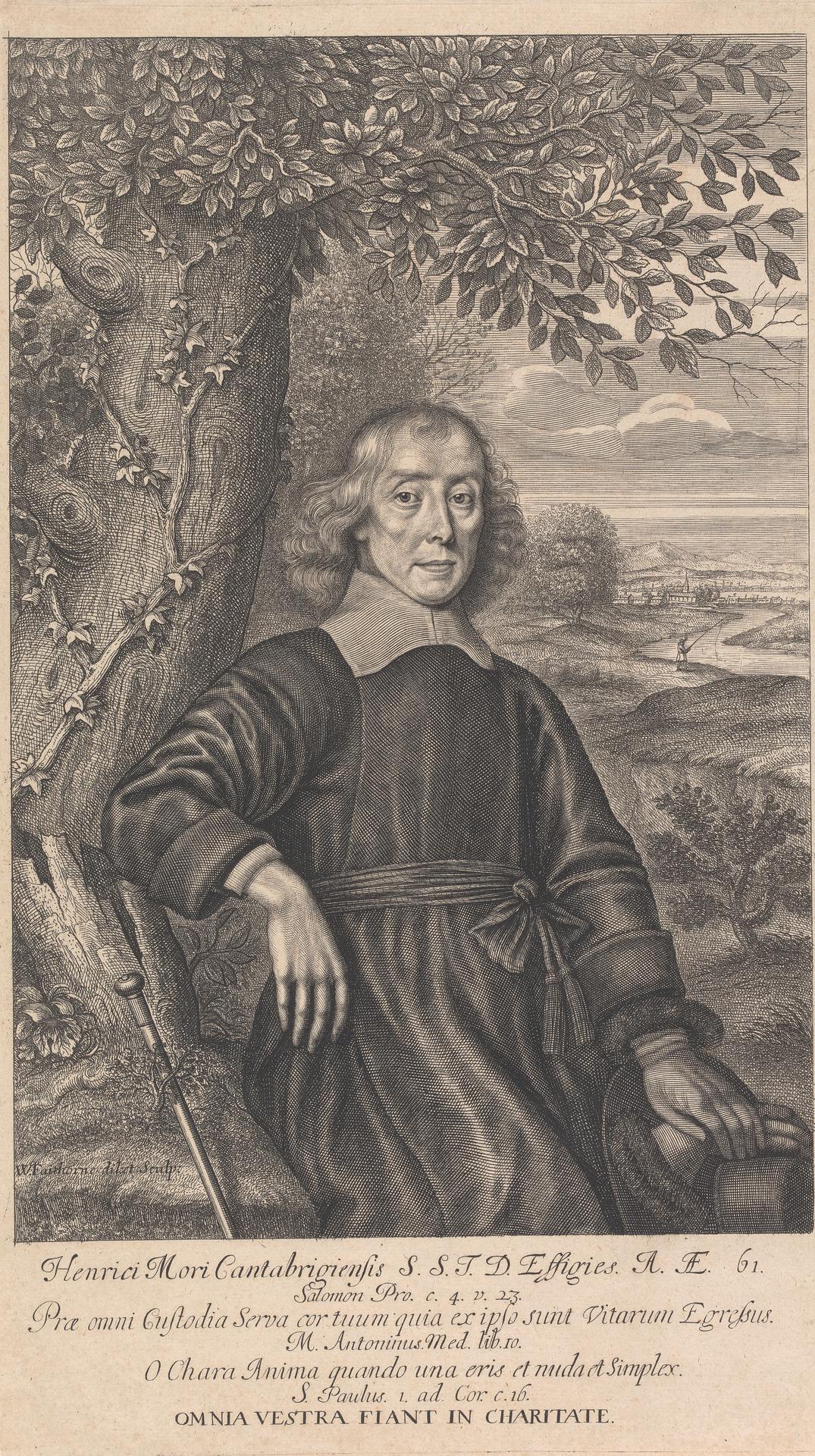
Henry More occupies a unique place in the history of learned esotericism in the 17th century. A philosopher, theologian, poet, and Fellow of Christ’s College in Cambridge, he belonged to the group that history has remembered as the “Cambridge Platonists.” Yet reducing him to a philosophical school would obscure what gives his work its true strangeness: More sought to demonstrate through reason that the universe could not be reduced to matter, that the soul possessed a reality of its own, and that the invisible world had to be incorporated into a complete philosophy of nature.
For him, spirits, apparitions, accounts of witchcraft, the immortality of the soul, and the divine presence in space were not separate subjects. They formed part of the same intellectual struggle against a conception of the world in which only bodies and their movements were real. His project was to defend a spiritual reality without renouncing the new natural philosophy developing around Descartes, Boyle, and the mechanists.
This position explains Henry More’s paradox. He was among the English thinkers who took the rational methods of the new philosophy very seriously, while also considering that accounts of apparitions and supernatural phenomena could provide arguments against atheism. He engaged in dialogue with Descartes, criticized Hobbes, later opposed Spinoza, taught philosophy to Anne Conway, and corresponded with men interested in the Kabbalah, spirits, and the limits of matter. His world belonged to that transitional period when philosophy, theology, science, and the study of the invisible world had not yet been confined to watertight domains.
From Grantham to Christ’s College, the formation of a Platonist
Henry More was born on October 12, 1614, in Grantham, Lincolnshire. He was the seventh son of Alexander More, who held municipal responsibilities in the town, and Anne Lacy. The family was shaped by a strict Calvinism. More would later recount that he felt an early inner resistance to certain forms of rigid predestination. This opposition would play a decisive role in his intellectual development: he sought a theology in which divine goodness, freedom, and human reason could coexist.
After his early studies in Grantham, he entered Eton in 1628. Three years later, his uncle Gabriel More, a Fellow of Christ’s College, arranged for his admission to Cambridge. Henry More arrived at Christ’s College in 1631. He obtained his Bachelor of Arts there in 1636 and then his Master of Arts in 1639. In 1641, he himself became a Fellow of the college, to which he remained attached until his death.
Cambridge provided him with a solid philosophical education, but More quickly turned away from the scholastic Aristotelianism that he considered incapable of answering his questions. He turned to Plato, Plotinus, and the Neoplatonic traditions. This intellectual conversion did not mean that he abandoned Christianity for an ancient philosophy. On the contrary, he saw Platonism as a language capable of defending the transcendence of God, the immortality of the soul, and the value of reason against what he regarded as the dead ends of materialism.
His early works took a poetic form. In the 1640s, he composed long philosophical poems in which he already sought to describe the soul, spiritual worlds, and the structure of reality. They included Psychozoia, followed by several pieces collected under the title Philosophical Poems. Poetry enabled him to develop an imagistic vocabulary before his thought unfolded in the philosophical treatises of the following decades.
The political and religious context was particularly troubled. The English Civil War broke out in 1642. More remained in Cambridge and continued his intellectual work in a country torn apart by religious, political, and military conflicts. This period strengthened his rejection of confessional fanaticism. Like several Cambridge Platonists, he defended the idea that a religion worthy of the name could not oppose reason, and that the moral life mattered more than doctrinal quarrels.
This milieu gave rise to a group of thinkers linked more by affinities than by a common doctrine: Ralph Cudworth, Benjamin Whichcote, John Smith, Peter Sterry, and others. More nevertheless remained the most committed of them to questions directly concerning the soul, spirits, apparitions, and phenomena that seemed to elude a purely mechanical explanation.
Descartes, Matter, and the Problem of the Soul
In the late 1640s, Henry More began corresponding with René Descartes. The exchanges of 1648 and 1649 rank among the major episodes of his intellectual career. More admired several aspects of Cartesianism. The distinction between the thinking soul and extended body initially offered him a weapon against philosophies that reduced thought to matter. For a time, he even encouraged the study of Descartes at English universities.
But the agreement is short-lived. For Descartes, extension characterizes corporeal substance. More rejects this overly strict identification of extension with matter. He wants to be able to conceive of a spiritual reality that possesses a certain presence or extension without thereby becoming a material body. This question becomes one of the starting points of his theory of space and spirit.
More also reproaches the Cartesian system for making matter too autonomous. If every natural phenomenon is explained solely by the shape, motion, and collision of particles, what remains of the action of the spiritual world? How are we to understand the organization of living beings, phenomena that mechanics cannot explain, or the presence of God in the universe?
His opposition to Descartes therefore does not mean a return to the old scholastic physics. More accepts much of the new corpuscular language. He nevertheless believes that mechanics does not exhaust reality. The body is indeed matter, motion, and structure, but something else must account for order, life, and spiritual activity.
This inquiry leads to one of his best-known ideas: the Spirit of Nature, or Spirit of Nature. More imagines it as an intermediate incorporeal principle, distinct from God but acting in the material world according to divine order. It is neither a second god nor an individual soul of the cosmos in any simple sense. It is a power intended to explain what matter left to itself cannot accomplish.
The concept recalls certain older philosophies of the world soul, but More develops it within the very different context of the new science of the 17th century. He seeks less to return to the Renaissance than to show that a modern philosophy of nature remains incomplete if it rejects every incorporeal cause.
This tension brings More, by contrast, close to figures such as Robert Fludd. Fludd still sees the cosmos as a vast network of correspondences in which macrocosm and microcosm reflect one another. More belongs to a later generation: he accepts mechanics and new physical descriptions to a greater extent, but tries to preserve a spiritual world at the very heart of this new universe.
An Antidote Against Atheism and the Proof Through the Invisible World
In 1653, An Antidote Against Atheism was published, one of More’s most important books. The title clearly announces the project: he aims to provide an intellectual “antidote” to the idea that the universe could exist without God or spiritual substance. His argument combines metaphysics, observations of nature, reflection on the order of the world, and accounts of extraordinary phenomena.
For a modern reader, the most puzzling part is where More uses stories of apparitions, witches, and actions attributed to spirits. His reasoning is nevertheless consistent with his project. If a single phenomenon of this kind could be established with sufficient force, strict materialism would be false: there would then be agents that cannot be reduced to ordinary bodies.
More therefore does not collect these accounts solely for their spectacular character. He treats them as pieces in a philosophical controversy. The skeptic denies the existence of spirits; More seeks facts that, in his view, make this denial untenable. He attaches great importance to the number of witnesses, their reputation, and the consistency of the accounts.
This method remains very far from contemporary standards of proof. A large part of the stories he reproduces is based on indirect testimony, local traditions, or trials in which the conditions of interrogation raise serious problems. These documents must therefore not be turned into modern proof of the supernatural. Their historical importance lies elsewhere: they show that a major 17th-century philosopher could regard the study of apparitions as a serious component of a defense of immateriality.
More also distinguishes the world of spirits from an uncontrolled imagination. In Enthusiasmus Triumphatus, published in 1656, he examines states in which an individual takes their own mental images for divine revelations. “Enthusiasm” then refers less to ordinary fervor than to the conviction of being directly inspired by God. More seeks to understand how imagination, temperament, passions, and certain bodily states can produce experiences mistakenly interpreted as supernatural.
This distinction is fundamental. More can believe in the real existence of spirits while considering that a given vision may be illusory. He therefore does not set up a simple alternative between credulity and skepticism. He attempts to establish criteria for separating, at least in theory, a real spiritual action from a phenomenon arising from the imagination.
This relative caution does not prevent More from accepting accounts that critical history today views very severely. His interest in witchcraft must be situated in a world where denying the existence of demons could seem to some theologians as dangerous as denying the existence of angels. The question directly concerns the interpretation of Scripture, the immortality of the soul, and the reality of an invisible order.
Joseph Glanvill, apparitions, and Saducismus Triumphatus
The intellectual affinity between Henry More and Joseph Glanvill extends this campaign. Glanvill, a member of the Royal Society and a defender of the new philosophy, likewise sought to reconcile rational method with the reality of the spiritual world. Their collaboration shows how poorly the modern categories of “science” and the “supernatural” function when projected directly onto the seventeenth century.
After Glanvill’s death in 1680, Saducismus Triumphatus appeared in 1681. The volume brings together texts devoted to the possibility and existence of witches and apparitions. A letter from Henry More appears in it, and later editions also include his reply to a correspondent on the nature of spirit, along with a collection of additional accounts.
The title refers to the “Sadducees,” a term used at the time to designate those whom authors accused of denying the existence of spirits and immortality. The strategy is transparent: skepticism toward apparitions is presented as a step toward a broader materialism.
In this context, More develops his own definition of spirit. According to him, a spiritual substance is not merely a dimensionless point. It can be present in space without possessing the properties of a material body. To explain this idea, he emphasizes characteristics such as penetrability and indivisibility: two spiritual realities could coexist in the same space in a way that would be impossible for two solid bodies.
These speculations may seem highly abstract, but they have a direct consequence for accounts of apparitions. For More, if the spirit possesses a genuine mode of presence, it becomes conceivable that it could act, perceive, or manifest itself without functioning like an ordinary body. His demonology therefore rests on a metaphysics, rather than on a mere accumulation of tales.
The subject remains morally difficult to read today, because seventeenth-century demonological literature is inseparable from a context in which people were accused, tried, and executed for witchcraft. A serious biography of More cannot treat this material as a charming curiosity. His intellectual interest in these accounts helped lend scholarly legitimacy to representations that had very real judicial consequences.
At the same time, one must avoid the opposite anachronism of portraying More as a mere defender of ancient superstitions. His argumentation also belongs to the emerging modern philosophy: he debated Descartes, Hobbes, and the mechanists; he sought a rigorous definition of substance; and he reflected on space, causality, and the soul. The same man could thus reason about the geometry of space and regard an apparition story as a philosophical argument.
Anne Conway, Kabbalah, and the Transformation of More's Circle
One of the most important intellectual relationships of his life was the one he maintained with Anne Conway. More came to know the young Anne Finch through her brother John Finch, who had been his student at Christ's College. Since women did not have access to university education at Cambridge, More agreed to give her philosophy lessons by correspondence.
Their exchange began around Cartesianism. Anne Conway quickly became an interlocutor in her own right, rather than merely a disciple. After her marriage to Edward Conway, she lived primarily at Ragley Hall, in Warwickshire, where More visited her many times. Their friendship lasted until Conway's death in 1679.
This relationship is crucial because it shows how philosophy circulated outside the university. Ragley Hall became a place where metaphysics, medicine, theology, natural philosophy, and new spiritual traditions came together. Conway suffered from severe chronic headaches; the search for treatments led her to meet several physicians and experimenters.
In 1670, More introduced Anne Conway to Francis Mercury van Helmont, the son of Jan Baptista van Helmont. Van Helmont subsequently became an important presence at Ragley Hall. Through him, Conway and More came into closer contact with circles of Christian Kabbalah and with Christian Knorr von Rosenroth.
More had already published a Conjectura Cabbalistica in 1653. Despite its title, this work was not yet based on an advanced knowledge of Jewish Kabbalistic texts. It was primarily a personal method of interpreting Moses. His later contacts with van Helmont and Knorr von Rosenroth gave him much more direct access to this tradition.
Kabbalah then became, for More, a possible ancient confirmation of certain intuitions he had developed elsewhere. He came to believe that a wisdom derived from Moses might have preserved elements of a genuine spiritual philosophy. This reading remains entirely rooted in the Christian Kabbalah of his time: it reinterprets Jewish traditions within a Christian theological framework.
Anne Conway, for her part, gradually moved away from several of More’s positions. Her philosophy notably rejects his overly pronounced dualism between spirit and matter and develops a much more continuous conception of creation. The disciple thus surpasses the master on several points. Their disagreement did not end their friendship.
The Ragley Hall circle is a good example of the transformations of learned esotericism in the 17th century. Cartesianism, van Helmontian medicine, Kabbalah, the philosophy of mind, and Quakerism intersect there. These currents do not merge, but they circulated through the same people and correspondence networks. More’s world was far less compartmentalized than modern disciplines.
Van Helmont’s presence also indirectly connects this milieu to the long legacy of Paracelsus. Jan Baptista van Helmont had transformed several Paracelsian legacies into a medicine and philosophy of his own. In More, these influences do not lead to occult medicine in the classical sense; they chiefly nourish a debate about spirit, nature, and invisible powers.
Infinite Space, God, and the Spirit of Nature
One of the most astonishing aspects of More appears in his philosophy of space. If extension does not belong exclusively to matter, space can receive a spiritual interpretation. More ultimately comes to think of infinite space as a reality that manifests several attributes traditionally associated with God: immensity, incorruptibility, omnipresence.
He does not simply say that God “is” space like a gigantic body. His argument is more subtle. Space provides a language for conceiving of a presence that is not material. God can be everywhere without occupying the universe like a bodily substance. This reflection would have an important afterlife in English discussions of absolute space.
The Spirit of Nature operates at another level. More refuses to have God intervene directly in every movement that mechanics cannot explain. He therefore imagines a subordinate, incorporeal power, not conscious in the human sense, that carries out the divine command in nature.
This theory seeks to solve a very concrete problem: can matter defined as passive produce the organization of the world on its own? More answers no. Mechanical laws describe part of the processes, but they are not sufficient to account for the overall cohesion of nature. The Spirit of Nature fills the gap between God and bodies.
The proposition belongs to an intellectual space that has now disappeared. It is neither “energy” in the sense of modern physics nor a personal spirit comparable to an angel. It represents an attempt to preserve incorporeal causality in a universe that mechanics describes with increasing effectiveness.
This point makes it possible to measure the distance between More and Renaissance occultism. For John Dee or Robert Fludd, mathematics, angels, correspondences, and natural philosophy could still belong to the same cosmic architecture, heavily inherited from the Renaissance. More worked in a world where this architecture was already beginning to fall apart. He sought to reconstruct a place for spirit within the new philosophy rather than simply restore the old cosmos.
Against atheism, but also against religious enthusiasm
More's struggle has two directions. On the one hand, he opposes those who reduce reality to matter. On the other, he attacks forms of religion that despise reason and take every inner impulse for a divine word.
This second target explains Enthusiasmus Triumphatus. In England emerging from the civil wars, many religious groups claimed visions, revelations, and inspirations. More feared that a religion deprived of discernment would turn into fanaticism. He therefore sought to describe the psychological and bodily mechanisms that can produce a false spiritual certainty.
He discusses the role of melancholy, imagination, passions, and certain physical states. A person may be sincerely convinced that they have received a revelation and be mistaken about the origin of their experience. Sincerity is not proof.
This analysis creates a fascinating tension with his defense of apparitions. More does not deny visions outright, but he refuses to let them authenticate themselves. An extraordinary experience must be submitted to reason, morality, and an examination of the circumstances. The invisible world exists for him, but it is not a license to believe just any story.
This position corresponds to the general spirit of the Cambridge Platonists. Reason is regarded as a divine gift, not as the enemy of religion. Truth cannot require human beings to renounce their judgment. This religious rationalism also explains why More is critical of certain theological doctrines that he considers incompatible with divine goodness.
He opposes in particular the rigid Calvinism of his childhood and the idea that God could arbitrarily condemn beings regardless of their freedom or conduct. His moral philosophy gives an important place to an inner faculty capable of recognizing the good. Spiritual life should produce charity, balance, and moral transformation, not exaltation and quarrelsomeness.
This demand makes More difficult to classify. He defends accounts of witchcraft and apparitions that contemporary readers will approach with considerable distance, while precisely combating religious irrationality. He accepts a spiritual reality broader than the material world, but wants to integrate it into a methodical system of thought. This apparent contradiction is in fact at the heart of his project.
Late works, criticisms of Hobbes and Spinoza, and legacy
Henry More remains at Christ’s College throughout his adult life. Despite several opportunities for a more prestigious ecclesiastical career, he prefers to preserve the freedom of study that Cambridge offers him. His body of work becomes immense: philosophy, theology, poetry, biblical commentaries, moral treatises, and controversies follow one another for nearly half a century.
In 1659, The Immortality of the Soul develops his argument in favor of an incorporeal soul that survives the death of the body. The subtitle is revealing: More seeks to establish this immortality through knowledge of nature and the light of reason. He does not merely invoke religious authority.
In the following years, he develops his ethics and metaphysics. The Enchiridion Ethicum appears in 1667. The 1671 Enchiridion Metaphysicum presents part of his philosophy of space, spiritual substances, and nature. His Latin Opera omnia bring together a large part of his work and contribute to its dissemination throughout Europe.
More strongly opposes Thomas Hobbes, whose materialism seems to him to lead to atheism and an impoverished conception of humanity. He also becomes one of the earliest English critics of Spinoza. In the 1670s, he attacks the Spinozist system because he believes it abolishes the true distinction between God and the world.
His old age remained intellectually active. His circle continued to bring together disciples and correspondents, including Henry Hallywell and Joseph Glanvill. Exchanges with Anne Conway, van Helmont, and circles of Christian Kabbalah continued to enrich his final years.
Henry More died in Cambridge on September 1, 1687. He was buried in the chapel of Christ's College. His memory would remain associated with the Cambridge Platonists, but this label long obscured the breadth of his contribution to the history of esotericism and spiritual philosophy.
His influence did not pass through an initiatory school bearing his name. Rather, it operated through several channels: the philosophy of space and spirit, the rational defense of the immortality of the soul, discussions of apparitions, the English reception of Christian Kabbalah, and the networks surrounding Anne Conway and Francis Mercury van Helmont.
He also belongs to the history of a slow transformation in the notion of the occult. A century earlier, authors such as John Dee or Paracelsus could still think of the hidden virtues of nature within a comprehensive philosophy. In More's time, mechanical explanations were gaining ground. The debate was no longer only about the secret properties of matter, but about the very existence of everything that was not matter.
This transition gives More his particular place. He stands on the threshold of a modern world that progressively separates physics and metaphysics, experimental science and demonology, the study of nature and the study of spirits. He still refuses this complete rupture. The laws of nature, the soul, God, and apparitions belong to a single inquiry into what exists.
For this reason, Henry More deserves better than the image of a gullible philosopher attached to ghost stories. He should be read as a thinker who sees modern materialism approaching and attempts to respond to it with all the resources available in his century: Plato, Descartes, Christian theology, accounts of apparitions, the Kabbalah, and a new philosophy of space. His answers are no longer ours, but the questions he asks - what is a spirit, what is a person, is matter sufficient to explain consciousness, what does it mean to be present in space - remain at the heart of philosophy.
Sources and reference points
The Stanford Encyclopedia of Philosophy now provides one of the most comprehensive overviews of Henry More: his birth in Grantham on October 12, 1614, education at Eton and then Christ’s College, degrees in 1636 and 1639, Fellowship in 1641, correspondence with Descartes, theory of the Spirit of Nature, philosophy of space, relationship with Anne Conway, and the development of his thought until his death in 1687.
The entry on the Cambridge Platonists places More alongside Ralph Cudworth, Benjamin Whichcote, John Smith, and Peter Sterry, and helps explain their shared project of defending a rational religion against materialism and confessional rigidity.
Christ’s College Cambridge holds documents relating to Henry More, including correspondence covering the years 1651 to 1686. The college also recalls his place in its history as a philosopher, theologian, and Fellow.
The old editions held by the Folger Shakespeare Library make it possible to consult the original bibliographical details of The Immortality of the Soul, published in 1659. The Folger also holds copies of More’s 1653 Conjectura Cabbalistica and 1656 Enthusiasmus Triumphatus.
For the question of apparitions and witchcraft, Wellcome Collection holds an edition of Joseph Glanvill’s Saducismus Triumphatus containing contributions by More, notably his response devoted to the notion of spirit and additional accounts of apparitions and witchcraft.
The portrait used on the cover is an engraving of Henry More by William Faithorne, an English engraver who was a contemporary of the philosopher, and is held by the Yale Center for British Art. This historical image is now in the public domain and provides an early visual record, without resorting to a modern reconstruction.

Par Olivier of Aeternum
Passionate about esoteric traditions and the history of the occult from the earliest civilizations to the 18th century, I share articles exploring these subjects. I am also a co-founder of Aeternum, the online esoteric store.