




























































































Jakob Böhme belongs to that rare category of authors who seem to emerge against the current of their age. Born into a rural family, trained as a shoemaker, and remaining almost entirely outside the university, he developed an astonishingly vast Christian theosophy within a few years. His work seeks to answer a question that had tormented him since his youth: how can divine goodness be reconciled with the existence of evil, suffering, division, and death?
To answer it, Böhme did not construct a scholastic theology. He spoke of fire, light, desire, the abyss, signatures, divine birth, and Sophia. His vocabulary drew on the Bible, the Lutheran tradition, German theosophy, Paracelsus, and alchemy, while transforming them into a system of his own. God does not appear in it as an immobile abstraction: all creation becomes the theater of a manifestation, a tension, and then a reconciliation.
The contrast between the man and his work explains part of his fascination. Böhme was neither a professor, nor a prelate, nor a court physician. He earned his living in trade and craftsmanship in Görlitz. Yet his manuscripts circulated among nobles, physicians, and readers of theosophical literature. After his death, they spread across Europe, inspiring the English Behmenists, the Philadelphian Society, William Law, Louis-Claude de Saint-Martin, German Romanticism, and several philosophers of Idealism.
From Peasant’s Son to Görlitz Shoemaker
Jakob Böhme was born in 1575 in Alt-Seidenberg, in Upper Lusatia, near Görlitz. The region was then situated at the border of several political, linguistic, and religious spheres. The Protestant Reformation had already transformed the German spiritual landscape, but doctrinal disputes remained intense. Böhme grew up in a relatively prosperous Lutheran peasant family. His father, also named Jakob, held a respected position in the local community, while his mother was named Ursula.
His education remained limited to local schooling. Unlike several authors with whom he would be compared, he received neither university training in philosophy nor an education in scholarly Latin comparable to that of theologians. This lack of a degree would become one of his adversaries’ arguments, but also one of the most striking features of his reputation. His readers would see in him the example of a man who claimed to have received through inner experience what the schools had not taught him.
At around the age of fourteen, he began an apprenticeship with a shoemaker. After his years of training and his journeyman travels, he settled in Görlitz in the mid-1590s. In 1599, he became a citizen of the city, a master shoemaker, and married Catharina Kuntzschmann, the daughter of a Görlitz butcher. The couple had four sons. Böhme bought a house and ran his business before turning increasingly to the trade of goods and fabrics.
The nickname “shoemaker of Görlitz” should therefore not make him seem like a hermit withdrawn from the world. Böhme was an urban artisan, family man, merchant, and regional traveler. He knew the fairs, trading networks, and several educated circles of Silesia and Bohemia. His lack of a university education did not mean he did not read. His writings testify to contact with Luther’s Bible, the theology of his time, the German spiritual tradition, and ideas originating with Paracelsus and Valentin Weigel.
In Görlitz at the turn of the 17th century, these currents were not marginal phenomena confined to a few secret chambers. Questions of medicine, nature, religious reform, and inner revelation circulated through networks where pastors, physicians, nobles, educated artisans, and readers of alchemical texts met. Böhme was shaped by this environment rather than by a regular course of study.
1600, the light on the pewter and the vision of the heart of things
The most famous episode of his life took place around 1600. According to the account transmitted through his letters and developed by his first biographer, Abraham von Franckenberg, Böhme was then going through a period of inner turmoil. The problem of evil preoccupied him: if God is good, how can violence, suffering, and corruption exist in a world created by him?
One day, sunlight reflects off a pewter vessel. This ordinary phenomenon triggers an experience in him that he interprets as a sudden opening of spiritual intelligence. Böhme would say that he perceived the unity connecting God, nature, and creatures. Biographical tradition would amplify the episode to the point of speaking of knowledge received in a few moments, surpassing what the schools could have taught him over several years.
Here, it is necessary to distinguish the reported event from the interpretation that developed around it. Obviously, we have no way of verifying the exact nature of this inner experience. However, it is certain that Böhme assigns it a decisive place in his own journey. He does not present it simply as an external apparition. He speaks of an understanding of the relationship between the visible and the invisible, as though the material world had momentarily allowed itself to be read from within.
This idea would remain at the center of his entire work: visible things are not opaque. They bear an expression of their inner principle. A plant, a metal, a human temperament, or a natural phenomenon can be regarded as a sign. This conception echoes the doctrine of signatures found in Paracelsus, but Böhme expands it into a true language of creation.
The detail of the tin vessel should therefore not be treated as a picturesque anecdote intended to embellish a legend. It sums up an entire way of knowing. Light strikes an ordinary material, and this encounter becomes the starting point for a reading of the cosmos. In Böhme, illumination does not lead to contempt for matter: it leads to seeking within it the trace of an invisible order.
Other inner experiences would become associated with his journey. Franckenberg, who met him late in life and wrote after his death, presents Böhme as a man whose contemplation could suddenly intensify until he felt that he was penetrating the nature of things. These accounts belong to a biography written by an admirer and must be read as such. Nevertheless, they remain important because they show how Böhme and his first circle understood the origin of his writings.
Aurora, the book that triggers the conflict
It was not until 1612 that this experience took the form of a major manuscript. Böhme then wrote Aurora oder Morgenröte im Aufgang, which can be translated as Aurora, or the Rising of the Dawn. The text was not conceived as an academic treatise. Its author writes quickly, searches for words, invents images, and attempts to capture a vision whose still-imperfect nature he would himself acknowledge later.
Aurora seeks to explain God, nature, the angels, creation, the Fall, and humanity through a single movement. In it, Böhme rejects the idea of a universe composed of entirely separate realms. The visible world proceeds from an invisible world; the qualities of nature correspond to spiritual principles; humanity carries within itself the tensions of the cosmos.
The manuscript circulates among his friends. This private dissemination changes everything. A copy reaches the hands of Gregor Richter, chief pastor of Görlitz, who sees it as a threat to Lutheran orthodoxy. Böhme is summoned before the municipal authorities in 1613 and ordered to stop writing on these subjects. His manuscript is taken from him.
The conflict cannot be reduced to opposition between a free spirit and an obtuse institution. Böhme’s formulations could genuinely alarm a theologian in the early 17th century. He speaks of the manifestation of God in terms that seem to bring divinity closer to nature, describes an internal dynamic between fire and light, and uses language that does not correspond to the classical categories of Lutheran dogmatics. His treatment of evil, freedom, and the birth of opposites could be understood as dangerously speculative.
Yet Böhme does not consider himself a founder of a religion. He remains Lutheran and considers himself a Christian. His ambition is not to replace the Gospel with a secret doctrine, but to explain the inner structure of what Scripture reveals. The tension with Richter arises precisely from this paradox: Böhme intends to remain faithful to Christ while producing a cosmology that goes far beyond the vocabulary accepted by his Church.
After the prohibition, he remains silent for several years. He continues to read, discuss, and develop his thought. When he resumes writing around 1618-1619, the tone changes. The major themes of Aurora remain present, but the system becomes more developed. The manuscripts multiply at a remarkable pace until his death in 1624.
The Ungrund, fire, light, and the seven qualities of nature
The heart of Böhme’s thought is difficult to reduce to a formula, because his concepts evolve from one book to another. One term nevertheless returns with particular force: Ungrund. The word literally means “absence of ground,” the groundless. Böhme uses it to designate what precedes all determination, quality, and opposition. It is not simply nothingness in the sense of emptiness. The Ungrund is freedom without determination, beyond what human intelligence can grasp as a thing.
In this groundless expanse, will appears. For something to manifest, there must be distinction, tension, desire. Böhme then describes a dynamic in which the divine reveals itself through opposites: contraction and expansion, darkness and light, fire and gentleness, anger and love. These terms do not mean that God is divided into two independent powers. Rather, they describe the conditions of all manifestation.
Fire occupies a central place. It represents tension, ardor, the force that consumes and transforms. Light does not eliminate fire; it transfigures it. Without tension, no manifestation would be possible. Without light, tension would become sterile violence. Böhme thus understands the good not as the absolute absence of all opposition, but as the right transformation of forces.
This cosmology is also organized around seven qualities or properties of nature. Translations vary because Böhme’s German vocabulary is difficult to render precisely. He describes a sequence that moves from contraction and desire to tension, fire, light, sound, and finally complete manifestation. The seven are not seven separate substances. They form the stages or powers of a single living process.
This structure explains why his work fascinated readers of alchemy. The passage from darkness to light, from contraction to openness, and from fire to a regenerated form recalls the language of the laboratory. Böhme does indeed use alchemical imagery, but he should not be reduced to a simple operative alchemist. Transmutation interests him primarily as a model of cosmic and inner transformation.
The connection with Paracelsus is especially clear here. Böhme takes up the idea that nature possesses forces, qualities, and signatures that one must learn to read. He also inherits a vocabulary in which sulfur, mercury, salt, fire, spirit, and body can describe something other than ordinary chemical substances. However, he reorganizes these notions around a highly personal Christian theosophy.
The problem of evil finds its place in this system. Böhme refuses to regard evil as a substance created by God in the same way as a stone or a plant. Evil appears when tension, desire, or fire closes in on itself and refuses transformation by the light. Freedom makes this deviation possible. This is why Lucifer and Adam take on considerable importance in his thought: both illustrate a will that turns inward toward its own power.
This way of thinking explains the accusations of heterodoxy. Böhme comes very close to the idea that opposition belongs to the conditions through which the divine manifests itself. His readers still debate exactly how this proposition should be understood. He himself modifies his formulations and never constructs a perfectly stable system. It is precisely this fluid character that gives his books their power and difficulty.
Sophia, Adam, and the Regeneration of Man
Among the most striking figures in his universe is Sophia, divine Wisdom. She is not an independent goddess added to Christianity. Böhme presents her as the eternal wisdom in which God contemplates the possibilities of creation. Sophia is the mirror, image, purity, and celestial form of humanity.
Sophia’s place becomes particularly important in his reading of Adam. The primordial human being is created in the divine image, in a state where oppositions have not yet become hostile separation. Böhme imagines an Adam bearing a form of primordial unity, prior to the sexual division as we know it. The Fall introduces a rupture into this balance.
The biblical account of Genesis thus becomes a cosmology of division. Adam turns toward the external world, multiplicity, and a mode of existence dominated by separation. The loss of Sophia symbolizes this degradation. Human beings are no longer transparent to their celestial principle; they become subject to the conflicts of the natural qualities.
Christ represents the opposite movement. For Böhme, the incarnation is not merely a legal event intended to erase a fault. It opens a path to new birth. Human beings can recover a relationship with divine wisdom by abandoning the self-will that has enclosed itself within itself. The vocabulary of the “death of the ego” thus recurs in several devotional treatises.
This regeneration does not consist in leaving the world. Böhme does not preach an escape from matter. He calls for a transformation of the will within existence itself. The regenerated person continues to live, work, suffer, and act, but ceases to make personal desire the absolute center of all things.
This dimension explains why The Way to Christ found readers far beyond those interested in cosmology. The treatises that make up this collection speak of repentance, surrender, new birth, and the inner life in language more accessible than the major discussions of the Ungrund or the seven qualities. They express the same movement: the contracted will must undergo a transformation so that the light can act within it.
Böhme’s Sophia would have a considerable legacy. Christian theosophical currents, followed by several Russian authors, would see in this Wisdom a key to understanding the relationship between God, the world, and humanity. It would nevertheless be misleading to project all subsequent sophiological constructions onto Böhme. For him, Sophia remains inseparable from his reading of creation, Adam, and Christ.
The Signature of Things and the Secret Language of Nature
With De Signatura Rerum, Böhme develops one of his most fruitful ideas: everything outwardly manifests something of its inner nature. Here, the term “signature” has a meaning quite different from that of a simple graphic mark. A form, a color, a behavior, a quality, or an affinity can function as signs of a hidden principle.
This idea directly extends the world of Paracelsus. Nature is not a silent heap of matter. It speaks. Man’s error lies in looking at objects as though they were isolated, when in fact they express broader relationships. To know, therefore, is to learn a language.
Böhme goes further by linking this language to Adam. In Genesis, Adam names the animals. For Böhme, the true name is not a matter of arbitrary convention: it expresses something of the being. The original language would thus be attuned to the very nature of things. The current human language preserves only fragments and echoes of it.
This theory led Böhme to assign unusual value to the sounds of words, roots, and verbal correspondences. His linguistic reasoning obviously does not follow the methods of modern linguistics. It belongs to a sacred conception of language, in which a word can bear a real relationship to the thing it names.
The world then becomes a text to be deciphered. This conception brings Böhme close to a broad Hermetic and Paracelsian tradition, but his outlook remains strongly Christian. He is not merely seeking a repertoire of correspondences that can be used in magical practice. He wants to rediscover behind the signs the dynamic through which creation expresses its origin.
This is where his work indirectly intersects with the worlds of Robert Fludd and Michael Maier. All three wrote in a Europe where the modern boundaries between theology, natural philosophy, alchemy, and symbolism had not yet been established. Their systems are not identical, but they share the conviction that a symbolic reading of nature can reveal an order that escapes the purely material gaze.
The chronological proximity to the Rosicrucians also encouraged many comparisons. Böhme was not the author of the Rosicrucian manifestos, and nothing supports presenting him simply as a member of an organized Rosicrucian fraternity. Nevertheless, his work belongs to the same climate of spiritual reform and natural philosophy that made the Rosicrucian explosion of the early 17th century possible.
1619–1624, five years of almost uninterrupted writing
When Böhme takes up his pen again after his years of silence, his output becomes considerable. Between 1619 and 1624, he writes more than thirty texts of widely varying lengths. Some respond to specific questions from his correspondents; others construct vast theosophical systems.
Of the Three Principles of the Divine Essence develops the ternary structure that organizes his universe. Of the Threefold Life of Man transposes this dynamic into anthropology. Forty Questions Concerning the Soul addresses the origin, nature, and destiny of the human soul. De Signatura Rerum sets out the doctrine of signatures. Mysterium Magnum, one of his most ambitious works, offers an immense interpretation of the Book of Genesis.
His manuscripts circulate through a network of sympathizers that includes nobles and educated readers. Abraham von Franckenberg, who would become his first biographer, belongs to this early reception. Böhme is no longer merely the shoemaker whom Richter had tried to silence. He becomes the center of a circle of readers who copy his texts, discuss them, and pass them on.
In 1623, two treatises are printed without his truly controlling the process, and are then incorporated into what would become known as The Way to Christ. Printing once again changes the situation. A manuscript can circulate discreetly; a printed book enters the public sphere. Gregor Richter renews his attacks with renewed violence.
Böhme responds. He defends his Christianity, rejects the accusations made against him, and maintains that he does not teach against Christ. The Görlitz city council seeks to avoid confrontation. In the spring of 1624, the pressure becomes such that Böhme accepts an invitation to Dresden. There, he meets officials, physicians, and learned men who welcome his ideas with more curiosity than his opponents in Görlitz.
Tradition holds that he hopes to see a kind of spiritual renewal begin. Nothing, however, leads to lasting institutional recognition. He returns to Görlitz. In the autumn of 1624, during a trip to Silesia, he falls seriously ill and returns home.
Jakob Böhme dies in Görlitz on November 17, 1624. Accounts passed down by those close to him give his final hours an almost visionary tone: he is said to have asked his son whether he could hear music that only he could perceive, before announcing his departure for paradise. This testimony belongs to the tradition of his inner circle and cannot be treated as a neutral account. It nevertheless shows that, from the moment of his death, his life was understood through the same porous boundary between the visible and the invisible as his books.
Even his burial causes tensions. Ecclesiastical opposition does not disappear with him, while his friends already begin organizing his memory and preserving his manuscripts. The man who had been ordered to stop writing becomes, within a few decades, an author translated and discussed in several European countries.
From the Behmenists to Saint-Martin, Schelling, and European occultism
Böhme’s legacy begins outside the academic structures that had ignored him during his lifetime. His manuscripts are copied, then his works are published in the Netherlands and translated into English. In England, a circle of readers known as Behmenists forms around his writings. John Pordage and Jane Leade are among the figures who carry forward his theosophical language in the second half of the 17th century.
The Philadelphian Society, associated with Jane Leade, takes up several themes close to his world: inner regeneration, divine Wisdom, the transformation of humanity, and the expectation of a renewal of Christianity. Quaker circles also encounter his writings. It would be excessive to reduce Quakerism to Böhme, but his reception in England is strong enough to leave a lasting mark on several dissenting religious movements.
In the 18th century, William Law becomes one of his most important readers in the English-speaking world. Initially known as an Anglican spiritual writer, Law discovers Böhme and redirects part of his later work in light of him. The German theosopher thus influences a Christian author who will help transmit some of his ideas to an audience that does not read German.
In France, Louis-Claude de Saint-Martin plays a major role in his reception. The Unknown Philosopher learns German partly to gain access to Böhme and translates several of his texts. This encounter strongly shapes Martinism. In Saint-Martin, inner regeneration and the spiritual reading of nature take on a distinctive tone, but the debt to Böhme remains considerable.
German Romanticism and Idealism in turn discover an author who seems to have thought before them about the role of opposition, freedom, and becoming. Schelling reads Böhme attentively, particularly on the question of existence’s dark ground and the relationship between freedom and evil. Hegel grants him an astonishingly high place in the history of German philosophy, despite the difficulty of his language and his lack of academic training.
This philosophical reception does not turn Böhme into a modern precursor in any simple sense. His categories remain rooted in the Bible, Christian theosophy, alchemy, and the philosophy of nature of the early 17th century. What fascinates later thinkers is rather his way of making opposition a driving force of manifestation: light and darkness, will and desire, fire and love are not merely set side by side; they enter into movement.
The esoteric movements of the 19th and 20th centuries would in turn take up his name. Some would make him a master of Christian theosophy; others would read his imagery through alchemy, Rosicrucianism, or the initiatory tradition. This appropriation sometimes reduced his work to a few symbols. Reading Böhme himself requires returning to a highly demanding Christianity, in which inner transformation matters more than the accumulation of secrets.
His influence in Russia also deserves mention. Vladimir Solovyov and Nikolai Berdyaev found in him themes that resonated with their own reflections on Sophia, freedom, and the origin of evil. Here again, this was not a simple linear transmission. Böhme became a source that each author reinterpreted according to his own system.
Why Jakob Böhme Remains a Figure Apart
More than four centuries after his death, Böhme resists categorization. To call him merely a theologian overlooks his philosophy of nature. To make him merely a philosopher erases his Christianity. To reduce him to alchemy neglects his work on the will and regeneration. To classify him among occultists without further qualification makes the central place of Christ and Scripture disappear.
His work stands precisely at the intersection of these worlds. It belongs to an era when nature could still be read as a book, when alchemy served as a language for the transformation of the soul, when a craftsman could discuss divine birth with nobles and physicians, and when the boundary between inner experience and cosmology remained open.
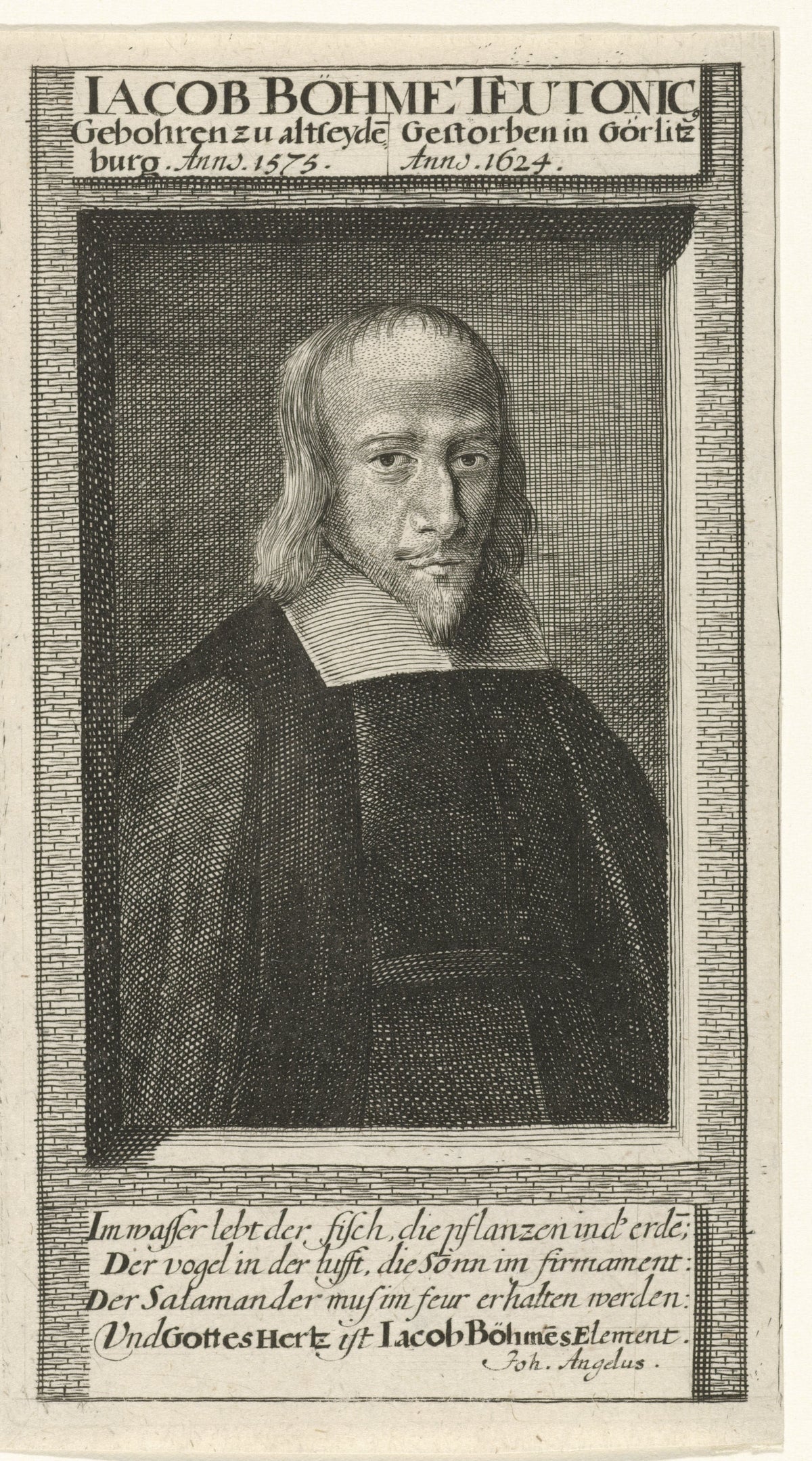
We must also resist the temptation to embellish his biography. No contemporary portrait of Böhme is currently known, according to the Neue Deutsche Biographie. The faces we associate with him date from after his death. His famous flash of light on a pewter vessel is transmitted to us through accounts, some of which came from admiring acquaintances. These documentary limitations do not diminish the interest of the figure. On the contrary, they allow us to distinguish the historical record from the legend that developed around him.
What remains indisputable is the existence of an artisan from Görlitz who, over the course of a dozen years, produced a body of work powerful enough to cross religious and national borders. His texts would be read in German, Dutch, English, French, and Russian circles. They would nourish Christian theosophy, certain currents of modern philosophy, and a significant part of European esoteric culture.
Böhme wanted to understand how light could arise at the very heart of tension. His entire work returns to this question. Darkness does not have the final word in it, but neither can it simply be denied. Fire must become light; the contracted will must transform itself; separated humanity must recover a living relationship with its source. It is this cosmic and inward drama that still gives his books their strange power today.
Sources and reference points
The Neue Deutsche Biographie provides the main biographical details: birth in 1575 in Alt-Seidenberg, activity in Görlitz, marriage to Catharina Kuntzschmann, conflict with Gregor Richter, journey to Dresden, and death on November 17, 1624. It also specifies that no contemporary portrait of Böhme is known.
For the structure of his thought, Brian J. Gibbons's chapter on Böhme in Gender in Mystical and Occult Thought, published by Cambridge University Press, makes it possible to trace the notions of Ungrund, will, fire, light, and Sophia within their theosophical context.
Bruce B. Janz's biographical article on Böhme in the Encyclopedia of the Early Modern World situates his work within the traditions of Paracelsus, Valentin Weigel, and German spirituality, and documents its reception in England and Holland, as well as by William Law, Louis-Claude de Saint-Martin, the Romantics, and German idealists.
Andrew Weeks's major modern study, Boehme: An Intellectual Biography of the Seventeenth-Century Philosopher and Mystic, State University of New York Press, 1991, remains a key reference for placing his visions, social background, trade, and writings within the religious and intellectual culture of the early 17th century.
The cover of this item reproduces an engraved portrait of Jakob Böhme attributed to the engraver Joseph Mulder and held by the Rijksmuseum in Amsterdam. The engraving postdates Böhme, is dated between 1668 and 1738, and is in the public domain. It is therefore a historical portrait of his posthumous reception, not a representation made during his lifetime.

Par Olivier of Aeternum
Passionate about esoteric traditions and the history of the occult from the earliest civilizations to the 18th century, I share articles exploring these subjects. I am also a co-founder of Aeternum, the online esoteric store.