





























































































Madame de Thèbes was one of the most famous French clairvoyants of the Belle Époque and the leading figure in Parisian society palmistry before the First World War. The Bibliothèque nationale de France and the CTHS identify her as Anne Victorine Savigny, born in 1845 and deceased in December 1916 in Clan, in the commune of Meung-sur-Loire. Research by Owen Davies, based on the contemporary press and testimony from people close to her era, instead identifies an Annette Savary born around 1844 in Ménilmontant. This variation in name and date recalls how her biography was assembled from scattered sources, long overshadowed by her legend as a “sibyl.”
What can be followed with greater precision is her astonishing rise through society: cashier, governess, actress under a stage name, then cartomancer before becoming a recognized specialist in palm reading. Protected by Alexandre Dumas fils and established at 29 avenue de Wagram, she received writers, aristocrats, diplomats, and members of royal families. Her annual almanacs subsequently spread her name throughout Europe. On the eve of 1914, Madame de Thèbes was no longer merely a Parisian consultant: she was an international media personality whose predictions were repeated, discussed, and challenged even in the foreign press.
A civil identity long obscured by a pseudonym
French bibliographic authorities now use the name Anne Victorine Savigny and the dates 1845-1916. The BnF describes her as a “palmist and clairvoyant” and places her death in December 1916 in Clan, Meung-sur-Loire. The CTHS uses the same identity.
Owen Davies, a historian of magic and divination practices, nevertheless found another form of the name in old press investigations: Annette Savary. He places her birth around 1844 at 52 rue des Envierges, in Ménilmontant, then attached to the commune of Belleville before the 1860 annexation. Her father is said to have been a carpenter. This reconstruction is based in particular on biographical investigations published during Madame de Thèbes's lifetime or shortly after her death.
Rather than choosing arbitrarily between these documentary traditions, it is preferable to preserve both levels: Anne Victorine Savigny is the identity used by contemporary heritage catalogs; Annette Savary appears in a recent historical reconstruction of her youth.
Before her fame, the future Madame de Thèbes led a much more ordinary life. Davies indicates that she first worked as a cashier in a men's clothing shop near the Palais-Royal. Around 1877, she became a governess in a bourgeois family.
This background is important for understanding her future ease with a wealthy clientele. She knew the codes of the Parisian bourgeoisie even before opening a consultation practice. Her rise therefore did not come from a world completely outside the salons: she gradually learned to move within these circles.
From around 1882 onward, she appears in small theater tours under the name Mademoiselle Dhalyle. The theater does not yet bring her fame, but this period gives her experience of the stage, diction, public presence, and contact with artistic circles.
In 1884, she grows closer to the actress Léonide Leblanc, a well-known figure in fashionable Paris. This association brings her into the orbit of a network combining theater, the press, politics, and high society. A few years later, this social capital will be decisive for her career as a fortune-teller.
1890, Madame de Sauval and the professional beginnings of cartomancy
Owen Davies places a precise turning point in 1890: the future Madame de Thèbes first adopts the professional name Madame de Sauval and establishes herself as a card reader at 46 rue Laugier, in Paris.
She then practices card reading in an already very active market. Paris has a long history of professional divination, illustrated in the previous century by Mlle Lenormand and, in another vein, by Mage Edmond. At the end of the 19th century, fortune-telling was at once a popular practice, an urban trade, and a fashionable curiosity.
Madame de Thèbes gradually turns away from simple cartomancy in favor of palmistry. The name Adolphe Desbarrolles is central here. An artist and occultist, Desbarrolles had published an important manual on palm reading as early as the 1850s and had become one of the leading French authorities on the subject.
Early sources regularly describe Madame de Thèbes as a student of Desbarrolles. This term nevertheless needs qualification: Desbarrolles died in 1886, before her divination career had truly begun. She certainly studied his system and placed herself within his intellectual lineage; the existence of prolonged personal instruction is more difficult to establish. To understand the historical principles of this art, our article devoted to palmistry examines the reading of the lines, mounts, and morphology of the hand.
Alexandre Dumas fils, the decisive patron
The man who truly transforms her career is Alexandre Dumas fils. The playwright himself has a longstanding interest in palmistry. According to Davies, the future Madame de Thèbes is introduced to him by a mutual acquaintance connected to the animal painter Louis-Eugène Lambert.
Dumas invited her to his Paris and Marly residences. Their closeness gave rise to rumors even during their lifetimes, but no solid source supports inferring an affair. What is certain is his role as a patron: he opened doors for her that a novice fortune-teller would hardly have been able to access alone.
It was Dumas fils who suggested the pseudonym under which she would become famous. The name refers to La Route de Thèbes, a psychological drama on which the writer had been working for a long time without managing to complete it.
The choice is remarkable. “Thèbes” evokes Antiquity, mystery, destiny, and prophecy all at once. At a time when ancient Egypt and ancient civilizations fascinated the European public, the pseudonym immediately possessed a greater evocative power than “Madame de Sauval.”
The first major publicity surrounding Madame de Thèbes seems to date from 1893. Dumas fils organized a dinner attended by doctors and members of the Académie française. The palmist was invited to examine the hands of several guests without knowing their identities.
The press reports on the experience. Le Figaro mentions the dinner in March 1893, while Le Gaulois mocks this new fashionable trend a few days later. The joke does not prevent her success: Madame de Thèbes becomes part of the Parisian scene.
A report by Adolphe Brisson published in 1898 explains that after this session, Dumas supposedly gave a favorable account of the experience in the press. The same text describes a seer who, since then, has “felt” the hands of both bourgeois and royalty. This contemporary investigation is one of the most interesting sources for understanding her method and public image.
29 avenue de Wagram, the address of a fashionable sibyl
Once her reputation was established, Madame de Thèbes received clients at 29 avenue de Wagram, near the Arc de Triomphe. The address is confirmed by several documents from the period, including guides devoted to the streets of Paris.
The choice of a highly visible grand avenue contrasts with the image of the fortune-teller hidden in a back room. Madame de Thèbes is no longer seeking secrecy: her office is becoming almost a fashionable address. Consulting the palmist is one of the curiosities of fashionable Paris.
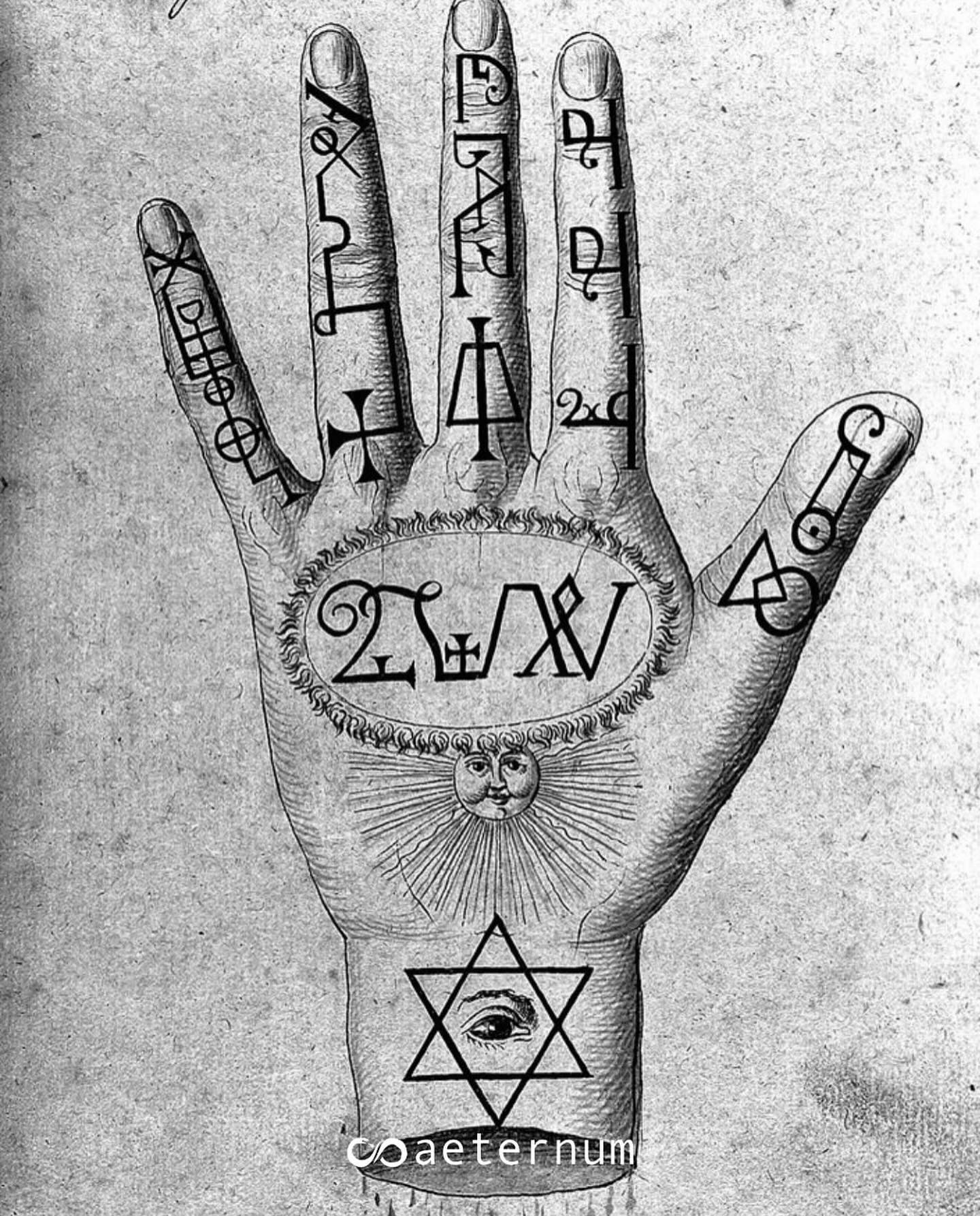
Palm reading is her public specialty. She examines the general shape, fingers, mounts, and lines, interpreting them according to the palmistry tradition of her time. She is also interested in handwriting and sometimes uses additional information to refine her advice.
Brisson’s 1898 report shows a practitioner who insists on the “positive” nature of palmistry. She wants to distinguish it from coffee grounds, somnambulistic methods, and practices she associates with charlatanism. She presents the hand as a set of regular signs that can be subjected to a method.
This ambition to turn palmistry into a “science of the hand” fully belongs to the late 19th century, when physiognomy, graphology, psychology, and divinatory arts still coexisted. For Madame de Thèbes, the hand is not merely a pretext for telling the future: it becomes a true landscape to decipher, where temperament, destiny, and bodily signs seem to correspond.
The same report gives a much more interesting image than that of a prophetess mechanically reciting predictions. Madame de Thèbes explains that she observes her clients’ different concerns, their attitudes, their questions, and their emotional relationships.
She even acknowledges using a husband’s handwriting to advise a woman on how to speak to him. This practice has more to do with psychological observation than with purely palmistic reading. It helps explain why several visitors might have left impressed by the relevance of her advice, regardless of any supernatural ability.
Among the literary clients cited by historical research is Marcel Proust. Owen Davies reports that Proust, feeling unwell, is said to have gone to consult her. After examining his hand, Madame de Thèbes allegedly advised him to leave and rest away from Paris.
The anecdote does not turn Proust into the seer’s disciple. Rather, it shows how Madame de Thèbes’s consultation could become a fashionable practice among writers and people who frequented Parisian salons.
Her clientele extends beyond French borders. Davies cites the testimony of a Serbian diplomat, according to whom Queen Nathalie of Serbia visited Madame de Thèbes in the early 1890s with two women from her entourage. One of them was Draga Mašin, who would later become Queen of Serbia by marrying Alexander I.
This type of clientele greatly enhances her reputation. A palm reader consulted by members of royal families can subsequently be presented as an adviser to the powerful, even when the exact nature of the consultation remains unknown.
1901, L’Énigme de la main
In 1901, L’Énigme de la main was published by Félix Juven. The Bibliothèque nationale de France describes a 278-page volume illustrated with figures and plates. The book constitutes the major synthesis of her palmistry teachings.
Madame de Thèbes seeks to give palm reading a structured presentation. She studies shapes, lines, and signs, and places her work within the tradition of 19th-century French palmistry. The press of the time presents the book as the summary of years of observation.
Madame de Thèbes’s career should therefore not be reduced to her study. Like Mlle Lenormand before her, she understood the power of print. A book enabled her to extend the consultant’s authority far beyond those able to travel to Avenue de Wagram. She became an author identified by the BnF and built a regular publishing output around palmistry, dreams, and above all annual predictions.
1903, the birth of the Almanach de Madame A. de Thèbes
The BnF preserves the complete record for the Almanach de Madame A. de Thèbes : conseils pour être heureux, published by Félix Juven from 1903 to 1917. The first edition bears a particularly revealing title: Conseils et prophéties de Madame de Thèbes : le livre de tous les prodiges et de tous les mystères.
Each year, the almanac combined advice, observations, and announcements concerning France and abroad. Its regular publication gave Madame de Thèbes a decisive advantage: unlike predictions recounted after events, printed texts can be reread and compared retrospectively with the facts.
The bibliographic series extends through the 1917 edition, although Madame de Thèbes died in December 1916. Since almanacs were prepared for the coming year, this final issue does not imply a publication produced by her after her death.
Madame de Thèbes did not limit her work to palmistry. In 1908, Félix Juven published L’Énigme du rêve : explication des songes, a volume of more than 250 pages now digitized by the Bibliothèque nationale de France.
The work belongs to the great tradition of dream books while seeking to modernize it. The seer connects dreams with personality, daily impressions, and premonition. This dimension places her within a broader history of oneiromancy and of the turn-of-the-century attempts to interpret nocturnal images.
At the beginning of the 20th century, “Madame de Thèbes” was no longer merely a woman’s pseudonym. The name became a true media brand. Newspapers cited her when they wanted to discuss prophecies, the political future, or public credulity.
This fame would have an unexpected effect during the First World War: false texts and false predictions would be marketed under her name. She herself would have to protest in the press against those she accused of abusing her reputation.
The iconography of Madame de Thèbes is filled with elephants. Press photographs show her beside statuettes of the animal, and several accounts describe her study as filled with small bronze or porcelain elephants.
It associates the animal with prudence and wisdom. Its public motto, “I do not deceive, I warn,” reinforces this image. The elephant therefore functions as a genuine personal emblem, immediately recognizable.
This preference was not solely decorative. The CTHS confirms that Madame de Thèbes became a member of the Les Amis de l’Éléphant society on April 4, 1906, and remained there until 1916. The association brought together scientists, writers, administrators, and public figures interested in the protection and study of the elephant. This membership gave her favorite symbol a very concrete social dimension.
Did Madame de Thèbes really predict the First World War?
This is the question that contributed most to her international renown. Unlike many prophecies fabricated after 1914, there are indeed texts predating the war in which Madame de Thèbes announces serious European tensions.
In January 1912, The Occult Review translates passages from her almanac in which she presents Germany as a threat to Europe and France and predicts that a war would lead to the disappearance of Prussian hegemony and the Hohenzollerns. In 1913, the same journal recalls that she maintains her warnings about a European war.
These were therefore indeed predictions printed before August 1914. The European context was already fraught with tensions, which makes it impossible to isolate these sentences from their era; nevertheless, their existence before the conflict gives Madame de Thèbes's prophetic reputation a depth that mere retrospective legends lack. The international press widely reprinted her 1913 almanac. An American newspaper reports that she describes the year as a period in which courage and stoicism will be particularly necessary and announces upheavals in Europe.
These predictions show the nature of her public work: Madame de Thèbes no longer limits herself to advising individuals. She interprets the destiny of nations, dynasties, and governments. Her almanac becomes a form of prophetic political chronicle.
When war breaks out, her texts are reproduced in many countries. Owen Davies shows that her advertisements circulate from America to New Zealand, via Great Britain and Germany. Her 1914 almanac is sold in the streets of Paris alongside other prophetic pamphlets.
But this success also produces numerous forgeries. Sellers use her name to circulate texts she did not write. In 1914 and 1915, she sends several protests to newspapers and states that her only authorized war predictions are those in her 1913 and 1914 almanacs. This clarification is essential for assessing her reputation: several spectacular prophecies attributed to Madame de Thèbes after 1914 may have originated in popular commerce rather than in her own publications.
She is credited with the Boer War, the Russo-Japanese War, the death of General Boulanger, that of Catulle Mendès, the sinking of the Titanic, in which William T. Stead perished, and the Caillaux affair. These claims appear in numerous biographies.
However, they do not all have the same level of documentation. Some are linked to published texts or contemporary testimonies; others gained strength mainly after the event. A rigorous study must therefore avoid presenting this list as a series of indisputable successes.
Press criticism
Madame de Thèbes never operated in an atmosphere of general acceptance. From the 1890s onward, newspapers made fun of her. Cartoonists and columnists particularly enjoyed predictions that were general enough to be reread in several ways.
She was also accused of claiming credit for certain announcements after the fact. The death of President Félix Faure in 1899 became one of the examples used by her detractors. The journalist Jacques Mauprat pointed out that the alleged prediction seemed to him to have been produced after the death. These controversies in no way prevented her success. On the contrary, admiration and mockery together contributed to creating her fame.
French memory later strongly associated the Great War with Madame Fraya. Yet Owen Davies shows that, during the conflict itself, the name of Madame de Thèbes dominated the international press by far.
After her death, Fraya was even presented in some newspapers as the “new Madame de Thèbes” or her heir. This chronology makes it possible to correctly situate the two great French seers: Madame de Thèbes belonged first to the Belle Époque and the early years of the war; Fraya occupied an increasingly prominent place in the following generation.
The BnF also holds a work published in 1914 under the title The Revelations of Mme de Thèbes on the Great Drama of 1914, or the European War. This document shows how quickly her name was mobilized to interpret the conflict.
The boundary between prophecy, current affairs, and propaganda then became very thin. The public wanted to know who would win, how long the war would last, and what fate awaited the sovereigns. Seers were questioned as though they could provide a parallel reading of military events.
In 1915, articles devoted to her predictions appeared in the English-language press. The phenomenon was no longer exclusively French. Her persona became that of the great Parisian prophetess whose statements were examined at each new phase of the war.
This international circulation is an important phenomenon in the history of modern occultism. The telegraphic press now enabled a prediction made in Paris to be discussed a few days or weeks later on several continents.
1915, Mauritz Stiller’s film Madame de Thèbes
Her fame was such that her name became the title of a Swedish film directed in 1915 by Mauritz Stiller. The Cinémathèque française and the Svenska Filminstitutet preserve records of Madame de Thèbes, a drama in which a fortune-teller plays a central role.
The screenplay is not a faithful biography of Anne Victorine Savigny. The film mainly uses her name and the type of character with which she had by then become associated. This is precisely what measures her fame: “Madame de Thèbes” had become an immediately recognizable character outside France. During the war, Madame de Thèbes gradually withdrew from the turmoil of Paris and acquired a rural property at Clan, in the commune of Meung-sur-Loire, southwest of Orléans.
Owen Davies reports that she raised poultry there, among other things. The French press could not resist the joke: the woman credited with being able to foresee the fall of empires was mocked because she supposedly could not foresee the future price of eggs. This anecdote, repeated in 1916, shows how fully her character had by then entered popular culture. Even her retirement became the subject of newspaper columns.
Death in December 1916
The BnF places her death in December 1916 at Clan, Meung-sur-Loire. The international press announced her death at the end of the month. Several sources give December 24, 1916. Davies states that she died at her country estate after having lost her adopted son some time earlier. News of her death reached the United States, Australia, and Central Europe, proof of the extent of her fame.
One particularly touching element of her estate brings Madame de Thèbes back to her neighborhood of origin. She stipulates that part of the capital from the sale of her property be used to establish a dowry for a poor and deserving young woman born in Ménilmontant and destined to marry within the year.
This bequest establishes a link between the fame of the avenue de Wagram and the working-class milieu from which historical research traces her life. It is also a far more concrete fact than several legends associated with her prophecies. Madame de Thèbes is buried in Père-Lachaise Cemetery. The choice of the great Parisian cemetery suits a figure who had become famous well beyond occultist circles. She thus joins a funerary landscape populated by writers, artists, and political figures whom she had sometimes encountered in late-19th-century Paris.
Her success cannot be explained solely by whether a particular prediction came true. She mastered several registers at once: private consultations, fashionable society, books, almanacs, and the press.
She also perfectly understood the importance of a public identity. Her pseudonym, her Wagram consulting room, her elephants, her motto, and her publications formed a coherent persona. Long before modern media, Madame de Thèbes built a genuine public presence around her art. Posterity readily transformed her into a prophetess capable of predicting wars, deaths, and scandals. Yet her own writings show that palmistry remained at the heart of her professional identity.
The hand served her to speak about character, health, dispositions, and personal trajectory. Her prophetic ambitions concerning nations belong mainly to the period of the almanacs and the media celebrity she acquired after 1900.
Madame de Thèbes in the history of French divination
She occupies a particularly interesting intermediate position. Mlle Lenormand had embodied the cartomancer of the revolutionary and imperial periods. Madame de Thèbes became the sibyl of fashionable Republican society and the Belle Époque. Madame Fraya would later extend this figure into the interwar period.
Through these women, French divination changed form without disappearing. It moved from the private consultation room to the mass press, then to almanacs and media celebrity. Our article Understanding divination through the ages places this evolution within a longer history.
Her prophecies mainly require us to maintain two perspectives at once. The first is to accept without verification all the predictions attributed to her by posterity. The second is to assume that everything was invented after the events.
The sources reveal a more interesting situation. Some announcements were indeed printed before 1914 and can be verified. Others circulated without a precise source, were reworded, or were even fraudulently published under her name. The almanacs, dated newspapers, and published works make it possible to determine what was actually announced before the events - and to assess what, in certain formulas, continues to intrigue us.
Madame de Thèbes remains a major figure because she transformed palmistry into a cultural phenomenon of the Belle Époque. She brought palm reading into salons, published an important method, produced an almanac for fifteen editions, and became well known enough to lend her name to an international film.
Her career also reveals the continuity of interest in divination in a France that nevertheless sought to be modern, republican, and scientific. Doctors, writers, journalists, and diplomats could joke about palmistry while also going themselves to examine what the famous sibyl of Avenue de Wagram would say about their hands.
Sources and reference points
The Bibliothèque nationale de France identifies Madame de Thèbes as Anne Victorine Savigny, born in 1845 and deceased in December 1916 at Clan, Meung-sur-Loire. Its bibliographic records confirm L’Énigme de la main in 1901, L’Énigme du rêve in 1908, and the Almanach de Madame A. de Thèbes for the years 1903 to 1917.
The Comité des travaux historiques et scientifiques documents her career as a palm reader and clairvoyant, her earlier time in the theater, and her admission to the society Les Amis de l’Éléphant on April 4, 1906.
Owen Davies’s chapter “Prophetic Times” in A Supernatural War: Magic, Divination, and Faith during the First World War, published by Oxford University Press in 2018, is the most detailed modern source on her youth, her beginnings under the names Mlle Dhalyle and Madame de Sauval, her relationship with Alexandre Dumas fils, her clients, her war prophecies, the forged texts circulated under her name, and her final years in Meung-sur-Loire.
The report by Adolphe Brisson published in 1898 and reprinted in L’Écho du Merveilleux is a remarkable contemporary source on her practice and her way of presenting palmistry. The issues of The Occult Review from 1912 and 1913 also make it possible to verify that predictions concerning a future European war and the Hohenzollern dynasty were circulating well before August 1914.
The Cinémathèque française and the Svenska Filminstitutet document the silent film Madame de Thèbes, directed by Mauritz Stiller in 1915, attesting to the international spread of her name.
The cover of this item uses an authentic photograph of Madame de Thèbes taken by the Manuel studio, published in the Larousse mensuel illustré in 1920 and now in the public domain.

Par Olivier of Aeternum
Passionate about esoteric traditions and the history of the occult from the earliest civilizations to the 18th century, I share some articles on these topics. I am also co-creator of the online esoteric shop Aeternum.