



















































































































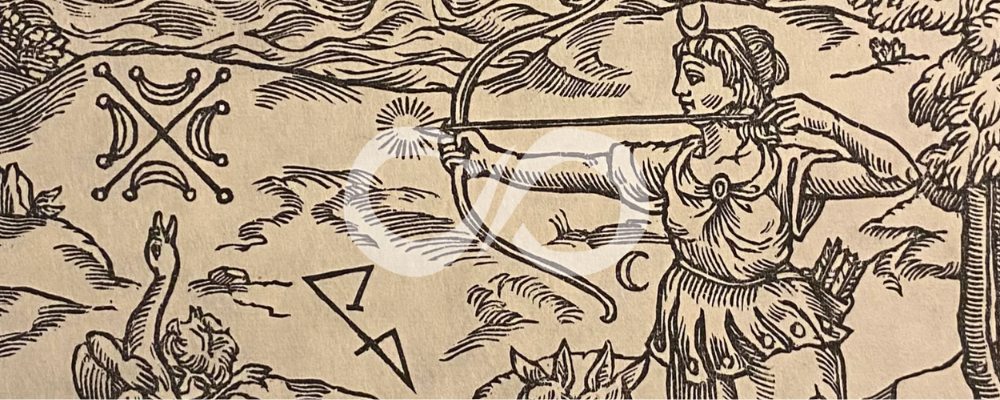
Ever since humanity first gazed at the sky, the stars have been far more than points of light in the night. For the sages of ancient times, each planet was the seat of a living power, endowed with its own will and character. These entities, known as planetary genii, were invoked, honored, and sometimes feared, in the hope of gaining their favor, for they alone govern the forces of the universe. Explanations.
Planetary genii across traditions
Since antiquity, the seven wandering stars - Saturn, Jupiter, Mars, Sun, Venus, Mercury, and Moon - have been associated with spiritual or divine entities that govern them. In ancient Greco-Egyptian and Gnostic traditions, these planetary genii appear as cosmic powers governing destiny and hindering the soul’s ascent. The Ophite Gnostics (a branch of the Gnostic movement that gave a central place to the serpent in the biblical account of Genesis) identified each planet with an archon: Saturn was dominated by Ialdabaoth, the “lion-faced” Demiurge, Jupiter by Iao, Mars by Sabaoth, the Sun by Adonaios, Venus by Astaphaïos, Mercury by Elaios, and the Moon by Horaios. These names, derived from Hebrew terms for God, reflect this esoteric vision in which the planets are inhabited by spirits that are sometimes benevolent and sometimes hostile.
In the Hermetic and Neoplatonic tradition, it is also believed that each planetary sphere is animated by a celestial intelligence emanating from the Divinity, and sometimes by a more earthly inferior genius (spirit). The Renaissance mage Cornelius Agrippa thus explains that for each planet, God established “an Intelligence for good and a spirit for evil”. These entities serve as mediators between the divine world and the material world. During the medieval and Renaissance periods, under the influence of Arab astrology and Hermetic texts translated from Greek or Arabic, the idea of summoning planetary genii through magical rituals developed. Treatises such as the Picatrix (Ghâyat al-Hakîm) and the Liber Juratus teach the creation of talismans and the invocation of planetary spirits to obtain concrete effects (wisdom, love, wealth, protection,...) in accordance with astrological correspondences. Traditional rituals called for working “on the day and at the hour” of the planet concerned, using appropriate incense, prayers, and other “suffumigations,” sometimes offerings or fasts, in order to attract the influence of the targeted planetary genius.
Saturn, Lord of Time and His Genius
Symbol of time, slowness, and melancholy, Saturn has always fascinated with its dual nature as the great astrological malefic and master of contemplation. In Greco-Roman mythology, it is Cronus/Saturn, the old god of time who devours his children. Ancient esoteric traditions made it a formidable power: in Gnostic cosmology, Saturn’s planetary genius is Ialdabaoth, the proud Demiurge who created the material world and was identified with Satan. Conversely, the Neoplatonist philosophers viewed Saturn as the highest sphere before the fixed stars, associated with supreme Intelligence and contemplative wisdom.

Representation of Saturn’s Genius according to Agrippa. Artist
In medieval and Renaissance magic, Saturn is served by several emblematic entities. The Kabbalistic and angelic tradition names Cassiel (or Tzaphqiel) as the archangel ruling Saturn. Cassiel is described as an austere angel associated with temperance and solitude, who observes worldly affairs without intervening too much. Agrippa, for his part, attributes to Saturn the benevolent intelligence Agiel and the opposing genius (spirit) Zazel, derived from Hebrew names and associated with the number 45, the mystical sum of Saturn’s magic square. In some grimoires, Zazel is considered a demon of Saturn, bearer of baneful influences (curses, obstacles), while Agiel is said to be the entity to invoke for constructive Saturnine workings (knowledge of hidden things, inner discipline).
One of Saturn’s most notable planetary geniuses is Aratron, presented in the Arbatel as Saturn’s “Olympic governor.” Aratron commands 49 provinces of the cosmos and must be invoked on Saturday at the first hour of the day (Saturn’s hour). According to the Arbatel, Aratron presides over everything astrologically attributed to Saturn: « He can turn any living being to stone in an instant; change coal into treasure and vice versa; he gives familiar spirits and reconciles subterranean spirits with humans; he teaches alchemy, magic, and medicine ». He can also make someone invisible, enable sterile people to have children, and « grants a long life » to the mage who obtains his assistance. Aratron thus appears as a powerful genius of transmutation and occult knowledge – a reflection of the Saturnian qualities of slow transformation, wealth hidden beneath the earth (metals, treasures), and mastery of time.
Historically, invocations of Saturn were considered difficult and dangerous because of this planet’s cold, dry, and restrictive nature. Rituals recommended acting within a favorable astrological framework (Saturn in a good position); otherwise, the genius might reveal its malevolent side. In talismanic magic, a Saturn talisman engraved on lead under favorable auspices served to ensure protection and power – but under harmful influences, the same inscriptions could instead cause ruin, discord, and delays. An Agrippa text indeed states that, when made while Saturn is “unfortunate,” a Saturnian talisman « prevents construction, causes the loss of honors and dignities, and brings about discord and quarrels ». As a precaution, practitioners therefore sought to invoke the “elevated” Saturn (the archangel or benevolent intelligence) to obtain the favor of people in high positions, stability, and depth of mind, while protecting themselves from the “obscure” Saturn (the demon Ialdabaoth or Zazel), who brings sadness and obstacles. This duality aptly illustrates Saturn’s rich symbolism: both master of secret knowledge and hidden riches, and bearer of trials and stern lessons.
Jupiter, the celestial king and his blessings
Jupiter, the brightest planet after Venus, has traditionally been associated with benevolence, royalty, and prosperity. Among the Greeks and Romans, he corresponded to Zeus/Jupiter, father of the gods and guarantor of cosmic order, justice, and abundance. In ancient astrology, Jupiter is the “Great Benefic,” bringing expansion and fortune. Esotericists therefore saw in his genius a positive, almost angelic, tutelary force.
In the Judeo-Christian celestial hierarchy, the archangel of Jupiter is called Sachiel (or Zadkiel). His name means “Justice of God” or “Grace of God,” and he appears in grimoires such as the Heptameron (16th century) among the governing angels of Thursday, day of Jupiter. Sachiel/Zadkiel is associated with mercy, generosity, and spiritual wealth, qualities reflecting the Jovian influence. In the Kabbalah, Jupiter corresponds to the sephira of Hessed (Grace), and Zadkiel is the angel of divine benevolence, presiding over clemency and prosperity.

Representation of the Spirit of Jupiter according to Agrippa. Artist
Renaissance occultists also mention an intelligence of Jupiter named Johphiel (or Jophiel) and a lesser spirit, Hismael, based on Agrippa’s magic squares. Agrippa states that the total number associated with Jupiter is 136, and that “Yohphiel, Intelligence of Jupiter” and “Hismael, Spirit of Jupiter” derive from it numerically. These Hebrew-origin names (containing the suffix -el, “of God”) show that Jupiter was integrated into an angelic cosmology: Yohphiel representing the planet’s luminous and beneficial power, and Hismael its more material energy to be mastered.
In planetary magic, the Olympic spirit attributed to Jupiter is Bethor. The Arbatel describes Bethor as the Jovian spirit quick to respond to requests: “The affairs of Jupiter are administered by Bethor, who responds quickly when called”. Anyone who acts under his character (his seal) “may be elevated to illustrious dignities and obtain vast treasures”. Bethor “reconciles the Spirits of the Air with men, so that they give truthful answers”, transports precious stones wherever they are needed, and composes remedies with miraculous effects. He can grant familiars (servant spirits) from the firmament and extend human life to 700 years if God permits. The occult encyclopedia specifies that Bethor, a jovial angel, may be invoked on Thursday during the first hour of Jupiter and that he governs 42 celestial provinces.
Historically, practices aimed at Jupiter sought to harness his beneficial influences of growth and good fortune. Jupiter talismans were made by engraving his seal and numbers on a silver plate on a Thursday when Jupiter was astrologically “dignified” (in a favorable aspect and position). Agrippa states that such a talisman, “Jupiter being powerful and reigning,” “brings gain, wealth, favor and love, peace and concord, and soothes enemies”. Likewise, a prayer invoking Jupiter’s angel could be offered to obtain the favor of a prince or the success of an undertaking. The texts also contain defensive uses: wearing a Jupiter talisman engraved on coral breaks evil enchantments. The planet of justice was used to dissolve spells and injustices.
The genius Jupiter inspired many occult legends. It was said that the medieval mage Albert the Great had created an oracular bronze head through the combined influences of Jupiter and Mercury - although this anecdote may be merely a myth. More concretely, in the 15th century, Marsilio Ficino recommended singing hymns in Jupiter’s honor (such as the Orphic Hymn to Zeus) on Thursday to attract his gifts of wisdom, optimism, and good fortune to the practitioner’s soul. Thus, from late antiquity through the Renaissance, the Jovian genius was always invoked as a force of grace and expansion, a guarantor of balance and prosperity, whether in the material or spiritual realm.
Mars, the celestial warrior and the Genius of strength
Astrologically, Mars is the planet of action, war, and ardent passion. Identified with the Roman god of war (Ares among the Greeks), it represents combative energy, anger, but also courage and strength of will. In esoteric cosmology, Mars is considered a more ambivalent influence: necessary for overcoming obstacles and protecting oneself, but potentially destructive if poorly controlled. Its planetary genius reflects this fiery nature.
In the angelic tradition, the archangel associated with Mars is sometimes called Samael or Camael. Samael, whose name means “venom of God,” appears in some Jewish sources as the angel governing the sphere of Mars. The Sabians of Harran (a star-worshiping sect of Late Antiquity) called him Mara Samîa, and this idea was transmitted to medieval grimoires. However, Samael is an ambiguous figure: both an angel of judgment and a heavenly accuser, often equated with a demon in rabbinic literature. In Christian magic, Camael (“He who sees God”), a warrior archangel at the head of the Powers, is sometimes preferred to embody the positive martial principle. In any case, Mars is linked to the sephira of Gevurah (Severity) in Kabbalah, the domain of divine strength and severity.

Representation of the Genius of Mars according to Agrippa. Artist
In Agrippa’s lists, Mars has Graphiel as its intelligence and Barzabel as its genius (spirit). Barzabel (or Barzakhiel in other manuscripts) is regarded as a formidable spirit, sometimes classified among demons. Its name carries a harsh resonance evoking iron and war, in keeping with the Martian nature. Magic manuals advised approaching it cautiously during martial conjurations, as it could just as easily grant victory as provoke discord.
The Olympic governor of Mars is named Phaleg, according to the Arbatel. Phaleg is presented more soberly than the other spirits: “Phaleg governs what is attributed to Mars. The person who possesses his character (sign) will be raised by him to great honors in military affairs.” In other words, Phaleg grants success and prestige to the warrior - he was invoked to win battles and duels, gain valor, or advance in the military hierarchy. The texts specify that Phaleg governs 35 provinces of the cosmos and must be invoked on a Tuesday (the day of Mars) at the Martian hour, while wearing his seal of command. His assistance was sought not only by soldiers but also by anyone who needed to assert power or overcome obstacles with authority.
The talismans and operations of Mars were intended for offensive or protective purposes. A Martian talisman engraved on iron or steel, crafted when Mars was favorably placed, was reputed to make “a man powerful in war and formidable to his enemies, victorious over them.” Conversely, if this same talisman was made under an ill-aspected Mars, Agrippa warns that it “causes disputes, enmity, and hatred between men and beasts, drives away bees, scatters pigeons, prevents mills from functioning properly, causes sterility and terror.” This shows that manipulating the energy of Mars could easily turn into harmful magic if one was not careful.
A famous case involving the use of the genius of Mars is recounted in certain medieval chronicles: during a siege, a mage supposedly attempted to invoke the spirit of Mars to trigger panic and discord among the besiegers - a sort of occult “psychological warfare.” More positively, Martian influences were believed to have the ability to heal certain blood-related illnesses or stop hemorrhages (Mars governing iron and blood, a talisman engraved on carnelian stone could, it was said, “stop blood and menstrual flows”). Moreover, for personal protection, knights sometimes carried inscriptions of the angel of Mars or recited the Tuesday psalm, hoping to channel warrior courage without cruelty.
Thus, the planetary genius of Mars embodies brute force and combative will. Whether called Phaleg in a theurgical context or Barzabel in a goetic context, it represents the energy of iron that the mage must forge with caution. In the right hands (those of a moral and prepared mage), the power of Mars brings righteous victory and active protection; in the wrong hands, it unleashes uncontrolled violence and destruction. This is why rituals insist on the necessity of self-control and the legitimacy of the cause when invoking the formidable genius of the red planet.
The Sun, light of the world and genius of splendor
The star of day and center of the traditional planetary system, the Sun has always been regarded as the source of life, light, and spiritual illumination. In late antiquity, Hermetic philosophers saw in Helios the symbol of the Nous (the divine Intellect) that illuminates the soul. In his Hymn to King Helios, Emperor Julian praised the Sun as the benevolent demiurge and the heart of the universe. Likewise, in the Kabbalah, the Sun corresponds to the sephirah Tiphereth, at the center of the Tree of Life, associated with beauty, harmony, and mediation between heaven and earth.

Representation of the Genius of the Sun according to Agrippa. Artist
The solar planetary genius is therefore surrounded by particular prestige. In the Judeo-Christian tradition, it is associated with Mikhaël (Saint Michael the Archangel), presented as the highest of the archangels and victor over the forces of darkness. Michael is readily linked to the Sun and solar fire by analogy: commander of the heavenly armies, he shines with divine light and combats darkness just as the sun dispels obscurity. Numerous grimoires (such as the Key of Solomon or Barrett’s Magus) list Michael as the angel of Sunday, bearing the omnipotence of the Sun. Other sources associate the archangel Raphael with the Sun (particularly in the Kabbalistic association of planets and sephiroth, where Raphael governs Tiphereth) and Michael with Mercury - there were some variations among esoteric schools. In any case, the Sun is generally under the aegis of a high-ranking archangel believed to bestow illumination, health, and glory.
In magical treatises, we still find a division between intelligence and spirit for the Sun: Agrippa attributes to the Sun the intelligence Nachiel (or Nikhiel) and the lower genius Sorath. This latter name, Sorath, has intrigued more than one commentator because its numerical values add up to 666 - the famous “number of the Beast” in Revelation. In reality, this is the total number of the solar magic square (6×6 cells yielding a sum of 666), from which the name is derived. Sorath represents the fiery spirit of the Sun, potentially corrosive or destructive if uncontrolled, while Nachiel embodies the benevolent solar intelligence that grants vitality and success. This duality recalls that the Sun can burn as much as it illuminates.
The Olympic genius of the Sun, according to the Arbatel, is named Och. Och is described as an extremely powerful spirit, master of riches and healing: “Solar affairs are administered by Och, who prolongs life to six hundred years in perfect health. He confers great wisdom, gives excellent familiar spirits, composes perfect remedies, converts any substance into the purest metal or precious stones; he also grants gold and a purse always filled with gold… He causes the bearer of his character to be worshiped like a god by the kings of the whole world”. As we can see, Och combines miraculous powers: prolongation of life, alchemical transmutation into gold, complete healing, inexhaustible wealth, and even quasi-divine glory. Of all the planetary genii, Och is undoubtedly the one whose list of abilities is the most impressive, which reflects the central status of the Sun. The Arbatel also specifies that Och must be invoked on Sunday at the hour of the Sun, as is fitting, and that he will respond favorably to requests as long as they remain within the order willed by God.
Historically, invoking solar influences was valued for everything related to vitality, social success, and spiritual elevation. Marsilio Ficino advised his melancholic disciples to turn to the Sun: through music, the singing of solar hymns, and exposure to light, one could balance the humors and attract the life-giving influx of Sol. Practitioners made talismans of the Sun from gold (the quintessential solar metal) or engraved solar symbols on carnelian or ruby, in order to promote the healing of diseases and obtain honors and joy. An astrologically “worthy” solar talisman was believed to “make a man loved by kings and the people, and assure him victory in all things”, such is the solar aura’s association with triumph and magnanimity.
The Sun also played a central role in theurgies: magi-priests recited the Hymn to Helios or used mirrors to capture a ray of sunlight during certain ceremonies, symbolizing divine illumination descending upon the magic circle. It was believed that the genius of the Sun could unveil the highest mysteries - for example, the Neoplatonist esotericist Iamblichus speaks of a “vision of the god Helios” granted to the mage in a state of ecstasy, that is, communion with solar intelligence. In a more down-to-earth context, astrological physicians in the Middle Ages chose the hour of the Sun to administer certain remedies (related to the heart, eyesight, or potable gold) in order to benefit from its healing virtue.
Venus, the lady of love and her Genius of grace
A universal symbol of beauty, love, and fertility, Venus has inspired cults and magical practices since the dawn of civilization. Identified with the Greek goddess Aphrodite or the Babylonian Ishtar, Venus is the Morning Star that presides over earthly attractions as well as celestial harmonies. Its planetary genius is therefore associated with the power of attraction, grace, and the arts.
In the angelic and Kabbalistic hierarchy, the archangel governing Venus is generally Haniel (or Anaël). Haniel means “Grace of God” - an appropriate name for the angel of the sephira Netzach (Victory), which corresponds to Venus and embodies divine love, beauty, and the victory of the forces of life. He is portrayed as a radiant angel bringing joy, seduction, and artistic creativity. Occult literature classifies him among the seven planetary archangels, ruler of Friday and dispenser of beneficial Venusian influences. In the Sigillum Dei cherished by John Dee, the name Anaël appears in correspondence with Venus. Some grimoires of astrological magic, following the influence of the Sefer Raziel, also mention an angel called Hagiel or Anael for Venus, alongside a less benevolent spirit called Kedemel (or Kedemel) - these names appear notably in Agrippa’s tables of correspondences. Indeed, Agrippa indicates for Venus an intelligence named Hagiel and a genius of “evil” named Kedemel, associated with the number 175 of the square of Venus.

Representation of the Genius of Venus according to Agrippa. Artist
The Olympian spirit of Venus, according to the Arbatel, is called Hagith. Hagith is described as the ruler of “Venusian things” (everything related to Venus). Whoever bears Hagith’s character (seal) “will be adorned with all beauty”. Hagith has the power to “instantly convert copper into gold and gold into copper”, and he “gives faithful servants” to assist the magician. These attributes aptly reflect Venus’s subtle alchemy: beauty (copper, Venus’s metal, can become gold, a symbol of solar perfection, and vice versa - thus Venus mediates between the material and the spiritual), the grace surrounding the beloved person, and loyalty in love or friendship (the “faithful servants” may also be understood as the loyalty of companions). The Arbatel states that Hagith governs 21 celestial provinces and that he can be called upon on a Friday during the hour of Venus to benefit from his gifts.
Love and artistic magic throughout history has made abundant appeal to Venus. Recipes for love potions, rituals to attract a partner or rekindle a spouse's affection called upon the evening star. The Picatrix gives instructions for sculpting the image of an embracing man and woman on a Friday under a favorable conjunction of Venus, burning sweet perfumes (sandalwood, rose) to invoke the Venusian spirit that “unites hearts.” Likewise, people were advised to carry copper engraved with the signs of Venus (since its number 7 and its seal were often inscribed on it) in order to increase their charm and popularity.
A notable practice, reported in medieval texts, is the invocation of the angel Anael on Friday before sunrise to consecrate magic mirrors intended for love. Prayers were recited so that Anael would grant the mirror the power to reflect the image of one's soulmate or reconcile separated lovers. Renaissance astrologers' journals also show that Venus was invoked to promote fertility: to help a couple conceive a child, a Venus talisman was calculated on a fig leaf which, placed beneath the marriage bed, was supposed to infuse it with the harmony and fertility of the Venusian spirit.
Of course, Venusian spirits could also be diverted to less noble ends - there is evidence of attempts at lust spells or forced seduction by calling upon the demons of Venus. Tradition also makes Asmodeus (Asmodai) a demon of lust once associated with Venus in certain classifications. However, in the reliable sources we favor, the emphasis is placed on the positive celestial Venus, patroness of sincere love and inspired art. Paracelsus considered the Venusian influence essential in spagyric medicine for preparing remedies acting on the renal and reproductive organs. He spoke of the “fire of Venus” as a moderate, restorative vital heat, in contrast to the more violent “fire of Mars.”
The planetary genius of Venus, whether known as Hagith, Haniel, or Anael, embodies the force of attraction that binds the Universe together. Its traditional invocation sought to increase beauty, love, and harmony. The ancients said that Venus “softens manners” - in fact, during a properly conducted ritual, the mage was to surround himself with music, songs, and sweet fragrances, creating a harmonious atmosphere filled with joy to invite the Venusian genius. For it is through joy, grace, and pure affectionate intention that one touches the heart of this powerful spirit of cosmic love.
Mercury, the winged messenger and the Genius of Knowledge
Mercury, a swift and elusive planet, has always been associated with the principle of movement, exchange, and intelligence. He is Hermes to the Greeks, Thoth to the Egyptians - the messenger of the gods, master of words, roads, and the occult sciences. The planetary genius of Mercury is thus linked to knowledge and communication and also, sometimes, to cunning or even ambiguity (Mercury can be deceptive).
In the Western kabbalistic and angelic tradition, Mercury is placed under the aegis of Raphael, archangel of Medicine and Science. Raphael, whose name means “God heals,” is one of the seven archangels and is said to rule Wednesday and the planet Mercury in many grimoires of planetary magic. Other lists attribute Mercury to Michael (as was the case in certain correspondences in the Liber Juratus), which can cause confusion - but most Renaissance occultists followed the scheme: Raphael for Mercury, Michael for the Sun. In any case, the Mercurial spirit is seen as fundamentally luminous and airy, bearing intellect. In Kabbalah, Mercury corresponds to the sephira Hod (Glory), the domain of reason, language, and ritual magic - Raphael or Michael are its guardian angels, depending on the source.

Depiction of the Genius of Mercury according to Agrippa. Artist
Agrippa, faithfully, gives Mercury an intelligence named Tiriel and a lower spirit called Taphthartharat. This latter name, with its repetitive sounds, was reputedly difficult to pronounce - some saw in it a mnemonic device for tracing the spirit's sigil on Mercury's square (8x8 squares, sum 2080). Taphthartharat is described as an unstable spirit, like quicksilver (metallic mercury), which constantly changes shape. In contrast, Tiriel represents the fixity of Mercurial intelligence capable of extracting order from chaos. Here again, we find the idea of a dual aspect: Mercury can enlighten the mind (sudden intuition, eureka!) or lead it astray through illusions (deceit, sophistry), and the mage should therefore address Tiriel/the archangel Raphael for constructive results, while remaining wary of the cosmic trickster that is Taphthartharat.
Mercury's Olympic spirit is called Ophiel in the Arbatel. Ophiel is presented as the master of Mercurial things, granting knowledge and talents. The Arbatel states: “Ophiel is the governor of what is attributed to Mercury; he gives familiar spirits, teaches all the arts, and allows whoever possesses his character to instantly change quicksilver into the philosopher's stone”. This passage is rich in meaning: Ophiel readily grants familiars (servant spirits capable of assisting with intellectual or magical work), he teaches all the arts (thus conferring inspiration and technical knowledge, whether in astrology, eloquence, or mathematics), and he holds the secret of the ultimate transmutation - ordinary Mercury (quicksilver) being fixed into the philosopher's stone. This last ability places Ophiel at the heart of spiritual alchemy: for alchemists, Mercury is indeed the volatile principle to be transmuted. Ophiel, invoked on a Wednesday at the hour of Mercury, could according to legend reveal the recipe for the philosopher's stone, or at least guide the alchemist on his path.
Invocations of Mercury throughout history have served various purposes: acquiring eloquence (for example, Roman orators worshipped Mercury to speak well in the forum), excelling in the sciences (many Renaissance scholars - Gérard Dorn, Tycho Brahe - wore talismans of Mercury to stimulate their intellect), or traveling safely (Mercury being the patron of travelers and merchants, his seal was believed to offer protection during journeys). A traditional Mercurial talisman was made by engraving a symbol of Mercury on an emerald or agate, believed to bring a lively memory and quick wit to its wearer. Manuals also recommend using mastic or lavender incense for Mercurial fumigations, as these fragrances stimulate the mind without overstimulating it.
A notable example is that of Dr. John Dee, an Elizabethan occultist, who mentions in his notebooks having invoked the “Angels of Mercury” on multiple occasions to better understand the structure of the universe. Dee worked to decipher the angelic language and believed that Mercury - the planet of intellect - held the key to the sacred Word. During his scrying sessions (magical vision) with Edward Kelley, he hoped to obtain the letters of Enochian from Uriel or Raphael (linked to Mercury). Thus, Mercury can be seen as the planet of ceremonial magic itself: it is through its spirit that rituals are organized (Hod being the sphere of ritual magic in the Kabbalistic tree).
It should nevertheless be noted that Mercury was also invoked for more worldly tricks: highway robbers sometimes prayed to Mercury (as the Roman god of thieves) to grant them luck and cunning! Texts on defensive magic suggest calling upon Mercury to confuse a liar or thwart an unfair contract, reflecting the planet’s “trickster” aspect. Nevertheless, in serious esoteric literature, Mercury remains above all the spirit of the Logos, that is, of the ordering intelligence of the world. It is he who constantly connects the celestial and terrestrial realms through the thread of reason and language. To invoke Mercury is to seek to understand, to translate the invisible into the visible - a pursuit dear to magicians and philosophers of all ages.
The Moon, guardian of dreams and Spirit of mysterious flows
The Moon, Earth’s only satellite, occupies a unique place in esoteric cosmology: it lies at the boundary between the heavens and the sublunar world, mediating the influences of the stars upon our world. Changeable and reflecting the Sun’s light, it has always been associated with the world of dreams, imagination, waters, and biological cycles (particularly feminine ones). The lunar planetary spirit is therefore linked to the magic of illusions, nocturnal revelations, and natural growth.
In the classical angelic hierarchy, the archangel of the Moon is Gabriel, the Messenger of God, herald and guide of souls. Gabriel governs Monday and the sphere of the Moon in the Heptameron and other grimoires; he is invoked for everything related to messages, fertility, and the protection of nighttime journeys. Kabbalah associates the Moon with the sephira Yesod (the Foundation), a reservoir of astral forces, and Gabriel reigns there as the provider of cosmic influences to Earth. Since Gabriel is the angel of the Annunciation, this accords with the idea that the Moon transmits the cosmos’s “announcements” (astral influxes) into the sublunar world.

Representation of the Spirit of the Moon according to Agrippa. Artist
Agrippa attributes a multitude of complex names drawn from the Hebrew tradition to the Moon. He mentions a spirit named Hasmodai for the Moon - which is none other than a transliteration of Asmodeus, the well-known demon, here considered an evil lunar spirit (perhaps because the Moon governs the fantasies and lust of which Asmodeus is the demon). By contrast, the aggregate of benevolent lunar angels is called Malcha betharsithim hed beruah schehakim in certain versions, essentially meaning “King of the stars and the heavens” - a pompous title for the intelligence of the Moon. These rare names highlight the richness of the lunar tradition, where angels, demons, and nature spirits intermingle.
The Olympian spirit of the Moon, in the Arbatel, is named Phul. Phul is presented as the governor of “lunar things” and a friend of transformation. The text says of Phul: “he changes all metals into silver by word and deed; he governs lunar things, cures dropsy, and provides water spirits (Undines) who serve man in a corporeal and visible form; moreover, he makes [l’homme] live 300 years”. Thus, Phul has the power of transmutation (into silver, the metal of the Moon), the healing of water-related illnesses (dropsy, an excess of fluids), and commands the elemental spirits of water (the Undines or spirits of springs), making them visible and useful to the practitioner. Finally, he can prolong life, although less than the higher spirits (300 years compared with Och’s 600). The Arbatel advises invoking him on Monday, which naturally follows, and praises the relative simplicity of his invocation for those who observe the rituals. Phul is therefore a spirit associated with water and lunar magic, touching on the mysteries of fluidity, healing through fluids, and the appearance of spirits.
In historical magical practice, the Moon was frequently called upon for divination and spiritual journeys. Onomancy (divination through dreams) recommended praying to the Moon and Gabriel before sleeping to obtain clear prophetic dreams. Likewise, “magic mirrors” or basins of water used for catoptromancy (mirror divination) were traditionally prepared during the hour of the Moon, so that the lunar genius might make visions shimmer within them. A medieval account tells that a mage of King Henry III of England supposedly evoked the angel Gabriel in a silver basin one night during a full moon to show the king an image of the future queen - a probably legendary procedure, but one that illustrates the belief in the visionary power of the lunar genius.
The Moon was also crucial to agricultural magic: peasants planned sowing and harvesting according to it, and certain rituals to encourage plant growth invoked the “Lady Moon” to water the fields with her beneficial dew. A small 15th-century agricultural grimoire, for example, advises hanging a lead talisman marked with the lunar sign in the orchard at the New Moon, while murmuring a prayer to Phul, to drive away harmful insects and ensure a juicy harvest.
Let us not forget the more occult aspect: since the Moon governs changeable spirits, it was invoked for transformations and enchantments. Witches in legends invoke the Moon to transform themselves (hence the myth of the werewolf associated with full moons). In learned ritual magic, there are recipes for becoming invisible by using the illusory force of the Moon - the Book of Honorius offers a charm to be performed on a Monday night, by burning camphor and salt (lunar substances), so that “men’s eyes may see you as transparent.” Here, the genius of the Moon is summoned to plunge others into illusion.
However, warnings were issued about lunar deceptions: the Moon reflects and distorts, and it is unstable. Practitioners had to purify their intentions, because a poorly framed magical working during an unfavorable lunar phase could lead to madness, hallucinations, or errors of judgment. This is why the Moon is both the source of prophetic visions and of chimeras. Alchemists revered it as Diana-Trivia, keeper of secrets, but knew that its enigmas were not always easy to decipher.
The planetary genius of the Moon, whether called Phul, Gabriel, or something else, is the guardian of nocturnal mysteries and vital fluids. It governs the ebb and flow of the tides as well as the humors of the soul. Its invocation traditionally sought to increase intuition, fertility, and occult protection. At the threshold of the material world (the Moon being the last sphere before Earth in the Ptolemaic system), it links the cosmos to our domain: it is both the agent of transmission (hence its role in astrological astronomy) and an autonomous magical entity granting the mage a glimpse of hidden arcana. Thus ends the journey through the classical planetary genii - with the Moon, the door to our sublunary world opens and those of the heavens close.
Through these successive explorations from Saturn to the Moon, an overall vision emerges: that of a living cosmos populated by intelligences and intermediary genii linking humanity to the divine. The planetary genii are an integral part of premodern magical and astrological thought. Even though our modern perspective is now informed by science and astronomical observation, it remains difficult not to be moved by the idea that each planet might harbor a benevolent or terrible spirit, capable of influencing our destiny.
Sources:
-
Irenaeus of Lyon, Against Heresies, Book I, testimonies concerning the doctrine of the Ophite Gnostics and their archons.
-
Hippolytus of Rome, Refutation of All Heresies, Book VI, description of Gnostic systems and planetary powers.
-
Heptameron (16th century), a treatise on ritual magic attributed to Peter of Abano, concerning the angelic correspondences of the days and planets.
-
De occulta philosophia by Cornelius Agrippa (1531), Books I and II, for the intelligences and spirits of the planets, as well as talismanic uses.
-
Arbatel de magia veterum (1575), presentation of the Olympic spirits and their attributes.
-
Picatrix (11th-century Latin translation of the Arabic Ghâyat al-Hakîm), for astrological recipes and planetary fumigations.
-
Sefer Raziel (13th century), a Kabbalistic work for the angelic names of the planets.
-
Marsilio Ficino, De vita libri tres (1489), particularly Book III on planetary influences and their hymns.
-
Artist Dexter Brightman for depictions of the planetary Genii
-
Modern academic studies in the history of astrology and esotericism, notably:
-
Wouter J. Hanegraaff, Esotericism and the Academy, Cambridge University Press, 2012.
-
David Pingree, works on the Picatrix and the Greco-Arabic transmission of astrological texts.
-
Antoine Faivre, Access to Western Esotericism, Gallimard, 1996.
-

Par Olivier of Aeternum
Passionate about esoteric traditions and the history of the occult from the earliest civilizations to the 18th century, I share some articles on these topics. I am also co-creator of the online esoteric shop Aeternum.













tres tres clair merci beaucoup