
















































































































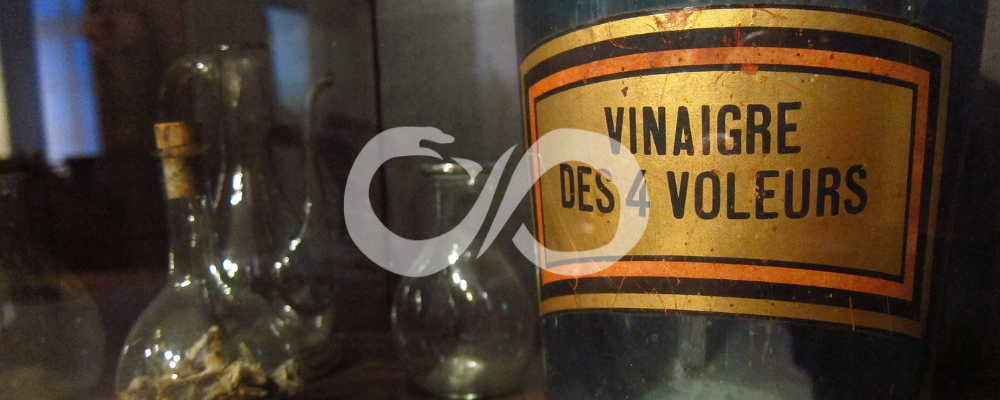
Imagine an era when death lurks in every street, bodies pile up, and simply breathing is cause for concern. Amid this chaos, four men loot houses without ever falling ill. This is not a fable: it is the starting point of a remedy that will endure for centuries. It is called Four Thieves Vinegar.
A Remedy Born in the Terror of Epidemics
It all began in the streets of Toulouse or Marseille, depending on the version. In the 17th century, an epidemic of plague struck the population. Corpses piled up, the sick were isolated, and no one dared approach the bodies... except four thieves. These opportunistic men moved freely through abandoned houses, stripping the dead without ever falling ill. When they were finally captured, they proposed a strange bargain: in exchange for their protective recipe, they asked for a pardon. They explained that they had survived thanks to a vinegar infused with herbs, which they applied to their bodies before every outing. The story captured people’s imagination. It spread quickly, reaching apothecaries, physicians, and herbalists.
But where did this vinegar come from? In fact, similar preparations had already circulated in monasteries and among healers in the 16th century. Four Thieves Vinegar was therefore not an invention of brigands, but a medicinal mixture that would enjoy a far broader destiny than its earliest uses.
An Official Medicinal Mixture of Powerful Herbs
The recipe is not fixed, but certain plants appear in it almost every time. It contains wormwood, sage, rosemary, lavender, rue, garlic, and sometimes camphor or cinnamon. These plants are left to macerate for several days in wine or cider vinegar. The liquid takes on a dark, almost opaque color. Its smell is pungent.
From a medical perspective, each ingredient has specific properties. Some plants repel insects. Others purify the air or surfaces. Garlic acts against bacteria. Vinegar itself plays a role in preservation and disinfection. A recent study from March 2025 confirms that this mixture is indeed effective against pathogens. At the time, it was used to rub the arms, wash floors, sanitize sheets, and even perfume the air in houses. It entered the official codices of French medicine and remained in pharmacopoeias until the end of the 19th century.
A Domestic Use That Became a Ritual
Very quickly, the vinegar left pharmacy shelves to take its place in homes. In the countryside, it was used as a preventive measure against illness, but also during influenza or cholera epidemics. It became both an act of care and an act of protection. People rubbed it on the doorstep, poured it around a sick person’s bed, or added a few drops to rinse water or bathwater.
| Ritual Use | Use | Intended Objective |
|---|---|---|
| Personal protection | A few drops in bathwater or on the threshold | Keep illness and witchcraft at a distance |
| Banishment | Thrown onto the enemy’s doorstep | Create quarrels, drive away an unwanted person |
| Strengthening magical objects | Maceration of needles, nails, or additional herbs | Intensify the aggressive nature of the working |
This gradual blending of medicine and ritual occurred without any sharp break. In many homes, no distinction was made between body and spirit, between illness and what attracted it. The vinegar acted in every direction and on every level. It thus entered the collective memory as a barrier against anything that destroys, weakens, or poisons.
When European knowledge mingled with Afro-descendant traditions in the southern United States, Four Thieves Vinegar found a new life. In Louisiana, it became a basic ingredient in conjure practices and in hoodoo. It was used to drive away harmful influences, protect the home, or harm an enemy. It found its way into ritual bottles, spiritual baths, and banishing spells.
Thus, Four Thieves Vinegar remains a vivid example of the ancient connection between herbs, gestures, and protection.

Par Olivier of Aeternum
Passionate about esoteric traditions and the history of the occult from the earliest civilizations to the 18th century, I share some articles on these topics. I am also co-creator of the online esoteric shop Aeternum.













Oui tres connue mes grands parents le faisaient eux memes
Je me décide à laisser un commentaire pour la première fois, après avoir profité bien des fois de mes lectures sur ce blog.
Je tiens à vous remercier Olivier pour l’excellence de vos articles. Écriture, sujets, documentation…chaque mail m’invitant à découvrir le nouvel article est une occasion de découvrir ou étoffer un sujet de façon complète.
Je vous encourage à éditer vos articles, pourquoi pas sous forme d’encyclopédie, car votre travail est remarquable et mérite d’être mieux connu.
Cliente et lectrice fidèle, je vous remercie.