































































































Jean-Baptiste Alliette, better known as Etteilla, is one of the decisive figures in the history of cartomancy and tarot divination. Born in Paris in 1738 and deceased in 1791, he was a grain merchant, print dealer, author, publisher, teacher, and cartomancer. His importance rests on a simple fact: before him, tarot was primarily a card game. With him, it also became an organized system of divination, equipped with meanings and card-reading methods, and soon with a deck specifically designed for occultist use.
Posterity long divided him between caricature and legend. In the 19th century, Éliphas Lévi turned him into an ignorant former barber; other traditions made him a mysterious initiate entrusted with Egyptian knowledge. Modern research by Thierry Depaulis, Michael Dummett, and Ronald Decker makes it possible to better understand the man behind these images: a Parisian autodidact, entrepreneur in print and divination, bold enough to give the cards a new structure and launch them on a genuine occultist career.
Jean-Baptiste Alliette was born in Paris in 1738
The Bibliothèque nationale de France gives the year 1738, with a question mark regarding the exact date. Thierry Depaulis's research proposes, more precisely, 1 March 1738. Jean-Baptiste Alliette was the second son of a Parisian master roaster who bore the same name.
His youth remains very poorly documented. The recovered documents nevertheless establish that in 1763 he worked as a grain merchant. This activity was far from anecdotal: his mother also worked in the seed trade, so Alliette grew up among Parisian small merchants before entering the world of publishing and divination.
In 1763, Alliette was married to Jeanne Vattier. The couple had at least one child before separating in 1767. The archives recovered by historians make it possible to establish this family context, long absent from occultist accounts devoted to Etteilla.
After this separation, he seems to have changed occupations. From the late 1760s onward, he worked as a print dealer. The BnF documents him in Paris in 1775-1776, notably at rue Froid-Manteau, under the sign of the Golden Lion House.
The name Etteilla is simply the surname Alliette read backwards. This process gives his name a foreign or enigmatic appearance while remaining directly linked to his identity.
The pseudonym gradually becomes more famous than the man who bears it. The books, methods, and derivative decks would subsequently be published under the name Etteilla for decades, to the point that most 19th-century readers sometimes did not know their author's civil name.
1770, the first major milestone in printed cartomancy
In 1770, Etteilla, or a way to entertain oneself with a deck of cards is published. The Bibliothèque nationale de France preserves this edition and several reprints. The book does not yet deal with tarot: it uses a reduced ordinary deck, similar to a piquet deck.
His importance is considerable. Alliette assigns precise meanings to the cards, organizes card spreads, and gives certain cards different values depending on their orientation. Upright and reversed meanings, which have become familiar in modern cartomancy, were already part of his method.
No. Forms of divination by cards existed before him, and historical research shows that a popular practice circulated independently of the major occultist authors. What Etteilla accomplished was different: he transformed this practice into a written, transmissible, and marketable system.
It is therefore more accurate to speak of one of the great founders of modern printed cartomancy than of the absolute inventor of divination by cards. Historian Will Pooley points out that the rise of card reading in France began precisely in the 1770s, with Etteilla’s publications and then the development of the myth of Egyptian tarot.
Etteilla later claims to have learned his system of cartomancy from an Italian and suggests that some of this knowledge may date back to 1751 or 1757. These claims play an important role in the way he presents his authority.
The known archives do not make it possible to follow this Italian initiation step by step. It therefore remains in the most secret area of his biography: the one in which Etteilla himself traces his art back to a transmission older than his books.
Two years after his first manual, Etteilla publishes The Mysterious Zodiac or Etteilla’s Oracles. The BnF preserves several editions of this text. The title already shows that his ambition extends beyond the simple reading of cards.
Astrology, predictions, and symbolic calculations gradually become part of a body of “high sciences” that the author seeks to organize. Etteilla is not content to be a card reader: he wants to construct a general language of divination.
In 1773, Etteilla, or the only way to read the cards is published. The book revisits and develops his earlier system. At this stage, the tarot still does not occupy the central place it will take ten years later.
This chronology is fundamental. Etteilla was already an author of cartomancy works before the publication of Court de Gébelin's theories about tarot. He therefore did not develop his entire practice after 1781. His transformation of tarot into the “Book of Thoth,” however, clearly belongs to the following period. Biographical research places Alliette in Strasbourg between 1777 and 1780, where he continued his work as a print dealer. He then returned to Paris.
This period remains poorly documented. Nevertheless, it shows that his professional career was not limited to that of a seer constantly receiving clients in a Parisian office. He remained connected for a long time to the trade in prints and books, two fields that were crucial to his future tarot.
1781, Court de Gébelin transforms the history of tarot
In 1781, Antoine Court de Gébelin published a now-famous essay in Le Monde primitif. He claimed that tarot was the vestige of an ancient Egyptian book containing wisdom transmitted since antiquity.
This theory is historically false: research on playing cards traces tarot to Renaissance Europe, not pharaonic Egypt. But Court de Gébelin's importance does not lie in the accuracy of his hypothesis. He provides a new way of looking at the deck: the cards become possible fragments of a symbolic book.
Tarot historians generally regard Court de Gébelin and Etteilla as the two founding figures of French occult tarot. The former formulates the idea of an Egyptian origin. The latter transforms this idea into a practical system of divination.
Recent research by Will Pooley emphasizes that their writings together helped popularize the idea of an Egyptian origin for tarot. Etteilla, however, does more than repeat Court de Gébelin: he reorganizes the cards, assigns meanings to them, and constructs a method that a reader can use.
1783, the first printed method of tarot divination
Starting in 1783, Etteilla published Manière de se récréer avec le jeu de cartes nommées tarots. Several booklets appeared through 1785. The BnF preserves these texts and describes them as works directly devoted to tarot.
This series marks a turning point: tarot is no longer interpreted solely symbolically. It becomes an instrument for consultation. Ronald Decker, Thierry Depaulis, and Michael Dummett identify these publications as the earliest known manuals to systematically propose tarot divination.
Etteilla adopted Egyptian vocabulary and spoke of the tarot as the "Book of Thoth." Thoth is the Egyptian god of writing and knowledge, whom Greco-Egyptian traditions would later associate with Hermes.
This identification has no historical basis in the actual origins of the tarot. Yet it became extraordinarily fertile in Western occultism. For more than a century, numerous authors would treat the cards as the remains of an initiatory book from Egypt.
Egypt then represented an antiquity that had to be almost entirely reconstructed. Hieroglyphs would not be deciphered by Champollion until the 19th century. This ignorance left immense room for speculation.
Occultists could therefore project Hermetic, Masonic, or biblical traditions onto Egypt. Court de Gébelin and Etteilla took part in this learned and initiatory Egyptomania, well before Bonaparte's expedition of 1798. In the booklets published up to 1785, Etteilla progressively expanded his tarot. He linked elements, astrology, moral interpretations, and correspondences specific to his system to it.
This is not yet the Kabbalistic network that would be established in the 19th century by Éliphas Lévi and then developed by other occultists. Some correspondences that later became classical belong to much later developments. Etteilla's system is best understood according to its own logic, which predates the great Kabbalistic system that Éliphas Lévi's occultism would develop.
Etteilla does not limit his publications to the tarot. In 1787, The Art of Knowing Men by Inspecting the Forehead, devoted to metoposcopy, and The Art of Reading the Lines and Characters in the Hands, devoted to palmistry, were notably published.
These books confirm his ambition to bring together several divinatory arts. The hand, the forehead, the cards, the stars, and numbers are, for him, systems that make it possible to read invisible correspondences. The BnF also preserves Science. Theoretical and Practical Lessons of the Book of Thoth. Intermediate Classes, published in 1787. The choice of school-related vocabulary is revealing.
Etteilla wants to teach. He divides his knowledge into lessons, classes, and degrees. Cartomancy is no longer merely personal knowledge transmitted orally: it becomes a method that can be learned from books and courses.
1788, the Society of the Interpreters of the Book of Thoth
In 1788, Etteilla organized the Society of Interpreters of the Book of Thoth. Contemporary publications referred to correspondents and interpreters working to decipher the symbolic book that the tarot was supposed to represent.
There, Etteilla served as general correspondent. A publication from 1788 even announced the distribution of handwritten booklets intended for people wishing to participate in this interpretation. This society shows that Etteilla’s tarot was no longer merely an individual commercial practice. He sought to create a community of study around his system.
At the end of the 1780s, Etteilla had a complete deck of 78 cards specifically adapted to his system developed. This was one of his most important innovations.
Earlier tarot decks were initially games intended for playing cards. Etteilla, by contrast, had the order, images, and inscriptions modified so that the deck would function as a divinatory instrument. The cards bear words and indications that directly guide interpretation. Tarot historians regard this deck as the first tarot specifically designed for occult and divinatory use. Decks derived from Etteilla’s retain the general structure of 78 cards and the tarot’s four suits, but they profoundly reorganize several figures and trumps.
Chaos, Light, Plants, the Sky, and the Stars appear at the beginning of the system. The creation of the world and cosmology replace some of the familiar images of the Tarot of Marseille. This transformation explains why later occultists would criticize Etteilla: his deck is not simply an interpretation of the traditional tarot, but a genuine reconstruction.
Around 1789, the deck designed according to his principles began to circulate. The political context makes this date particularly striking: as the Ancien Régime collapsed, Etteilla sought to establish a tradition that he presented as dating back to ancient Egypt.
Etteilla’s tarot would long outlive its creator. Several publishers produced variants of it in the 19th century, and the “Grand Etteilla” became an entire family of divinatory decks.
1790, the New School of Magic
In 1790, the Overview of the New School of Magic Established in Paris on the First of July of the Second Year of French Liberty was published. The document confirms the creation of a public school devoted to his teachings.
The revolutionary vocabulary of the title is revealing. Etteilla does not present himself as a clandestine survivor of the Ancien Régime. On the contrary, he adapts his project to the new political context and speaks of a school established in “French Liberty.”
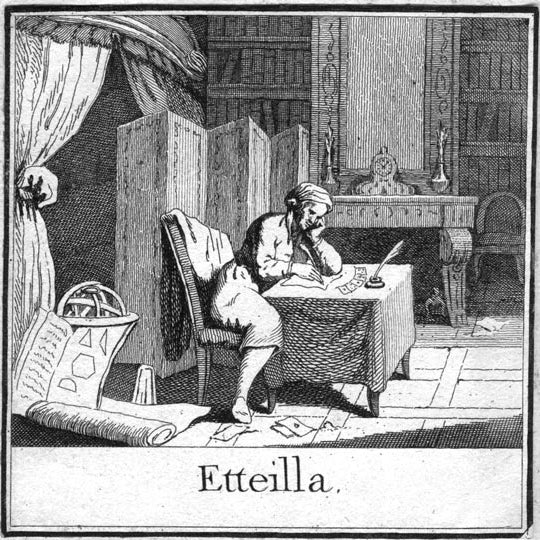
That same year saw the publication of his Theoretical and Practical Course of the Book of Thoth, for Correctly Understanding the Art, Science, and Wisdom of Delivering Oracles. The BnF holds a copy of the work, and an engraving included in this edition depicts Etteilla himself at his worktable.
This image, used today on the cover of this biography, is one of the most direct iconographic testimonies from his era. It shows the author surrounded by books, cards, and objects of study, far removed from the fanciful portraits created much later.
Alliette sometimes uses the title “professor of algebra” for himself. This phrase long intrigued biographers. Nothing indicates that he worked as a mathematics professor at a recognized institution.
The term seems instead to form part of his symbolic vocabulary and his way of giving his system a methodical appearance. Numbers, combinations, and the relationships between cards play an important role in his teaching.
The circles Etteilla frequents are close to esoteric Freemasonry, Hermeticism, and the research societies of the 18th century. He knows their language and engages in dialogue with some of their members.
It is nevertheless risky to attribute a specific Masonic affiliation to him without solid documentation. Accounts that credit him with degrees, secret rites, or an Egyptian initiation must be distinguished from what is actually attested by his works.
Several later authors attribute an Egyptian Masonic rite to him. The documentary evidence is more tenuous than that for the Society of the Interpreters of the Book of Thoth or the New School of Magic, but this tradition shows how strongly his contemporaries and successors perceived his work as a genuine attempt to restore the mysteries of Egypt.
A historical biography should therefore avoid turning this attribution into a certainty. Etteilla's Egyptomania is indisputable; his membership in a specific Masonic rite is much less certain.
Etteilla lives through the early years of the Revolution and attempts to continue publishing under the new political order. In 1791, the BnF notably holds his True National Bourgeois Pension, as well as periodical publications connected to his projects.
He also launches a Prophetic and Patriotic Journal. These texts reveal a lesser-known side: Alliette is not limited to individual prediction and also seeks to intervene in the political and social debates of his time.
Like many prophets and diviners, Etteilla retrospectively claimed credit for certain political predictions. Caution is warranted here. Dated texts make it possible to study his statements, but the tendency to reread an old sentence in light of a later event is common throughout the history of prophecy. His importance does not need to rest on this claim, either. His role in the history of cartomancy is much better documented than his possible prophetic successes.
December 12, 1791, Etteilla's death
Jean-Baptiste Alliette died in Paris on December 12, 1791, at approximately fifty-three years of age. He disappeared as the Revolution entered a phase of radicalization and French society underwent immense upheavals.
His death did not, however, put an end to his system. His students, readers, and publishers continued to circulate his books and decks. The name Etteilla almost became a category of divination cards.
An engraving published in the Cours théorique et pratique du Livre de Thot in 1790 depicts Etteilla seated at a table, his head resting on one hand, with cards and papers in front of him. Volumes fill the bookcases behind him, and several symbolic objects appear in the room.
The image should not be read as an exact photograph of his study, but it belongs directly to Etteilla's publishing world and dates from his lifetime. It is therefore infinitely more relevant as a cover than an invented modern portrait.
Éliphas Lévi and the hairdresser legend
In the middle of the 19th century, Éliphas Lévi attacked Etteilla with a phrase that has remained famous, presenting him as a former hairdresser incapable of writing French correctly. Historical research has not confirmed that he was a hairdresser. Instead, it identifies Alliette as a seed merchant and later a print dealer. Lévi's phrase must therefore be understood as a polemical attack, not as biographical fact.
Lévi developed another model of the occultist tarot. He wanted to find in the twenty-two trumps a structure corresponding to the Hebrew alphabet and the Kabbalah. In his view, Etteilla's reconstruction had altered the order and images of the tarot too extensively.
This conflict heralds an opposition that would run throughout the 19th century: should one work with the traditional images of old tarot decks, or create a deck explicitly designed to express an esoteric doctrine? Etteilla clearly chose the second option.
Papus and other French occultists of the late 19th century would also speak harshly of Etteilla. Yet they worked within a landscape he had largely helped create.
The idea that a tarot could embody a comprehensive esoteric architecture, be discussed in books, taught, and connected to several occult sciences now became self-evident. This was much less the case before Alliette's publications. The great next generation was embodied by Mlle Lenormand. At the beginning of the 19th century, she became the most famous French cartomancer.
It is reasonable to see Etteilla's success as part of the context that made this new professionalization of card reading possible. It would, however, be excessive to claim without evidence that Lenormand simply adopted his system or used his tarot. The cartomantic practices of that period were much more varied.
The Petit Etteilla and later decks
The name Etteilla continued to be used by publishers long after 1791. Simplified manuals and decks bearing this name circulated throughout the 19th century.
The BnF also holds, for example, an illustrated Petit Etteilla or the Art of Reading Cards, published in 1826. The creations directly associated with Jean-Baptiste Alliette subsequently continued in a whole body of publishing that turned his name into a genuine cartomantic lineage.
The decks known as “Grand Etteilla” were reissued and transformed by several manufacturers. The BnF notably holds 19th-century examples described as “Egyptian” divinatory tarot decks.
These decks preserve the fundamental principle established at the end of the 18th century: a tarot designed specifically for readings, with indications to guide interpretation.
Etteilla's importance becomes particularly clear when his work is compared with the ordinary use of cards. Tarot had a long recreational history before him. It did not need an occultist in order to exist.
What Alliette introduced was a new way of reading it. The cards became the pages of a symbolic book, an organized language in which each element had a divinatory meaning. This transformation would have immense consequences for the entire subsequent history of tarot.
The material history of cards places the appearance of tarot in Europe in the 15th century. The connection with the priests of Thoth should therefore not be understood as a continuous documentary genealogy. For Etteilla, it belongs instead to a symbolic lineage: Egypt becomes the name of a primordial wisdom that the images of the tarot could awaken.
But Court de Gébelin and Etteilla’s historical error had considerable cultural power. By making the tarot an Egyptian relic, they gave it a mythical depth that occultists of subsequent generations would continue to explore.
The answer requires nuance. Court de Gébelin preceded Etteilla in interpreting the tarot as an Egyptian esoteric monument. But Etteilla was the first to produce a methodical system of tarot divination and to have a deck created specifically suited to this purpose. He is therefore one of the two historical founders of occultist tarot and the decisive figure in its transition from scholarly speculation to divinatory practice.
A lasting influence on French cartomancy
Will Pooley’s study of French cartomancy shows that Etteilla’s meanings continued to circulate throughout the 19th century in popular manuals. Female cartomancers pursued by the police still used interpretations directly inherited from his system.
This may be where his greatest achievement lies. Beyond his most extravagant Egyptian theories, Etteilla created a practical vocabulary that readers continued to use long after his death.
Part of his discredit came from the occultists who succeeded him. Lévi, Papus, and several other authors preferred to invoke a more prestigious tradition and denounced the reorganizations carried out by the 18th-century cartomancer.
His style, spelling, and social origins also made caricatures easier. Etteilla possessed neither the literary prestige of Court de Gébelin nor that of the great occultist authors of the following century. Tarot historians have nevertheless thoroughly reassessed his place. Once legendary claims are separated from his documented achievements, his role becomes difficult to minimize.
His works should first be read as foundational documents in the history of cartomancy. They make it possible to see, almost in real time, the emergence of techniques that have since become familiar: meanings assigned card by card, upright or reversed orientation, structured spreads, and the creation of a deck specifically designed for divination.
They also bear witness to a particular moment in the 18th century, when Enlightenment scholarship, Hermeticism, the fascination with Egypt, and the print trade converged. Etteilla fully belonged to this hybrid culture.
His work marks the transition between two histories. On the one hand, the history of cards used as games and, more diffusely, as tools for popular divination. On the other, that of the modern occult tarot, interpreted as a complete symbolic system.
Etteilla is the man who transforms this second possibility into a method, books, courses, a study society, and a printed deck. Two centuries later, the fact that a tarot deck is sold directly as a divinatory instrument seems natural. At the end of the 1770s, this assumption did not yet exist in this form.
Sources and references
The Bibliothèque nationale de France identifies Jean-Baptiste Alliette as a cartomancer and print merchant, born around 1738 and deceased in 1791. Its record documents, in particular, his Paris address on rue Froid-Manteau in 1775-1776 and gathers his principal publications from 1770 to 1791.
Thierry Depaulis’s article on Jean-Baptiste Alliette in the Encyclopædia Universalis summarizes the biographical research that established his Parisian birth, his father’s profession as a master roaster, his work as a grain merchant, his marriage to Jeanne Vattier, and his later move into the print trade.
The book by Ronald Decker, Thierry Depaulis, and Michael Dummett, A Wicked Pack of Cards: The Origins of the Occult Tarot, remains a major reference for understanding the chronology of its publications, the Société des Interprètes du Livre de Thot, and the creation of the first tarot specifically intended for occultism.
Will Pooley’s study, “Paper tools for broken hearts: fortune-telling with cards in France, c. 1803–1937”, published in French History, places Etteilla and Court de Gébelin in the emergence of the French vogue for divinatory tarot and demonstrates the persistence of Etteillian meanings in popular cartomancy in the 19th century.
The cover uses the authentic engraving depicting Etteilla at his work table, published in his Cours théorique et pratique du Livre de Thot in 1790. The engraver is unidentified, and the image is in the public domain.

Par Olivier of Aeternum
Passionate about esoteric traditions and the history of the occult from the earliest civilizations to the 18th century, I share some articles on these topics. I am also co-creator of the online esoteric shop Aeternum.