






























































































Franz Bardon, whose Czech name was František Bardon, holds a singular place in 20th-century European occultism. Born on December 1, 1909, in Kateřinky, now a district of Opava, and deceased on July 10, 1958, in Brno, he was successively a skilled worker, variety artist, healer, author, and teacher of Hermetic magic. His reputation rests chiefly on three works published between 1956 and 1957, in which he proposes a methodical progression based on mastery of attention, the balancing of the four elements, work on the body, soul, and spirit, and then evocation and operative “Quabbalah.”
The difficulty - and part of Bardon’s appeal - lies in the superimposition of several narratives. A biographical core is preserved in Czech notices and editions of his books; around it, a Bardonian tradition developed, attributing extraordinary faculties, secret missions, and occult confrontations to him. Rather than erasing this second layer, it should be read as the initiatory memory of a master whose influence far exceeded the administrative records.
František Bardon, a Child of Austro-Hungarian Silesia
František Bardon was born on December 1, 1909, in Kateřinky, then Katherein, near Troppau in Austrian Silesia. The city is now called Opava, in the Czech Republic. The biographical notice published by the municipality of Opava presents him as the eldest son of Viktor Bardon and Ludvika Bardonová, née Herudková. His father worked as a tinsmith in a local jute factory. The couple would have a large family in a territory whose political and cultural identity would be transformed by the disappearance of the Austro-Hungarian Empire at the end of the First World War.
This background matters for understanding Bardon. He grew up in a border region where German and Czech languages, Catholicism, working-class culture, German-speaking occultism, and the Czech esoteric revival intersected. When he published his major books in the 1950s, he wrote in German and was read throughout the German-speaking world before becoming an international reference.
The available Czech sources do not describe Bardon as an academic or a qualified physician. The municipality of Opava states that he learned the trade of repairing sewing machines at the Minerva company. The Czech Academy of Sciences’ Religionistická encyklopedie likewise presents him as a trained locksmith.
This point helps correct an image frequently repeated in later biographies, in which Bardon appears as a “doctor” or medical specialist in the academic sense. He did work as a healer and prepared remedies, but this does not justify attributing university medical training to him without additional documentation.
The interwar Czech Hermetic milieu
Interwar Czechoslovakia had a particularly active esoteric milieu. Authors such as Karel Weinfurter popularized yoga, magic, esoteric Christianity, and initiatory traditions among Czech readers. The notice from the Czech Academy of Sciences indicates that Bardon was first influenced by Weinfurter before moving closer to the ideas of Friedrich Wilhelm Quintscher.
This documented context sheds light on the soil in which Bardon took root, without exhausting the tradition that presents him as the heir to an older initiatory chain. He read and worked in an environment already rich in translations, societies, journals, and occult teachings; his later work drew on this world while claiming to transmit something older and more universal.
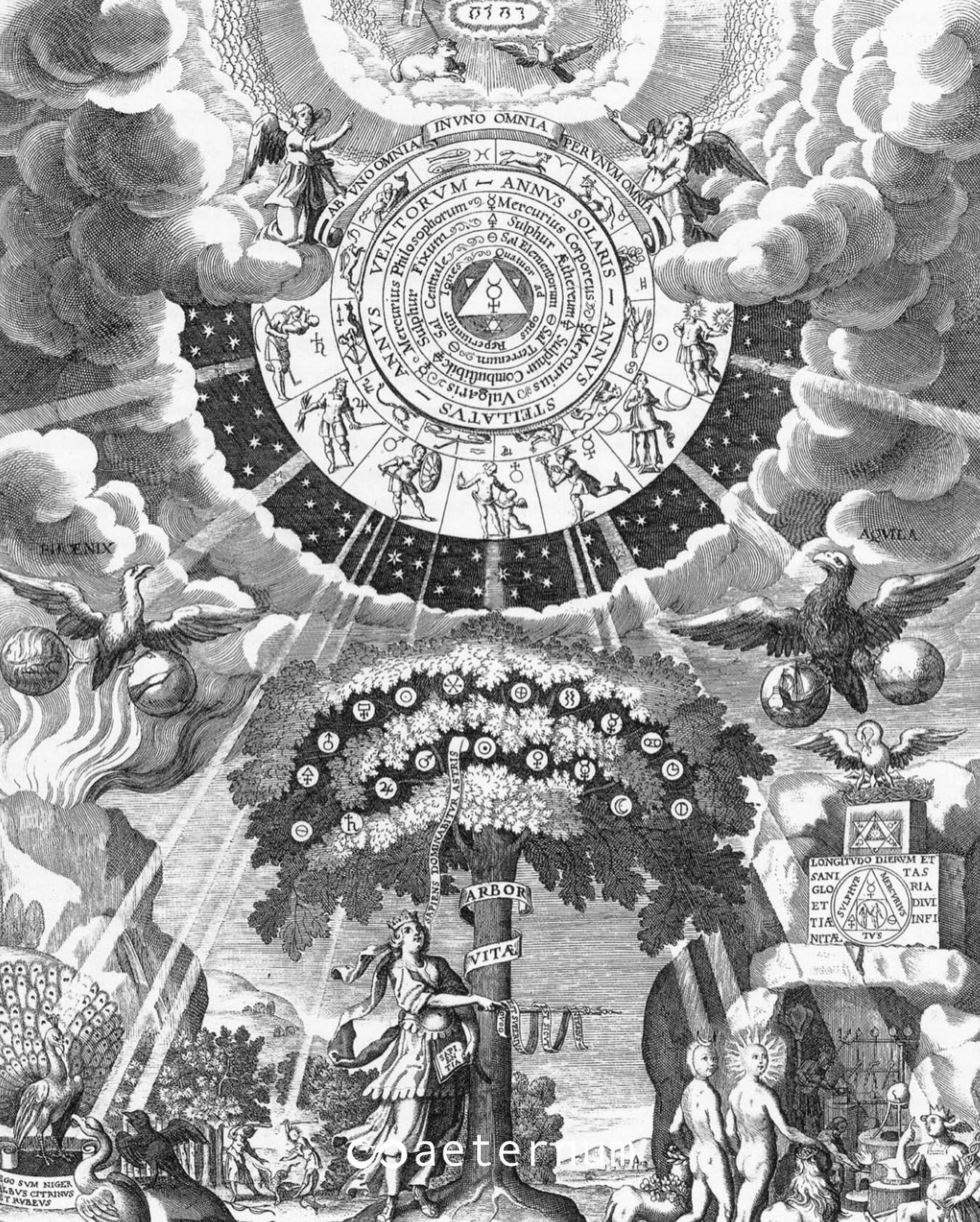
To place this vocabulary within a longer history, our article devoted to Hermeticism examines the texts attributed to Hermes Trismegistus and their successive transformations. Bardon's “Hermeticism” cannot be equated with the ancient Corpus Hermeticum alone: it belongs to a modern occultism that brings together several legacies.
Friedrich Wilhelm Quintscher, a German occultist born in 1893, is one of the most important figures for understanding Bardon's formation. Quintscher published practical magic texts under several pseudonyms and frequented the circles of the Fraternitas Saturni and Adonism. The Religionistická encyklopedie states that Bardon trained as a magician under his influence.
The exact nature of their relationship has nevertheless been debated in Bardonian circles. Bardon's editors and disciples rejected the idea that he had simply adopted Quintscher's system, while other researchers have noted similarities in vocabulary and method. It is more prudent to acknowledge contacts and influence within the German-speaking magical milieu, without reducing Bardon to an imitator or presenting his system as entirely detached from its predecessors.
Frabato, the variety performer
From the 1920s onward, Bardon performed under the name Frabato. Czech notices describe a variety performer whose acts were close to stage magic. The Bardonian tradition generally explains “Frabato” as a contraction of Franz Bardon, Troppau, and Opava. This etymology is plausible and widely repeated, but it comes from the account handed down around the author rather than from an administrative record.
The character of Frabato is crucial because it explains the public image Bardon would construct before his books. He did not present himself merely as a theoretician. His lectures and demonstrations sought to show that training the mind could produce perceptible effects. Later testimonies attributed clairvoyance, mind reading, remote diagnosis, and other abilities to him. These accounts belong to the memory of his students and associates; not all of them have independent verification allowing them to be treated as established facts.
The literature devoted to Bardon attributed to him, from an early stage, the extraordinary destiny of an “adept.” Some accounts say that a high spiritual entity took possession of his body during his adolescence; others claim that he was an incarnation of Hermes Trismegistus. These accounts played a considerable role in the reception of his work, but they belong to an initiatory interpretation transmitted by his disciples.
They should not be confused with established biographical facts. Bardon can be studied as a major occultist without having to determine historically whether these supernatural claims are true. This distinction instead makes it possible to better understand the formation of a master figure in 20th-century esotericism.
The war and imprisonment from 1941 onward
The Second World War marked a major rupture. The Religionistická encyklopedie states that Bardon was imprisoned in a concentration camp from 1941 onward. Several later works repeat this information. However, versions claiming that Adolf Hitler personally wanted to use his powers, that Bardon refused a magical position serving the Reich, or that he escaped execution at the last moment thanks to a bombing are based mainly on hagiographic tradition.
Caution is therefore necessary. Bardon's imprisonment under the Nazi regime is part of his biographical record. The dramatic scenarios grafted onto this episode would require independent archival evidence before being presented as certainties.
After the war, Bardon returned to Czechoslovakia and resumed working as a healer and herbalist. The official Opava notice describes him as a writer, graphologist, astrologer, clairvoyant, mage, and healer. He received people, prepared remedies, and continued teaching esotericism alongside this work.
The boundary between folk healing, herbalism, and medical practice was particularly sensitive in postwar Czechoslovakia. Bardon did not have the status of a hospital physician. He worked in a private setting, which would later contribute to the difficulties he encountered with the communist authorities.
What distinguishes Bardon from many occultist authors of his time is the pedagogical form of his work. He does not merely construct a cosmology. He arranges his teaching into successive exercises and asks the reader not to skip steps. The general principle is simple: the practitioner must attain mastery over themselves before seeking to act upon external forces or entities.
This priority given to inner discipline explains much of his lasting influence. The reader does not enter a system composed solely of symbols and correspondences. They find exercises in concentration, observation of thoughts, breathing, visualization, elemental work, and introspection. Bardon presents magic as an art that requires repetition, balance, and control.
1956, Der Weg zum wahren Adepten
In 1956, Der Weg zum wahren Adepten, literally “The Path to the True Adept,” was published in Freiburg im Breisgau by Hermann Bauer. The book is now known in French under several titles, including Le Chemin de la véritable initiation magique. Its German subtitle clearly announces the project: a ten-degree course, theory and practice.
The first book constitutes the gateway to the entire Bardonian system. Each degree combines mental, psychic, and physical work. The goal is not to accumulate extraordinary phenomena but to achieve a balanced inner structure. The student must learn to observe their thoughts, develop concentration, compile an inventory of their character, and work on the qualities attributed to the four elements.
One of Bardon’s best-known exercises consists of compiling two inventories of oneself: one devoted to faults, the other to qualities. The author then organizes them according to the four elements. Fire receives certain traits related to impulse and will, air those associated with intellectual movement, water emotional dispositions, and earth tendencies toward fixation and stability.
This classification is not a scientific psychology. It belongs to Bardon’s symbolic language. Its function is practical: to force the student to examine their own character before proceeding to more ambitious operations. In the Bardonian system, anyone who seeks power without inner balance risks amplifying their own disorders.
The Four Elements and Akasha
Fire, air, water, and earth structure Bardon’s entire cosmology. He associates them with qualities, temperaments, bodily functions, and forces of nature. These four principles are joined by Akasha, a term borrowed from Indian vocabulary and reinterpreted as the causal principle or higher source of the elements.
Bardon also uses the concepts of an “electric fluid” and a “magnetic fluid.” These expressions do not correspond to the electricity and magnetism described by physics. They designate two occult polarities, one active and expansive, the other attractive and receptive. Their balance forms what he calls “quadripolar magnetism.”
Bardon's system describes the human being on three levels: physical, astral, and mental. The material body belongs to the physical plane; the soul or astral body encompasses elemental and emotional qualities; the spirit corresponds to mental consciousness. Training must act on all three levels without allowing any one of them to develop at the expense of the others.
This vocabulary belongs to modern European occultism and intersects with Theosophy, ceremonial magic, Western yoga, and older legacies. It does not correspond to an anatomy recognized by contemporary medicine. For Bardon, however, it is an operative framework intended to organize magical experience.
The progression of the books is not arbitrary. Bardon considers that evoking entities has meaning only after a long period of preparation. A mage unable to govern his thoughts, emotions, and impulses would remain vulnerable to his own projections or to the influences he seeks to contact.
This idea connects Bardon with a long tradition of learned magic in which purification and preparation precede operations. This requirement appears in different forms in the work of Cornelius Agrippa and John Dee, even though their religious and ritual frameworks are not those of Bardon.
1956, Die Praxis der magischen Evokation
That same year, Die Praxis der magischen Evokation was published, devoted to magical evocation. The book explains the use of the circle, triangle, lamp, mirror, wand, sword, ritual clothing, seals, and other instruments. Bardon nevertheless insists on one point: the material object is never sufficient. Its value depends on the preparation and inner authority of the person who uses it.
The second part of the work presents a vast hierarchy of intelligences and entities associated with the elements, the area surrounding Earth, and the planetary spheres. Names, functions, and seals are given for numerous entities. This catalogue has strongly influenced contemporary evocation magic, as it provides a much more developed system than those found in many 20th-century manuals.
For Bardon, the circle is not merely a protective barrier. It represents the state of wholeness and divine authority that the operator must realize inwardly. The magician therefore commands not because he possesses a particular geometric design, but because he ritually identifies with a higher principle.
This conception distinguishes his approach from a purely mechanical reading of grimoires. The instruments serve as supports for an already developed consciousness. Without preparation, the symbol remains inert. This idea runs throughout his work.
1957, Der Schlüssel zur wahren Quabbalah
In 1957, the third volume, Der Schlüssel zur wahren Quabbalah, was published, also by Hermann Bauer. The word “Quabbalah,” with this spelling, refers in Bardon to a magical discipline based on letters, sounds, colors, and elemental qualities.
This system should not be confused with the history of Jewish Kabbalah. Bardon borrows a term already extensively transformed by Christian occultism and European magical traditions. His “Quabbalah” is above all operative: letters and sounds are associated with colors, elements, regions of the body, and states of consciousness. The aim is to learn to produce what he describes as a creative word.
In the third book, the letter is not merely a written sign. For Bardon, it has a sonic, visual, and elemental quality. The student learns to “charge” it through color, sound, and sensation, then to combine several letters into formulas.
This method gives his system a highly recognizable character. Bardonian magic does not seek to reproduce Renaissance rituals word for word. It reconstructs a modern initiatory language from correspondences and progressive exercises.
“Fluid condensers” are among Bardon's most characteristic techniques. He uses this term for substances or media intended to receive and retain an occult charge. Herbal preparations, liquids, metals, or certain objects can become, in his system, receptacles for the forces he describes.
The term should not be understood in the sense of modern physics. Bardon's “fluid” belongs to the vocabulary of magnetism and occultism. What interests him is the symbolic and material capacity of a medium to fix an intention or an elemental quality. The condenser then serves as an intermediary between the inner exercise and the material operation.
Bardon did not organize his teachings as a system of grades dependent on a particular lodge. His books are designed to enable individual practice. This characteristic explains their circulation after his death: an isolated reader can theoretically follow the exercises without belonging to the Golden Dawn, the Fraternitas Saturni, or a Rosicrucian society.
This does not mean that Bardon was entirely uninfluenced. His language clearly belongs to the esoteric culture of his time. But he transformed these materials into an autonomous curriculum, which encouraged the emergence of informal Bardonian groups rather than a centralized international organization.
Otti Votavová and the transmission of the texts
Otti Votavová plays a major role in Bardon’s posthumous legacy. She was close to him and helped shape materials that would circulate after his death. Her name is particularly associated with Frabato the Magician, a work published in 1979.
The book was long read as an occult autobiography. Yet this interpretation requires great caution. Later publishing information and the testimony of the publisher Dieter Rüggeberg show that Votavová played a substantial role in its writing and fictional construction. Frabato can therefore shed light on the Bardonian legend and certain traditions of his circle, but it should not be used as a factual chronicle of Bardon’s life.
The novel depicts a malevolent occult society, magical confrontations, and a hero endowed with exceptional powers. This framework largely shaped Bardon’s popular image. It reinforces the idea of a mage engaged in a secret struggle against dangerous organizations.
Nothing requires us to reject the symbolic or initiatory value of the account in order to recognize that it is a literary work. Historical biography must therefore distinguish the documented Bardon from the fictional Frabato.
The publishing tradition mentions a fourth work, Das goldene Buch der Weisheit, “The Golden Book of Wisdom.” It was intended to continue the cycle devoted to the arcana of the Tarot and complete the three published volumes. Fragments and answers attributed to Bardon circulated after his death.
According to accounts passed down by those close to him and by his publishers, materials related to this project were allegedly seized during his arrest in 1958 and were never returned. In the absence of complete accessible archives, it is preferable to speak of an unfinished project and a lost-manuscript tradition rather than reconstructing the contents of a book whose completed version we do not possess.
After 1948, Bardon lived under a communist regime unfavorable to independent religious activities, occultism, and healing practices carried out outside official structures. The Religionistická encyklopedie states that he was questioned several times during the 1950s. His last case was reportedly connected to the production of remedies in a private laboratory.
This information helps explain his arrest without resorting to later accounts in which Soviet agencies supposedly sought to seize his powers. These versions circulate widely in literature devoted to Bardon, but they are not supported by the same level of documentation.
The 1958 arrest
In 1958, Bardon was arrested and detained in Brno again. The precise circumstances of the proceedings remain difficult to reconstruct from readily accessible sources, but Czech biographical notices regularly cite his healing activities and the private preparation of medicines.
He died during this detention. The Religionistická encyklopedie places his death on July 10, 1958, in Brno and specifies that he died in the prison hospital. Bardonian publications give pancreatitis as the cause of death. Accounts of poisoning, voluntary suicide, or KGB involvement belong to much later and far less reliable literature.
One fact deserves emphasis: the three books that made Bardon a worldwide figure appeared only during the last two years of his life. Der Weg zum wahren Adepten and Die Praxis der magischen Evokation date from 1956; Der Schlüssel zur wahren Quabbalah from 1957. Bardon died in 1958.
His career as a published author was therefore very short in view of his influence. International dissemination occurred mainly after his death, through reprints and translations into English, French, Spanish, and many other languages.
Bardon’s success is largely due to his pedagogical structure. His works give the reader the impression of a complete path, from the first concentration exercises to evocation operations and magical letters. The system has a strong internal logic and does not depend on inaccessible oral instruction.
It also responds to a need specific to the 20th century: to have a form of magic structured as a training method. Whereas some grimoires already presuppose a body of religious or ritual knowledge, Bardon attempts to reconstruct a progression from the beginning.
Not in the strict sense. Ancient Hermeticism is linked to the Greco-Egyptian texts attributed to Hermes Trismegistus, composed during the Roman era. Bardon uses the word “hermetic” in its modern occultist sense. His system brings together the four elements, Akasha, evocation magic, Westernized Kabbalah, yoga, magnetism, and the theory of the planes.
It therefore belongs to the modern history of Western Hermeticism rather than to a direct and unchanged transmission of the Alexandrian texts. This distinction does not detract from the coherence of his work; it simply allows it to be properly situated in the history of ideas.
The comparison with the Golden Dawn makes it possible to assess Bardon’s originality. The British order uses grades, temple rituals, astrological correspondences, Hebrew, the Tarot, and a collective organization. Bardon greatly reduces this institutional dimension and concentrates the work on personal exercises.
The two traditions share a taste for the four elements, ceremonial magic, and Western Kabbalah, but they must not be confused. Bardon does not simply take up the Golden Dawn curriculum under another name.
In his books, Bardon repeatedly states that the development of faculties must remain subordinate to moral and psychic balance. Magic is not measured by the number of phenomena produced but by self-mastery. This idea explains his distrust of shortcuts, pacts, and the immediate pursuit of powers.
The modern reader may not share his cosmology while still recognizing the consistency of this demand. Bardon rejects the model of power obtained without personal transformation. Every external operation must be preceded by inner work.
Bardon uses words such as fluid, magnetism, vibration, and condensation, but his system should not be presented as a forgotten branch of physics. These terms belong to an occultist language inherited from 19th-century magnetism and transformed by the esoteric schools of the 20th century.
His exercises can be approached as practices of concentration, directed imagination, and bodily discipline, but Bardon places them within a much broader occult reality. The Akasha, subtle bodies, and planetary entities are not mere metaphors for him: they belong to an operative cosmology that the student is invited to experience progressively through practice.
An Influence That Extends Beyond Czechoslovakia
The Religionistická encyklopedie notes that Bardon became more famous abroad than in his own country. His books gave rise to groups of readers in Germany and elsewhere, without creating a church or a centralized order.
This international dissemination continues into the 21st century. Authors such as Rawn Clark, William Mistele, and Martin Faulks have published commentaries devoted to his exercises. Successive editions of his three books have kept his name alive in contemporary ceremonial magic.
It is useful to read Bardon on three levels. The first is historical: his books bear witness to a time when Central European occultism sought to transform ancient traditions into individual methods. The second is doctrinal: his cosmology of the elements, the Akasha, fluids, and planes constitutes a coherent system that deserves to be studied on its own terms. The third is practical: his exercises explain why his work continued to circulate long after 1958.
This reading nevertheless benefits from setting hagiography aside. The powers attributed to Bardon, the stories concerning Hitler, the Soviet services, or a supernatural identity should not be used as a biographical shortcut. The documented man is remarkable enough: a Silesian worker who became a variety artist, healer, and author of three manuals that left a lasting mark on Western magic.
Bardon’s legacy rests less on an organization than on a method. He proposed a progressive form of magic in which concentration, character, imagination, and symbolism must be developed before evocation. He gave a modern pedagogical form to a body of themes inherited from European occultism and reinterpreted Eastern traditions.
His work also remains a useful example of how esoteric authority was constructed in the 20th century. Around a few solid biographical facts have accumulated memories, disciples’ accounts, novels, and initiatory traditions. Distinguishing between them does not diminish Bardon; on the contrary, it makes it possible to understand what he actually transmitted and why his three books continue to be read.
Sources and key points
The František Bardon entry in the Religionistická encyklopedie, published under the auspices of the Czech Academy of Sciences, provides the main information about his birth, training as a locksmith, career as a variety artist, the influence of Karel Weinfurter and Friedrich Wilhelm Quintscher, his imprisonment from 1941 onward, the investigations of the 1950s, and his death in Brno on July 10, 1958.
The biographical profile by the city of Opava documents his family background, his training at the Minerva company, and several aspects of his local activities. Bibliographic catalogs confirm the German editions of his works: Der Weg zum wahren Adepten and Die Praxis der magischen Evokation in 1956, followed by Der Schlüssel zur wahren Quabbalah in 1957, published by Hermann Bauer.
The portrait used on the cover is an authentic photograph of Franz Bardon dating from around 1948. Its author is unknown, and Wikimedia Commons classifies it as being in the public domain in Europe as an anonymous work.

Par Olivier of Aeternum
Passionate about esoteric traditions and the history of the occult from the earliest civilizations to the 18th century, I share some articles on these topics. I am also co-creator of the online esoteric shop Aeternum.