



















































































































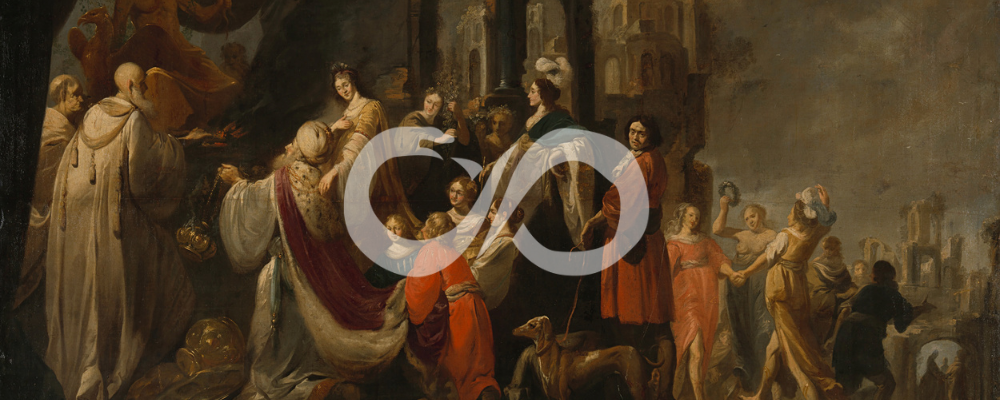
If there is one work to know in magic, it is certainly the Key of Solomon, (or Clavicula Salomonis, its original title). This collection of 120 to 130 manuscripts is attributed to King Solomon, renowned for his wisdom and magical abilities. These texts, whose origins date back to the Middle Ages, compile a series of rituals, incantations, magical formulas, and pentacles created to invoke spirits, command supernatural forces, and obtain various magical effects. The impact of the Key of Solomon on magic is considerable, as it influenced a large part of the Western magical tradition and is considered the reference text for many occultists and magicians, particularly those who practice talismanic magic. An introduction.
1. Who is King Solomon?
King Solomon is a biblical figure, widely recognized for his prosperous reign over the kingdom of Israel in the 10th century BCE. The son of King David and Bathsheba, Solomon was the third king of Israel, succeeding his father. His reign is often described as Israel's golden age, marked by peace, prosperity, and remarkable architectural achievements, the most famous being the construction of the First Temple in Jerusalem, which became the spiritual center of the Jewish people.
In the Bible, Solomon is praised for his great wisdom. One of the most famous stories concerning this wisdom is Solomon's judgment, in which he settles a dispute between two women claiming to be the mother of the same child by proposing to divide the child in two, thereby revealing the true mother through her reaction.

Beyond his wisdom and his role as a builder, Solomon is also surrounded by a mystical and esoteric aura. According to Jewish, Christian, and Islamic traditions, Solomon possessed occult knowledge that had been transmitted to him by God himself. For example, he was able to communicate with spirits and animals, and even command demons. This mastery of the mystical arts is often associated with the famous Seal of Solomon, a magical ring that, according to legend, granted him these supernatural powers.
2. The Seal of Solomon
Also called the Star of Solomon, it is represented as a six-pointed star (hexagram), consisting of two interlaced equilateral triangles. According to legend, this seal was engraved on a ring worn by Solomon, allowing him to control these supernatural entities and perform magical acts. It is notably described in the Testament of Solomon, in which Solomon uses the seal to enslave demons and compel them to build the Temple of Jerusalem.
It is said that the ring is in King Solomon's tomb, whose location remains unknown (or has been lost forever).
3. Origins between myth and reality
Although these stories are largely mythical, the Key of Solomon is first mentioned in medieval texts, particularly from the 12th century onward, a period during which these manuscripts appear as collections of codified magical practices. According to esoteric tradition, Solomon is said to have compiled these grimoires to pass on his knowledge to his successors or descendants.

There are in fact several versions of the Key of Solomon, each stemming from different traditional and linguistic interpretations. Among the best known are the Latin, Hebrew, and Italian versions, with each manuscript presenting variations in the content of the rituals and pentacles. The Latin version, which is believed to have been compiled around the 13th or 14th century, was widely circulated in Europe. These differences between the versions can be explained by the adaptations made by copyists and occultists over the centuries, who often incorporated local elements of magic and occultism, thereby modifying the original to adapt it to their own cultural and spiritual context.
It is also important to know that this collection is part of a broader work devoted to magic. While the Key of Solomon focuses on ceremonial magic and the invocation of spirits, there is also the Testament of Solomon (more narrative, concerning demonology and the way Solomon enslaved demons to perform earthly tasks) and The Lesser Key of Solomon (a later compilation, more focused on demonic magic, particularly through the book Goetia).
4. The structure and content of the work
The Key of Solomon is presented as a practical manual of talismanic magic, structured into several sections or books, each dealing with different aspects of magic and occult practices. Although versions of the text may vary, most manuscripts are generally organized into two main books:
-
Book I (generally divided into two parts) is devoted to the preparations necessary for performing magical rituals. It describes in detail the various stages of the magician's purification, the creation of ritual tools (such as swords, planetary pentacles, and incense), and the conditions to be observed for magical operations to be effective. This book also addresses the creation and consecration of magic circles, which serve as protection against the forces invoked.
-
Book II, meanwhile, focuses on invocations and magical formulas proper. It contains precise instructions on how to invoke, constrain, and banish spirits, whether angelic or demonic. This book also includes a series of pentacles, each associated with specific spirits or particular objectives, such as protection, wealth, or healing.
5. Astrology and planetary magic
If you plan to study this work, you will notice that most of the seals are linked to the planets. Indeed, in the Middle Ages and the Renaissance, astrology was considered a sacred science that revealed the influence of celestial bodies on earthly life. Each planet governs certain aspects of human life, emotions, events, and even spiritual forces. The planets were thus perceived as mediators between the divine world and the earthly world, and their influence was considered decisive in the practice of magic.
The Key of Solomon thus presents 44 seals, pentacles (or, more precisely, pentacles) linked to a specific planet.
6. Famous talismans
Sometimes the seals in this work are directly associated with demons. Although part of it is indeed associated with Goetia, it is not a collection of evil talismans, but rather of seals intended to help achieve an intention.
6.1. The First Pentacle of Saturn

The First Pentacle of Saturn is one of the most powerful pentacles in the Key of Solomon. This pentacle is engraved with a central hexagram surrounded by divine names, including "YHVH" (the sacred Tetragrammaton) and "Adonai". This pentacle is designed to protect against dangers and repel malevolent spirits. Saturn is often associated with protection and stability, so this pentacle is used to strengthen the practitioner's spiritual security.
6.2. The Pentacle of Mars
The Pentacle of Mars is another important talisman. It is used to invoke the power of Mars, the Roman god of war, and to grant the wearer strength, courage, and protection in conflicts. This pentacle is engraved with symbols of Mars, as well as divine names, and is often used in rituals intended to defeat enemies or overcome major obstacles.
6.3. The Seal of Solomon

As mentioned above, the Seal of Solomon (the hexagram) often appears on the pentacles and talismans of the Key of Solomon. It is used as a symbol of power and control over spirits, and it frequently appears in magic circles drawn on the ground during rituals.
6.4. The Magic Circle

The magic circle as used today as a protective circle was not created by Solomon, but the Key of Solomon extensively codified it. It is traditionally drawn on the ground with sacred symbols, names, or sigils, forming a protective barrier between the magician and the forces invoked.
6.5. The Third Pentacle of the Sun
The Third Pentacle of the Sun is used to obtain royal favors, glory, and fortune. It is associated with solar power and is engraved with sacred names, as well as solar symbols. This pentacle is often used in rituals intended to attract public recognition and succeed in ambitious endeavors.
7. Where does the current translation of the Key of Solomon come from?
The Key of Solomon began circulating in manuscript form during the Middle Ages. At that time, the texts were copied by hand by monks, scribes, and scholars. These copies were primarily in Latin, although Hebrew and Italian versions also exist. The manuscripts were often modified, supplemented, or reorganized by those who copied them, which led to the existence of multiple versions of the text.
One of the names most closely associated with the modern translation and dissemination of the Key of Solomon is Samuel Liddell MacGregor Mathers, a British occultist. Mathers is best known for his role in founding the Hermetic Order of the Golden Dawn, a secret (but famous) society dedicated to the study of occultism.
In 1889, Mathers published an English translation of the Key of Solomon under the title The Key of Solomon the King. This version, based on several Latin and French manuscripts, was one of the first translations to make the text accessible to an English-speaking audience. Although Mathers sometimes reinterpreted or added certain elements to align the text with the teachings of the Golden Dawn, his translation remained an important reference for occultists.
It should be noted, however, that studies and analyses are still being conducted to interpret or update this text as closely as possible to its origins.
And that concludes this introduction to a major text for everyone interested in roots and foundational texts. I hope this article has made you want to explore these famous seals, talismans, and pentacles in greater depth!
From the Key of Solomon to texts and pentacles
To explore the sources further, see the Grimoires & Parchments. For Solomonic figures to wear or place on your altar, browse the Talismans and the Ritual Seals & Sigils collection.

Par Olivier of Aeternum
Passionate about esoteric traditions and the history of the occult from the earliest civilizations to the 18th century, I share some articles on these topics. I am also co-creator of the online esoteric shop Aeternum.













J’ai vraiment adoré