
















































































































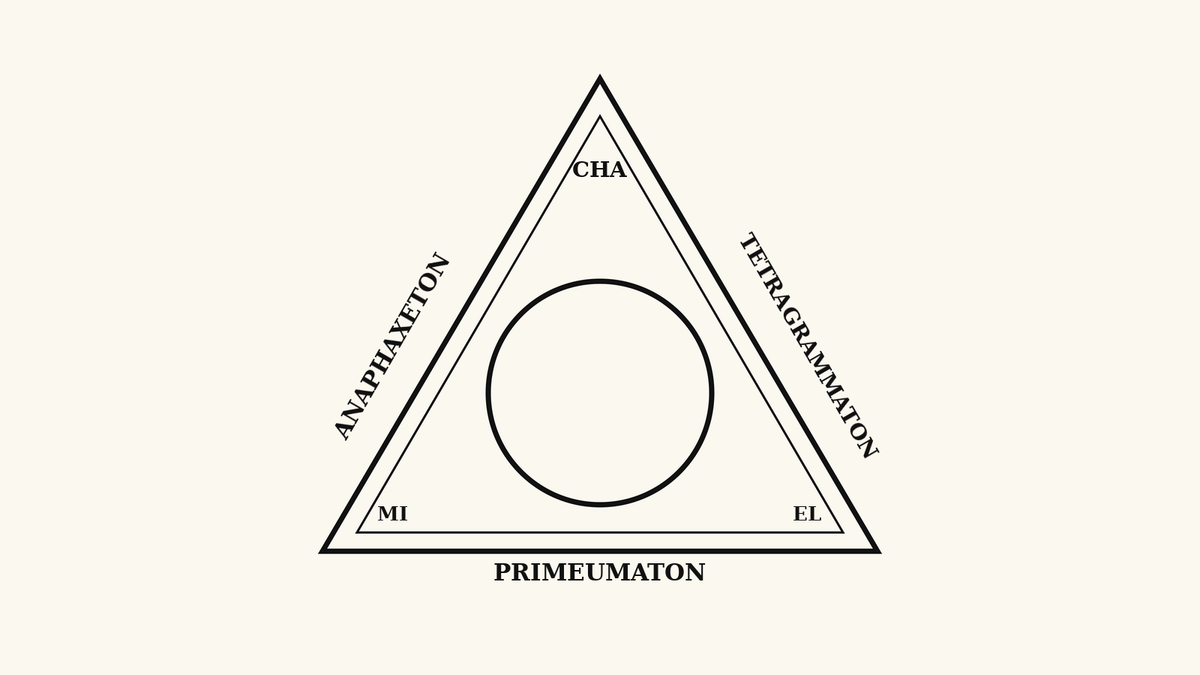
The Triangle of Art is a diagram from the Ars Goetia placed outside the Circle of Solomon. The manuscript tradition gives it a triangular form surrounded by sacred names and places the name Michael in its central section. The triangle belongs to a precise ritual geography: the circle defines the operator’s position, while the triangle represents the space assigned to the spirit’s manifestation.
| Manuscripts | What is the source of the Triangle of Art? |
|---|---|
| Geometry | Why use a triangle? |
| Names | What is found around the figure? |
| Circle | How do the triangle and circle work together? |
| Reception | How did the diagram become a Goetic standard? |
What is the source of the Triangle of Art?
The diagram is transmitted with the Ars Goetia in the manuscripts of the Lemegeton. Peterson reproduces the design and compares its inscriptions in several British Library witnesses.
It is not an ancient symbol that can historically be attributed to King Solomon, but a figure from modern European Solomonic magic.
Why use a triangle?
Triangular geometry has a long history in learned magic and Christian theology. In the Goetia, it primarily serves to create a space distinct from the circle.
The triangle should therefore not be explained solely through a modern formula of “manifestation”: its meaning comes from its place within the manuscript’s overall arrangement.
What is found around the figure?
Manuscript variants give the forms of the names Anephezeton, Tetragrammaton, and Primeumaton, while Michael appears in the center.
The spellings change from one witness to another, a common characteristic of names transmitted in magical manuscripts.
How do the triangle and circle work together?
The Circle of Solomon forms an enclosure around the operator. The triangle is drawn outside it and represents a separate space.
The circle-triangle pair thus became one of the most recognizable compositions in Goetic magic.
How did the diagram become a Goetic standard?
Printed editions from the late nineteenth and early twentieth centuries widely disseminated the design among English-speaking occultists.
Contemporary reproductions frequently use the Mathers-Crowley version, but studying the manuscripts reveals variations in names, proportions, and details.
Sources and historical reference points
The Lemegeton edited by Joseph H. Peterson reproduces the Triangle of Art and the variants found in Sloane 3825, 3648, 2731, and other witnesses.










