



















































































































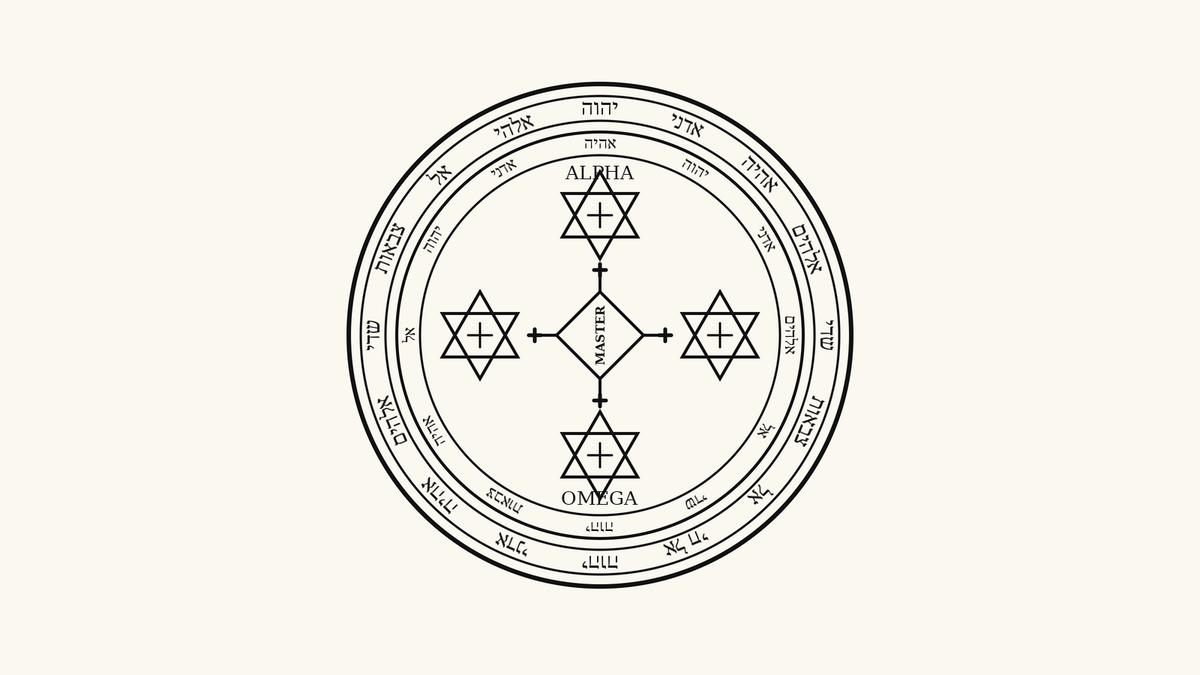
The Circle of Solomon from the Ars Goetia is one of the most recognizable diagrams in Western ceremonial magic. It consists of concentric circles inscribed with divine and planetary names, complemented by pentagrams and sacred characters. The version transmitted in the Lemegeton manuscripts in the 17th century is not a “universal magic circle”: it belongs to a specific Solomonic tradition and has several manuscript variants.
| Manuscripts | Where does the Circle of Solomon come from? |
|---|---|
| Names | Why is the circle filled with sacred names? |
| Planets | What role do the planetary spheres play? |
| Protection | Why is the space enclosed around the operator? |
| Variants | Why are several designs in circulation? |
Where does the Circle of Solomon come from?
The Lemegeton, or Lesser Key of Solomon, is known through several seventeenth-century English manuscripts. Joseph H. Peterson’s edition primarily follows British Library Sloane 3825 and compares variants from other witnesses.
The circle belongs to the first part, the Ars Goetia, devoted to the seventy-two spirits and the ceremonial apparatus surrounding their summoning.
Why is the circle filled with sacred names?
The names arranged around the perimeter refer to God, the Sephiroth, angels, and celestial correspondences. The design thus creates an enclosure based on a religious and cosmological hierarchy.
The Tetragrammaton and other Hebrew names belong to this Solomonic vocabulary.
What role do the planetary spheres play?
The handwritten notes connect several names to the spheres of Saturn, Jupiter, Mars, the Sun, Venus, Mercury, and the Moon. This organization derives in part from the correspondence systems of Renaissance learned magic.
The circle therefore connects Solomonic magic, Christian Kabbalah, and planetary cosmology in a single diagram.
Why is the space enclosed around the operator?
The text presents the circle as an enclosure intended to protect the operator and mark a separation between their position and the space assigned to the apparition.
The Triangle of Art completes this symbolic geography by occupying a distinct position outside the circle.
Why are several designs in circulation?
The Sloane 3825, 3648, and 2731 manuscripts do not all contain exactly the same inscriptions. The Mathers and Crowley editions also introduce graphic choices that have influenced modern reproductions.
A historical reference page should therefore identify the version used instead of presenting a single design as an eternal model.
Historical sources and reference points
The online critical edition of the Lemegeton by Joseph H. Peterson reproduces and compares the Circle of Solomon based on British Library manuscripts Sloane 3825, 3648, and 2731.










