



















































































































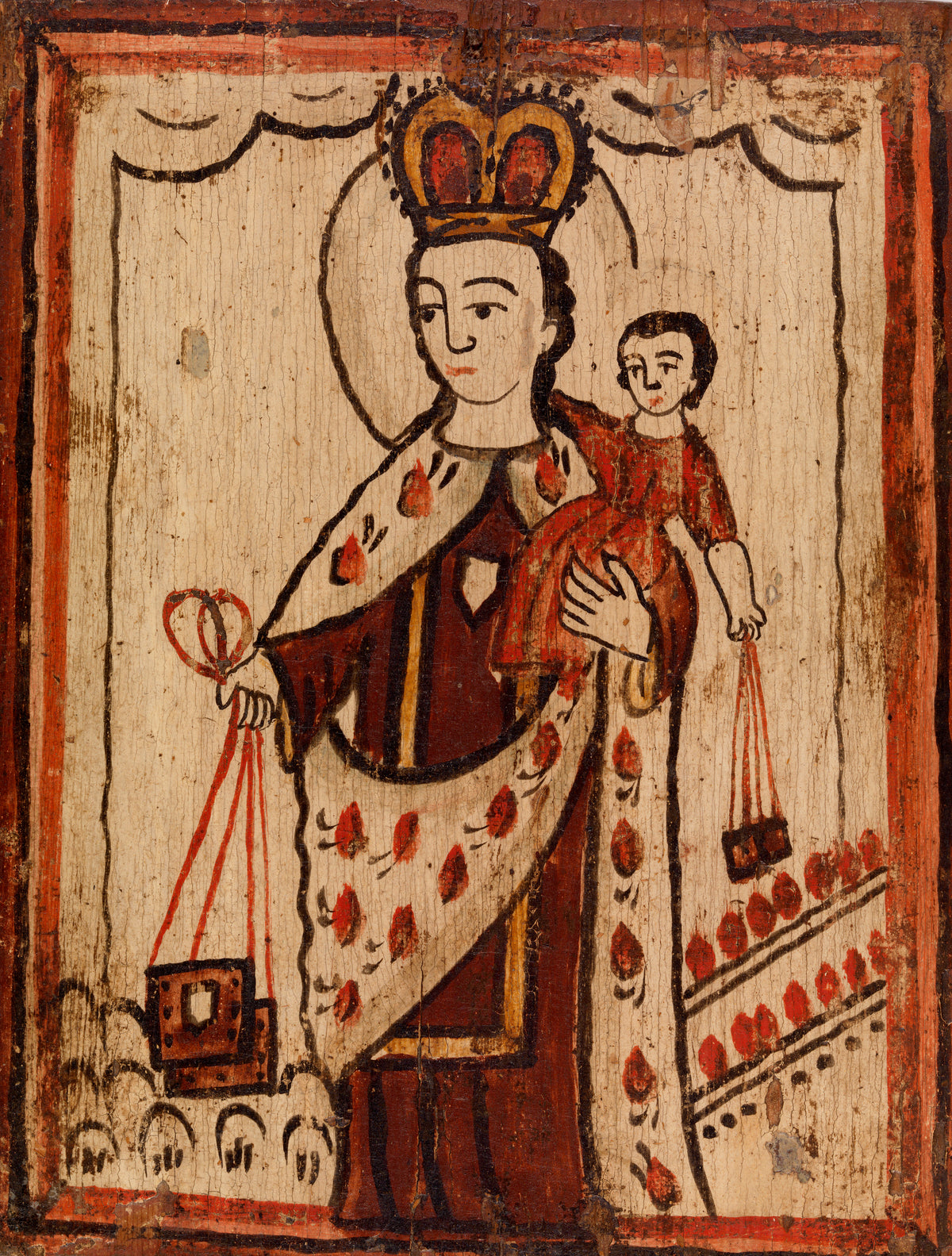
Our Lady of Mount Carmel is the patroness of the Carmelite family, which emerged from communities of hermits established in the Holy Land at the end of the 12th and beginning of the 13th century. Mount Carmel connects the contemplative life of religious communities with the memory of the prophet Elijah, while Mary becomes their model of prayer and openness to the word of God. Her best-known representation shows her holding the Child Jesus and a brown scapular, a sign of belonging to the Carmelite tradition. A legend places the presentation of the scapular to Simon Stock in 1251, but its documentary history is more complex. The feast on July 16 preserves the memory of this relationship between Mary, monastic life, and the faithful who wear the scapular.
| Place of origin | Mount Carmel, Holy Land |
|---|---|
| Religious family | Carmelite orders and communities |
| Devotion | Brown scapular |
| Tradition | Simon Stock and an apparition dated July 16, 1251 |
| Feast | July 16 |
| Attributes | Brown habit, scapular, Child Jesus, and stars |
The Hermits of Mount Carmel
Mount Carmel overlooks the Mediterranean in the region of Haifa. Biblical texts connect it in particular with the story of the prophet Elijah, who confronts the prophets of Baal in the First Book of Kings. This memory attracts men who desire to live in prayer and silence, according to an ideal of contemplative existence.
At the end of the 12th and beginning of the 13th century, Latin hermits settled in this region and received a rule of life from Albert, Patriarch of Jerusalem. Their community developed around prayer, fraternal life, and meditation on Scripture. It was placed under the patronage of the Virgin Mary.
The beginnings of Carmel therefore belong to the history of religious communities in the Holy Land, not to the direct continuation of an institutional order founded by Elijah in antiquity. The prophet became a major spiritual figure, but Carmelite establishments emerged in a precisely situated medieval context.
Mary as Patroness and Model of Carmelite Life
The first Carmelites saw Mary as a model of openness to God and contemplation. The account of the Annunciation, in which she welcomes Gabriel's word, plays an important role in their spirituality. Their relationship with the Virgin is not merely the object of an external devotion: it guides a way of life founded on prayer and service.
Over time, the Carmelites left the Holy Land and established themselves in Europe. Their order underwent institutional changes to adapt to new circumstances. The memory of Mount Carmel nevertheless remains present in its name and in Mary's patronage.
This continuity explains why the Virgin of Carmel appears in Carmelite churches and in many communities associated with the order. She recalls a geographical origin and a contemplative ideal transmitted through the centuries.
The Scapular, a Habit That Became a Sign of Devotion
The scapular was originally a piece of religious clothing worn over a monk's habit. In the Carmelite tradition, it gradually became a sign of connection with Mary and with the order. A reduced form, consisting of two pieces of fabric connected by cords, is worn by laypeople who wish to participate in this devotion.
Documents from the 13th century attest to the existence of the scapular in Carmelite practices, particularly in communities and confraternities. Its presence forms part of a religious culture in which clothing can express belonging and commitment. The small scapular is not a decorative miniature unrelated to Christian life: it recalls the call to prayer and imitation of Mary.
In Catholic doctrine, a sacramental accompanies the faith and prayer of the Church. It does not possess the autonomous efficacy of a magical object. Wearing the scapular therefore does not permit anyone to regard salvation as guaranteed without conversion or personal commitment.
The Tradition of Simon Stock in 1251
Carmelite tradition recounts that Mary appeared to Simon Stock, the order's prior general, and gave him a scapular as a sign of protection. The traditionally accepted date is July 16, 1251, in England. The account belongs to a period when the Carmelites faced difficulties in finding their place within European religious institutions.
The documentary history of this apparition requires a cautious reading of the texts that transmit it. Manuscripts and traditions developed over several generations, and not every detail of the account can be regarded as attested at the very time of the event. The Carmelite order itself presents the tradition within a historical framework.
Its religious meaning remains connected to the relationship between Mary and the community that honors her as patroness. The scapular becomes the visible sign of a commitment and of trust in the Virgin's maternal intercession.
Carmelite Iconography and the Figure of the Child Jesus
Our Lady of Mount Carmel is represented holding the Christ Child and presenting a scapular. Her robe and mantle may use the traditional colors of Carmel, particularly brown and white. Some statues show her crowned and accompanied by Carmelite saints such as Teresa of Ávila.
Reproductions emphasize the gesture of the hand holding the scapular. It does not merely represent a clothing accessory; it connects the image to a long history of communities and to a practice of prayer. The stars on the mantle may recall Mary's purity and the conventions of Marian art.
The figure is thus distinct from Our Lady of Lourdes or Guadalupe, whose attributes come from traditions of local apparitions. Carmel transmits a title associated with a religious order, centered on belonging and an ideal of contemplation.
The Feast of July 16 and the Carmelite Heritage
The feast of Our Lady of Mount Carmel is celebrated on July 16. It holds particular importance in Carmelite communities, where it recalls Mary's patronage and the continuity of the religious tradition. It is also known in parishes and confraternities whose members wear the scapular.
Major Carmelite authors, especially John of the Cross and Teresa of Ávila, gave this spirituality remarkable literary and theological richness. The Marian title connects them to a family of prayer that has continued to renew itself over the centuries.
The scapular should be understood within this whole. It reminds the person who wears it of a relationship of faith, charity, and fidelity to Christ. Discovering Carmelite texts is the best way to understand why a piece of religious clothing has acquired such an important place in Catholic devotion.
Scapular Confraternities and the Life of the Laity
The brown scapular extended beyond monastic communities when lay faithful began wearing it to express their relationship with the Carmelite family. Confraternities and associations provided a framework for this devotion, inviting members to pray and live according to the Gospel. The use of small pieces of fabric connected by cords makes the sign compatible with everyday clothing.
This adaptation does not erase the object's monastic origin. The scapular recalls a habit received within a religious community and points to prayer, charity, and fidelity to Christ. The history of the confraternities shows how a practice born within an order can become a sign shared by people who do not themselves enter a monastery.
The language of protection associated with the Virgin of Carmel must therefore be read within a tradition of commitment, not as a promise of salvation independent of conduct and faith. The visible sign derives its meaning from the Christian life it encourages people to pursue.
Sources and References
Carmel in France, history of the scapular, 13th-century documents, and the tradition of Simon Stock.
Saint Elijah Carmelite Province, history and spiritual significance of the brown scapular.
John Paul II, letter to Carmel dated March 25, 2001, on the scapular as a sign of religious habit and Christian commitment.
Illustration: José Rafael Aragón, Our Lady of Mount Carmel, Barnes Foundation, public domain.










