



















































































































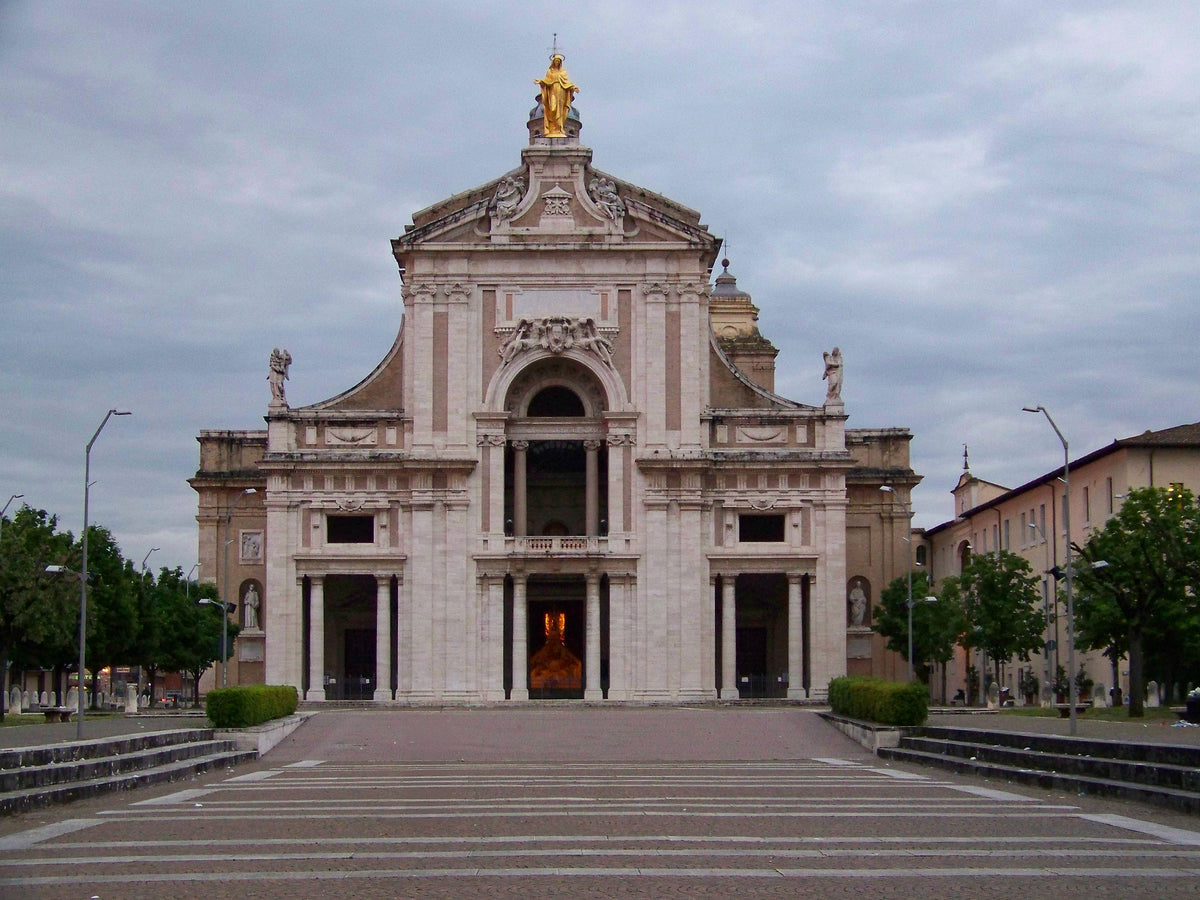
Our Lady of the Angels is a Marian title particularly dear to the Franciscan family. It is linked to the small church of Saint Mary of the Angels, called the Porziuncola, near Assisi, where Francis and his first companions gave a stable form to their fraternity at the beginning of the 13th century. This place also accompanied Clare’s choice of life and Francis’s death in 1226. A tradition tells that the saint received in prayer the promise of an indulgence for visitors, giving rise to the Pardon of Assisi celebrated on August 2. Today, the small chapel stands at the heart of a large basilica, while the title of Our Lady of the Angels has been adopted in many places.
| Major location | Porziuncola, Assisi, Umbria |
|---|---|
| Associated order | Franciscan family |
| Building | Small chapel preserved at the center of the Basilica of Saint Mary of the Angels |
| Event | Pardon of Assisi, traditionally associated with 1216 |
| Feast | August 2 at the Porziuncola |
| Symbol | Virgin surrounded by angels, small church |
The Porziuncola in the Life of Francis of Assisi
At the beginning of the 13th century, Francis of Assisi sought to live the Gospel in poverty and fraternity. The small church of Saint Mary of the Angels, called the Porziuncola, became one of the places where his project took shape. Located in the plain of Assisi, it is modest in size, far from the great cathedrals of the Italian cities.
The presence of this chapel is essential to Franciscan history. The first brothers prayed there, gathered there, and found an anchor for a life that would also lead them onto the roads. The building predates Francis, but in his time it received a new significance.
The importance of the place comes precisely from the contrast between its smallness and the reach of the order that would develop there. An unobtrusive church became a center of religious memory on the scale of the Catholic world.
The Name Saint Mary of the Angels
The title Our Lady of the Angels refers to Mary in her relationship with heavenly praise and with the communities that gather under her patronage. In the Franciscan tradition, it is attached to the chapel of the Porziuncola and to its devotion to the Virgin.
There is no Gospel account telling that Mary received this title in a specific scene. The name belongs to liturgical history and to the foundation of a sanctuary. It may be associated with depictions of the Virgin surrounded by angels, especially in images of heavenly glory, but these compositions do not all have the same origin.
The name has been passed on to Franciscan churches and institutions in different countries. The connection with Assisi remains particularly strong, even when new foundations develop their own local traditions.
Clare of Assisi and the Birth of a Consecrated Life
The Porziuncola also holds an important place in the history of Clare of Assisi. According to Franciscan memory, it was near Francis and his brothers, in this place, that she carried out one of the founding acts of her vocation in 1212. Her departure from her family home paved the way for the formation of a community of women that would find its center at San Damiano.
The chapel therefore became a place of memory shared by the male and female branches of the Franciscan family. It connects preaching, fraternal life, and contemplation. This history should not be confused with the later emergence of the order’s major institutions, which would develop in many cities.
The bond between Francis and Clare gives the Porziuncola a singular place in medieval vocation narratives: two different paths found a common point there in evangelical commitment.
The Pardon of Assisi and the Tradition of 1216
A tradition tells that in 1216 Francis, praying at the Porziuncola, received a vision of Christ and Mary surrounded by angels. He asked that the faithful who came to pray in the chapel might receive an indulgence. In Franciscan memory, the approval of this favor is linked to Pope Honorius III.
The Pardon of Assisi developed around this tradition and is still celebrated on August 2. Its documentary history must be approached carefully: the surviving texts concerning the origin of the indulgence and the ways it spread belong to different periods.
In Catholic doctrine, an indulgence replaces neither repentance, confession, nor reconciliation. The liturgical and spiritual conditions are intended to connect the pilgrimage with a process of conversion and sacramental life. The Porziuncola thus became a place associated with the memory of forgiveness.
Francis’s Death and the Memory of the Porziuncola
Francis died on October 3, 1226, near the Porziuncola, a place he had known since the beginnings of his fraternity. This proximity between the order’s beginnings and the end of his life helped give the chapel a particular significance in Franciscan memory.
The accounts of his death, called Transitus accounts, are read and meditated upon by the Franciscan family. They focus attention on prayer, fraternity, and evangelical detachment. The small sanctuary remains the physical setting that unites several decisive moments in this history.
The faithful come to Assisi not only to admire monuments, but to discover the places where Francis and his first companions lived. The Porziuncola gives this memory a tangible presence.
The Great Basilica Around the Small Church
In the modern period, a vast basilica was built around the Porziuncola. Its architecture makes it possible to welcome an increasing number of pilgrims while preserving the original chapel at the center. The contrast in scale is particularly striking: a small medieval structure stands protected inside a monumental building.
The Basilica of Saint Mary of the Angels is now one of Assisi’s major pilgrimage sites. Its spaces host celebrations, confessions, and gatherings connected with the Pardon. The feast of August 2 retains particular importance in this calendar.
The history of the site offers a concrete introduction to Franciscan spirituality. The Marian title, the small chapel, the memory of Francis, and that of Clare are brought together in a single religious space whose influence extends beyond Italy.
Why the Title Our Lady of the Angels Does Not Designate a Heavenly Order
Christian tradition recognizes several angelic choirs, and medieval theology sought to arrange them in a hierarchy. Yet the title Our Lady of the Angels does not assert that Mary herself is an angel or that she belongs to one of the nine choirs. It expresses the honor paid to her as the mother of Christ, amid a creation that religious images depict praising God.
Representations of Mary surrounded by angels may draw inspiration from the Nativity, the Assumption, or a scene of heavenly glory. Their form varies according to the churches and periods. At the Porziuncola, the name is above all the name of a church that became the center of the first Franciscan fraternity. Local history is therefore essential for understanding its use.
This distinction clarifies the relationship between the praise of the seraphim, the presence of angels in representations of Mary, and the religious life of Francis. The celestial categories belong to the language of theology; the chapel’s Marian patronage belongs to the history of sanctuaries and devotion.
By returning to the simplicity of the Porziuncola, one understands that the reach of the title is not connected to the grandeur of a building. It rests on the memory of a community that placed its life of prayer and service under this name.
Sources and References
Sanctuary of the Porziuncola, history of the site and traditions of Saint Mary of the Angels.
Diocese of Assisi, Pardon of Assisi and the memory of Francis.
Assisi Tourism, traditions of the Pardon and the August 2 feast.
Illustration: Photograph of the Basilica of Saint Mary of the Angels, Assisi, Wikimedia Commons.










