



















































































































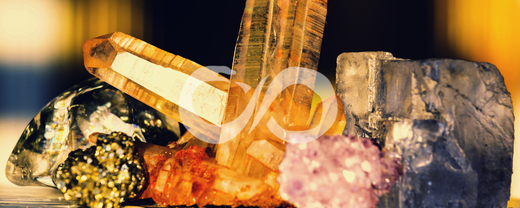
A stone that you wear, a pendulum used for a reading, and a geode placed on an altar do not require exactly the same care. Hand contact, dust, and storage conditions all affect their maintenance. Purification and recharging serve a different purpose: preparing an object for spiritual use, bringing a working to a close, or renewing an intention. Caring for your stones means balancing these two dimensions without sacrificing the material to the ritual.
How can you clean and recharge your stones without damaging them? Water, fumigation, sound, moonlight, and recharging surfaces offer several options. The right choice depends on the mineral, its shape, condition, and your practice. This guide details the actions, their order, precautions, and easy-to-repeat routines. To find a specific stone directly, consult the stone care table.
Cleaning, purification, and recharging: what is the difference?
Cleaning the material
Cleaning removes what is actually on the surface: dust, fingerprints, soap residue, or dirt. A clean cloth, a suitable brush, or gentle washing meets this need. A clean stone does not necessarily need to shine more brightly: the matte finish of a raw mineral is part of its appearance. The goal is not to turn every piece into a polished pebble.
Purifying a ritual object
In esoteric practice, purification means preparing the object, symbolically clearing it of its previous use, or marking a new beginning. Words, measured fumigation, or a few sounds can accompany this gesture. Ritual purification is neither washing nor disinfection. A stone that has touched a dirty surface requires appropriate cleaning, even after a ceremony.
Recharging and consecrating
In contemporary esoteric terminology, recharging refers to renewing the spiritual availability attributed to the stone. This is done, in particular, through a period of contemplation, a dedicated surface, or a lunar appointment. Consecrating more specifically means reserving the object for a particular function. A pendulum can therefore remain consecrated to divination, while a pebble supports protection work.
These terms do not refer to the same operation. Cleaning a stone does not mechanically erase its dedication, and recharging it does not require you to repeat its entire consecration. For personal practice, you can simply maintain the object, perform your chosen purification gesture, and then reaffirm its purpose. The vocabulary of charging here expresses a spiritual practice, not an amount of electricity to be measured in the mineral.
The preparation and consecration of objects have a history in European magic. In the 16th century, Agrippa discusses consecration and prayer in book 3 of his Occult Philosophy. The Key of Solomon also describes fumigations and aspersions for objects used in the art. These texts shed light on an ancient ritual framework; they do not prescribe identical care for all stones today. [1]
From this guide
Put it into practice
A selection of products to support your reading and practice.


Which method should you choose to begin without water or smoke?
For a polished stone in good condition, start with a gentle method. Set up at a cleared table, away from the sink. Place a clean cloth on a tray. Examine the surface and remove loose dust with a soft cloth, without pressing. If the piece has fragile crystals, fibers, or unusual powder, do not rub it: keep it resting in place and find out how it should be cared for.
Then take a moment to clarify what you are completing. You may say: “The previous work is complete. I am preparing this stone for a new use.” Allow a moment of silence, then state its purpose: “I dedicate this stone to the calm of my workspace.” Return it to its pouch or designated place. A small bell may mark the opening and closing, without touching the object.
This protocol combines minimal care with spiritual preparation, without immersion, salt, or heat. The formulas proposed in this guide are examples written for your practice; they do not come from an ancient grimoire. Likewise, the durations indicated are intended to organize the session, not to measure an invisible charge.
What should you check before cleaning a stone?
The mineral and its condition
The precise name comes before the method. Rock crystal and selenite may appear clear, but they do not require the same precautions. Then check for a crack, a recent chip, bonding, or a deposit. A weakened surface calls for more careful treatment than an intact piece.
Hardness is only one indicator among others. It provides information about resistance to scratching, not about all reactions to water, heat, or products. A fairly hard stone can break along a cleavage plane; another may have a sensitive surface treatment. GIA therefore distinguishes hardness, toughness, and stability in its care guides. [2]
The shape and associated materials
A loose stone, a point on a stand, and a bracelet involve different constraints. On a mounted object, the elastic, glue, metal, wood, and paint matter just as much as the stone. For an item made of several materials, use the method suited to the most fragile component. A quartz pendulum does not become fully washable if its glued setting cannot withstand immersion.
On a geode or crystal cluster, also examine the rock supporting the points: this matrix may be friable, porous, or different from the visible mineral. Advice that is valid for a cut amethyst therefore does not automatically apply to a large geode. The shape does not make water more necessary either; it mainly calls for more stable handling.
The work environment
Prepare what you need before starting: a tray, two clean cloths, and, only for pieces that are compatible, a container of water and a little mild soap. Remove rings and objects that could strike the stone. Keep children and animals away from the work surface. A fall into the sink or onto the tile floor represents a much more concrete risk than a delay in your ritual schedule.
How to clean your stones dry or with water
Removing dust without damaging the surface
On a smooth stone, a soft, lint-free cloth is sufficient for light marks. Move it without excessive pressure, using a clean side for each pass. On robust crystals, a very soft brush can clear dust from between the points. Never force it between two crystals or pull on a fiber or flake.
Keep a brush reserved for this purpose, free of makeup, paint, or oil residue. Do not use a wire brush, abrasive sponge, or scouring powder. Dirt that resists gentle handling requires identification before any more forceful attempt. Household cleaning should not become a stripping treatment for your collection.
Washing a water-compatible stone
For an identified, intact stone that is compatible with water, prepare water close to room temperature or slightly lukewarm. Place the stone in a small container rather than directly over an open drain. Dampen a cloth, add a trace of mild soap if necessary, then clean the surface. Rinse briefly with clean water and dry immediately with a second cloth.
Do not prolong the bath once the dirt has disappeared. Washing does not require a night of immersion. Tap water is suitable for several common gems; demineralized water can limit limescale marks, but it does not make a water-sensitive stone suitable for soaking. The GIA notably recommends lukewarm soapy water for amethyst, rose quartz, and tourmaline. [3] [4]
After wet cleaning, let the recesses finish drying at room temperature before storage. Do not use a hair dryer, radiator, oven, or scorching sunlight to speed up this step. If the stone comes from a very cold or very hot place, wait until it returns to room temperature before washing it.
Gestures to avoid
Avoid vinegar, lemon, bleach, stain removers, toothpaste, and improvised household mixtures. Acids attack certain materials, especially malachite; other products may affect a surface treatment. An ultrasonic or steam cleaner is not a general solution for an assortment of minerals. [5]
Rain, a river, and seawater are not safer shortcuts. They introduce concerns involving temperature, salinity, dirt, and loss. To associate your ritual with a watercourse, remain on the bank with the stone kept dry. A symbolic connection with water does not require immersing it.
How do you purify your stones by fumigation?
Choose the fragrance and prepare the space
Fumigation accompanies the setting apart of the object: the fragrance marks a transition between everyday use and ritual time. For a European-inspired practice, frankincense or benzoin are references found in ceremonial magic texts. The Key of Solomon specifically mentions incense and benzoin in its chapter on fragrances. There is no need to gather several resins to prepare a few stones. [1]
Choose a product intended for fumigation and a burner designed for its format. A shell, kitchen glass, or decorative dish does not become a charcoal holder simply because it looks like one. Place the burner on a stable, heat-resistant surface, away from fabrics. Keep the stone tray separate from the hot area.
Ensure ventilation and limit the amount burned. Incense smoke adds particles to indoor air: “purifying” in a ritual sense does not mean sanitizing the air. If someone sensitive to smoke, young children, or animals is present, choose a method without combustion. Coughing or irritation is a reason to stop, not to persist. [6]
Complete the passing
Begin by removing dust from the stone using the method appropriate for it. Light the incense according to its instructions. When a little smoke appears, place the stone at a distance from the source, on its holder, or hold a safe tumbled stone in your hand. Let a light wisp of smoke pass near the object. Do not hold it above a flame, charcoal, or cone.
Say a sentence related to your goal, for example: “I close the previous uses and prepare this stone for its protective function.” A few calm passes are enough to give the gesture form. There is no need to cover the surface with smoke for several minutes. The amount of smoke does not measure the quality of your purification.
Finishing properly
Place the stone back on a clean cloth, state its dedication, then store it or return it to the altar. Extinguish the incense according to the manufacturer's instructions. A charcoal disc may remain hot without visible smoke: keep it under supervision until it has cooled completely. Air out the room, and do not close a still-hot burner inside a cabinet.
For porous surfaces, waxed pieces, crumbly minerals, or objects you will subsequently wear against your skin, sound or words avoid smoke deposits. Fragrance can also accompany the ritual from a distance, without passing the stone directly through its wisps.
How do you use sound, words, or prayer?
Sound offers a preparation without water or smoke. Arrange the stones on a tray, leaving space between them. Take a ritual bell or a small bell and produce a few sounds at a comfortable volume. Let each note fade before the next. You can reserve the first sound for opening, the next for your intention, and the last for closing.
The number of sounds depends on the rhythm you choose. Three notes can structure a session, but no general requirement sets this number. Nor is there a specific frequency to follow in this protocol. Do not increase the volume in search of stronger purification.
Keep the stones next to the instrument, never in the sound bowl. Do not place them on its rim or in water inside it. They could knock against it or be exposed to unsuitable contact. An ordinary sound instrument used from a distance is not an ultrasonic cleaning device; the two uses are not interchangeable.
Words alone are also suitable. Hold a polished pebble or leave a fragile piece in front of you. Express the closing of the previous working, observe a moment of silence, then name the intended use. In a religious path, a prayer addressed to the deity of your tradition can replace this wording. You do not have to adopt a pantheon, language, or text that does not suit your approach.
A silent preparation remains possible: write down the intention, place the stone next to the paper, and devote a few moments to this dedication. The absence of audible speech does not require compensating with more accessories. This option is particularly suitable for a shared space or a discreet practice.
Should you use salt to purify your stones?
Why avoid direct contact with salt?
Covering all the stones with coarse salt is a poor maintenance practice. Grains can remain in a crack or in the holes of beads. Moist contact with salt adds risks for certain surfaces and metal parts. A hard stone, soft gypsum, and a bonded assembly do not react in the same way. Therefore, for a guide applicable to a mixed collection, we rule out direct salt and salt baths.
Ordinary food salt is not ritually disqualified because it is refined. The choice between sea salt and rock salt depends on your symbolic reference or a specific rite. Ritual black salt, protective powder, and table salt may have very different compositions: do not treat them as interchangeable products, and do not pour a colored mixture over your stones.
The two-container method
To keep the salt within your ritual, use a physical separation. Pour a little dry salt into a large dish. Place a second clean, dry, nonporous container in the center, then put the stone inside this small container, on a soft base if necessary. The rim must prevent any grains from reaching the object. The stone touches neither the salt nor the salt water.
State your purification intention and leave the setup in place for the duration of your contemplation. Ten or fifteen minutes can serve as a possible guideline for this session; it is not a period required for measurable absorption. An entire night is not a mandatory step.
At the end, remove the small container without spilling the salt, then take back the stone. Set aside the salt used for the ritual; do not put it back in the kitchen. Do not pour it into a plant pot or the garden. Separating the containers preserves the symbolic gesture without subjecting the material to unnecessary contact.
How do you recharge your stones in the light of the Moon?
Preparing a lunar appointment
The lunar method allows you to connect stone preparation with a rhythm beyond everyday life. Choose an available evening, clean your tray, and arrange the pieces after caring for them. You can follow the full moon as a time of fullness, or choose another phase in keeping with your intention. The calendar should support your practice, not become an obligation that is difficult to maintain. Our lunar calendar helps you identify the phases to organize this appointment.
Place the stones on a dry, stable, accessible surface. An indoor location near a window is suitable for this practice. Check for condensation and keep the pieces away from the edge. Water-sensitive minerals should remain indoors: dew, rain, and nighttime humidity are not nullified by the ritual aspect of the session.
Begin the preparation with a simple phrase: “I renew the dedication of these stones to the work I have chosen.” Then name their function, together if they share the same use, separately otherwise. Leave them on their support for a quiet period, then pick them up again with a closing phrase.
How long should they be left?
You can devote a quarter of an hour to the session and leave the tray in place until bedtime. You can also choose a night, provided the location remains safe. These are two possible ways to organize the ritual, not two levels of effectiveness. There is no single duration that applies to all stones and must be followed to the minute.
Plan to put everything away before a ray of sunlight reaches the items in the morning. A portable tray makes this step easier, especially with several minerals. A small note near your alarm clock can help prevent forgetting. There is no need to get up at an unpleasant hour to save a preparation: choose a location without direct sunlight from the outset.
The window, clouds, and lunar phase
In the ritual proposed here, a window does not invalidate the session. On the contrary, it helps keep the material protected. An overcast sky does not mean you have to start everything over either: your appointment with the lunar cycle can continue even without a visible disk. Maintain the distinction between contemplating the Moon and seeking precise physical exposure.
To give the phases a direction, you can reserve the waning moon for closing out an old working, the waxing moon for developing an intention, and the full moon for a time of consecration or reflection. This organization is a suggested practice, not a mineralogical rule. A dirty stone should be cleaned when its condition calls for it; it does not need to wait for the next favorable phase.
Can all stones be recharged in sunlight?
No: full sunlight is not a general care method. Some colors may fade under prolonged intense light. The GIA notes this for certain amethysts and citrines. Heat and sudden temperature changes pose a separate problem: they can weaken a stone or its mounting materials. [3]
For work associated with the Sun, you can choose the morning, set up your altar in a bright room, and express an intention of clarity, activity, or success. Keep the stones in indirect light, at a comfortable temperature. This adaptation maintains a solar orientation without requiring exposure that heats the object. For planetary magic work, our planetary hours calculator lets you choose a time aligned with your ritual; this choice remains separate from material care.
The stone’s color alone is not enough to decide. Yellow citrine does not need several hours of sunlight, and rose quartz is not automatically doomed to fade as soon as it receives light. The GIA describes rose quartz as generally stable in light and heat. Storing it away from prolonged intense radiation remains a collection precaution here, not a claim that all stones are photosensitive. [3]
Also avoid direct sunlight for transparent spheres and surfaces capable of concentrating a beam of light. A shape that acts like a magnifying glass has no place near a curtain or paper in full sun. Keeping these objects covered or away from windows is part of their physical placement, independently of any ritual.
How to use a geode, selenite, or charging slab?
With quartz or an amethyst geode
You can choose quartz or a geode as the center of your preparation space. Arrange the other stones around it on a clean tray, and formulate the shared intention. There is no need to stack them on the points. A heavy pebble can chip a small crystal; lateral movement can scratch a softer surface.
When the geode’s shape offers a cavity, do not fill it as a matter of principle. Check its stability and the available space. A small independent dish placed in front of the geode serves the same organizational purpose for this ritual. The central holder remains visible, while the pieces avoid abrasive contact.
Time spent alongside quartz can be understood as combining holders in esoteric practice. It does not replace caring for the objects themselves. A dusty cluster is not a good place for a freshly washed stone, and a large geode does not require a longer duration than a small crystal.
With a selenite slab or dish
Selenite belongs to the gypsum family. White objects with silky reflections sold under this name may be fibrous gypsum, also called satin spar. These forms share a soft material that is sensitive to scratches and water. For the routine care of these holders, we therefore favor dry cleaning and avoiding firm rubbing. [7]
Place the holder on a stable surface. Place only clean, completely dry stones on it, without sliding them. On a delicate slab, a small soft cloth placed between them helps limit scratches. For a heavy or angular object, prefer a small dish beside the selenite rather than stacking.
The spiritual function attributed to a holder does not make it maintenance-free. Check its condition, remove loose dust without abrasion, and keep it away from moisture. Placing it near other stones may be part of your preparation, but it does not justify either regular soaking or cleaning with salt.
With a Flower of Life or Metatron design
A recharging plaque serves as a dedicated support. Place it on a clear table, then set the stone in the center, or place several pieces with space between them. A Flower of Life plaque and a wooden Metatron plaque offer different designs: choose the one that matches your symbolic language, without any obligation to use both.
You can accompany the setup with a dedication and leave the stones in place during your time of reflection. The design structures your attention and marks a reserved spot. It does not impose a standard number of hours, a maximum number of stones, or a promise of automatic recharging.
Take care of the tool itself. A wooden plaque should not go into a bath with the stones, nor should it receive oil or water by default. Salt, incense, and a candle should remain in their appropriate containers and at a distance. A clean, available surface is the best foundation for reusing this small ritual space.
How do you formulate an intention and consecrate your stone?
Begin by choosing a sufficiently precise function to guide its use. “Succeed at everything, attract love, and never have difficulties again” combines too many expectations. A phrase such as “support my concentration at work” instead provides a direction you can recall when using the stone.
Once the cleansing is complete, place the tool in front of you. Hold it only if its shape and material allow it. Take a few natural breaths, without holding your breath or exerting yourself, and speak your dedication. A visualization may accompany the words: imagine a light, a boundary around the space, or the action you wish to commit to. Visualization is optional; some people prefer to write or recite.
For protection, you might say: “I dedicate this stone to guarding my space and respecting my boundaries.” For study: “This stone supports my focus, order, and perseverance.” For divination: “I reserve this tool for a calm, clear, and measured practice.” Choose words that have meaning for you rather than an impressive formula whose significance you do not understand.
Consecration can then take the form of a concrete habit. The study pebble joins you at your table when you open your books. The stone dedicated to the home takes its place on a stand near the entrance. The pendulum returns to its pouch after the consultation. This consistency of use extends the initial words.
To change its function, first close the previous dedication: “I am ending this work and making this tool available for a new use.” Carry out the necessary care, then dedicate the stone to its new purpose. By contrast, simple dusting does not require you to cancel and then renew a dedication you wish to keep.
How often should you clean, purify, and recharge your stones?
A rhythm suited to use
For material care, observe its condition rather than the calendar. A stone worn daily requires more attention to marks and dirt than a piece kept in a display case. A pendulum put away after a short session does not require the same cleaning as a pebble left at the bottom of a bag. Clean what needs cleaning using the least aggressive method.
For ritual preparation, you may choose a few occasions: when a stone arrives, at the beginning of a working, at the end of a cycle, or when changing its dedication. A weekly or lunar schedule can also provide consistency. This rhythm is a matter of organization; it is not a prescription attached to every mineral species.
A brief closing after each use can replace lengthy, repeated purification. Put away the tool, acknowledge the end of the session, and reserve a more extensive practice for a genuine change in your routine. Care thus remains present without becoming a series of unnecessary manipulations.
Personal impressions are not a measure of energy load
You find a stone less pleasant to hold, lose the desire to use it, or wish to let it rest: you may follow that need without concluding that it has accumulated a dangerous influence. Your feelings change with fatigue, attention, and context. They may guide your personal practice, but they do not replace examining the object.
A stain, crack, or new powder instead calls for a material inspection. Do not try to resolve a surface problem with more intense purification. Nor do you need to repeat the ritual several times until you achieve a particular sensation. A session can simply end without warmth in your hands or a spectacular sign.
Which method should be used for each stone?
This chart provides careful household maintenance guidance for identified pieces in good condition. Brief washing applies to loose stones without glue, sensitive coatings, or crumbly matrix. “Barely damp cloth” does not mean immersion; “keep dry” is our precautionary choice for routine care. The item's instructions and the piece's actual condition take precedence over the chart.
The last column indicates ritual preparation without harsh contact, not a mandatory correspondence. For all rows, avoid direct salt, salt baths, and thermal shock. GIA-specific recommendations and mineralogical references appear in the sources. [8]
| Stone or material | Preferred care | Point of caution | Simple ritual preparation |
|---|---|---|---|
| Rock crystal | Brief gentle washing of a sound piece, then dry. | Points, cracks, inclusions, and shapes that concentrate light. | Words, sound, or an indoor tray in the evening. |
| Amethyst | Slightly warm water and mild soap for a loose pebble. | Avoid prolonged intense light and heat; use caution with the geode matrix. | Dry lunar ritual indoors. |
| Rose quartz | Brief gentle washing, then dry cloth. | No steam or ultrasonic cleaning; check for cracks. | Intention on a cloth or slab. |
| Citrine | Brief gentle washing of an intact pebble. | No prolonged sun exposure for the ritual. | Morning preparation in indirect light. |
| Smoky quartz | Damp cloth or brief gentle washing if the piece is sound. | Avoid heat, impacts, and prolonged intense exposure. | Sound and renewal of intention. |
| Agate | Damp cloth; brief washing if the finish permits. | Take dyes and cavities into account. | Clean tray and words. |
| Carnelian | Damp cloth, then dry. | Do not confuse solar symbolism with a need for heat. | Preparation time in the morning, in the shade. |
| Aventurine | Damp cloth or gentle washing of an intact pebble. | Check the finish and surface inclusions. | Intention on a dry support. |
| Jasper | Damp cloth; brief washing of an identified, sound piece. | The trade name may cover different materials. | Sound at a distance and dedication. |
| Tiger’s eye | Damp cloth on an intact polished piece. | No sanding or abrasive cleaning. | Words and ambient light. |
| Black tourmaline | Gentle washing is possible for a sound piece; keep friable rough material dry. | Striations and cracks require gentle handling. | Bell at a distance, without contact. |
| Labradorite | Barely damp cloth, then dry. | Avoid impacts and pressure on cleavage areas. | Indoor tray and intention. |
| Moonstone | Slightly warm soapy water, briefly, for a loose stone. | Cleavage, impacts, and temperature changes. | Moon appointment on a dry support. |
| Amazonite | Barely damp cloth on a sound surface. | Use caution with fractures and mounted parts. | Words or a symbolic support. |
| Aquamarine | Brief gentle washing of an intact piece. | Inclusions, possible fillings, and heat. | Quiet intention. |
| Garnet | Brief gentle washing, then dry. | Avoid steam and impacts; check the settings. | Sound and dedication. |
| Obsidian | Damp soft cloth; mild soap if necessary, then dry. | Sharp chips and scratches on mirrors. | Words, then storage in a pouch. |
| Lapis lazuli | Barely damp cloth; spot-test before using any product. | Surface treatments, solvents, and soaking. | Sound or prayer, kept dry. |
| Malachite | A barely damp cloth on intact polished surfaces, followed by drying. | No acid, abrasive powder, or brushing of friable raw material. | Contact-free preparation. |
| Turquoise | Barely damp cloth, followed by a dry cloth. | Porous or treated surfaces; avoid oils and solvents. | Spoken words indoors. |
| Fluorite | Gentle dry dusting as the first approach. | Do not test its resistance through rubbing, impact, or heat. | Sound at a distance on a stable tray. |
| Calcite | Gentle dusting; seek appropriate advice for a persistent stain. | Avoid acidic cleaners and abrasives. | Spoken words or prayer, without unnecessary handling. |
| Selenite and fibrous gypsum | Routine care dry, without pressure. | No ritual bath; the material is soft and soluble in water. | Intention at a distance, protected from moisture. |
| Pyrite | Keep dry; stop cleaning if powder appears. | Moisture can promote oxidation. | Sound or spoken words in a dry room. |
| Amber | Slightly damp cloth, mild soap if useful, then drying. | Heat, alcohol, products, and vigorous rubbing. | Spoken words, away from smoke and flames. |
| Hematite | Soft cloth; check the nature of the beads and their finish. | No prolonged bath or salt. | Dry support and dedication. |
| Howlite | Soft cloth; use minimal moisture after checking. | Check for any surface coloring. | Sound or intention on a cloth. |
| Sodalite | A barely damp cloth on intact polished surfaces, followed by drying. | No soaking by default and no harsh products. | Spoken words and a dry support. |
For stones not included in this table, start by identifying them in the Mineral Grimoire and provisionally choose a contact-free preparation. An esoteric guide can help you choose an intention; the material, its treatments, and its condition guide the choice of cleaning method.
Six complete routines for putting it into practice
Here are six practical situations to help you choose the appropriate actions and their order. Each routine combines suitable care with ritual preparation. Prepare the materials before the session and decide from the outset where the stone will be placed at the end.
Welcoming a newly received amethyst or rose quartz
Keep the label and inspect the piece in ordinary light. For a loose, intact pebble with no special treatment indicated, remove the dust and then wash it gently if its condition calls for it. Rinse briefly and dry with a clean cloth. For a bracelet, adapt the care to the beads and thread instead, as in the following routine.
Place the dry stone on a cloth. Take time to look at its shape, then choose its purpose: accompanying a period of rest, a meditation, or a specific personal practice. Speak your dedication and allow a moment of silence. Then place the pebble in its chosen spot or store it in its pouch. Receiving a stone can become a pleasant welcoming moment, without assuming that its time in the shop left anything harmful on it.
Caring for a bracelet worn every day
Remove the bracelet over a table covered with cloth. Examine the elastic, knots, separators, and beads. Clean the surfaces one by one with a soft cloth, without pulling on the thread. Very light dampening is reserved for compatible materials; avoid baths, which affect the entire assembly. If the thread shows signs of wear, set the bracelet aside for repair.
Lay it flat in a dry dish on a soft surface. To close the day, you can say: “I end today’s work and return to calm.” A bell or a period of silence is enough to mark this transition. The next day, pick up the bracelet again with a reminder of its dedication. Keep perfume and creams away when putting it back on, especially with porous or treated materials. [2]
Preparing a pendulum before and after a session
Place the pendulum, its chain, and any optional witness on a clean cloth. Check the attachment and remove handling marks with a suitable cloth. The body of the pendulum may be stone, but the chain, cap, and glue have their own constraints: preparation without immersion remains the best starting point.
Before the session, take a few moments to focus on your question and recall the support’s purpose: “I reserve this pendulum for a calm and attentive consultation.” At the end, express closure, make a note of your work, and store the chain separately from the point to prevent rubbing. A small-compartment pouch or folded cloth makes storage easier. Fumigation and lunar timing may be part of your practice, but they do not become an obligation after every question.
Restoring a protective stone or black mirror
Start with the location: dust the shelf or tray that holds the stone. For polished labradorite or sound obsidian, remove marks with a soft, slightly damp cloth, then dry it. A mirror requires particular care with dust on its polished surface; avoid firm rubbing and keep the object on a stable surface.
Recall the boundary or chosen use. For a protective stone, name the place or personal commitment associated with the support. For a divination mirror, first close the previous work, then prepare the next session only when the time is right. Storing it in a cover marks a clear separation between uses. Our article on obsidian and black mirrors explores this approach to contemplation and closure. A difficult period alone does not call for more aggressive physical cleaning.
Caring for Selenite or Pyrite
These two materials call for a dry routine, for different reasons. Gypsum needs protection from water and scratches; pyrite can deteriorate when exposed to moisture. Set the piece away from a bathroom, a damp windowsill, and open containers. Examine it before handling it. [7] [9]
On a sound surface, remove only loose dust without applying pressure. If the piece is crumbly, limit yourself to cleaning its support. Then state your intention with the stone placed in front of you, without touching it. You can finish with a moderate sound or a dedication phrase. A contact-free preparation has its own coherence: your attention is focused on the object, while the material remains in good storage conditions.
Organizing a lunar evening for several stones
Prepare a tray large enough to space out the pieces, along with labels if you are starting a collection. Separate material care from the evening itself: stones that require washing should be cleaned and dried beforehand; the others should receive dry care. When evening comes, choose an indoor setup away from drafts, condensation, and the following day's sunlight.
Arrange the stones by use: those for an altar, those for divination, and those you wear. Create a shared opening, then recall the purpose of each group. Leave the tray in place during your time of contemplation, without multiplying methods. Close before going to bed or at the agreed time, then put each object away. This organization allows for a regular appointment with the entire collection without treating all materials the same way.
How can care be adapted for geodes, spheres, and composite objects?
Geodes and crystal clusters
Handle a geode by its base, using both hands when its weight requires it. Do not lift it by a point or protruding crystal. Place it on a support that distributes its weight, then inspect the cavity. Use a soft brush only on sturdy areas; loose crystals, repaired areas, and crumbly matrix require appropriate advice.
For a large piece that stays on the altar, move the small objects around it before cleaning. A prayer, dedication, or sound can be performed in front of the geode while it remains in place. Ritual preparation does not require moving a heavy object, filling its cavity with water, or carrying it to a window.
Spheres and points
Work with the sphere in a stable holder, above a cloth. Turn it gently to clean one area at a time rather than holding it above the floor. Then check its stability: an overly small ring or an unsteady base is not suitable for a place where people pass. A point also needs clear space above and around it, away from a cupboard door or curtain.
For spiritual preparation, the object's position can follow your intention, but stability remains the priority. Keep a transparent sphere away from direct sunlight. After the session, return each piece to a place where it cannot roll or fall.
Crystal trees, orgonites, and glued supports
A crystal tree combines metal wires, drilled fragments, a base, and, depending on the model, glue. An orgonite contains resin and embedded elements. In these cases, follow the instructions for the finished object. A bath suitable for quartz alone does not become a suitable method for the entire assembly.
For routine care, use a soft cloth and handle the branches without pulling on them. Keep resin objects away from heat and solvents, in accordance with the manufacturer's instructions. Speech, sound, or a dry ritual medium allows preparation without contact with sensitive materials.
How should you store your stones and keep a simple routine?
Good organization reduces unnecessary cleaning. Store small stones separately in clean pouches or compartments lined with a soft material. Points should not rub against pebbles, and harder stones should not move freely against softer materials. Put only completely dry objects in a closed box. [2]
Choose a stable piece of furniture away from steam, radiators, and direct sunlight. Keep small pieces out of the reach of children and animals. A closed box does not dry an object that is still damp; a dusty case puts particles back onto a freshly cleaned surface. Caring for the storage area is therefore part of caring for the collection.
For delicate pieces, keep a record with the name, known provenance, reported treatments, chosen care method, and an initial photo. You can add the date of cleaning or consecration without keeping a daily log. This record is especially helpful when you forget the name of a mineral or when several stones look alike.
A light schedule is enough: a visual inspection when you use the object, cleaning according to its condition, and a ritual appointment at the pace you choose. If a routine becomes burdensome, simplify it. Keep a method you practice mindfully rather than combining salt, smoke, water, and light out of fear of doing it wrong.
What should I do after contact with water, salt, or a product?
A fragile stone was left in water
Remove it gently and place it on a clean surface. Absorb any free water with a soft cloth without rubbing the softer parts. Let it dry at room temperature, without a hair dryer, radiator, or intense sunlight. With gypsum, take particular care not to press or scrape a surface that has become uneven. [7]
Brief contact does not automatically mean that the piece is ruined. Examine its condition once dry. If a setting has shifted, the surface is disintegrating, or its appearance has changed, set it aside and ask the seller or someone experienced in mineral conservation for an assessment. Adding fumigation will not repair material damage.
Salt or salt water came into contact with the piece
First, remove any loose grains without crushing them against the polished surface. For a pebble identified as water-safe, intact, and without any setting, a brief rinse can remove the salt, followed by thorough drying. For sensitive material, a composite piece, or an unidentified mineral, avoid adding water automatically: ask for a suitable method.
Do not try to neutralize the salt with vinegar, baking soda, or another product. An improvised chemical reaction adds uncertainty to the original problem. Set the piece aside, keep a photo of its condition, and state precisely how long it was in contact with the substance and which products were used when asking for advice.
The stone is fading, cracking, or producing powder
A visible change first warrants a material examination. Move the piece out of sunlight, humidity, or a heat source, then observe it without scraping. For pyrite that is crumbling or developing new deposits, limit handling and keep it separate from the rest of the collection. Humidity-related oxidation is a conservation issue, not a failure of purification. [9]
Avoid deliberately breathing in dust or rubbing residue with your fingers. A broken stone is no longer suitable to hold if its edges are sharp. Wear or breakage does not show that it has absorbed an attack. Choose an appropriate repair, another way to display it, or remove the object from use depending on its condition.
The practical questions that come up most often
Do I have to start all over when someone touches my stone?
No. Ordinary contact does not prove any spiritual contamination. Clean off any residue if necessary, and renew the dedication if that gesture is meaningful to you. For an object reserved for personal practice, you can simply ask that it remain in its designated space. A clear boundary is enough; there is no need to treat every handling as an incident.
How do I prepare a gifted or second-hand stone?
First, find out its name, condition, and care instructions. Clean it according to its material, then take some time to welcome the object. You can acknowledge the end of its previous use and choose its new purpose. If the object belongs to a specific religious tradition, learn about its function before altering its symbols or assembly.
What should I do if I feel nothing after recharging it?
No particular sensation is necessary to complete the ritual. A feeling of warmth may come from contact with the hand; the absence of any sensation does not mean that the stone rejects your intention. Follow the chosen procedure, close the ritual, and return to your usual practice. Avoid repeatedly testing with a pendulum or piling on methods in an attempt to obtain a sign at all costs.
Have I ruined my preparation by missing the full moon?
You can practice on another evening, choose a period of silence, or use your usual ritual tool. The calendar provides support. For a consecration carried out as part of a specific traditional ritual, follow the rules of that practice; for routine care and personal preparation, missing a full moon is not an emergency.
Can several stones be purified together?
Yes, for a contact-free preparation, with the pieces spaced apart on a tray. A shared invocation can open and close the session. Washing, however, remains appropriate for each object. Separate stones by material and setting rather than submerging them in the same container. A soft stone should not strike a harder piece.
Do rock crystal and selenite need no cleaning?
Their role as ritual tools does not eliminate dust or fingerprints. Maintain them according to their material: gentle washing may be suitable for a loose, intact quartz crystal, while a gypsum-based tool should be kept dry. You can set aside time for their own dedication without seeking a second stone and then a third to recharge each tool in turn.
Should a stone be buried to purify it?
This guide favors a dry practice. Soil adds moisture and particles and creates a risk of loss; a pot also contains materials that can complicate cleaning. For an Earth-oriented rite, place the stone on a clean dish beside a container of soil instead. The symbolism remains without direct contact with the ground.
Can you drink the water used to clean or recharge a stone?
No: cleaning water is not intended for consumption, and this guide does not recommend any drinkable preparation involving minerals. A stone’s composition, treatments, setting, and condition cannot be determined from its color. For a ritual involving a glass of water, keep the stones outside it, with no contact with the water or the rim brought to the mouth. Spiritual practice with stones does not replace medical care.
Building a regular practice that respects your stones
A clear routine begins with the actual object: its name, shape, surface, and condition. It continues with appropriate care, followed by the spiritual gesture you have chosen. Water for compatible pieces, words or sound for delicate supports, dry moonlight, a clean plate or bowl: each method has its place when its use is clearly defined.
Keep three principles in mind: preserved material, a clear intention, and a definite closing. This allows you to care for a simple pebble or a complete altar with the same attention, without adding unnecessary constraints. Consistency depends less on the number of actions than on the quality of the time you devote to your practice.
Sources and further reading
[1] Preparation and consecration of objects. Henri-Corneille Agrippa, De occulta philosophia, book 3, chapter 62, in the Esoteric Archives transcription. See also the Key of Solomon, book 2, chapters 10 and 11, edition presented by Joseph H. Peterson, on fumigations and aspersions.
[2] Care, treatments, and storage. Gemological Institute of America, care and cleaning tips. This presentation explains the effects of impacts, heat, products, and cleaning devices, as well as storage precautions.
[3] Quartz and exposure to light. GIA, care guides for amethyst, citrine, and rose quartz. Their guidance distinguishes reactions to light, heat, and cleaning according to the variety and treatments.
[4] Tourmaline. GIA, Tourmaline Care and Cleaning Guide. The guide recommends warm soapy water and advises against steam and ultrasonic cleaners; its precautions also take fragile rough stones and settings into account.
[5] Malachite and gentle cleaning. International Gem Society, guide to malachite, particularly on care precautions and the differences between a polished piece and dust produced when working with the material.
[6] Smoke and indoor air. United States Environmental Protection Agency, Indoor Particulate Matter and Sources of Indoor Particulate Matter. These resources support precautions regarding combustion, exposure to smoke, and ventilation.
[7] Gypsum, selenite, and fibrous gypsum. University of Waterloo, Earth Sciences Museum, overview of gypsum and its forms. International Gem Society, guide to gypsum, covering hardness, cleavage, solubility, and care.
[8] Table references by stone. GIA, guides to lapis lazuli, moonstone, turquoise, aquamarine, garnet, and amber. Additionally, International Gem Society, Gemstone Care Guide and guides to labradorite and obsidian.
[9] Humidity and pyrite. American Museum of Natural History, Temperature and Relative Humidity, on the risks of deterioration to mineral collections associated with environmental conditions, including the oxidation of pyrite.

Par Olivier of Aeternum
Passionate about esoteric traditions and the history of the occult from the earliest civilizations to the 18th century, I share some articles on these topics. I am also co-creator of the online esoteric shop Aeternum.













