



















































































































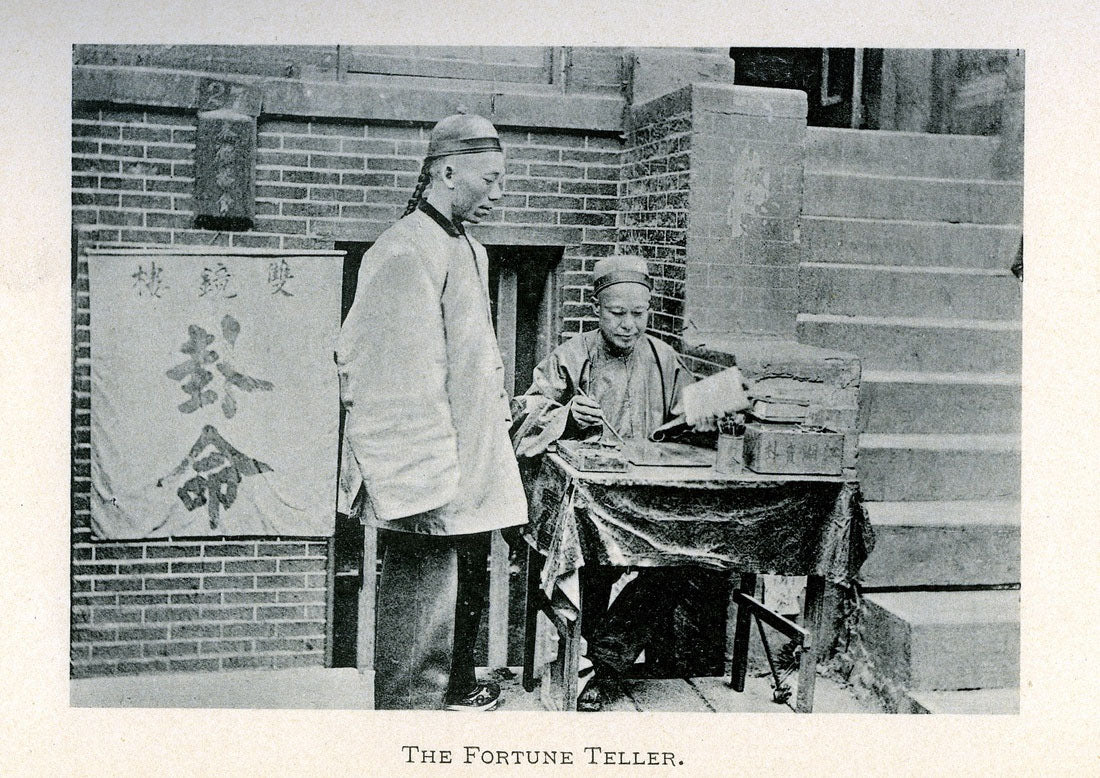
Divination refers to all the methods by which a tradition seeks to obtain an answer about what lies beyond ordinary knowledge: the future, a decision to be made, the divine will, a hidden event, the meaning of an omen, or the direction of a situation. Reducing divination to mere “prediction of the future” would therefore be too narrow. In antiquity, as in later occult traditions, it is also used to read a sign, consult an oracle, choose a time, or shed light on a decision.
Its history spans civilizations that were very distant from one another. Mesopotamian sacrificial livers, Egyptian dreams, the Pythia of Delphi, Roman auspices, the Yi Jing, astrology, cards, runes, mirrors, pendulums: behind this variety lies the same idea, that of a world in which certain signs can be read according to a language transmitted, ritualized, or symbolic.
What Is Divination?
The French word comes from the Latin divinatio. Among ancient authors, the term did not simply refer to a vision of the future, but to the ability or art of interpreting signs considered to carry a message from the gods or a higher order. In the 1st century BC, Cicero devoted his treatise De divinatione to it, a major testimony to Roman debates surrounding oracles, dreams, auspices, prodigies, and other forms of mantic practice.
It is also important to distinguish several concepts that are easily confused. Divination seeks information or guidance. Magic instead aims to act on a situation through rituals, words, objects, or correspondences. Prophecy, in many religions, presents itself as inspired speech that does not necessarily depend on a technical process. An oracle, meanwhile, may refer to the answer received, the institution that conveys it, or the medium used.
In divinatory arts, the method matters as much as the interpretation. A card reading, an astrological chart, or a hexagram from the Yi Jing does not operate according to the same language. Each system has its own rules, vocabulary, and history. That is why a serious reading begins by respecting the framework specific to the tool being used.
Divination in Ancient Civilizations
Mesopotamia and the Reading of Omens
Mesopotamia provides exceptional documentation on divinatory arts. Thousands of cuneiform tablets attest to highly structured techniques. Court diviners could interpret celestial phenomena, unusual births, dreams, or the appearance of the entrails of sacrificed animals. Extispicy, particularly the reading of a sheep's liver, played an important role in royal and military decisions.
The Metropolitan Museum of Art, for example, holds a fragment of a liver-omen tablet in which the condition of a sacrificial liver is linked to an army’s success or failure. This was therefore not an individual improvisation: the signs were compared with scholarly series transmitted by scribes and specialists.
Mesopotamian celestial divination would also play a major role in the history of astrology. Repeated observation of planets, eclipses, and atmospheric phenomena gradually produced a corpus of omens, followed by forms of horoscopic astrology that would spread beyond Babylonia.
Ancient Egypt and Dreams
Egyptian documentation must be approached with caution. Haruspicy cannot be presented as a “particularly widespread” Egyptian method in the same way as in Mesopotamia or the Etrusco-Roman world. Egyptian sources do, however, clearly attest to the interpretation of dreams, temple oracles, and certain consultations involving the drawing or movement of divine images.
The Chester Beatty III papyrus at the British Museum, dated to around 1220 BC, contains a dream-interpretation manual. Each vision is given a favorable or unfavorable classification and an associated interpretation. This document shows that oneiromancy was not limited to literary accounts: it could be codified.
The oracle of Amun at Siwa also achieved great renown in antiquity. Alexander the Great went there in 331 BC. The details of the message he received remain disputed, but the sanctuary illustrates the importance of oracular consultations in the late Egyptian world.
Greece and Oracular Sanctuaries
In the Greek world, mantikè encompassed several techniques: inspired oracles, observation of birds, dreams, lots, and sacrificial omens. Delphi remains the most famous case. The Pythia, priestess of Apollo, answered questions presented at the sanctuary according to a precise religious protocol.
The popular image of a Pythia automatically plunged into a trance by “hallucinogenic vapors” needs qualification. Geological studies have revived the hypothesis of gas emissions beneath the temple, but the exact course of the prophetic state remains debated. It is better to speak of a rite of Apollonian inspiration attested by ancient sources than to turn a modern hypothesis into a certainty.
Geomancy, on the other hand, should not be presented as an ancient Greek method consisting of reading natural shapes in the ground. Scholarly geomancy as it became known in the medieval West has a different history, linked notably to Arabic and then Latin traditions.
Rome: Augurs, Haruspices, and the Sibylline Books
In Rome, divinatory practices were integrated into public affairs. Two functions are regularly confused. The augurs interpreted auspices, especially signs from the sky and birds observed within a ritually defined space. The haruspices, associated with an Etruscan tradition, examined the entrails of sacrificed animals. An augur was therefore not a liver reader.
The Romans also consulted the Sibylline Books during major crises. This did not involve directly asking a living Sibyl for a prediction: these texts were kept by a priestly college and consulted at the authorities’ decision.
This distinction is important for understanding Roman logic. A large part of public divination did not seek to determine exactly “what will happen,” but to establish whether the gods approved of an action and whether the ritual conditions allowed it to be undertaken.
China: Oracle Bones and the Yi Jing
China offers another extremely well-documented ancient tradition. Under the Shang, royal questions were inscribed on animal shoulder blades or turtle plastrons. Heat produced cracks that were interpreted. The inscriptions left on these “oracle bones” are among the earliest testimonies to Chinese writing.
The Yi Jing, or Book of Changes, belongs to another stage of this history. Its oldest layers date back to the 1st millennium BC, and the text was initially associated with divination before becoming a philosophical and cosmological classic. Traditional consultation using yarrow stalks produces a hexagram made up of six lines, which is then interpreted using the text.
Ba Zi, or “Eight Characters,” should not be reduced to numerology. It is a Chinese destiny system based on the year, month, day, and time of birth, expressed through the heavenly stems and earthly branches. Its language belongs to a specific calendrical and cosmological tradition.
The Main Methods of Divination
Astrology
Astrology is one of the major divinatory systems built from a complex set of celestial correspondences. Its ancient forms developed in Mesopotamia before undergoing significant transformations in the Hellenistic world. Western astrology, Indian astrology, and Chinese systems should not be confused: their calculations and symbolic frameworks differ.
An astrological chart cannot be reduced to the sun sign. It is based on the positions of several celestial bodies, their relationships, and, depending on the school followed, houses, dignities, aspects, and other parameters. For a distinct approach to Western astrology, our article on Vedic astrology presents the basics of Jyotisha.
Tarot and cartomancy
Today, tarot is almost inseparable from divination in the Western imagination, but its origin was initially recreational. The earliest documented tarot cards appeared in 15th-century Italy. They were used for playing, not to reproduce a lost ancient “Egyptian book.” Egyptian, Kabbalistic, and Hermetic associations were added much later.
The Metropolitan Museum of Art documentation clearly places the earliest tarot cards within 15th-century Italian playing-card games. Divinatory use became much more visible in the modern era, particularly with Jean-Baptiste Alliette, known as Etteilla, whose editions of Instruction on the Art of Reading Cards, published from 1770 onward, are preserved by the BnF.
From the 19th century onward, French and British occultists reorganized the interpretation of the arcana by connecting them with Kabbalah, astrology, and Hermeticism. This modern history led to the divinatory Tarot de Marseille, the Rider-Waite-Smith, the Thoth tarot, and the multitude of decks available today.
For further reading, you can consult our guide Understanding tarot, our article on the origins of divinatory tarot, as well as our comparison Tarot or oracle, which should you choose?. The Belline Oracle is also a good example of 19th-century French cartomancy.
Pendulum and dowsing
The pendulum holds a special place because its current use belongs mainly to the modern history of dowsing. Claims that the divinatory pendulum was used in ancient Egypt or Rome in a form comparable to contemporary practices are not supported by solid documentation.
A pendulum provides conventional answers, generally yes, no, or indeterminate, but it can also be used with boards, alphabets, and dials. Its movement is sensitive to very small involuntary muscle contractions, which partly explains why the protocol and the neutrality of the question are so important in its use.
Our divination pendulum guide presents the basic methods, while the Divination Pendulums collection brings together the main models used today.
Runes and Rune Readings
Runes are first and foremost a Germanic writing system. Historical inscriptions were used to write names, commemorate the dead, mark objects, or transmit formulas. Some inscriptions have a magical character, but this does not support the claim that the modern “rune reading” already existed in the same form during the Viking Age.
Tacitus reported in the 1st century CE that certain Germanic peoples consulted marked lots, but he did not specify that they were runes. The fixed divinatory meanings attributed today to each rune largely stem from modern reconstructions and from the esoteric or neopagan movements of the 19th and 20th centuries.
This historical reservation does not detract from the symbolic coherence of a modern reading, provided that it is not given an invented, continuous documentary lineage. Our guide Viking Runes: History, Meanings, and Reading Guide explains this distinction in detail.
Palmistry, mirrors, crystals, and sign reading
Palmistry interprets the shape of the hand, the lines, and the elevations of the palm according to a set of correspondences transmitted and revised over the centuries. It should not be reduced to the three famous “life line, heart line, and head line”: classical treatises also take into account the hand’s overall shape, the fingers, the mounts of the planets, and the texture.
Crystal gazing and catoptromancy belong to another family: vision in a reflective or translucent surface. Crystal balls, black mirrors, dark water, or polished glass do not provide a fixed alphabet comparable to that of tarot. The reading depends more on the images perceived, their sequence, and the ritual framework.
Finally, oneiromancy interprets dreams as signs. It has ancient traditions that differ greatly from one another, from Egypt to the Greco-Roman world. Here again, correspondences depend on the corpus used: the same symbol does not necessarily receive the same interpretation across eras and cultures.
How should you approach a divination practice?
A consultation becomes clearer when the question is defined before the spread. “What should I understand about this situation?” creates a different framework from “What will happen?” Traditional schools do not all give the same place to prediction, either: some seek an omen, while others seek ritual validation, advice, a tendency, or a reading of the moment.
It is also useful to keep a record of consultations. Recording the date, the question, the spread obtained, and the interpretation makes it possible to revisit later what was read. This discipline prevents changing the meaning of a symbol afterward to make it correspond to the event.
The same principle applies to tarot, the pendulum, runes, and oracles: it is better to know one system precisely than to multiply the tools without mastering their language. A deck or instrument becomes truly readable when its symbols, rules, and limitations are known.
Divination does not replace a documented medical, legal, or financial decision. It belongs within a ritual, religious, symbolic, or personal framework. Taking it seriously does not require attributing to it what it cannot establish.
Which method should you choose to begin?
Tarot suits those who enjoy images, symbolic associations, and readings built from several cards. Oracles generally offer more direct access, with less codified systems. The pendulum is suited to brief answers and structured inquiries. Runes are suited to a more concise reading in which each sign concentrates several ideas. Astrology requires more calculation and study before it can be read independently.
There is therefore no single “best” method in absolute terms. The choice depends on the type of question, your relationship with symbols, and the time you wish to devote to learning. To discover the available tools, our Divination Arts collection brings together tarot decks, oracle decks, pendulums, and other reading instruments.
Divination in Western occultism
In 18th- and 19th-century occultism, divination changed status. It was no longer merely a popular or religious heritage: it became one of the branches of a broader system linking astrology, planetary correspondences, Kabbalah, magnetism, tarot, and ceremonial magic.
This period produced much of the vocabulary still used today. Etteilla transformed tarot into a structured divinatory system. Éliphas Lévi incorporated it into an occultist synthesis. The Golden Dawn pushed the correspondences between arcana, Hebrew letters, planets, signs, and elements even further. The Rider-Waite-Smith and Crowley’s tarot emerged from this legacy.
Understanding this chronology helps avoid two opposite errors: presenting all current practices as recent inventions without roots, or projecting our modern methods unchanged into antiquity. The real history is more interesting: some ancient techniques have survived, others have disappeared, and some have been reconstructed, combined, or reinterpreted over the centuries.
The final word
Divination is not a uniform tradition. It constitutes a broad family of techniques that have been used to question the gods, interpret omens, determine a favorable time, read a situation, or seek guidance. Mesopotamian practices, Greek oracles, Roman auspices, the Yi Jing, astrology, and cartomancy do not speak the same language and should not be merged into a simplified history.
It is precisely this variety that makes the divinatory arts so rich. Studying their history helps us better understand what we use today, distinguish documented traditions from recent reconstructions, and bring greater coherence to our own practice.
Sources and reference points
For Mesopotamia: Metropolitan Museum of Art, Cuneiform tablet: fragment of a liver omen, and Ulla Susanne Koch, Sheep and Sky: Systems of Divinatory Interpretation, Oxford University Press.
For Egypt: British Museum, Papyrus Chester Beatty III, a dream interpretation manual, circa 1220 BCE.
For the Greco-Roman world: Cicero, De divinatione; Victor Gysembergh, Extispicine et palmomancie dans l’Antiquité entre Grèce et Proche-Orient, Journal des Savants, 2016.
For China: Joseph A. Adler, The Yijing: A Guide, Oxford University Press, 2022; Metropolitan Museum of Art, Shang dynasty oracle bone collections.
For tarot: Metropolitan Museum of Art, Before Fortune-Telling: The History and Structure of Tarot Cards; Bibliothèque nationale de France, Etteilla ou instruction sur l’art de tirer les cartes, 1770.
For runes: Cambridge University Press, studies on the historical uses of runes and on the gap between ancient inscriptions, attested rune magic, and modern divinatory meanings.

Par Olivier of Aeternum
Passionate about esoteric traditions and the history of the occult from the earliest civilizations to the 18th century, I share some articles on these topics. I am also co-creator of the online esoteric shop Aeternum.













