



















































































































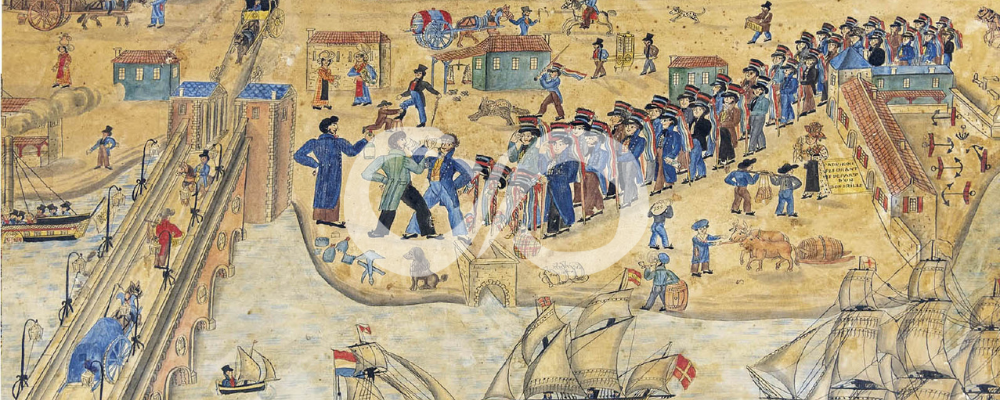
The French and European Compagnonnages - fraternities of itinerant workers in the trades of wood, stone, and metal - have always cultivated an initiatory heritage. Like other initiatory societies, they possess their own rites and symbols, passed down through the generations and arousing the curiosity of the profane. Discreet rather than truly secret, and with no political aim beyond a love of good workmanship and the transmission of a workers' morality, the Compagnons share a rich and highly codified culture. Their esoteric tradition is alive and rooted in matter, a legacy of what is known today as the Compagnons du Devoir. An exploration.
Legendary Origins and Patron Figures
As early as the 16th century in France, these workers' brotherhoods (formerly called Devoirs) claimed prestigious and mythical origins to strengthen their identity. Each compagnonnage rite thus placed itself under the patronage of a legendary ancestor: King Solomon (builder of the Temple of Jerusalem, assisted by the architect Hiram), Master Jacques (a wise builder from Gaul in legend), or Father Soubise (a monk companion of more mysterious origins). Compagnons still refer to themselves as Children of Solomon, Children of Master Jacques, or Children of Father Soubise, according to the symbolic lineage they claim. In reality, these founding narratives only took shape relatively late (in the 18th - 19th century), but they gave the compagnonnages a sense of a glorious past reaching back to the construction of Solomon's Temple. The episodes from the lives and deaths of these mythical ancestors serve as models: they are invoked as patron figures guiding the young compagnon in the values of his Devoir. Tradition holds that every compagnon du Devoir should make the pilgrimage at least once in their life to the hermitage of Sainte-Baume in Provence - the supposed tomb of Master Jacques - in memory of this martyred founder. Likewise, Mary Magdalene (reputed to have withdrawn to Sainte-Baume) is honored as the patron saint of the compagnons, symbolizing the spiritual role assigned to women in this fraternity. These invocations and constant references to compagnon ancestors anchor the community in an unbroken initiatory chain, distinct in spirit from that of Masonic lodges and closer to a craft-based esotericism enlivened by legend and traditional Christian sacredness.
Despite these symbolic links with the Bible and the Crusades (Master Jacques has sometimes been equated with the last great Templar grand master, Jacques de Molay, or Soubise associated with the Cistercian monks who taught geometric art to builders), the compagnonnages remain deeply attached to matter and the trade rather than to faith. The Compagnon sees himself as the heir to a workers' culture that expresses, through the monuments he raises, humanity's effort to rise “from the visible to the invisible.” The compagnonnage - described as the “chivalry of the trade” - preserves a unity between the artisan's gesture and the quest for spiritual meaning. This is why its founding legends, even though late, remain rooted in the concrete reality of construction: the Temple, the Cathedral, and the construction lodge (the Cayenne) are both material realities and spiritual ideals for the compagnons. Here we find the ideal of a “Ars Magna” of the builder, a Royal Art of Construction in which mastery of stone, wood, or iron approaches the sacred.
Symbols, the Builder's Knowledge, and the Art of Line Drawing
The compagnonnage tradition also includes an entire body of closely guarded know-how and magical-religious practices connected with the building site. Builders of old, trained in ancient methods since the Middle Ages, surrounded their trade with symbolic precautions intended to protect the work and the workers. Thus, many old buildings contain inscriptions or marks considered apotropaic (that is, protective against evil). Often deliberately confused with artisans' purely utilitarian marks, these figures - crosses, pentagrams, wheels, or interlacing patterns - were actually intended to ward off evil influences and place the construction under favorable auspices. It is not uncommon to observe on the beams of a roof frame or the lintel of a door compass-drawn rosettes (six-petaled wheels known as “daisy wheels”), series of joined V shapes or intertwined M shapes (Marian monograms invoking the Virgin), endless knots, or small crosses engraved in stone - symbols our ancestors believed effective in warding off evil spirits by magically sealing the place. These ritual “marking” practices extend a very ancient tradition: from ancient Rome and the Middle Ages onward, foundation nails and foundation-stone deposits accompanied construction, symbolically binding buildings to the ground and calling divine protection upon them. The compagnons of the Tour de France, great builders of cathedrals and residences, perpetuated this magical heritage of the builder in their own way by concealing blessings, cabalistic signs, or emblems within the work or on its surface. Many cut stones in Gothic cathedrals thus bear lapidary marks - letters, numbers, or geometric drawings - left by stonemasons. Officially, these marks served to identify each worker's work or guide assembly. But their recurring forms and resemblance to esoteric symbols suggest that, in the eyes of medieval workers, they may also have served a talismanic function. The spirit of the building site was therefore complete: a favorable fate was “sealed” into the masonry just as one seals a cornerstone.

Beyond these protections inscribed in matter, the compagnons possessed above all a jealously guarded treasure of knowledge: the Art of Line Drawing. This is the geometric science applied to stonecutting, carpentry, and forging, enabling the components and volumes of a structure to be designed with almost miraculous precision. Have you ever wondered, while visiting an old monument, how the building managed to withstand the centuries, or how it could even have been constructed without our modern technologies? This art of line drawing - involving the learned use of the line, the circle, and harmonic proportions - was once taught in the strictest secrecy to deserving apprentices. From the 16th century onward, it was transmitted through two channels: on the one hand, the written treatises of master architects (beginning with Philibert Delorme's First Book of Architecture in 1567), and on the other, the oral instruction given during evening classes that the compagnons attended during their Tour de France. By this means, advanced knowledge of descriptive geometry (stereotomy, and the design of vaults and roof frames) was able to survive beyond the gaze of the profane. Compagnon carpenters and stonemasons held this Art of Line Drawing in the highest esteem, considering it the heart of the transmission of their knowledge. To master the science of line drawing was, in a sense, to penetrate the secrets of Form concealed in nature - knowledge that granted power over raw matter, almost akin to magic to anyone who did not possess it. Indeed, the art of sacred geometry taught by the compagnons closely links construction and the sacred. Drawing a perfect figure on the drafting board, raising a vault according to the golden ratio, or orienting a church according to the stars all belonged equally to technique and ritual. Medieval compagnons were said to have received from builder monks the secret of mystical proportions and symbolic plans, inherited from ancient temples and Greco-Roman esotericism. It is not surprising that later some esoteric authors saw them as custodians of an ancient Hermetic Tradition: thus Fulcanelli, at the beginning of the 20th century, interpreted the sculptures of Gothic cathedrals as a true book of alchemy written by the compagnon-builders of the Middle Ages. Without necessarily accepting all these occult interpretations, one can observe that universal symbols are abundant in compagnonnage iconography: the crossed Square and Compass (major emblems recalling the union of the material and the spiritual), the Level and the Balance (referring to equality and justice), and motifs borrowed from Antiquity and the Bible, such as the Labyrinth and the Tower of Babel, which still proudly adorn their panels and alliance ribbons. All these symbols, transmitted internally to the compagnons, form a secret language understood only by them, stimulating imagination and study far more than simple speech could.
Initiatory Rituals and Hermetic Heritage
As an initiatory society, the compagnonnage recruits and elevates its members through rites of passage rich in symbolism. From the status of young aspirant to that of received compagnon, the candidate undergoes several trials and ceremonies in which moral teachings, sacred staging, and sometimes elements of Hermeticism and spiritual alchemy are interwoven. The traditional progression generally comprises three initiatory stages: the adoption of the apprentice (marking his entry into the compagnonnage family), the reception of the compagnon into his trade body, and finally, at the end of his career, the recognition of the “finished” compagnon (now symbolic). Each of these stages is accompanied by codified rituals and sacramental words, sometimes to the point that the Church regarded them as parodies of its own sacraments (thus, in 1655, the Sorbonne condemned compagnonnage practices deemed too close to religious ceremonies).

Labyrinth and Tower of Babel. Source
During the adoption of the apprentice ceremony (the apprentice then being called an aspirant), he swears an oath on a sacred text and receives the society's colors - a ribbon or sash in the colors of his trade, bearing its symbolic marks. These symbols notably include two key images of his spiritual journey: the Labyrinth and the Tower of Babel. The labyrinth, borrowed from ancient myths (Daedalus in Crete) and present on the floors of cathedrals such as Chartres, evokes the long inner journey toward the light, the candidate's arduous progress through the initiatory trials. The labyrinthine path, which former compagnons could symbolically complete on their knees while praying, represents the humility and perseverance required to attain perfection - a form of allegorical pilgrimage toward the heavenly Jerusalem. Conversely, the Tower of Babel recalls the builder's pride: it represents early successes of which one might become too proud and warns against vanity, since the biblical tower collapsed unfinished. For the young compagnon, becoming aware of the Babel within means accepting that much progress remains to be made and that only humility will one day allow a completed work to be raised. Thus, from the very first rite, the postulant is invited to “open his eyes to the reality of evil” within himself and around him, and to understand that true fraternity does not unite perfect beings but people of good will helping one another to emerge from the ruins of ignorance and selfishness. As we can see, the teaching is both moral and allegorical, in the tradition of medieval Christian mysticism and Western esotericism.

Rite of the guilbrette, alliance oath. Source
The reception of the compagnon constitutes the culmination of the initiation. It generally takes place during a nocturnal ceremony, behind closed doors, around a laid table symbolizing the altar (the table's four legs representing the four Evangelists, and the bread and wine evoking Christ's body, according to some descriptions). After performing symbolic “journeys,” the recipient swears a solemn oath on a sacred Volume (Bible) and receives his colors again, this time marked with new initiatory symbols belonging to his new grade. In the Rite of the Devoir (the Children of Master Jacques), the emblems traditionally given to the received compagnon are the Pyramid, the Temple, the Tomb, and the Cathedral. The Pyramid, the first symbol, represents the perfection of living growth, which is fulfilled from base to summit in a synthesis - the allusion is clearly alchemical, recalling the progressive ascent of matter toward spirit and containing “the secret of its construction” (an allusion to the inner Great Work). The Temple, the second symbol, naturally refers to Solomon's Temple: it is the lodge (Cayenne) where the compagnons meet, but it is also the image of the inner sanctuary that each person must build within themselves by following the rule (the Square) and wisdom (the Compass). The Tomb, the third symbol, invites the compagnon to meditate on death: “one must know how to die,” say the old rites, that is, to die to one's ignorance and pride in order to be reborn renewed. The compagnon is thus encouraged to accomplish a work of quality during his lifetime - his own tomb - as though through his work he were shaping the tombstone that will attest to his worth. This idea echoes the Hermetic themes of initiatory death and alchemical putrefaction that precede the initiate's rebirth. Finally, the Cathedral, the fourth symbol, represents fulfillment: it is the expression of the fruitfulness of work and sacrifice, the perfection of the completed work. Above all, it symbolizes the union of Heaven and Earth, of hand and thought. In it, the duality between the spiritual and the material is resolved - an idea at the heart of Hermeticism, where the alchemical Work aims to marry opposing principles (sulfur and mercury, spirit and body) to obtain the philosopher's stone. With the Cathedral, the compagnon reaches the very notion of a Masterpiece: not only a technically perfect achievement, the fruit of love for the trade, but also a reflection of his soul and moral fulfillment. The Masterpiece, which he must sooner or later execute, will be both proof of his artisanal mastery and the tangible expression of the transformed initiate - the equivalent, in a sense, of the compagnon's philosopher's stone.
The Compagnons du Devoir, Heirs and Renewers
The organization known today as the Compagnons du Devoir is the direct heir of the old Devoirs that structured the brotherhoods of itinerant workers from the Middle Ages onward. These Devoirs were therefore three in number: the Children of Master Jacques, the Children of Father Soubise, and the Children of Solomon. Each had its founding legends, reception rites, and emblems, but all shared the same ideal: to make the trade a path of elevation and fraternity.
In the 19th century, the compagnonnages went through a difficult period. Conflicts between rival Devoirs, administrative prohibitions, and the upheavals associated with the Industrial Revolution considerably weakened the movement. It was then that a decisive figure emerged: Agricol Perdiguier (1805-1875), a carpenter from the Gard region, himself a compagnon received under the name “Avignonnais la Vertu.” In his Livre du Compagnonnage, published in 1839, he denounced the bloody rivalries that still divided certain trade bodies and called for reconciliation among the different branches. His work had a lasting influence on the movement and paved the way for gradual unification.
At the turn of the 20th century, compagnons from different Devoirs joined together to establish a common structure that preserved the spirit of the tradition while adapting it to a modern world. From this desire emerged the Workers' Association of the Compagnons du Devoir du Tour de France (AOCDTF), officially established in 1941, which took up and united the legacies of Master Jacques, Soubise, and Solomon. The Association then presented itself as the common home of the Compagnons, bringing under one roof trades that had once claimed affiliation with different Devoirs.
This link with the ancient heritage can be seen on several levels. The Compagnons du Devoir perpetuate the Tour de France, an initiatory journey in which the apprentice becomes a compagnon by traveling from city to city, housed and guided by his elders. They also preserve the memory of the patron figures and founding narratives that structured the old rites, even though the ceremonies have evolved to accord with the times. Finally, they retain the ideal of the masterpiece, a handmade creation that demonstrates mastery of a trade and symbolizes the completion of a journey.
Through all these rites of passage, one can therefore perceive a genuine esoteric quest specific to traditional compagnonnage. Although expressed through Christian or operative symbols (tools, monuments), this quest joins the universal initiatory journey: purification of the postulant, transmission of knowledge, symbolic death and rebirth, and the conquest of the Light. The compagnonnage can thus be seen as a school of mysteries adapted to the world of manual labor. It reconciles Homo faber and Homo sapiens, technical know-how and spiritual savoir-être, where modernity tends to separate them. The Compagnons forged a unique craft-based esotericism that makes work itself an almost sacred mission. The compagnons du Devoir perpetuate this ritual heritage. They remain, in the beautiful words of one of their own, “the heirs of a workers' culture that merges with the spiritual heritage of the great civilizations,” continually seeking to raise inert matter into a living masterpiece and to transmit, through line and compass, the flame of a Tradition that is always awake.

Par Olivier of Aeternum
Passionate about esoteric traditions and the history of the occult from the earliest civilizations to the 18th century, I share some articles on these topics. I am also co-creator of the online esoteric shop Aeternum.













Merci beaucoup pour votre commentaire !
A lire relire et à intégrer dans son intellect et son cœur.
Pour le franc-maçon que je suis c’est une mine d’or en tout point
Merci