



















































































































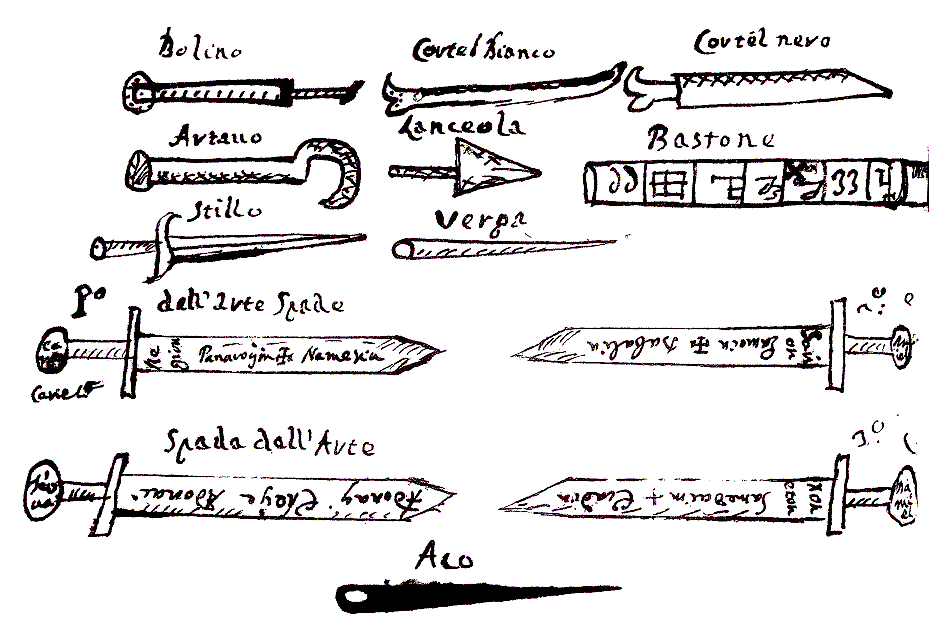
Consecrating a ritual object does not simply mean “charging it with energy.” In Western religious and magical traditions, consecration primarily refers to a change of status: an ordinary object is set aside for a specific sacred or ritual use. Depending on the sources, this setting apart may involve a blessing, sprinkling, fumigation, anointing, prayers, divine names, or a formula specific to the object.
The modern idea of an object being “emptied of its old energies” and then “recharged” with one’s personal intention belongs primarily to contemporary esoteric vocabulary. It can perfectly well be part of a current practice, but it does not accurately describe all traditions of consecration. A Solomonic grimoire, a Christian blessing, a Golden Dawn rite, and a Neopagan practice do not consecrate the same things, in the same way, or for the same reasons.
What does it mean to consecrate?
The primary meaning is simple: to remove something from ordinary use and assign it to sacred use. The Catholic Encyclopedia still gives this classic definition at the beginning of the 20th century: consecration separates a person or thing from common use in order to dedicate it to divine service.
In this context, consecration is therefore not the addition of a vague property. It creates a designated purpose. A consecrated chalice is no longer simply a cup; it is reserved for a liturgical function. A consecrated altar is no longer an ordinary table. In ritual magic, the same logic appears in other forms: a sword, knife, book, or pentacle may be prepared and then reserved for a specific operation.
This idea of setting apart is historically much more solid than the phrase “imbue an object with one’s personal energy.”
Purify, bless, consecrate, and dedicate are not four synonyms
The four verbs are regularly mixed up in modern manuals. Distinguishing them helps clarify what is actually being done.
| Action | General meaning |
| Purify | Remove what is considered improper, defiled, or incompatible with the rite, materially or ritually according to the tradition |
| Bless | Call upon divine favor, protection, or sanctification for a person, place, or object |
| Consecrate | Set aside for sacred or ritual use and give it a specific status |
| Dedicate | Deliberately assign an object, place, or practice to a deity, saint, power, or function |
These actions may follow one another within the same rite, but they are not necessarily all present. The Catholic tradition itself distinguishes between blessing and consecration: consecration is more solemn and enduring, while many things receive only a blessing. The distinction is detailed in the historical entries devoted to blessing and consecration.
In a grimoire, the vocabulary may be less legalistic, but the logic remains comparable: the object is prepared, purified, named, blessed or conjured, and then reserved for the Art.
Purification is not a universal “energetic reset”
Describing purification as erasing the object’s “prior energies” belongs to contemporary esoteric vocabulary. This image is common today, but it should not be presented as the traditional definition of purification.
In religious practices, purification can mean washing, sprinkling, censing, preparing through fasting, changing clothes, confessing a fault, or removing whatever makes a person or object unfit for sacred action. Purification can be material, moral, ritual, or symbolic.
In Solomonic grimoires, for example, tools are made according to certain instructions and then blessed or conjured. Water, incense, clothing, iron instruments, and even ink can receive a specific preparation. The aim is not described as the creation of an “energetic void” that would then need to be filled.
The modern formula can be used if it fits your system, but it is better to know that it is a recent interpretation.
What do grimoires actually say about the consecration of tools?
The Clavicula Salomonis provides an excellent example. Its second book contains chapters devoted to instruments, knives, the sword, quills, ink, incense, clothing, and other objects necessary for the operation.
The comparative edition published by Joseph H. Peterson on Esoteric Archives shows that the manuscripts call for specially prepared instruments. The circle itself can be drawn with a consecrated sword or iron instrument, and objects intended for the operation are treated as henceforth belonging to the rite rather than to everyday use.
This detail is important: one does not necessarily consecrate just any object after purchasing it. In some grimoires, the making, material, astrological timing, inscriptions, and blessing form a whole. Consecration does not come afterward to repair an object that is completely unrelated to the tradition; it has been part of its preparation from the very beginning.
To understand this logic in its broader context, see What Is High Magic Really?.
The pseudo-Agrippa provides a formula that became highly influential
A text published after Agrippa's death under the title Fourth Book of Occult Philosophy describes a general method for consecrating instruments. The attribution to Agrippa is now considered doubtful: Johann Weyer, who had known Agrippa, was already rejecting it, and modern editors readily refer to the pseudo-Agrippa. Joseph H. Peterson recounts this history in his edition of the text.
This treatise recommends sprinkling the instrument with holy water, perfuming it with a sacred fumigation, anointing it with oil, marking it with a sacred sign, and then blessing it with a prayer. This is supplemented by passages from Scripture, divine names, and religious references suited to the object's function. The passage can be consulted in the edition of the Fourth Book of Occult Philosophy.
The example of the sword is revealing: the text does not simply say to “visualize your will in the blade.” It calls for recalling biblical passages in which the sword has a religious or symbolic function. Consecration thus establishes a correspondence between the physical object and a chain of sacred texts.
A traditional consecration is linked to the object's function
In this literature, not all instruments receive an interchangeable formula. A sword, a book, water, or incense are not consecrated in exactly the same way because they do not serve the same function.
The pseudo-Agrippa thus advises choosing sacred texts and divine names appropriate to the object being consecrated. Likewise, certain versions of the Key of Solomon provide distinct blessings or conjurations for the sword, knife, quill, ink, incense burner, or book.
This logic is much more precise than the modern “fumigation + candle + intention” recipe. Consecration depends not only on the operator’s wish; it depends on what the object is called upon to do within the system being followed.
Does a ritual object absolutely have to be consecrated?
No, not in all traditions. It all depends on the corpus.
Some grimoires explicitly prescribe a ritual preparation of tools. An initiatory tradition may require a specific consecration. A Christian practice may use objects blessed according to a defined rite. Conversely, a folk custom may use an ordinary object without an elaborate preliminary rite.
Therefore, saying that “no object can be used in magic unless it is consecrated” is false. A hawthorn branch cut according to a local custom, a household bowl used for a prayer, or a piece of fabric tied into a charm can have a ritual function without corresponding to the model of ceremonial magic.
The better question is: does the tradition or operation I am following require a consecration?
An athame, a sword, or a wand are not all consecrated in the same way
Modern ritual tools are frequently placed in the same set: athame, wand, cup, and pentacle. This organization mainly comes from modern ceremonial systems and their successors.
An athame in a Wiccan tradition, a Solomonic magic sword, and the Golden Dawn’s elemental dagger have different histories. Therefore, there is no universal consecration rite for “the magic weapon” that applies to all three.
The Key of Solomon provides for iron instruments whose preparation depends on the text. The Golden Dawn has its own consecration ceremonies for elemental weapons. Wiccan traditions develop yet another framework.
When one knows the lineage of their tool, its consecration ceases to be a decorative formality and becomes consistent with its role.
Pentacles clearly show why context is essential
A grimoire pentacle is not simply a pendant to which one adds an “intention of protection.” Its design, names, and sometimes the time of its creation are part of its structure.
In a Solomonic tradition, consecrating a pentacle may involve fumigation, prayers, and sacred texts. In a modern neopagan practice, an altar pentacle may receive an entirely different elemental consecration.
Our article Why don’t pentacle and pentagram refer to the same thing? helps explain why the word itself does not always refer to the same object.
Should you purify with the four elements?
Passing an object through smoke for Air, near a flame for Fire, into contact with water and then salt or earth is now a very widespread method. It can form a coherent rite within a contemporary system built around the four elements.
Yet it does not represent “the” traditional way of consecrating all objects. Modern elemental correspondences have their own history, particularly in the Golden Dawn and 20th-century neopaganism.
The four elements themselves come from an ancient natural philosophy and were later integrated into Western magic by various schools. Our article Where do the four elements of Western magic come from? explains this development.
If your rite belongs to this framework, using four elemental representations is coherent. If you follow a Clavicula Salomonis, a Christian blessing, or another tradition, there is no reason to impose this structure on them artificially.
Why consecrate the space before the object?
Several texts on ceremonial magic do not focus solely on the instrument: they also prepare the place of the operation.
The pseudo-Agrippa describes, for example, a blessing of the space with holy water and fumigation, accompanied by references to Sinai, the Temple of Jerusalem, Golgotha, and other sanctified places. The logic is the same as for the instrument: recalling sacred precedents in order to give the space its new function.
The Clavicles also contain prayers and fumigations intended for the space. In the edition of the True Clavicles of Solomon, sanctifying the space precedes several material preparations.
In a modern practice, this recalls a simple principle: preparing the object without preparing the ritual context is not always very logical. A consecrated instrument takes on meaning within a space, a text, and an operation.
Can a candle be consecrated?
Yes, but the word can cover different actions. A candle may be blessed before a religious celebration, anointed in a magical practice, dedicated to an intention, or prepared as a tool for a particular working.
In contemporary candle magic traditions, people readily speak of consecration when the candle is cleaned, anointed, and set aside for a purpose. This terminology is perfectly usable, provided one does not claim that it exactly reproduces a medieval rite.
For the material preparation of a candle, see How to anoint a candle?. The choice of an oil also has its own history: How to use magical oils properly.
Does incense need to be consecrated before being burned?
Not necessarily. Here again, the texts differ.
In some traditions of ritual magic, the scented material receives a blessing or conjuration before being used. In other religious contexts, incense itself is offered or blessed as part of the rite. In a folk fumigation, resin may simply be burned without prior consecration.
The idea that every grain of incense must be “energetically charged” to become active is therefore not a universal historical rule.
Why is Saturday not the universal day of consecration?
Consecration does not have to be performed systematically on a Saturday, Saturn’s day. This prescription cannot be generalized.
In astrological magic, the day and hour may depend on the nature of the object and the operation. A solar talisman is not automatically prepared under Saturn. A Venusian operation seeks Venusian conditions. A general-purpose instrument from a grimoire may follow yet another prescription.
In Christian practices, the liturgical calendar and the minister’s authority obviously follow a distinct logic. In a personal Neopagan practice, someone may choose a symbolic date without invoking planetary hours.
Saturday is therefore neither mandatory nor intrinsically “more purifying.” Planetary correspondences should be used when they genuinely belong to the system being followed.
Is personal will the heart of every consecration?
Twentieth-century esotericism placed a great deal of emphasis on the operator’s will. In some systems, it does indeed occupy a central place.
But a grimoire consecration may rely much more on divine authority, prayer, sacred names, and the text’s prescriptions than on personal visualization. In a Christian blessing, it is not the person’s psychological conviction that produces the object’s religious character.
Saying that “the most important tool is yourself, and without your belief nothing works” therefore corresponds to a particular philosophy of magic, not to a truth shared by all traditions.
How can you consecrate an object today without mixing traditions?
Begin by identifying what the object is and which system you intend to use it in. A Wiccan knife, a Solomonic pentacle, a rosary, a medal, a Golden Dawn wand, and a folk magic candle do not require the same preparation.
Next, find out whether the tradition already has a rite. When a historical text provides a blessing, a prayer, or a prescribed method of making something, it is more coherent to start from that source than to replace the whole thing with a universal recipe found online.
If your practice is personal and eclectic, you can construct your own rite. In that case, it is useful to clearly distinguish what is inherited from what is created by you. A fumigation, a prayer, an anointing, and a dedication formula can form a simple whole without the need to claim an imaginary antiquity.
We will keep the article Consecration ritual as a separate practical example. It too will be revised so that it corresponds to a clearly identified system rather than to a recipe presented as valid for all forms of magic.
Does the object become “powerful” after consecration?
Historically, the clearest consequence is rather that it becomes reserved. The object now has a ritual purpose.
In a religious tradition, this setting apart may prohibit or discourage its return to secular use. In a grimoire, the instrument is kept separately and used for the operations for which it is intended. In personal practice, this separation may be less strict, but it remains at the heart of the act.
That is why it is coherent to keep certain ritual objects in a cloth, box, or specific space: not because outside contact would “draw out their energy,” but because their status and purpose justify no longer treating them exactly like ordinary objects.
Consecration is first and foremost a matter of ritual coherence
There is no universal method requiring salt, four elements, a colored candle, a crystal, a bell, and an oil. Accumulating accessories does not make a rite more traditional.
A consecration, by contrast, gains symbolic strength when it knows why each gesture is performed. Sprinkling refers to a specific purification; fumigation sanctifies or perfumes; anointing marks and sets apart; a prayer names the authority being invoked; a dedicatory formula establishes the object's function.
The Western tradition has extremely elaborate examples, but their richness comes from their internal coherence. Copying them only partially while mixing Wicca, Christianity, Kabbalah, the four elements, and the psychology of intention produces a rite that is more confused than complete.
Sources and reference points
For the historical distinction between consecration and blessing: Catholic Encyclopedia, “Consecration”, and “Blessing”.
For the preparation of instruments in the Solomonic tradition: Key of Solomon, Book II, Joseph H. Peterson's comparative edition based on the manuscripts.
For the general consecration of instruments by sprinkling, fumigation, anointing, sacred sign, and prayer: the Fourth Book of Occult Philosophy, a pseudo-Agrippian text published after Agrippa's death. Its attribution had already been rejected by Johann Weyer.
For another account of the consecration of tools and the magical book: The True Keys of Solomon, Lansdowne 1203 manuscript.
Cover image: ritual instruments drawn in Bodleian Library manuscript Aubrey 24, Zecorbeni sive Claviculae Salomonis, 1674. Public-domain reproduction preserved on Wikimedia Commons.

Par Olivier of Aeternum
Passionate about esoteric traditions and the history of the occult from the earliest civilizations to the 18th century, I share some articles on these topics. I am also co-creator of the online esoteric shop Aeternum.













