



















































































































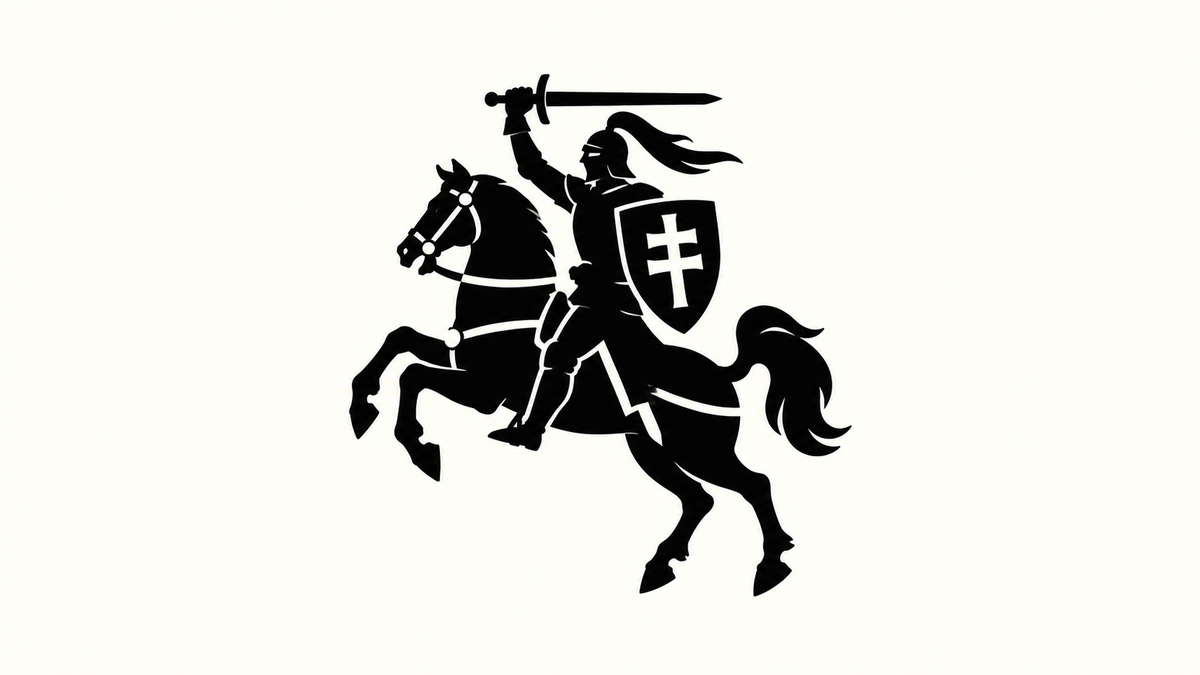
The Vytis is Lithuania’s national emblem: an armored knight rides a white horse on a red field, sword raised and carrying a shield bearing a double cross. The image originated in the seals of the grand dukes at the end of the 14th century and gradually became the emblem of the Grand Duchy of Lithuania as a whole. After the occupations and bans of the 20th century, the Vytis was restored with independence.
| Name | Vytis |
|---|---|
| Form | Armored knight on a white horse |
| Field | Red |
| State origin | Grand Duchy of Lithuania, late 14th century |
| Status | Official coat of arms of the Republic of Lithuania |
Why does a rider represent the state?
Medieval seals initially show the sovereign himself on horseback, armed like a knight.
Over time, this personal image became a symbol of the country governed by the grand duke.
When did it become the emblem of the grand duchy?
The Lithuanian Seimas places the turning point at the end of the 14th century and under Vytautas, who ruled from 1392 to 1430.
At the beginning of the 15th century, the rider was already used as the state’s coat of arms on grand seals.
What does the rider’s shield bear?
The shield displays a gold double cross on a blue background, another historic element of Lithuanian heraldry.
The rider and this cross now form a composition codified by law.
Why did the Vytis disappear in the 20th century?
The Soviet and Nazi occupations interrupted the normal use of the symbols of the independent state.
Nevertheless, the Vytis remains a sign of continuity and resistance among the diaspora and national movements.
What is its current status?
The independent Republic restored the Vytis as the national coat of arms.
The Seimas defines its colors and details: silver horse and rider, red field, blue shield, and double gold cross.
The symbol is distinct from the Gediminas Columns, another historic Lithuanian emblem already covered in the Grimoire.
Historical sources and landmarks
The Seimas of the Republic of Lithuania traces the history of the Vytis from the seals of the grand dukes to the current coat of arms.










