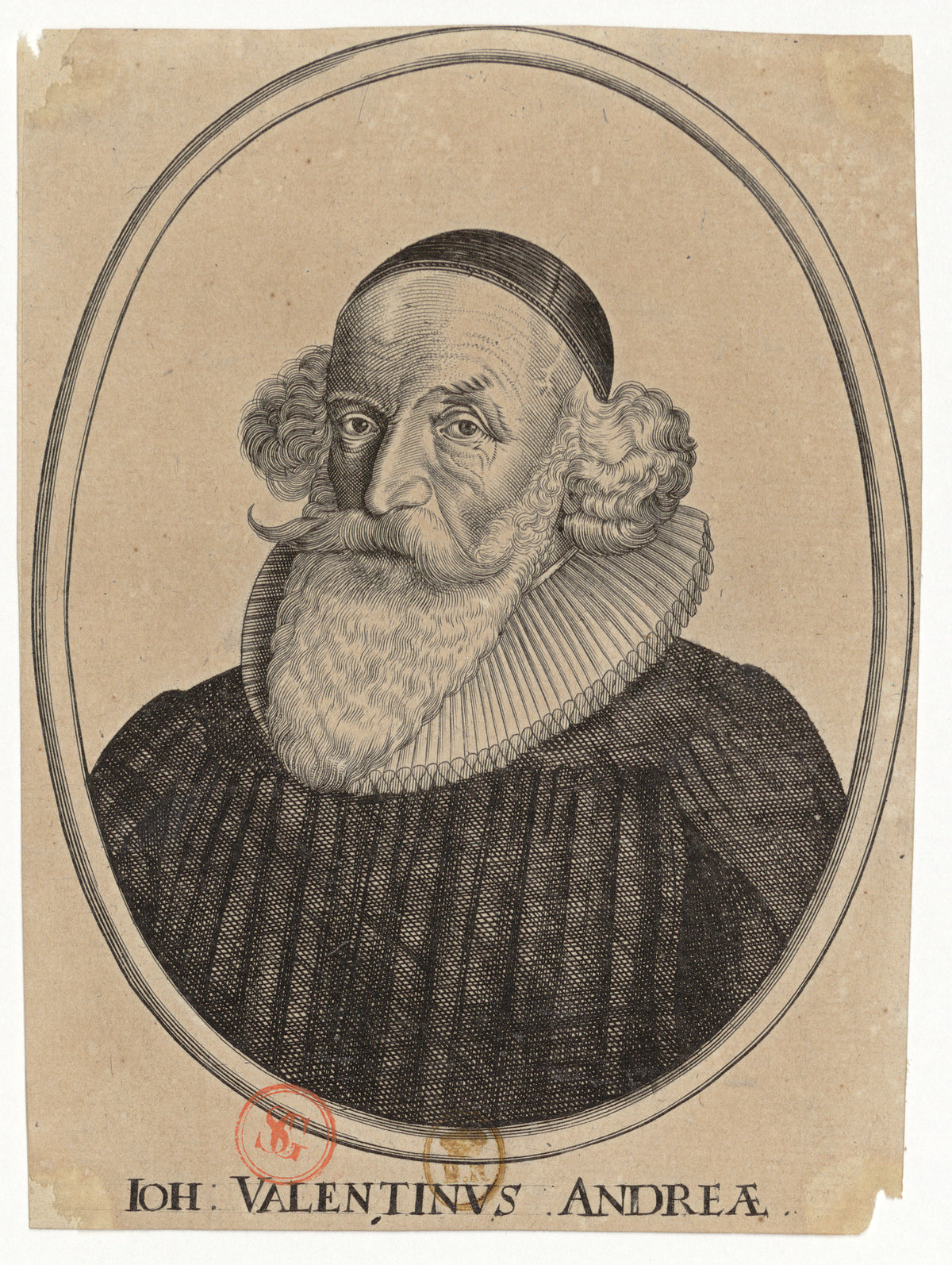
Johann Valentin Andreae occupies a strange place in the history of Western esotericism. A Lutheran theologian, writer, social reformer, author of a Christian utopia, and a major figure in the first Rosicrucian dossier, he stood at the intersection of theology, alchemy, satire, the reform of knowledge, and the ideal of an invisible fraternity. His name is linked to the Rosicrucians, but it would be misleading to portray him simply as the founder of a secret order in the modern sense.
Andreae belonged to the early 17th-century generation for whom religious reform, medicine, mathematics, the study of nature, and the occult arts could still form part of the same intellectual horizon. The Rosicrucian manifestos emerged in this climate: they announced a transformation of knowledge, a renewal of Christianity, and the existence of a discreet fraternity that was said to have preserved a wisdom inaccessible to ordinary scholars.
The question then becomes unavoidable. Did Andreae create the Rosicrucians, participate in a real fraternity, write a fiction that spiraled out of control, or later attempt to conceal his involvement? The sources do not allow such a simple answer. They do, however, show a man directly connected to the Tübingen circle from which the first Rosicrucian texts emerged, the undisputed author of The Chymical Wedding of Christian Rosenkreutz, and a lifelong advocate of a Christian reform of knowledge and society.
Understanding Andreae therefore requires holding together two dimensions that later interpretations separated: the literary game and the program of reform. Behind the irony, pseudonyms, and initiatory narratives lies a constant conviction: knowledge has value only if it transforms life, education, the Church, and the human community.
A Childhood at the Heart of German Lutheranism
Johann Valentin Andreae was born on August 17, 1586, in Herrenberg, in the Duchy of Württemberg. He grew up in a family closely connected to the history of German Lutheranism. His father, Johann Andreae, was a theologian and became abbot of Königsbronn. His grandfather, Jakob Andreae, played an important role in the doctrinal controversies of the 16th century and in the drafting of the Formula of Concord.
This lineage matters greatly. Andreae was not an outsider on the margins of the ecclesiastical world. He belonged to a family established within Lutheran institutions. His later interest in alchemy, learned societies, and the Rosicrucians should therefore not be understood as a complete break with his background. For him, the search for hidden wisdom almost always remained anchored in a Christian horizon.
His father died in 1601. The family then moved to Tübingen, where Andreae continued his studies. He earned his bachelor's degree in 1603 and his master's degree in 1605. He was interested in theology, but also in mathematics, mechanics, music, languages, and the natural sciences. The old German biography notes that he received instruction in mathematics from Michael Mästlin, who had also been Johannes Kepler's teacher.
This intellectual openness partly explains the form of his work. Andreae never writes solely as a theologian. He thinks as a dramatist, satirist, organizer, educator, and amateur scientist. His early texts include plays and literary compositions. From a very young age, he was already experimenting with the forms that would later allow him to conceal a serious program beneath the mask of a narrative, allegory, or learned joke.
In 1607, a university scandal connected with a satirical writing forced him to leave Tübingen. He then traveled through several regions of Europe. The sources place him in Strasbourg, Switzerland, France, Austria, and Italy. His stay in Geneva seems to have left its mark through the ecclesiastical discipline and organization of religious life that he observed there.
This period of travel played an important role in his development. Andreae discovered other forms of Christian organization and other intellectual circles. He did not return from these journeys with plans for ceremonial magic or a school of alchemists. What he increasingly sought was a reformed, disciplined, educated Christian society capable of putting knowledge at the service of the common good.
The Tübingen Circle and the Birth of a Rosicrucian Imaginary
Even before his travels, Andreae frequented a group of scholars in Tübingen that played a decisive role in the history of the Rosicrucians. Around the jurist Christoph Besold and the physician Tobias Hess gathered several men interested in theology, history, prophecies, the reform of knowledge, and the esoteric traditions of the Renaissance.
This group was not an established Rosicrucian lodge with degrees, rituals, and a membership register. Modern research instead describes it as a circle of friends and intellectuals. Yet it was within this milieu that several themes later appearing in the manifestos took shape: the general renewal of knowledge, inner Christianity, reforming medicine, criticism of universities, an apocalyptic reading of history, and the expectation of a new age.
The intellectual context was also shaped by Paracelsus and his heirs. Chemical medicine, the philosophy of nature, and the idea that the visible world contains signatures to be deciphered circulated widely throughout the German-speaking lands. Authors such as Heinrich Khunrath had already attempted to unite Christianity, alchemy, Christian Kabbalah, and the reform of knowledge.
Andreae therefore found himself in the midst of a landscape where esotericism did not constitute an isolated sphere. It engaged with theology, medicine, mathematics, and projects for social reform. The Rosicrucian movement emerged in this zone of contact. This explains why the earliest texts can be read simultaneously as initiatory literature, learned satire, religious manifesto, and program for intellectual transformation.
After his return, Andreae resumed his theological studies between 1612 and 1614. In 1614, he became a deacon in Vaihingen an der Enz. On August 2 of the same year, he married Agnes Elisabeth Grüninger. The couple would have nine children.
That same year, 1614, the Fama Fraternitatis appeared in Kassel. Learned Europe suddenly discovered the story of a secret fraternity founded by Christian Rosenkreutz, a traveler initiated into the hidden sciences of the East, whose tomb was supposedly rediscovered one hundred and twenty years after his death. The text called for a “general reformation” of the world and invited scholars of good will to respond to the fraternity.
The publication caused considerable agitation. Readers wrote publicly to the invisible brothers, some authors defended them, while others accused them of fraud, heresy, or illicit magic. The Rosicrucian movement became a European phenomenon even before anyone could demonstrate the physical existence of the fraternity described in the manifesto.
Did Andreae write the Rosicrucian manifestos?
The answer requires distinguishing the three major texts associated with the first Rosicrucians. The Fama Fraternitatis appeared in 1614. The Confessio Fraternitatis followed in 1615. Finally, the Chymical Wedding of Christian Rosenkreutz was published in 1616 in Strasbourg.
For the Chemical Wedding, the evidence is strong: Andreae himself acknowledged that he had composed the text in his youth. His autobiography links it to his years in Tübingen, and modern studies generally place its composition around 1605. The book, however, was published anonymously more than a decade after it was composed.
The Fama and the Confessio raise a different question. Some historiography attributed both manifestos directly to Andreae. Other scholars have emphasized the role of Tobias Hess, Christoph Besold, and the Tübingen circle. More recent research tends to regard collective or semi-collective composition as highly plausible.
Several elements nevertheless link Andreae to this body of work. He belonged to the group that shared the manifestos’ central ideas. Phrases from the Confessio appear in his own writings. His immediate circle participated in disseminating texts connected with the first publication. His role in shaping the Rosicrucian imagination therefore cannot be reduced to coincidence.
It is nevertheless prudent to avoid such a categorical formulation as “Andreae invented the Rosicrucians single-handedly.” The early Rosicrucian movement looks more like a creation that emerged from an intellectual milieu than the solitary work of a founder. Andreae occupies a major place in it, but the evidence bears traces of ideas circulating among several authors.
The question of whether a fraternity existed before the manifestos is even more delicate. No archival document establishes the existence, before 1614, of an organized order corresponding to the account in the Fama. The tomb of Christian Rosenkreutz, the first brothers, and their history belong to the narrative framework of the texts.
This does not mean that the entire project is empty or mocking. The fiction serves to stage a serious idea: a few learned, pious, and discreet men might unite their knowledge, provide free medical care, move beyond academic quarrels, and participate in a general reform. The fraternity’s story gives an imaginary body to an ideal that is very real.
Andreae would later use the Latin term ludibrium in connection with the Rosicrucians. The word was too quickly translated as “hoax.” It can refer to a game, a satirical fiction, a theatrical construction, or a learned joke. For Andreae, the term makes it possible to distance himself from a literal reading of the fraternity without thereby cancelling the moral and intellectual program it embodied.
This ambiguity lies at the heart of the character. Andreae seems to have wanted to provoke reflection through fiction. When readers began physically searching for the invisible brothers, writing letters of allegiance, and presenting themselves as representatives of the order, the literary game took on an autonomy its author no longer controlled.
The biographies of Michael Maier and Robert Fludd show what happened next. Both took the Rosicrucian message seriously and gave it considerable alchemical, philosophical, and religious scope. The Rose Cross then left the circle of Tübingen to become a European language.
The Chymical Wedding, the book that escaped its author
The Chymical Wedding of Christian Rosenkreutz remains Andreae’s most important work for the history of esotericism. The book presents itself as the account of an adventure experienced by Christian Rosenkreutz over seven days. A mysterious invitation leads the hero to a castle where a royal wedding is to be celebrated.
The narrative works as a succession of trials. The guests are weighed, examined, and separated. Some prove unworthy. Others continue along the path. The reader moves through rooms, ceremonies, riddles, symbolic executions, laboratory operations, and scenes of resurrection. The text accumulates signs without providing a definitive key.
The royal wedding belongs to the old language of alchemy. The union of the king and queen may evoke the conjunction of opposites, the reunion of the Sun and the Moon, sulfur and mercury, the active and the passive. But Andreae is not writing a disguised laboratory manual. The book deliberately blends alchemy, theater, satire, religion, the marvelous, and initiation.
Part of its power comes precisely from this indeterminacy. The reader is placed in the position of the candidate who never knows whether they correctly understand what they see. Characters who appear too self-assured are regularly ridiculed. True initiation requires less proclaiming knowledge than recognizing the limits of one’s understanding.
The seven days give the narrative an almost liturgical structure. Each stage brings Rosenkreutz closer to a center he does not entirely control. The castle becomes a closed world in which knowledge is acquired through participation rather than simple reading. This is one of the reasons the text exerted such a fascination on later Rosicrucian movements.
He also introduces a powerful moral dimension. The candidates are not judged solely on their erudition. Their vanity, conduct, and ability to endure the trial matter just as much. Knowledge without inner transformation is not enough.
This idea accords with a conviction that would reappear in his openly Christian works. True knowledge must produce a reform of the human being. The alchemy of the Wedding thus becomes a possible image of spiritual transformation, without it being necessary to reduce every scene to a fixed correspondence.
Finally, the book possesses a quality that doctrinal readings can easily obscure: it is funny, strange, and deliberately disconcerting. Andreae plays with the reader. He draws the reader in with the emblems of the arcane, then refuses to provide a completely closed system. This movement explains part of the text's longevity.
From the Rose Cross to Christianopolis
From the late 1610s onward, Andreae gradually distanced himself from public Rosicrucian agitation. In Turris Babel, published in 1619, he criticizes the chaos of commentaries, claims, and polemics that had formed around the fraternity.
This withdrawal does not, however, amount to abandoning his reforming ambitions. At the same time, Christianopolis, one of his major works, was published. In it, Andreae describes an ideal Christian city organized around education, work, discipline, community life, and the development of knowledge.
The shift from the invisible fraternity to the ideal city is revealing. In the manifestos, a few hidden brothers preserve and transmit superior knowledge. In Christianopolis, the project becomes institutional: schools, workshops, a community, an economy, and a religious life capable of shaping better human beings must be organized.
Andreae therefore does not abandon the dream of transformation. He seeks to make it more concrete. His interest in Christian societies, scholarly networks, and educational programs extends the reforming core of early Rosicrucianism in another form.
He also wrote texts devoted to the image of a Christian society and to the possibility of bringing educated men together around a shared moral commitment. Here again, the fraternity was not sought for its secrets or its initiatory prestige. It was meant to produce works, educate, provide aid, and reform existing institutions.
This orientation helps explain why Andreae was hostile to readers who saw in the Rose Cross nothing but promises of secrets, transmutations, or hidden powers. In his view, the pursuit of arcana without moral reform reproduced exactly the defects he wanted to combat.
Andreae's Rosicrucianism is therefore not merely a question of attribution. It is a question of purpose. What use is hidden knowledge if it does not make society more just, the Church more demanding, education better, and scholars more responsible? His entire subsequent career can be read as an attempt to answer this question concretely.
Calw, the War, and the Transition from Utopia to Action
In 1620, Andreae became superintendent in Calw. He then had a real setting in which to implement some of his ideas. Studies of his local work show that he did more than preach. He supported youth education, aid for the poor, scholarships, and the establishment of a public library.
The reform he had staged in his books thus became the daily work of religious and social administration. Andreae wanted to form communities disciplined through study and charity. The gap between Rosicrucian literature and this pastoral activity is smaller than it appears: in both cases, knowledge must bring about a collective transformation.
The Thirty Years' War brutally destroyed part of this work. In 1634, Calw was looted and set ablaze by imperial troops. Andreae lost his home and his library. This episode marked a major turning point in his life. The man who had imagined orderly cities now had to work amid a country ravaged by war.
At the end of the 1630s, he moved to Stuttgart. In 1639, he became court preacher and consistorial adviser. He took part in reorganizing Württemberg's ecclesiastical and educational system. In 1641, the University of Tübingen awarded him a doctorate in theology.
His activity remained considerable. He preached, wrote, administered, corresponded, and sought to strengthen the clergy’s education. The University Library of Tübingen notes that his surviving correspondence exceeds five thousand letters. This network shows the extent to which Andreae belonged to a European Republic of Letters, far beyond the Rosicrucian episode alone.
In 1646, he joined the Fruchtbringende Gesellschaft, a major German linguistic society, under the name “Der Mürbe.” Four years later, he left Stuttgart and became abbot of Bebenhausen as well as general superintendent. In 1654, he also received the prelacy of Adelberg.
Andreae died in Stuttgart on June 27, 1654. He left behind an immense body of work, but also an image blurred by three centuries of Rosicrucian narratives. Orders that would later claim Christian Rosenkreutz as their founder would portray him variously as a concealed initiate, a founder, or an author who had publicly repudiated a very real fraternity. Historical sources demand a more nuanced reading.
What Andreae Truly Transmitted to Western Esotericism
It would be reductive to regard Andreae as an occultist in the sense this term would acquire in the 19th century. He did not found an initiatory order comparable to modern Rosicrucian societies, nor did he construct a system of ceremonial magic. His importance lies elsewhere.
He helped create a model of exceptional power: that of an invisible fraternity of Christian sages, heirs to ancient knowledge, devoted to healing and reforming the world. This model would survive long beyond its original Lutheran context.
Later generations would reinterpret this fiction as an initiatory tradition. Alchemists, Freemasons, Theosophists, occultists, and modern Rosicrucian orders would give it new genealogies. However, there is no simple documentary continuity allowing these later organizations to be directly linked to a historical fraternity active before 1614.
Andreae also conveys a way of writing about esotericism. The Chymical Wedding does not present a catechism. It constructs a space of symbols, trials, and ambiguities in which the reader must work. This form would be adopted in a large part of later initiatory literature.
Finally, it reminds us that the esotericism of the early 17th century cannot be artificially separated from theology, the sciences, educational policy, and social reform. For Andreae, secrecy has value only if it leads to a higher form of responsibility.
That is the paradox. The man who helped give Europe one of its most enduring occult myths spent much of his life trying to redirect that myth toward education, charity, discipline, and Christian reform. The Rosicrucian mystery outlived him precisely because it was never entirely resolved.
Sources and key points
The Deutsche Biographie provides the main biographical details: born in Herrenberg on August 17, 1586, studied in Tübingen, left the university in 1607, served as a minister in Vaihingen and then Calw, held positions in Stuttgart, Bebenhausen, and Adelberg, and died in Stuttgart on June 27, 1654.
The University Library of Tübingen presents Andreae as a theologian, writer, and utopian, documents his membership in the Tübingen circle, his role in early Rosicrucianism, his social work in Calw, and the breadth of his correspondence.
Academic studies published by Cambridge University Press place the Rosicrucian manifestos in the context of the reform of knowledge and discuss Andreae's role in their drafting and reception.
Works devoted to the author and the worldview of the early manifestos at Brill emphasize the Tübingen circle and the hypothesis of a composition by several hands, making it impossible to reduce the matter to the idea of a single author.
The portrait used on the cover is a 17th-century engraving depicting Johann Valentin Andreae, held in the collection of the Bibliothèque Sainte-Geneviève and released into the public domain.

Par Olivier of Aeternum
Passionate about esoteric traditions and the history of the occult from the earliest civilizations to the 18th century, I share articles exploring these subjects. I am also a co-founder of Aeternum, the online esoteric store.