





























































































There is something in the ruins of Greek temples that never fades. Hellenism was a way of seeing the world, of living in connection with the divine, nature, and the city, a religion before religion. Yet it is not based on a revelation, a holy book, or a mandatory personal faith. It does not require conversion or promise universal salvation. Born on the shores of the Aegean Sea, it has never completely disappeared. Even today, there are voices calling upon Apollo, honoring Demeter, or saluting Zeus. It is toward this tradition that we turn here.
Hellenism, from the culture to the religion of Ancient Greece
Hellenism refers to the polytheistic religion practiced in Ancient Greece for more than 1,000 years, from the 2nd millennium BCE to the 4th century CE. It developed without sacred scripture or imposed dogma, drawing on a rich body of myths and rites passed down through tradition. At the heart of this faith are numerous anthropomorphic deities (gods and goddesses in human form), at least known to us by name, led by Zeus, the king of the sky. Honoring the gods is an integral part of civic and family life: it is a religion lived out every day, from the domestic hearth to the great pan-Hellenic sanctuaries.
The word Hellenism comes from the Ancient Greek Hellēnismos, which initially meant “the Greek language and culture,” in opposition to what was foreign (barbaros). Over time, hellēnismos came to refer to Greek identity as a whole: the way of living, thinking, speaking, and honoring the gods. During the Hellenistic period (after Alexander the Great), the word took on a broader meaning: it encompassed the spread of Greek culture throughout the Mediterranean basin, as well as the preservation of Greek religious practices in an increasingly cosmopolitan world. It was only much later, in the modern era, that the word “Hellenism” came to be used to refer to the ancient Greek religion itself.
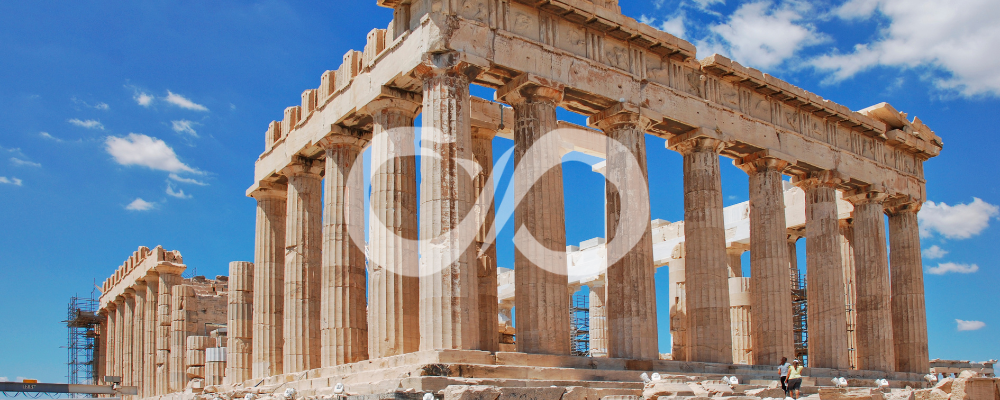
Hellenism is sometimes defined as the celebration of beauty, which is correct in a certain sense, but it is not only what pleases the eye or seduces the senses. It is that which manifests order, harmony, proportion, clarity, and correctness. This beauty is connected to truth, goodness, and the cosmos, and it permeates everything: the body, speech, ritual gesture, the temple, the law, music, and moral conduct. It is a visible manifestation of divine balance. The Greeks did not invent beauty, but they conceived of it as a reflection of the divine in the sensible world. That is why the gods are as beautiful as their temple: not out of vanity, but because they embody the perfect measure of each thing.
The Pantheon of the Gods of Olympus
The Hellenic pantheon is composed of a multitude of gods and heroes revered for their powers over the natural world and human society. At its summit sits Zeus, of course, master of the sky and storms, guarantor of cosmic and social order. Alongside Zeus sit the great Olympian deities, his divine family: Hera, his wife, is the protector of marriage and fertility; Athena, born from Zeus alone, goddess of wisdom and military strategy, watches over the cities; Apollo, son of Zeus and Leto, solar god of the arts, oracles, and poetry, bestows music and prophecies; his sister Artemis reigns over the wild and the hunt. Poseidon, Zeus's brother, rules the sea and earthquakes, while Demeter brings the harvests to ripeness and ensures the fertility of the earth. Among them are also Ares, the impetuous god of offensive warfare; Aphrodite, goddess of love and beauty, born from the sea foam; Hermes, the divine messenger with winged sandals, patron of travelers and merchants; and Hephaestus, the smith god of fire and volcanoes. According to tradition, these twelve great gods reside on Mount Olympus and form a celestial court united around Zeus. In reality, the composition of the Dōdekatheon (the group of the “twelve gods”) varies according to the regions (at that time, ancient Greece was a world fragmented into autonomous city-states).

Temple of Zeus or Olympieion, Athens
Around the Olympians throngs a multitude of other sacred beings. Local gods abound: every city and every region of Greece honors particular tutelary deities, identified with the Olympians by distinctive epithets (for example, Zeus Ammon in Libya, equated with a Berber god). Greek religion also incorporates the forces of nature: woods, rivers, and mountains are populated by nymphs and rustic gods such as Pan, the goat-god of shepherds, or the Nereids, sea nymphs. Abstract concepts can take divine form, like the Moirai (Fates), who spin the lives of mortals, or Nike (Victory). Greek gods share the trait of adopting forms and behaviors comparable to those of humans. They marry, have children, feast, and may even quarrel, while displaying extraordinary power and immortality that raise them far above human beings. Finally, the Greeks worship an hero worship: these semi-divine figures, born mortal but endowed with prestige, continue after their death to intercede with the gods and protect their people. Legendary heroes such as Heracles (Hercules) - son of Zeus who was welcomed among the gods of Olympus after his exploits - or Asclepius, Theseus, and many others have their sacred tombs and receive offerings at their local sanctuaries. In the Classical period, Persephone (Proserpina), daughter of Demeter and queen of the Underworld, also ranks among the major deities honored in connection with the cycle of the seasons and the underworld. À

Theater of Dionysus, Athens
Indeed, Persephone initially lives on Mount Olympus, in the light of the world of the living. But one day, Hades, king of the Underworld, rises from the earth and carries her off to his underground kingdom to make her his queen. Demeter, struck by grief, leaves Olympus and interrupts all growth on earth. Nothing germinates, nothing grows, and the fields become barren.
Faced with this distress, Zeus intervenes. He demands that Hades return Persephone to her mother. But before letting her go, Hades makes her taste six pomegranate seeds (she was famished, after all), a symbol of an irreversible bond with the world of the dead. From then on, a compromise is necessary: Persephone will spend part of the year with her mother, on earth, and another part in the Underworld, alongside Hades.
It is this back-and-forth that marks the rhythm of the seasons. When Persephone returns to the surface, nature blooms again and the crops are reborn: it is spring and summer. When she returns underground, the earth closes up, vegetation dies, and autumn followed by winter arrives.
Places of worship, rites and festivals
Hellenic worship is expressed above all through ritual acts, performed according to custom to honor the gods. The central place of religious practice is the sanctuary (hierón), a sacred open-air space. It typically contains an altar (bōmós) - the heart of the ritual - and often a temple (naós) housing the deity's cult statue. The Greek temple is the “dwelling of the god”: it contains the god's image and offerings, but public ceremonies take place exclusively outside, on the esplanade and around the altar. Some sanctuaries, such as those of Zeus at Olympia or Apollo at Delphi, periodically attract crowds of pilgrims from throughout the Greek world during panhellenic festivals. Other places of worship are more modest, dedicated to a protective deity of a city or rural community. At every level - from the domestic hearth to the great temples - rituals aim to establish a tangible connection between the human community and the divine world.

Temple of Athena Nike, Athens
Animal sacrifice, although cruel, is the central rite of classical Greek religion. This ritual follows a codified sequence: after the procession and prayer, a flawless animal (ox, goat, ewe, etc.) is slaughtered on the altar, generally at dawn. The Greeks then share the victim with their gods according to a symbolic division during a banquet attended by human participants, while the gods receive as an offering the smoke of the bones and fat burned for them. This sacred banquet seals the alliance between heaven and the city, while strengthening the cohesion of the community of worshippers around the common table. Alongside animal sacrifices, bloodless offerings are also practiced: libations of wine poured onto the ground or altar, libations of honey or milk, flour cakes, fruit, flowers, incense, and various valuable objects are presented to the gods to seek their favor. A single grain of incense cast into the sacred fire may be enough to express daily piety. Votive deposits (material offerings) are also common: the Greeks place weapons, treasures, or statuettes in sanctuaries, in thanks for a fulfilled vow or in prayer for particular protection. Every important ritual begins with purifications (lustrations with lustral water, fumigations) and is accompanied by prayers spoken aloud, with arms raised toward the sky, to express the request addressed to the honored god.

Bas-relief depicting the Panathenaea, Athens. Source: Louvre
Religious celebrations are part of the civic calendar. Throughout the year, each Greek city organizes major festivals (ἑορταί) in honor of its deities. These festivals combine solemn rituals and collective festivities: exceptionally large public sacrifices (for example, the Hecatomb, which theoretically involves one hundred oxen), richly decorated processions through the streets, athletic, musical, or dramatic competitions, and banquets open to citizens. Thus, in Athens, the Panathenaea in honor of Athena (and the city's most important festival) feature a grand procession to the Acropolis, while at Delphi or Dodona, games and songs were dedicated to Apollo. Likewise, Athens's Great Dionysia celebrate Dionysus with processions of thiasoi (corteges of fervent devotees) and the organization of theatrical competitions featuring tragedies and comedies. At Olympia, the festival of Zeus, held every four years, brings together Greeks from all the cities for sacred athletic contests: these are the famous Olympic Games, regarded as offerings of human physical excellence to the king of the gods. These religious festivities have a strong civic dimension: they help secure the gods' favor for the city in the coming year by giving them all the honors they are due. They also provide an opportunity for the population to celebrate its shared identity through fervor, music, and the sharing of the sacrifice.

Representation of the Komastes in a cup (participants in a komos, a joyful procession associated with Dionysus). Source: Open Edition
Finally, among the essential rites is divination, a privileged means of communicating with the divine will. The Greeks seek to learn the gods' wishes before major decisions (the founding of a colony, a military undertaking, etc.) by consulting oracles, fortune-tellers. The most prestigious is the oracle of Apollo at Delphi: the Pythia, a priestess inspired by the god, gives her enigmatic answers to pilgrims in the temple of the sanctuary of Delphi.
A representative example is that of King Croesus of Lydia (6th century BC). Before going to war against the Persian Empire, Croesus consults the Oracle of Delphi. The Pythia replies:
— If you cross the Halys River, you will destroy a great empire.
Croesus thinks it is the Persian Empire. He therefore launches his attack... and loses. The oracle was right: he did destroy a great empire, his own.
Other famous oracles include that of Zeus at Dodona (where signs were interpreted through the rustling of the sacred oak leaves or the sound of cauldrons) and that of Zeus Ammon in Egypt. Divination could also be practiced by observing signs (sēmeia) in daily life: the flight of birds, a flash of lightning in the sky, or even the examination of the entrails of a sacrificial victim were all messages that seers attempted to decipher. While the dream through Oneiromancy was considered a channel of revelation, it was above all institutionalized oracular practice that structured the consultative relationship between the Greeks and their gods. Through these various forms of mediation, Hellenism offered worshippers a framework for understanding the divine will and seeking guidance from the gods at decisive moments.
Gods and worshippers: a relationship of exchange
Ancient Greek religion is based on an implicit exchange pact between humans and the divine. Mortals honor the gods through rites and gifts, and in return they hope for protection, abundance, and prosperity. “I give so that you may give” - according to the principle later formulated in Latin as do ut des - summarizes the spirit of civic cults. Each sacrifice and each festival thus reminds the gods of the homage rendered to them and seeks their goodwill in return. This is not merely a material transaction, but the preservation of harmony: by nourishing the gods with respect and offerings, the Greeks ensured that they would not attract celestial wrath and could preserve the order of the world as ordained by Zeus. Piety (eusebeia) was, in their eyes, a fundamental virtue, consisting of showing the gods scrupulous respect in both ritual and moral life. Offending the gods through pride or sacrilege - that is, committing hybris (excess) - called for exemplary punishment in return. Myths abound with stories of mortals punished for their irreverence or arrogance (such as Niobe, turned to stone for comparing herself to Leto, or Icarus, struck down for defying the heavens). Conversely, examples of divine favor encouraged piety: heroes protected by Athena or Apollo triumphed through their devotion, and certain families or cities prospered under the wing of a tutelary god.
For fans of streaming series, you can watch the series Kaos on Netflix, which ultimately provides a good summary of this cult and, above all, the consequences of Zeus's anger.
Nevertheless, and this is important, Greek religion does not teach a morality that is necessarily rewarded in the afterlife. The fate of the soul after death is generally envisaged without exaltation: ordinary deceased people descend into the realm of Hades, a dull and melancholy universe where shadows persist without joy, but which is not a world of punishment. Only a few chosen heroes enjoy a happy rest in the Isles of the Blessed or the Elysian Fields, while unrepentant criminals suffer eternal punishments in Tartarus. Classical Hellenism mainly values the present life, in which the pious person hopes for timè - the honor granted by the gods and humans - rather than posthumous salvation. The role of religion is first and foremost to preserve the balance between humanity and the divine in this world. Thus, Greek priests and priestesses are servants of the cult rather than spiritual guides: they ensure the proper performance of ceremonies and the purity of sanctuaries, without constituting a clergy separate from society. No creed is imposed on the faithful apart from acknowledging the gods and observing ritual practice: no catechism or defined "orthodoxy" governs religious thought, this concept itself being foreign to the Ancients. It is enough for a Greek to "do what is pious" - celebrate the rites of their city and respect sacred prohibitions - to be considered a good practitioner, without their inner convictions being questioned. This freedom of thought explains how, despite the prevailing "religiosity," critical thinkers such as Xenophanes or Socrates were able to question the myths or morality of the gods (although Socrates was ultimately condemned for asebeia, impiety). In fact, from the 5th century BC onward, philosophical and ethical reflection led some to view the gods in a more allegorical or rational way, without thereby breaking with the traditional framework of worship. An ultimately very open and avant-garde vision of the cult.
In the Greek tradition, sacred prohibitions generally concern gestures, attitudes, or serious transgressions against the order and the gods. Acts of hubris (excess) lead to eternal punishments in Tartarus. A few examples:
-
One must not compare oneself to the gods: when a mortal compares themselves to a god or attempts to equal one, they cross a boundary that the divine order will not tolerate. This is what happens to Niobe, who boasts that she has more children than the goddess Leto. Her children are killed by Apollo and Artemis, and she is turned to stone with grief.
-
One must not deceive the gods: Tantalus, a well-born king close to the gods, commits an absolute offense by serving the flesh of his own son as a meal to the immortals, to test their divine knowledge. The gods recognize the horror, reject the offering, and punish him in Tartarus. There, he stands in water beneath fruit trees, but the water withdraws and the fruit eludes him whenever he tries to feed himself.
-
One must not betray a god: Ixion is welcomed by Zeus despite his troubled past. In return, he attempts to seduce Hera. To trap him, Zeus sends him an illusion of Hera, with whom Ixion unites. For this affront, Ixion is cast into Tartarus, chained to a flaming wheel that spins endlessly.
-
One cannot escape the gods: Sisyphus, a cunning king, attempts to escape death by chaining Thanatos (Death itself), then voluntarily returns to the world of the living, claiming that a funeral rite was forgotten. When the gods catch up with him, they send him to Tartarus, where he must eternally roll a boulder up a hill, only for it to roll back down every time.
5. Men, Women, and Sexuality in the Hellenic Order
In ancient Greek religion, the gods do not impose a single moral order, but their existence shapes how men and women perceive themselves in the cosmos, the city, and worship. Mythological stories depict active, carnal, powerful gods, capable of loving, desiring, becoming jealous, or punishing. Although immortal, these divine figures share an emotional, sexual, and political life with humans. This means that Hellenic religion is integrated into the natural and social cycle.
Men hold a predominant place in the major civic cults. They preside over public sacrifices, participate in competitions, lead processions, and sit on religious councils. But women, far from being absent, hold essential ritual functions: they officiate as priestesses, weave sacred garments, prepare offerings, and lead autonomous women's cults. Certain festivals, such as the Thesmophoria in honor of Demeter and Persephone, are reserved exclusively for them. The priestesses of Athena, Apollo, Artemis, and Dionysus play an active role in mediating between the gods and the living, and their office is recognized, respected, and passed on. In the Greek world, the gods need women.
The human body is not experienced as a source of shame. It is an object of care, strength, and beauty, often represented naked in sacred art as well as in sanctuaries. Sexuality is not subject to any religious prescription. It is neither punished nor sanctified nor reduced to a single norm; it is, in fact, normalized. The gods themselves love both women and men. Zeus seduces Hera as well as Europa (a woman), Ganymede (a young man), and Callisto (a young woman). Apollo loves Hyacinthus (a young man). Dionysus sometimes changes appearance or gender, or inspires states of exaltation in his followers in which identities merge. Religion does not condemn these stories: it passes them on as simple truths about the world.
In society, sexual relations between men are not taboo. They may take place within an educational, emotional, or ritual framework, without being reduced to a simple act or an orientation. In Athens in particular, relationships between free men could follow a structured, socially recognized framework called paiderastia (literally, love of boys in a structured and social relationship, a term that would later be used very pejoratively as “pederasty”). This bond brought together an adult man, called the erastès (the “lover,” the one who gives), and a pubescent adolescent, called the eromenos (the “beloved,” the one who receives). It was not a fleeting relationship, but an educational, emotional, and symbolic bond based on the transmission of knowledge, values, and civic habits in every aspect of life, even the most intimate (although this view of intimacy did not exist, or barely existed, in Greek society).
The erastès assumed the role of a model: he offered his attention, advice, and experience. However, he had to show restraint, respect, and sincere commitment. The eromenos, for his part, was not supposed to submit passively or seek favor without dignity: he had to choose his erastès freely, and his reputation depended on his ability to embody the virtues expected of a future citizen.

A erastès offering a hare to a eromenos, a traditional gift symbolizing affection and romantic interest.
Families monitored these relationships, poets spoke about them, and philosophers commented on them. Gross abuse, forced relations, commodification, or brutal excesses were frowned upon and could bring public dishonor to the adult and also, as we saw above, a place in Tartarus. In Athens, laws existed to bar a man who had had “unvirtuous” relations with a young citizen from holding certain public offices. The political, social, and divine spheres therefore imposed indirect control.
The purpose of this relationship was not simply carnal. It aimed to prepare the adolescent for his future role as a free man through imitation, dialogue, and closeness. This education through loving friendship rested on strict codes: once he reached adulthood, the eromenos ceased to be available for this type of bond, became an erastès in turn, and sometimes married. This logic did not exclude heterosexual relationships, but placed male sexuality within a cycle of education and transmission.
These bonds do not annul marriage or diminish women’s place, but fit into a more fluid and embodied view of desire. The world is full of forms, desires, and impulses. What matters is not the partner’s gender, but balance, boundaries, and decency in one’s relationship with the body and with others.
Hellenism draws no line of separation between the sacred and sensuality. Pleasure, desire, fertility, strength, beauty - all of these partake in the divine order. Aphrodite is not an abstract symbol: she inhabits living bodies, fertile unions, and gestures of attraction or tenderness. In certain festivals honoring Dionysus or Pan, the excesses permitted for a time remind us that the divine sometimes overflows human rules, and that the world cannot be reduced to reason.
Philosophical Perspectives on the Gods
Several philosophical schools of Antiquity proposed innovative interpretations of Greek religion while preserving a profound respect for the divine. These schools sought to reconcile inherited cult practices with a more abstract or ethical understanding of the gods, thereby illuminating certain spiritual values of Hellenism.
Orphism
Emerging as early as the Archaic period, the Orphic movement presents itself as an initiatory path centered on the purification of the soul and posthumous salvation. The Orphics trace their tradition back to the mythical poet Orpheus, who is said to have brought back sacred teachings from his journey to the Underworld. They propose a cosmogonic myth in which Dionysus Zagreus, son of Zeus, is killed by the Titans and then resurrected, with humanity arising from the ashes of the Titans struck down by Zeus. This story gives rise to a vision of the human condition: within every being shines a spark of the divine Dionysus, mingled with the Titans' blameworthy heritage. The soul must purify itself of material impurities to recover its celestial nature. Orphic followers therefore observe ascetic rules of life, such as vegetarianism, and celebrate secret initiatory rites, with hymns and sacred formulas, intended to ensure a better destiny in the afterlife. Unlike the classical public sacrifice, they mainly practice symbolic offerings, such as incense, and reject blood sacrifice, emphasizing a more inward relationship with the divine. Orphism influenced Greek religious thought by emphasizing the purity of the soul, the possible reincarnation of guilty souls, and the pursuit of a form of individual salvation - elements that sharply contrast with civic religion oriented toward the community.
Stoicism
The Stoic philosophers of the Hellenistic period (Zeno, Cleanthes, Chrysippus) and the Roman period (Seneca, Epictetus, Marcus Aurelius) propose a worldview in which God is conceived as a single, immanent, and rational principle. For them, Zeus is not merely the king of the gods of mythology; he is the Soul of the World, the universal Reason (Logos) that orders the cosmos. Cleanthes, a disciple of Zeno, celebrates in his Hymn to Zeus this divine Providence that “directs all things according to the law” and with which mortals should unite by living virtuously. The Stoics thus interpret the traditional gods as manifestations of the Logos: for example, Zeus represents fire and sovereign reason, Poseidon the aquatic element, Hera the ether, and so on. This reading gives polytheism a monotheistic dimension: a single God-nature unfolds into a multitude of divine powers. In terms of worship, the Stoics continue to practice the public rites of their city, believing that eusebeia (piety) is part of the sage’s duties. However, their piety emphasizes moral virtue: honoring Zeus means above all living in accordance with universal Reason and serenely accepting the order of the world as it is. Stoicism thus illustrates a spiritualization of Hellenism, in which mythology is reread allegorically and serving the gods amounts to cultivating ethics and reason.
Platonism
The famous philosopher Plato (5th-4th century BC) and his successors introduce a critical and metaphysical perspective on the gods of the city. In his work The Republic, Plato questions traditional myths that attribute immoral or unworthy actions to the gods, maintaining that divinity must be good and perfect.

It must be said that there is a real tension in Greek thought: on the one hand, the gods are honored as guarantors of the order of the world, patrons of justice, beauty, wisdom, etc.; on the other, or at any rate contradictory:
-
Zeus resorts to numerous deceptions and transformations to seduce or force mortal women.
-
Hera is jealous, cruel, and cunning.
-
Ares acts out of impulsiveness and a taste for carnage.
-
Aphrodite betrays her husband Hephaestus to sleep with Ares.
He advocates purifying religion of its overly human elements, retaining only what elevates the soul toward the Good. Plato conceives, at the summit of his hierarchy, a supreme reality, the Good or the One, a transcendent principle that surpasses even Zeus. Nevertheless, he acknowledges the existence of intermediary gods - whom he calls demons (daimones) or subordinate gods - charged with administering the sensible world in accordance with the orders of the demiurge (divine craftsman). Later Platonic philosophers, particularly during the imperial period (Plotinus, Iamblichus, Proclus), went further by fully integrating traditional religion into a complex theological system. Neoplatonism interprets the gods of Olympus as emanations of the One and practices theurgy rites to unite with divine intelligences (which seeks to establish contact with the gods not through prayer alone, but through rites, symbols, gestures, and invocations). In the 4th century AD, the emperor Julian, educated in Neoplatonism, attempted to restore the ancient religion by providing it with a unified philosophical theology: for him, myths were merely symbols, and the sage had to uncover their meaning in order to honor the one God through the worship of all the gods. Thus, Platonism and its successors sought to elevate Hellenism to the level of a universal philosophy, emphasizing the quest for the Good, intellectual purification, and the allegorical understanding of traditions.
Through these approaches, philosophers enriched Hellenism by contributing reflections on virtue, the fate of the soul, the unity of the divine, and the symbolic nature of myths, demonstrating the spiritual depth that a seemingly polytheistic and mythological cult could contain.
Heritage and Modern Revivals of Hellenism
After antiquity, Hellenism gradually declined with the Christianization of the Roman Empire. The triumph of Christian monotheism in the 4th and 5th centuries relegated the ancient religion to the status of a persecuted pagan tradition, and then to oblivion. Nevertheless, the influence of Greek religion continued in a diffuse form: many of its myths and divine figures survived in literature, the arts, and even in the form of saints and local legends. Proof of this is that we all know it, at least in part. During the Renaissance, the rediscovery of ancient texts and admiration for the beauty of sculpted gods revived interest in Greco-Roman paganism. This cultural heritage continues to nourish the imagination and thought to this day: the names of the gods of Olympus appear throughout our vocabulary, our planets, and our works of art, bearing witness to the lasting imprint of Hellenism on Western civilization.
From the 20th century onward, and even more so in the 21st, certain groups have undertaken to explicitly revive the Hellenic religion as a spiritual practice. This movement, described as Neopagan or reconstructionist, aims to restore the worship of the ancient Greek gods with seriousness and authenticity. In Greece itself, official associations were founded to promote the return of ancient worship: the Supreme Council of Ethnic Hellenes, abbreviated YSEE), founded in 1997, campaigns for the recognition of polytheistic Hellenism as a religion in its own right. Its members, like other devotees in Europe and America, define themselves as “ethnic Hellenes,” heirs to the Greek national religion transmitted through the centuries. Moreover, they prefer the term ethnic Hellenism or dodekatheism (“worship of the twelve gods”) to the designation “Neopagan,” in order to emphasize continuity with antiquity rather than a modern novelty.

Contemporary ritual in Greece organized by a Hellenist association: dressed in white tunics, participants honor the gods of Olympus with collective prayers and offerings. Source: Wikipedia
In practical terms, contemporary Hellenist groups seek to reconstruct ancient rites based on historical sources. Ceremonies are organized on the symbolic dates of the Attic calendar (Greek New Year, solstices, festivals of Athena, Apollo, Demeter, etc.), during which prayers, offerings of fruit, cakes, or incense, and libations of wine in honor of the Olympian gods are performed. The recitation of Homeric or Orphic hymns, the use of Ancient Greek in prayers, and the reconstruction of processions or sacred dances are part of their activities. Animal sacrifices, however, are generally replaced by symbolic offerings, in accordance with contemporary sensibilities. These modern devotees of Zeus, Hera, Athena, or Apollo thus embrace a form of spirituality alternative to the dominant monotheistic religions, centered on divine plurality, harmony with nature, and faithfulness to Europe's historical roots. Although a minority movement, it has gained visibility: in Greece, private temples dedicated to the ancient gods have been erected, and public gatherings are regularly held, for example on the slopes of Mount Olympus or at Delphi, to ritually celebrate the ancient pantheon.
Neo-Hellenists emphasize the humanistic and civic values inherited from Antiquity: religious tolerance (no exclusivity in worship), respect for the diversity of gods and cultures, and the pursuit of virtue in public life as an integral part of piety. They see Hellenism as a living tradition capable of inspiring a better understanding of oneself and the world, without sectarianism or aggressive proselytism. However, the movement remains discreet in the face of established Churches - particularly the Orthodox Church in Greece, which remains predominant and is sometimes critical of this pagan revival. Modern practitioners of Hellenism say they are pursuing a process of spiritual reconnection with the ancient gods: far from superficial folklore, they profess sincere devotion to theoi (gods) and theai (goddesses) of ancient Greece. By once again celebrating Zeus, the heavenly Father, wise Athena, radiant Apollo, and all the others, they echo, more than two millennia later, the voice of the ancient Hellenes.
From Antiquity to the present day, Hellenism thus appears as a complete and coherent religion. An elaborate polytheistic structure, public rites, and roots in civic life: ancient Greek religion is neither a mythological whim nor simple folklore, but a pillar of Hellenic civilization. It gave meaning to human actions by linking them to the divine, while still leaving room for reason and inner freedom. Hellenism belongs not only to the past. As long as there are voices to name the gods, gestures to honor them, and eyes to seek order in the world, this tradition will remain alive.

Par Olivier of Aeternum
Passionate about esoteric traditions and the history of the occult from the earliest civilizations to the 18th century, I share some articles on these topics. I am also co-creator of the online esoteric shop Aeternum.