



















































































































A rope stretched between two hands, a knot tightened around an object, a lace whose ends remain trapped: these actions belong to everyday work, but they have also given rise to a rich magical language. In many traditions, tying meant giving material form to the idea of holding fast. Unbinding suggested the return of movement, the opening of a passage, or the end of an obstruction. This language could concern an absent person, a marriage, a birth, a sea voyage, or the relationships between the living and invisible powers.
Yet the magical knot has never been a uniform technique shared by all peoples. The ties described by Greek poets, the belts of ancient Rome, and the ropes of northern sailors do not belong to an unbroken tradition whose original recipe can be recovered. They share an immediately understandable image—that of a bond that restrains or protects—but their meanings come from the cultures that used them. Literary texts, archaeological finds, and folk tales make it possible to trace these nuances.
This history must also be distinguished from that of the Witch’s Knot, an interlaced graphic motif that became a protective emblem in some contemporary esoteric circles. Here, the focus is on ropes, belts, ties, and their representations in magical thought. More than a catalogue of practices, this is a journey through the ways people have entrusted the act of binding with part of their relationship to fate.
A rope, a bond, and the power of things held fast
The symbolic power of the knot lies in a very simple property: it changes the state of a pliable material without turning it into a new substance. A loose rope becomes a bond that holds fast; once undone, it regains its mobility. This contrast gave rise to analogies between controlling an object and controlling a situation. The importance of this image does not mean that every knot is magical. The same actions are used to carry a load, secure a sail, fasten a garment, or gather materials in a workshop.
Everyday life in ancient societies made extensive use of cords and textiles. Plant fibers, leather straps, spun threads, and strips of cloth were used in homes, farms, sanctuaries, and boats. The knot was therefore not a sign reserved for a few figures reputed to possess occult knowledge. It was a familiar form to everyone, whose meaning could shift from practical work to a relationship between people or powers.
This shift is reflected in language. Verbs meaning “to bind” are also used to express obligation, commitment, and constraint. In Greek, the vocabulary of binding can extend to acts of magical domination; in Latin, word families built around ligare and nodus allow us to conceive of relationships that go beyond a mere cord. This kinship between word and gesture sheds light on traditions without proving that every metaphorical expression corresponds to a ceremony actually performed.
Ancient Egypt offers particularly early material evidence of this protective dimension. The tyet sign, known as the knot of Isis, represents a shape evocative of knotted cloth. The Metropolitan Museum of Art holds several amulets of this type, including examples made of red stone from funerary contexts. They are significant in two ways: they show the religious importance of the knot and remind us that a carved image of a bond is not the same thing as a cord actually tied.
In the New Kingdom, the tyet was associated with Isis and her protection. The red color of some amulets was part of a religious interpretation linked to the goddess’s blood. Chapter 156 of the Book of the Dead refers to this protective figure in a funerary context. This is a distinctively Egyptian doctrine, not proof that the European symbolism of wedding cords or winds derived directly from this talisman. A resemblance in form can exist without any demonstrated transmission.
The materials themselves have a history. Linen, wool, leather, and silk had different social uses, economic values, and places in religious systems. Modern interpretations assign a fixed meaning to each fiber; ancient documents call for greater precision. A thread of wool worn in a Roman family rite and an Egyptian funerary amulet carved from stone cannot be understood within a single classification improvised several millennia after they were made.
The number of knots calls for similar caution. Three, seven, or nine appear in European traditions, but their presence in a story is not enough to establish a universal law of magic. A number can structure a narrative, mark stages, or form part of a particular symbolic system. The three bonds mentioned in some Norse stories have a meaning connected to the wind; this does not justify attributing to them the qualities of every religious triad in antiquity.
A knot can also serve as a means of remembrance. In everyday life, a tied cord can identify a package, keep a net taut, or physically mark an action that has been carried out. In magical thought, this ability to retain a configuration gives the binding an additional significance: the object seems to preserve a state until it is changed. This comparison is a key to interpretation, not a claim that a thread can affect events independently of the meaning people attribute to it.
Archaeologists face a particular challenge when studying these practices. Textile materials and cords decay far more quickly than metal tablets or stone amulets. A text may indicate that a binding existed even when no corresponding object has survived. Conversely, finding a cord in an ancient deposit does not prove that it had a magical purpose. The context of discovery, any inscription, and documentary comparisons are needed to move beyond the impression made by an object’s shape.
This first distinction helps us understand everything that follows: the power attributed to the knot lies not in any single type of material, but in the relationship established between an object and an event. Traditions of protection, coercion, or release shared a vocabulary of gestures without sharing the same interpretation. The history of magical binding is therefore the history of the meanings attributed to a basic human action, across places and periods that must be kept distinct.
In antiquity, binding could protect, prevent, or compel
The Greek world left many accounts of the idea of “binding” another person by magical means. Katadesmoi, known in the Latin world as defixiones, are generally binding inscriptions deposited on small tablets, very often made of lead. Their wording seeks to immobilize an adversary’s actions, diminish their means, or tip the balance in a rivalry. These are concrete historical documents, even when their claimed effectiveness belongs to the religious thinking of those who produced them.
Research by Esther Eidinow and Jessica Lamont shows that these inscriptions belong to specific social contexts. Legal rivalries, competitions, and situations of uncertainty could prompt appeals for restraint directed at divine or underworld powers. The earliest attestations date back to Greek antiquity, particularly in the Sicilian world. The term “binding” has an operative meaning in the language of the tablets here, but does not imply that a physical rope accompanied every inscription.
This distinction matters if we are to avoid conflating the evidence. A tablet bearing an opponent’s name is archaeological evidence of an intent to restrain, expressed in writing. A knotted thread would represent a different kind of medium. Both may belong to related conceptions of magical domination without necessarily forming part of the same assemblage in every case. The word “binding” is appropriate for explaining the language of these practices, but should not obscure the attested material forms.
Ancient poets offer another way into this imagery. In Book 9 of the Metamorphoses, Ovid recounts the difficulties of the labor of Alcmene, Hercules’ mother. Lucina, a goddess associated with childbirth, sits near the house with her fingers interlaced and knees together. Her posture symbolically prevents delivery. The servant Galanthis deceives her by announcing that the child has been born; Lucina loosens her limbs, and the obstacle disappears.
Ovid’s episode is neither a medical report nor proof that a goddess intervened in this way in Roman birth chambers. It is a mythological story that gives an intelligible form to the idea of a birth being held back. The bond is not even necessarily a rope: fingers and legs themselves become an image of closure. Delivery corresponds to the opening of this posture. The symbolic power of the knot thus goes beyond the material that represents it.
Scholar Maurizio Bettini devoted an analysis to these images in ancient accounts of birth. Clasped hands and crossed limbs formed part of representations of the body in which closure and opening carried symbolic meaning. This study shows how ancient culture could project the relationships between physical bonds and bodily movements onto the moment of childbirth. It also invites us to distinguish literary narratives from documentation of lived customs.
In Rome, another tradition attributed protective value to the “knot of Hercules.” Ancient sources report the existence of a bridal belt fastened with a particular knot. Ancient interpretations associated it with fertility, marital stability, or the protection of the young bride. Historical studies of Roman matrons remind us that these explanations are not all the same: they reflect successive attempts to make sense of an ancient custom.
Pliny the Elder also mentions the knot of Hercules in his Natural History, in connection with the virtues attributed to certain bandages and ways of tying a belt. His account bears witness to practices and interpretations of the Roman era. It should not be turned into modern medical advice. What matters for the history of magical binding is that a knot’s shape could be invested with protective power, even in the context of injuries.
Protection and constraint are therefore two very different functions. In thought associated with marriage, a knot can preserve a person’s integrity; it can also signify an obstacle imposed on an adversary in the language of tablets or mythological tales. The same apparent gesture does not imply a uniform intention. Ancient traditions gave binding a specific purpose: to preserve, prevent, restrain, protect. That purpose depended on a particular religious and social context.
Antiquity also offers a lesson in methodology. Poetic texts, encyclopedic passages, lead inscriptions, and votive objects do not all have the same documentary status. Ovid gives voice to a world of gods and heroes; Pliny recounts a body of received knowledge and practices; the tablets bear witness to words actually written by those who commissioned them. Comparing them reveals a culture of binding, but it does not prove that the same technique was repeated from Greece to the modern European countryside.
In European families, untying meant opening a passage
In European popular culture, the binding goes far beyond tales of curses. It serves to reflect on birth, marriage, the safeguarding of possessions, and the difficulties a family must face. Cords, belts, and clothing fastenings are part of the household; their proximity to the body and to work gives them immediate symbolic value. However, the surviving accounts come from specific regions and periods, and we must resist the idea of a single rural custom shared across the continent.
Walter Gregor, a collector of traditions from northeastern Scotland, published a study in 1881 based on oral testimony. He reports that during childbirth, the house’s locks were left open. This detail belongs to a logic of deliverance: a closed material obstacle could symbolically represent an obstacle affecting the body. It should be read in the social context of the study, not as a rule attested in every era or as medical advice.
The presence of locks is illuminating, since no rope knot is involved. The bolt, latch, and textile tie share one property: they can prevent or allow passage. Their association by analogy shows that the magic of bonds belongs to a broader family of symbolic acts. Closing and opening, imprisoning and freeing, holding and releasing form a vocabulary that makes situations difficult to control directly visible.
Marriage involves another form of bond. In many European societies, spouses are symbolically united through words, gestures, and objects. The image of people “bound” by a promise does not make every ceremony a magical operation. It reminds us that commitment creates a lasting relationship. The knot can represent this stability, but in accounts of hostility it can also suggest making union or fertility impossible. The two interpretations should not be confused.
Fear of the “knotted aiguillette” appears in French sources from the early modern period. It refers to a form of sexual impediment that contemporaries attributed to malicious intervention. Accusations, the medical explanations available at the time, and established facts must be distinguished. A complaint or treatise shows that this interpretation circulated; it does not prove that a cord could produce the feared effects. Here, the historian observes a social way of giving a face to impotence or marital conflict.
Witchcraft accounts also assigned bonds the function of imprisoning forces, good fortune, or relationships. Their vocabulary transforms a concrete act into control exerted at a distance. But not every piece of evidence in a witchcraft trial is spontaneous testimony: interrogations, threats, judges’ representations, and collective expectations can influence what was said. A court document first proves that an accusation was made under particular circumstances.
The protective knot has a different place in domestic traditions. It can be compared with ordinary objects that communities believed could mark a boundary between the home and dangers from outside. The term apotropaic refers specifically to the desire to ward off evil. It does not apply only to cords: inscriptions, metals, religious images, and plants can serve a similar purpose, depending on the place. Our study of apotropaic magic clarifies this terminology without reducing bonds to a single category.
Christian culture gave the act of untying a famous visual expression. Around 1700, the painter Johann Georg Melchior Schmidtner created the image of Mary, Undoer of Knots, kept at St. Peter's Church in Perlach, Augsburg. The Virgin appears before a ribbon whose knots are coming undone. The Diocese of Augsburg recounts the history of this image and the growth of its devotion. Here, human difficulties become knots entrusted to Mary's intercession.
This image belongs to a theological framework distinct from folk witchcraft. The ribbon is not presented as a way to subjugate someone’s will, but as a representation of the trials for which the faithful ask for help. The iconography of untying then takes on a meaning of trust and liberation. Our article on Mary, Undoer of Knots explores this devotion on its own terms, without turning it into a variation on cord magic.
These accounts form a body of material whose unity is symbolic rather than institutional. The Roman knot, the open lock in 19th-century Scotland, and the Marian ribbon do not come from a shared manual. They show how a bond can represent a human relationship: a child to come, a union to protect, a difficulty to resolve. By following the sources, the occultist can recognize a persistent idea without erasing the religion, geography, or circumstances that give it meaning each time.
On the northern seas, knots could hold back the winds
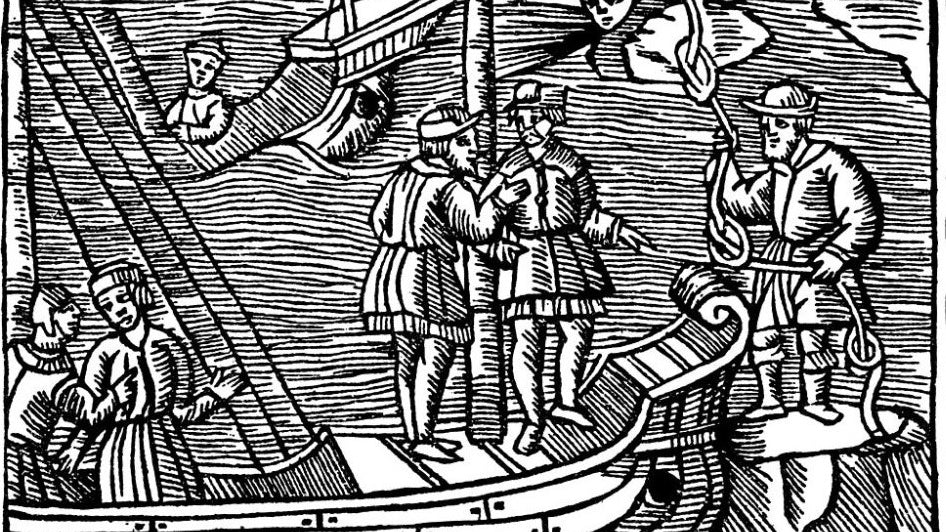
One of the most famous images of knot magic comes from northern shores. In his History of the Northern Peoples, published in Rome in 1555, Olaus Magnus recounts that figures reputed to be magicians offered sailors winds enclosed in a knotted cord. The story has endured through the centuries thanks to an engraving depicting a man on the shore, a crew, and the transaction involving a cord. This scene is the one chosen for this article’s cover.
The tale describes several degrees of wind associated with the rope’s three knots. The progression leads from a favorable breeze to a more dangerous force. In the engraving, a boat in distress evokes the dangers the sea poses to the unwary. The cord becomes an image of mastery over the unseen: the wind cannot be grasped like an object, but according to the tale, it could be held in the material handled by the hands. Here we describe a reported tradition, not a method for controlling the weather.
Olaus Magnus was a Swedish clergyman, geographer, and exiled author writing for European readers in the 16th century. His work combines geographical descriptions, gathered information, accounts of customs, and elements of wonder. We must therefore examine the narrator’s intentions as well as the scene depicted. The text proves that this image of selling the wind circulated in a scholarly work of its time. It does not prove that all northern sailors performed the actions described.
The populations the author discusses are presented through ethnographic and religious categories specific to his time. Historian Marit Kleinmanns has studied, in particular, how his work portrays the Sámi. Her analysis reminds us that these descriptions were read and repeated throughout Europe, helping to shape stereotypes about northern populations. Reproducing an anecdote without mentioning this context would mean taking the perspective of a 16th-century Christian author as a transparent description of Indigenous traditions.
Maritime trade explains part of the story’s enduring appeal. Before motorized navigation, winds and currents determined whether it was possible to reach a port, transport goods, or return to one’s loved ones. A prolonged calm threatened schedules; a storm could destroy a ship and its crew. In this context, believing that someone had power over the winds offered a symbolic response to a life-threatening uncertainty. The legend expresses a reality of maritime life without overturning the laws of physics.
Sailors already relied on knots. They were used to keep rigging taut, join components, and distribute force across ropes. A poorly secured rope could have concrete consequences for the safety of a voyage. It was precisely because knots were known to be mechanically effective that the imagination could attribute another power to them. The technical mastery of rope provided familiar ground on which the story of winds held back could seem plausible.
It would be tempting to turn this Renaissance account into direct proof of an unchanged “Viking magic” dating back to ancient Scandinavia. Nothing in the 1555 publication, taken on its own, supports such a conclusion. Medieval inheritances, sailors’ traditions, and the author’s interpretations may all come together in it. The date of an account first of all proves that an idea was accessible in its own time. To go further back in history, we would need other sources with an established line of transmission.
The comparison with Aeolus, keeper of the winds in Homer’s Odyssey, illustrates this requirement. Aeolus gives Odysseus the winds, confined in a bag, which his companions open at the wrong moment. The idea of atmospheric power contained in an object is similar to that of winds tied up, but the Greek bag is not Olaus Magnus’s three-knotted rope. Distinct stories can draw on the same opposition between holding back and releasing without deriving directly from one another.
The 1555 engraving should ultimately be read as an argumentative image. Its creator stages actions and consequences to make the story understandable. The sinking ship serves as a warning in the narrative. The scene is not a photographic record of a specific transaction. Its documentary value lies in making visible the Renaissance imagination of power over the wind, with its depictions of the sailor, the magician, and danger.
Even today, this image sums up the magic of knots with remarkable effectiveness. It shows a humble material invested with disproportionate power: a rope could hold the force of the sky. For the occultist, it raises an old question about the correspondence between gesture and nature; for the historian, it recalls the paths by which popular stories found their way into learned books and their illustrations. Together, these two perspectives help us grasp the significance of the account without overlooking its limits.
Tying and untying, a magical grammar rather than a universal sign
A magical bond is defined less by any mandatory physical form than by the relationship it expresses. Tying can signify attachment, commitment, closure, or preservation. Untying can mean liberation, the restoration of movement, the removal of an obstacle, or the end of a period. These meanings are not interchangeable. The same knot can be protective in a story about safeguarding and feared in a story about coercion. The meaning of the act depends on the person, the situation, and the religious context.
This ambivalence is evident in human relationships. Marriage bonds signify a commitment that unites; the vocabulary of ancient binding spells, by contrast, can target another person’s freedom. A garment’s belt can symbolically protect bodily integrity, while Lucina’s intertwined hands represent an obstacle to childbirth in Ovid. A serious reading therefore cannot present all knots as beneficial amulets or all bindings as hostile acts.
The possibility of untying the knot introduces a temporal dimension. The object preserves a state that can be changed. In sailors’ tales, the rope holds a wind that the story presents as releasable; in Marian iconography, the ribbon recalls troubles that should not last; in family traditions, undoing fastenings gives physical form to the anticipation of a birth. Each example builds a relationship between the passage of time and the moment when change becomes imaginable.
The physical act alone, however, is not enough to explain the doctrine. A knot takes on a place in magic only because a context gives it meaning and, depending on the tradition, a particular power. Language, the names invoked in certain texts, the authority of a deity, or the history of a group can determine this interpretation. Remove these elements and keep only a number of turns of rope, and the historical substance of the practices disappears. All that remains is a form stripped of its world.
The actual knot must also be distinguished from the graphic emblem. The Witch’s Knot, explored elsewhere in the Notebooks, is now widely used as a protective interlaced motif. Its depiction on a pendant or in a drawing belongs to the history of visual symbols and their contemporary uses. This article addresses a different question: how cultures have interpreted the act of tying a physical bond. The two subjects are connected by their vocabulary, but they are not identical.
The available evidence is of different kinds. An Egyptian amulet is a preserved object, with its material and discovery context. A Greek tablet is an ancient inscription whose words have survived. A text by Pliny is a literary account of Roman interpretations. A 19th-century folklore record reports statements gathered from living people. A 16th-century engraving expresses the ideas of the author who had it published. Examining them all in the same way would lead to false certainties.
Archives also preserve silences. Cords decompose, gestures do not always leave traces, and oral transmission can change from one generation to the next. The absence of a physical knot does not disprove every tradition mentioned in a text, but it prevents us from automatically confirming every detail. Conversely, the many utilitarian knots found in maritime settings do not become magical through simple analogy. Rigor protects the richness of the subject from overly easy reconstructions.
The connection between the tie and an absent person merits special attention. The idea of binding someone without touching them appears in the language of magical restraint. The person targeted may be represented by their name, image, or an account about them. This relates to the broader question of indirect presence in folk magic, which we discussed in connection with footprints and the absent. The medium changes; the question of a relationship at a distance remains, though the historical transmissions are not identical.
Contemporary accounts that speak of “energy ties” or “invisible contracts” also borrow the knot metaphor. But they should not automatically be presented as faithful translations of Greek documents or Scottish accounts. Modern categories have their own history. Respecting ancient traditions means allowing them to retain their own vocabulary, gods, practices, and uncertainties, rather than folding them into a recent explanation that erases their differences.
The knot ultimately reveals a human experience that is difficult to reduce to a formula: what we love may hang by a thread, what we fear seems to hold us back, and what we hope for calls for a way through. Traditions have given these images tangible form. Their symbolic power comes from this meeting between our hands and our lives. A tight bond makes visible the relationship between will and constraint; an untied bond offers the image of a path reopened.
Thus, from the red stone associated with Isis to Greek binding inscriptions, from the Roman bridal girdle to the locks on Scottish houses and the winds of Olaus Magnus, no single rope can contain the entire history of magic. What remains is a way of thinking about action: tying to preserve or restrain, untying to free or let things unfold. Knowing this history does not teach a ritual how-to; it reveals how an everyday gesture could, over the centuries, become a language of fate.
Sources and references
- The Metropolitan Museum of Art, Tit amulet, New Kingdom (museum entry)
- Jessica L. Lamont, In Blood and Ashes, Oxford University Press, 2023 (study of Greek tablets)
- Esther Eidinow, Oracles, Curses, and Risk Among the Ancient Greeks, Oxford University Press, 2007
- Ovid, Metamorphoses, Book 9, lines 273–323, translation and notes by UCLouvain
- Maurizio Bettini, Women & Weasels, chapter “The Knots,” University of Chicago Press, 2013
- The Religious Life of Matrons in Archaic Rome, École française de Rome, 1993, Persée
- Walter Gregor, Notes on the Folk-Lore of the North-East of Scotland, 1881, chapter “Birth”
- Olaus Magnus, Historia de gentibus septentrionalibus, Rome, 1555, digital copy
- Marit Kleinmanns, The description of the Sámi people in the Historia de gentibus septentrionalibus, Journal of Nordic History, 2016
- Diocese of Augsburg, story of Mary who unties knots, work by Johann Georg Melchior Schmidtner
- Olaus Magnus, engraving of the sale of winds, 1555, Wikimedia Commons, public domain
Cover image credit: Engraving by Olaus Magnus, Historia de gentibus septentrionalibus, 1555, reproduction via Wikimedia Commons, public domain. The image depicts a tale of winds sold to sailors in the form of a knotted rope.

Par Olivier of Aeternum
Passionate about esoteric traditions and the history of the occult from the earliest civilizations to the 18th century, I share some articles on these topics. I am also co-creator of the online esoteric shop Aeternum.













